A child support deduction on your pay stub usually means payroll withheld money under an income withholding order, often abbreviated IWO. The deduction reduces the cash you receive. It does not, by itself, reduce the wages subject to federal income tax, Social Security or Medicare. To check the amount, compare the order, the correct pay-period conversion, disposable earnings and the applicable withholding ceiling.
This guide explains the U.S. federal framework as reviewed in November 2026. State and tribal rules, the place where you principally work, and the actual order can change the result. The worked figures are fictional and are not a calculation of anyone’s support obligation.
What does child support mean on a pay stub?
Look in the deductions section for a label such as child support, support withholding, IWO or a payroll-specific code. A statement may show current-period withholding and a separate year-to-date total. Neither abbreviation alone tells you which case received the money or how much of it paid current support, arrears, medical support or an authorized fee.
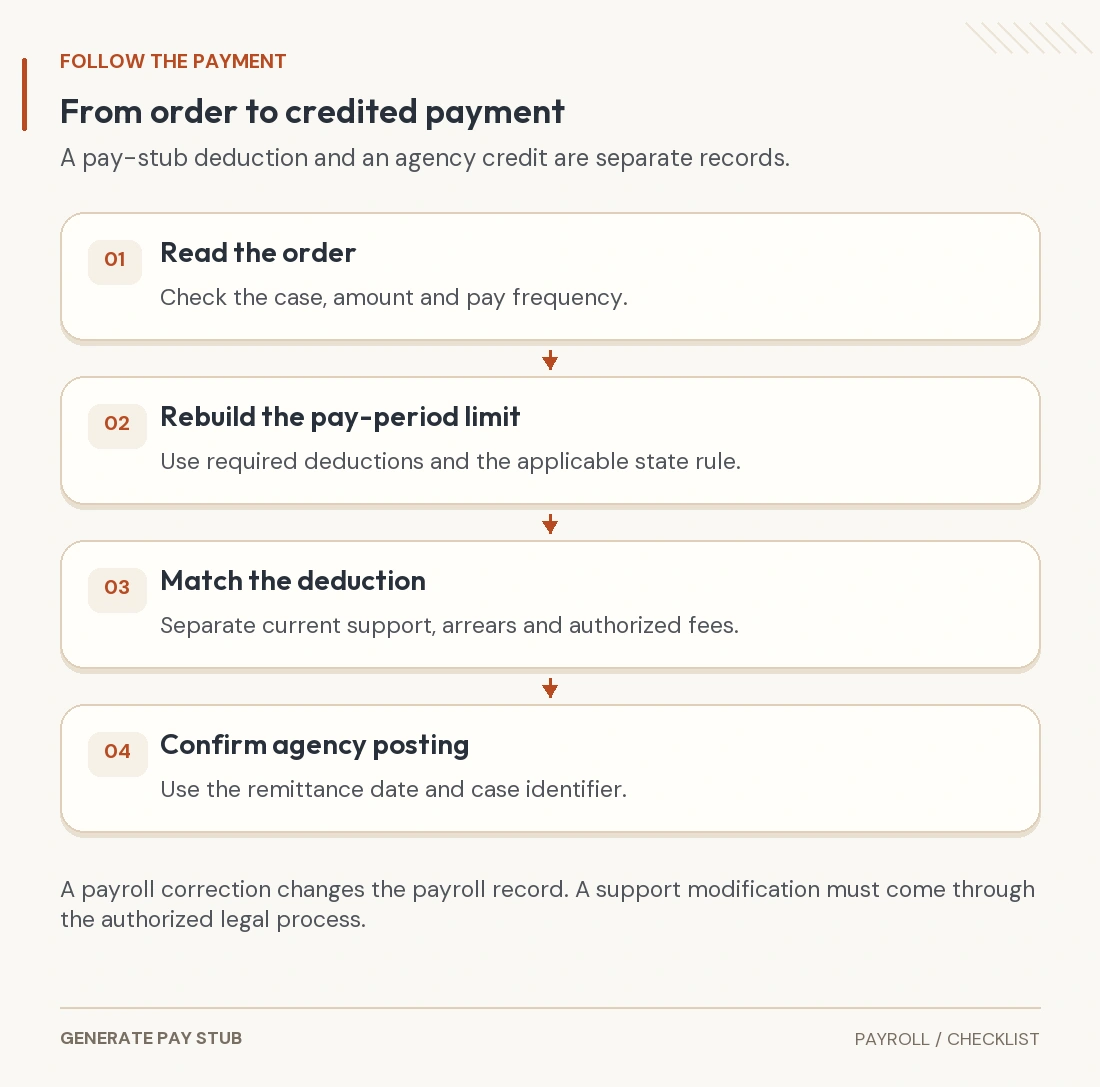
The underlying documents answer different questions. The support order establishes the obligation. The withholding notice gives payroll instructions for collecting it from income. The pay statement records the payroll deduction. The child support agency’s payment history shows receipt and application to the case. Keep those records together when checking a discrepancy.
Child support is generally an after-tax cash deduction. The IRS explains that child support is not deductible by the payer and is not income to the recipient. A payroll label that appears under “pre-tax benefits” deserves clarification; the location of a software label cannot change the payment’s federal tax treatment.
How much can payroll withhold for child support?
Start with disposable earnings, which has a specific legal meaning. Under the federal Consumer Credit Protection Act, it generally means earnings remaining after legally required deductions, such as required income-tax withholding and employee FICA contributions. It is different from the deposit amount after every voluntary deduction.
For example, voluntary retirement contributions and ordinary voluntary insurance deductions generally do not lower this federal base. A legally required deduction may qualify. The Department of Labor’s garnishment fact sheet explains the distinction and the separate rules for support withholding.
| Employee’s circumstances | Base ceiling | If collecting support more than 12 weeks overdue |
|---|---|---|
| Supporting a spouse or child other than the person covered by the order | 50% | 55% |
| Not supporting another spouse or child | 60% | 65% |
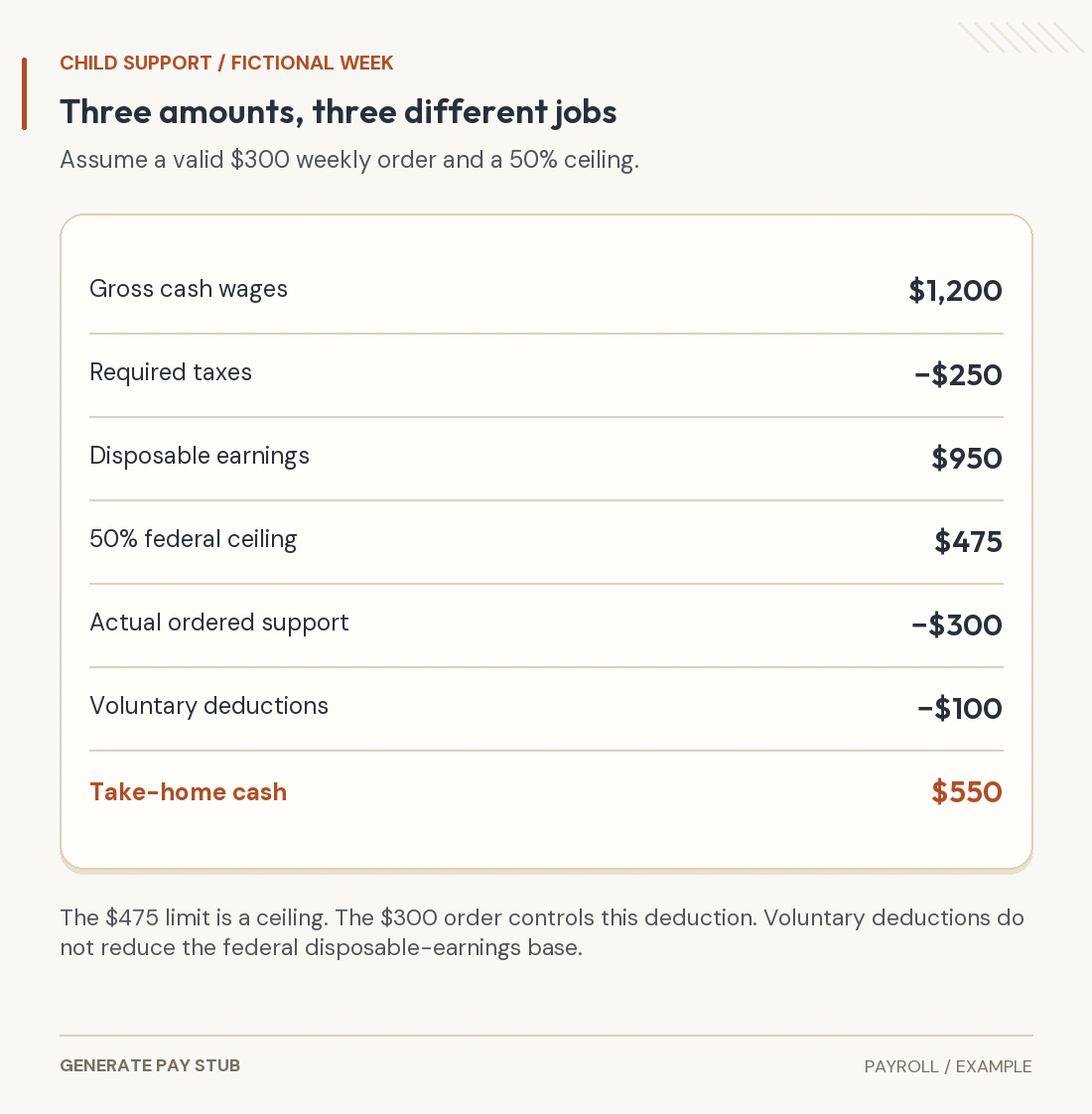
These percentages are maximum protections, not automatic deduction rates. If the amount called for by the order fits below the applicable ceiling, payroll generally withholds that ordered amount. A $300 order does not become a $475 deduction just because $475 is legally available.
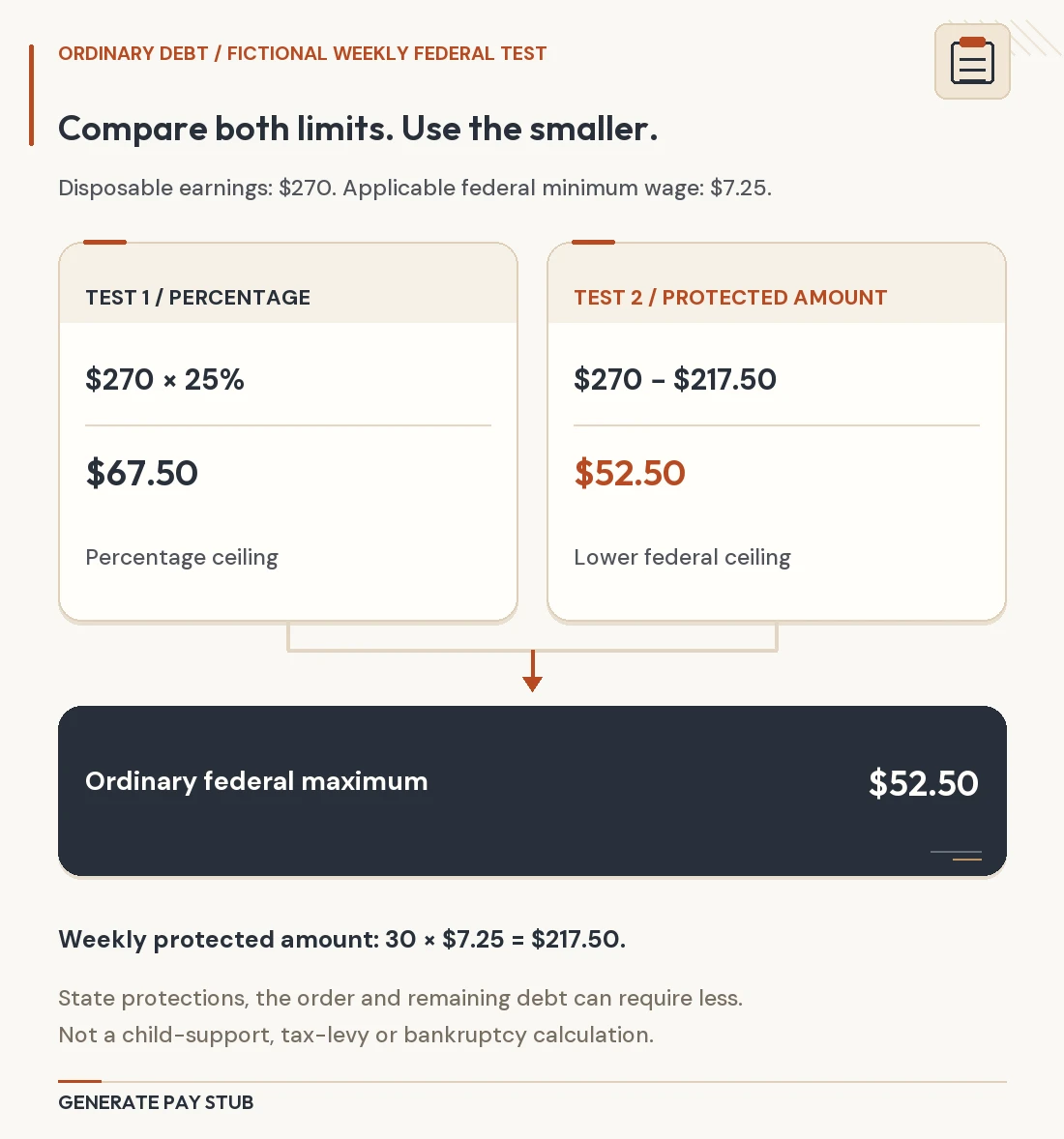
A more protective applicable state limit can lower the maximum. For a concrete jurisdictional example, Oregon’s employer guidance describes a 50% limit for combined cash support orders and health coverage premiums for employees working there. Do not apply that Oregon rule to every state. The ordinary consumer-debt rule of 25%, and its minimum-wage calculation, also should not be substituted for child support limits.
A worked example: disposable earnings versus take-home pay
Assume an employee receives $1,200 in weekly cash wages. Legally required tax deductions total $250, and voluntary deductions total $100. A valid IWO directs $300 of weekly support. Assume a 50% limit applies, with no lower state ceiling, other orders, fees or medical support allocation.

| Step | Calculation | Amount |
|---|---|---|
| Gross wages | Starting cash earnings | $1,200.00 |
| Disposable earnings | $1,200 − $250 required taxes | $950.00 |
| Available federal ceiling | $950 × 50% | $475.00 |
| Support withheld | Order is below the assumed limit | $300.00 |
| Final take-home cash | $1,200 − $250 − $300 − $100 | $550.00 |
Subtracting the voluntary $100 before applying 50% would produce $425. That would use the wrong federal disposable-earnings base under these assumptions. Conversely, deducting the full $475 would take $175 more than this example’s order calls for.
If the same order called for $600 instead, the assumed $475 limit would constrain this payday’s withholding. The employer would need to follow the notice and applicable agency procedures for the shortfall. The example does not determine how arrears, interest or another case would be handled. For broader distinctions between support and other attachments, see our pay-stub garnishment guide.
Why a monthly order may look different on a biweekly paycheck
“Every two weeks” and “twice a month” are different schedules. A normal biweekly schedule has 26 payments in a year; a semimonthly schedule has 24. Use the payment-frequency fields on the IWO and the agency’s required conversion, including its rounding instructions.
For an arithmetic illustration, $650 per month corresponds to $7,800 annually. Dividing by 26 gives $300 per biweekly payment; dividing by 24 gives $325 per semimonthly payment. Dividing a monthly amount by two for a biweekly schedule would overstate the annual collection if used on all 26 payments. This is a comparison of standard schedules, not permission to override amounts already provided in the notice or special calendar instructions.
The New York courts’ withholding instructions illustrate conversion between annual, weekly, biweekly and semimonthly amounts. Ask the issuing agency which figure applies if the order’s frequency and the payroll setup disagree. A third biweekly payday in a month is not automatically an extra erroneous deduction.
Multiple orders, bonuses and medical support need another check
Several support cases do not create a separate full withholding ceiling for each case. Payroll must consider the combined collection and the relevant allocation rules. Do not assume the first notice received always takes all available funds, or divide the payment equally without checking the governing rule.
The applicable state or tribal allocation procedure can determine how limited funds are distributed. The federal income-withholding form directs employers handling insufficient income and multiple notices to the rules at the employee’s principal place of employment. Interstate paperwork requires attention to those instructions rather than simply using the issuing state’s rule for every payroll issue.
Also identify whether the notice includes current support, past-due support, cash medical support or another component. A National Medical Support Notice can involve dependent health coverage and premiums; that is not interchangeable with an ordinary voluntary insurance deduction. Employer processing fees depend on authorization and local limits. Request a breakdown if the total on the pay stub exceeds the current-support line you expected.
Bonuses, commissions, severance and other lump sums may trigger separate reporting or withholding instructions. Before changing the deduction for such a payment, payroll should check the notice and the relevant agency’s lump-sum process. Neither “all bonuses are exempt” nor “the entire bonus goes to support” is a safe general rule.
How to resolve a wrong deduction or a missing case credit

- Collect the evidence. Save the pay stub, pay date, pay-period dates, current IWO and relevant agency payment history. Compare the current amount with the prior pay period and the YTD movement.
- Ask payroll for its calculation. Request the order amount and frequency used, legally required deductions, applicable ceiling, other-order allocation and any fee. Keep the request limited to your own records.
- Separate deduction from delivery. If payroll deducted the expected amount but the case has no credit, ask when it was remitted and which case identifier accompanied it. Give that information to the agency through its verified channel.
- Escalate the right problem. Payroll can investigate its processing. The issuing agency or court handles case balance disputes and order modifications. Do not ask payroll to stop a valid notice because a private agreement has changed.
- Recheck the correction. Obtain a corrected statement when appropriate, verify the next deduction and check that the case history reflects the resolution. Do not assume a separate direct payment automatically offsets the next payroll withholding.
A short posting gap does not establish that payroll lost the money. North Dakota’s employer FAQ, for example, distinguishes the date withheld from the date received by its state disbursement unit and gives its remittance deadline. Check the deadline and posting process for your actual case instead of borrowing a state example as a nationwide timetable.
Common questions about child support on a pay stub
Will child support reduce my W-2 wages?
The support deduction itself does not reduce federal taxable wages. It redirects part of the employee’s pay after the wage and tax calculations. Other qualified benefits can affect wage bases independently, which is why taxable wages and gross cash earnings may already differ before support is withheld.
Can my employer stop when my child reaches a certain age?
Do not treat a birthday as sufficient payroll authorization to stop. The notice, jurisdiction, possible arrears and termination instructions matter. Ask the issuing agency to confirm the correct action and provide the required updated notice.
Does a low-hours week mean no support is due?
Low earnings can reduce the amount collectable through payroll under the applicable limit. The support obligation is a separate issue. If income has changed materially, seek guidance about modification promptly rather than waiting for pay-stub shortages to resolve the balance.
What should I conceal before sharing a pay stub?
Use a secure channel and disclose only what the verified recipient needs. A statement can expose case numbers, bank information, address and other private details. Keep the unaltered original for payroll or agency review; use a clearly identified redacted copy for unrelated purposes when accepted.