Health plan value on a pay stub usually describes coverage cost or an employer contribution, rather than an additional cash deduction. The label is not standardized across payroll systems. Ask whether it shows the employer’s share, the combined coverage cost or a year-to-date informational amount. Your own premium deduction is a separate item.
On Form W-2, Box 12 Code DD generally reports the aggregate cost of applicable employer-sponsored health coverage when reporting is required. Code DD itself does not make that coverage taxable. This guide explains the federal rules reviewed in November 2026 for an ordinary employee, with fictional examples and separate notes for exceptions.
What does “health plan value” mean on a pay stub?
Start with where the number appears and whether it participates in the net-pay calculation. A line in an employer-contribution or benefits-information panel can describe something the company funded. A medical premium in the employee-deductions section can be money taken from your wages. The same plan can appear in both places for different purposes.
Software may use labels such as health plan value, employer medical, health coverage cost or benefit value. There is no reason to assume that one vendor’s label means precisely what another vendor’s label means. A current-period figure can also be different from the annual cost eventually reported with Code DD.
The 2026 W-2 instructions expressly describe Code DD as coverage-cost reporting and state that the reported amount is not taxable. That is a rule about the W-2 field, not a definition of every informal label on a pay stub.
| Number | What it describes | How to check it |
|---|---|---|
| Employee premium deduction | The portion collected from your pay | Compare elections, rate sheet, deduction frequency and net-pay math |
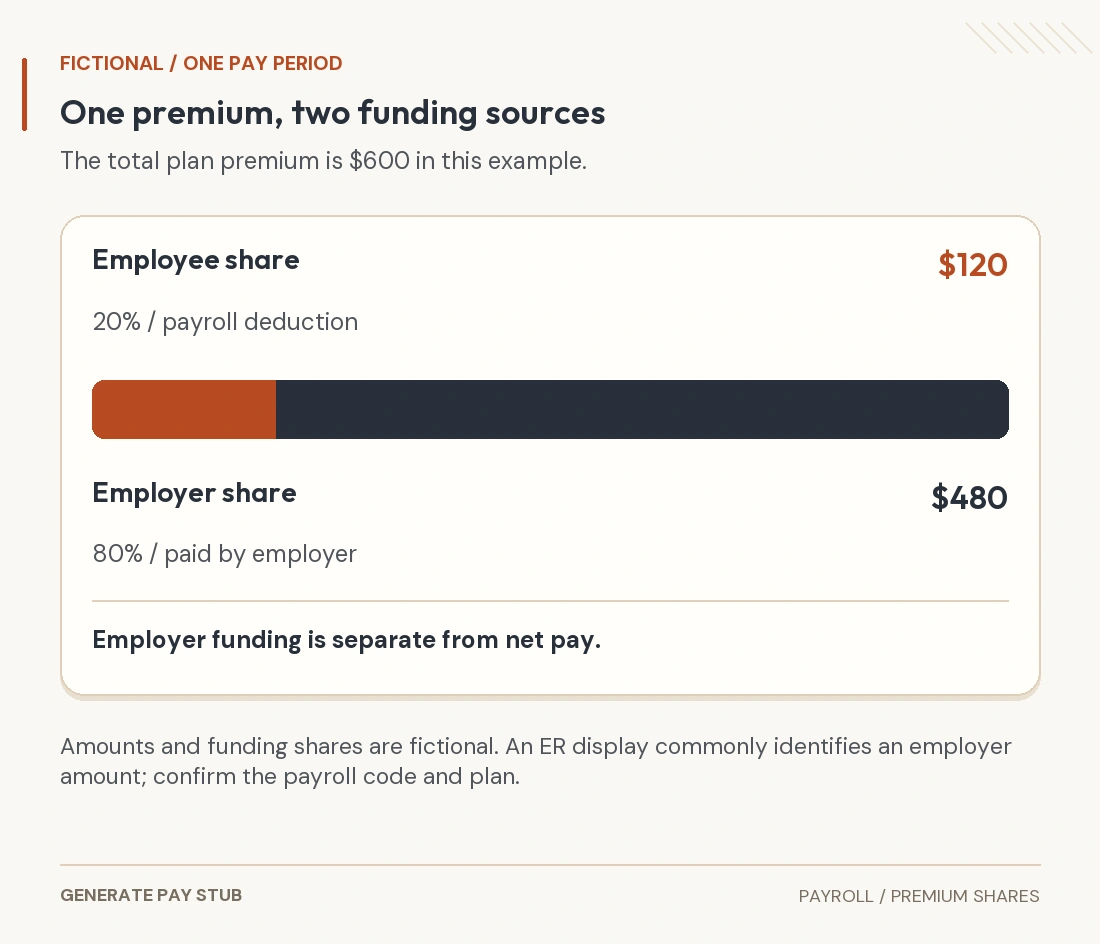
| Employer contribution | The employer-funded portion, if separately displayed | Ask whether the line is employer-only and whether it is current or YTD |
| Total coverage cost | The aggregate cost assigned to the applicable coverage | Check what is included and the months or periods covered |
| W-2 Box 12 Code DD | Annual informational reporting of applicable coverage cost | Use the employer’s year-end reporting reconciliation |
How the employee and employer shares fit together
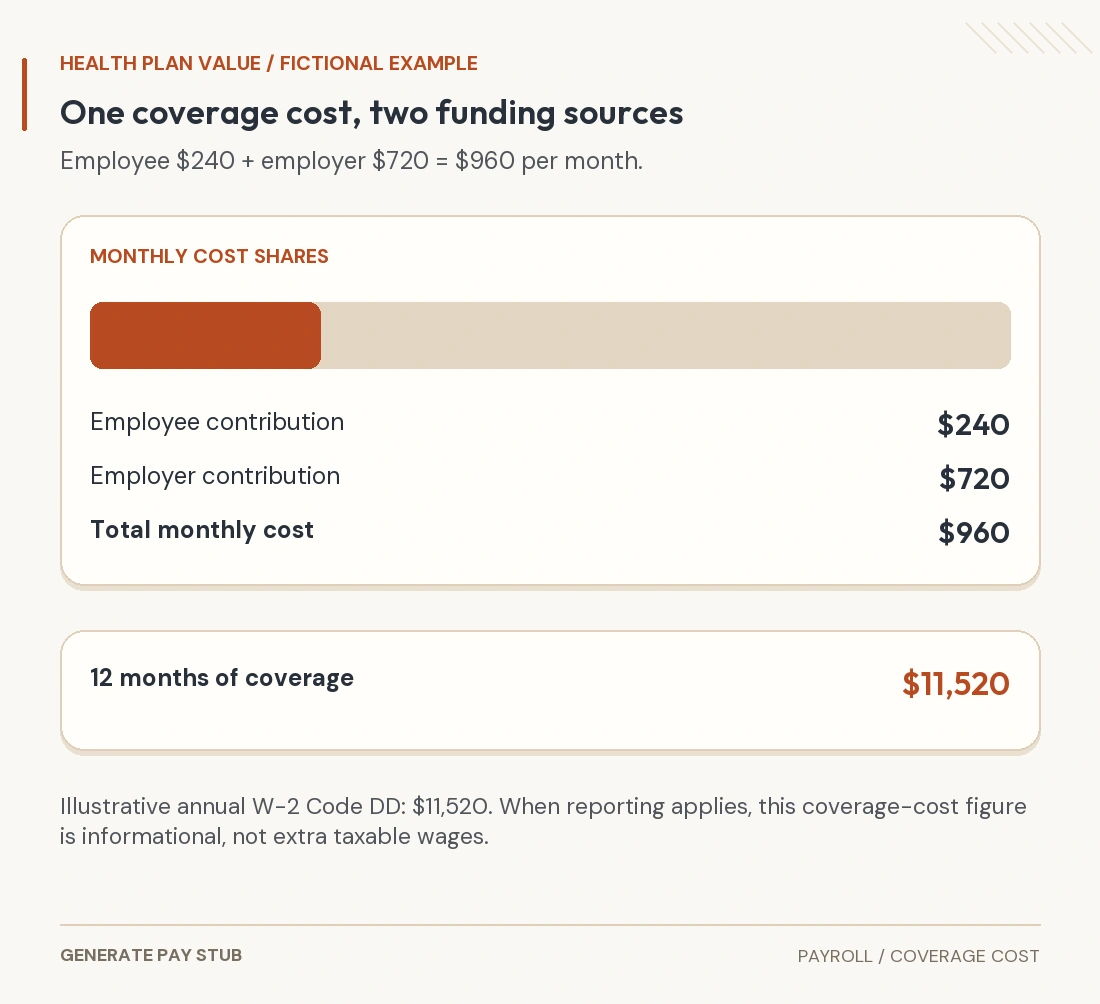
Assume the employee contributes $240 each month toward ordinary employer-sponsored major medical coverage and the employer contributes $720. The combined monthly coverage cost is $960. If this same reportable coverage and cost apply for all 12 months, the illustrative annual Code DD amount is $11,520.

The employee’s annual premium payments would be $2,880; the employer’s annual share would be $8,640. Neither number alone equals the example’s $11,520 total. If the pay stub displays only the employer share, comparing its $8,640 YTD line directly with Code DD could create a false alarm.
The IRS coverage-reporting questions and answers explain that the reported amount generally includes both employee and employer portions. The amount is a cost of providing coverage, not a statement of medical claims paid for that individual. A self-funded plan may use an allowed cost method rather than a simple insurance-invoice figure.
Do not confuse coverage cost with a deductible, out-of-pocket maximum, insurance benefit limit or a spending-account balance. A $960 informational line does not mean there is $960 available to withdraw, nor that the employer has deposited that amount into an HSA.
Does health plan value reduce take-home pay?
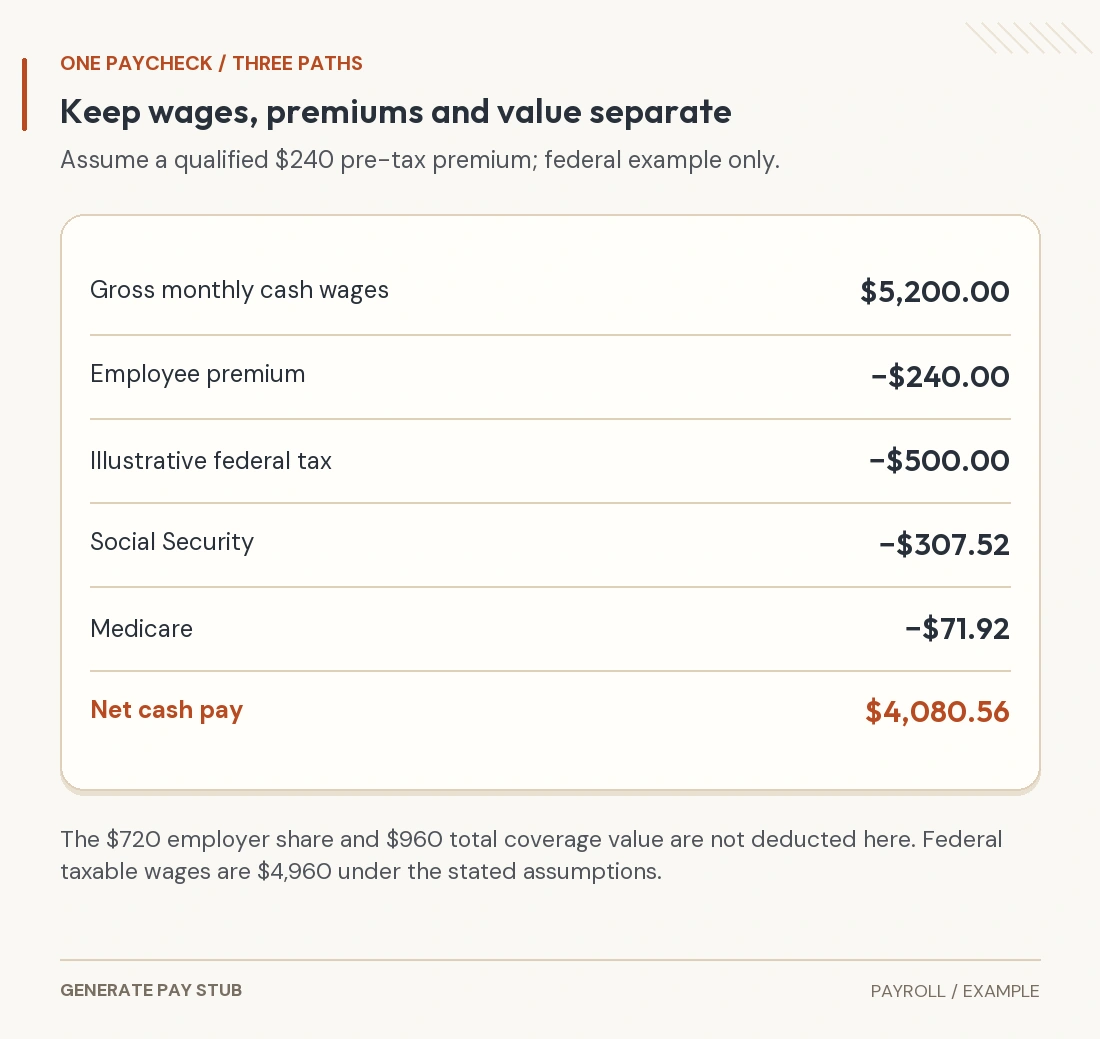
An informational coverage-cost line should not be subtracted as though it were a second employee premium. Rebuild the actual cash calculation to see what payroll did. For this example, assume $5,200 monthly cash wages, a $240 qualified pre-tax premium through a valid cafeteria plan and no other benefits or adjustments.
Assume this premium reduces federal income-tax wages and Social Security/Medicare wages to $4,960, wages remain below the Social Security cap and Additional Medicare withholding threshold, and federal income tax actually withheld is $500. That $500 is a supplied example amount, not a tax-table estimate. State and local taxes are omitted.

| Cash-pay item | Calculation or assumption | Amount |
|---|---|---|
| Gross cash wages | Starting pay | $5,200.00 |
| Employee premium | Qualified pre-tax deduction | $240.00 |
| Federal income tax | Assumed actual withholding | $500.00 |
| Social Security | $4,960 × 6.2% | $307.52 |
| Medicare | $4,960 × 1.45% | $71.92 |
| Net cash pay | $5,200 − $240 − $500 − $307.52 − $71.92 | $4,080.56 |
Subtracting the $720 employer contribution or the $960 total value again would understate take-home pay. For a real statement, use the actual deductions and wage bases. An after-tax premium, taxable benefit or another benefit arrangement can produce a different result. State wage bases do not always follow the federal treatment.
IRS Publication 15-B for 2026 explains the exclusion framework for qualified health benefits and cafeteria plans. Being called “health insurance” does not automatically establish every tax exclusion. Our pre-tax versus post-tax deductions guide shows how to read those separate payroll effects.
Is W-2 Code DD taxable or something you claim as a deduction?
Code DD is informational coverage-cost reporting. Do not add that amount to W-2 Box 1 wages when entering an ordinary return, and do not treat it as an extra cash payment. The figure also does not, by itself, establish a personal medical-expense deduction: it includes funding that may never have come from your after-tax money.
Coverage cost and taxable fringe-benefit income are different concepts. A taxable imputed-income line can legitimately increase wages under separate rules. It should not be assumed to be the same thing as Code DD. If a statement contains both, ask payroll to identify the benefit and explain each calculation.
For example, special rules can apply to health insurance for an S corporation owner who holds more than 2% and to some domestic-partner coverage. The ordinary-employee example above does not cover those situations. See the dedicated S corporation shareholder health-insurance guide before applying the ordinary employee treatment to an owner.
Are HSA, FSA, dental and vision amounts part of Code DD?
Do not add every benefit line together. The IRS reporting chart distinguishes required reporting, excluded items and optional reporting under transition relief. Important examples include:
- HSA contributions: do not belong in Code DD. Certain employer and cafeteria-plan HSA contributions are reported using Code W instead.
- Health FSA funded solely by employee salary reductions: is not included in Code DD. Certain additional employer-provided FSA value can have a different reporting result.
- Separate dental and vision coverage: reporting can be optional under the stated relief conditions, including arrangements not integrated with another health plan. Do not presume every dental or vision line is included.
- Health reimbursement arrangements: have their own reporting relief and should not simply be added to a medical-premium total.
The chart’s Code DD instructions do not eliminate reporting required elsewhere. An HSA amount omitted from DD can still need Code W; a taxable benefit excluded from the DD total can still affect wages under a separate provision.
Why is the value different from last month—or missing?
First compare like periods. Monthly premiums, biweekly deductions and annual informational totals measure different spans. Check the plan’s collection schedule, especially when employee premiums are spread across a different number of checks than the number of payroll payments.
A rate increase, move from employee-only to family coverage, enrollment change, new employer contribution or midyear start can change the annual result. If reportable monthly cost is $960 for six months and $1,080 for six months, the total is $12,240. Multiplying the final month’s $1,080 by 12 would incorrectly produce $12,960. Use actual covered periods and the employer’s permitted reporting method.
A blank Code DD box does not necessarily mean no health coverage existed. Current IRS guidance retains transition relief for employers that filed fewer than 250 Forms W-2 for the preceding calendar year, as well as relief for certain coverage types and situations. For a 2026 reporting review, that employer-count test looks to the preceding year; it is not the same question as how many people are enrolled in the plan or the threshold for electronically filing returns.
An employer can also provide benefit information somewhere other than the pay stub. Check the benefits portal, enrollment confirmation and W-2 explanation before assuming a missing informational pay-stub line is an unlawful deduction or a loss of coverage.
A practical health-plan-value review
- Identify the field. Ask for the payroll code definition and whether the amount represents employer-only or total cost.
- Identify the period. Separate current pay-period, monthly and YTD figures.
- Confirm coverage. Match plan, coverage tier, covered dates and election changes to benefits records.
- Check cash and taxes separately. Verify the premium deducted, relevant wage bases, actual withholding and net deposit.
- Reconcile year-end reporting. Ask which benefits and cost method contributed to Code DD; do not just sum all deduction lines.
- Resolve the specific error. A wrong premium deduction, wrong informational total and wrong W-2 wage amount require different corrections. Ask whether a corrected statement or W-2c is needed and retain the explanation.
When contacting payroll, a focused request helps: “My medical deduction is $240, but health plan value is $960. Does that field include the employer contribution, and which amount feeds Code DD?” This asks for the meaning without assuming the extra $720 was deducted.
Common questions about health plan value
Is the value an amount my employer owes me in cash?
Usually it reports coverage funding or cost, not cash wages payable to you. Whether an employer offers an alternative cash benefit depends on the actual plan and compensation terms; the informational line does not create that entitlement.
Can I use it to estimate COBRA premiums?
It can help explain why continuation coverage may cost more than the old employee deduction, but it is not a binding quote. CMS explains that a COBRA premium can generally include both employee and employer portions plus up to 2% for administration, subject to the applicable rules and exceptions. On an assumed $960 applicable monthly premium, 102% is $979.20. Get the actual eligibility and premium information from the plan administrator; an annual Code DD total divided by 12 may not represent current coverage.
Does a higher Code DD mean higher taxable income?
Not by itself. It may reflect higher coverage cost, more covered months or a different coverage tier. Evaluate any change in taxable wages using the actual wage and benefit rules separately.
Should the amount equal the employer’s insurance claims for me?
No. It is coverage-cost reporting under the applicable method, not an individual claims ledger. Your insurer’s explanation of benefits and the plan’s deductible accounting serve different purposes.