Whether unused PTO must be paid when employment ends depends on the applicable law, the kind of leave and the employer’s enforceable policy or agreement. A balance printed on a pay stub does not, by itself, establish the cash payout. First identify the payable hours and required rate, then reconcile the payment with final wages and deductions.
This U.S. guide, reviewed in November 2026, focuses on unused-leave payouts and final paychecks. It uses selected California, Texas and New York examples, not a 50-state rule. The worked figures are fictional and assume the payout obligation has already been established.
Is unused PTO automatically owed when you quit or are fired?
There is no single nationwide answer. The U.S. Department of Labor’s vacation guidance explains that the FLSA generally does not require paid vacation. State protections, enforceable promises and particular government-contract requirements can create obligations beyond that federal baseline.
Separate three issues: whether leave was earned, whether that category must be cashed out at separation, and when the money is due. A handbook can help answer those questions, but it cannot override a governing law that protects vested vacation. Conversely, a displayed sick-leave balance is not necessarily payable in cash.
How do California, Texas and New York differ?
| Jurisdiction | General approach in the cited guidance | Important qualification |
|---|---|---|
| California | Earned, unused vacation generally must be paid at the final rate when employment ends. | The agency identifies a collective-bargaining qualification. Combined PTO and sick-only leave need different analysis. |
| Texas | Accrued-leave payout is required under the Texas Payday Law when a written policy or agreement promises it. | The actual wording and satisfied conditions matter; a balance alone does not establish the promise. |
| New York | The vacation or resignation policy can determine payout and valid forfeiture conditions. | The agency says earned vacation must be paid if there is no written forfeiture policy; conditions must have been communicated in writing. |
California’s vacation FAQ treats earned vacation as wages and does not permit forfeiture merely because employment ends. It also explains the treatment of a combined PTO bank usable for vacation or personal purposes. Do not assume a “use it or lose it” clause is enforceable there.
Texas Workforce Commission guidance instead emphasizes the written payout promise and its conditions. A policy conditioning payment on a particular type of separation or notice requires checking those facts, rather than importing California’s rule.
New York’s wage FAQ distinguishes a disclosed written forfeiture condition from the absence of one. A generic claim that “all states require payout” or “the handbook can always cancel it” would miss these differences.
Sick-only leave is a separate category. California’s paid-sick-leave FAQ generally does not require cashing it out unless the employer’s policy provides otherwise; it also explains restoration on qualifying rehire. Do not combine sick-only hours with payable vacation without checking the governing plan.
Which PTO balance should be used for the payout?
Reconcile the leave ledger through the separation date. A portal can show a projected year-end balance, a frontloaded allowance or an earlier processed balance. Identify what was actually earned and payable under the applicable rules.
- Start with the verified balance. Record its effective date and whether it represents hours or days.
- Add final earned accrual. Include any accrual owed through the relevant date; do not assume the full future year has been earned.
- Subtract actual leave used. Resolve approved leave not yet reflected in the payroll export.
- Separate leave categories. Keep vacation, combined PTO, sick-only leave and other banks identifiable.
- Confirm the payout rate. Check the required legal or policy rate, especially after a raise or for a salaried worker.
If records use days, establish the applicable hours-per-day conversion instead of silently treating every day as eight hours. If a balance is negative, do not assume the employer may recover it from final wages. California’s vacation FAQ, for example, rejects self-help deductions for advanced vacation from final pay.
Example: turn a verified leave balance into a gross payout
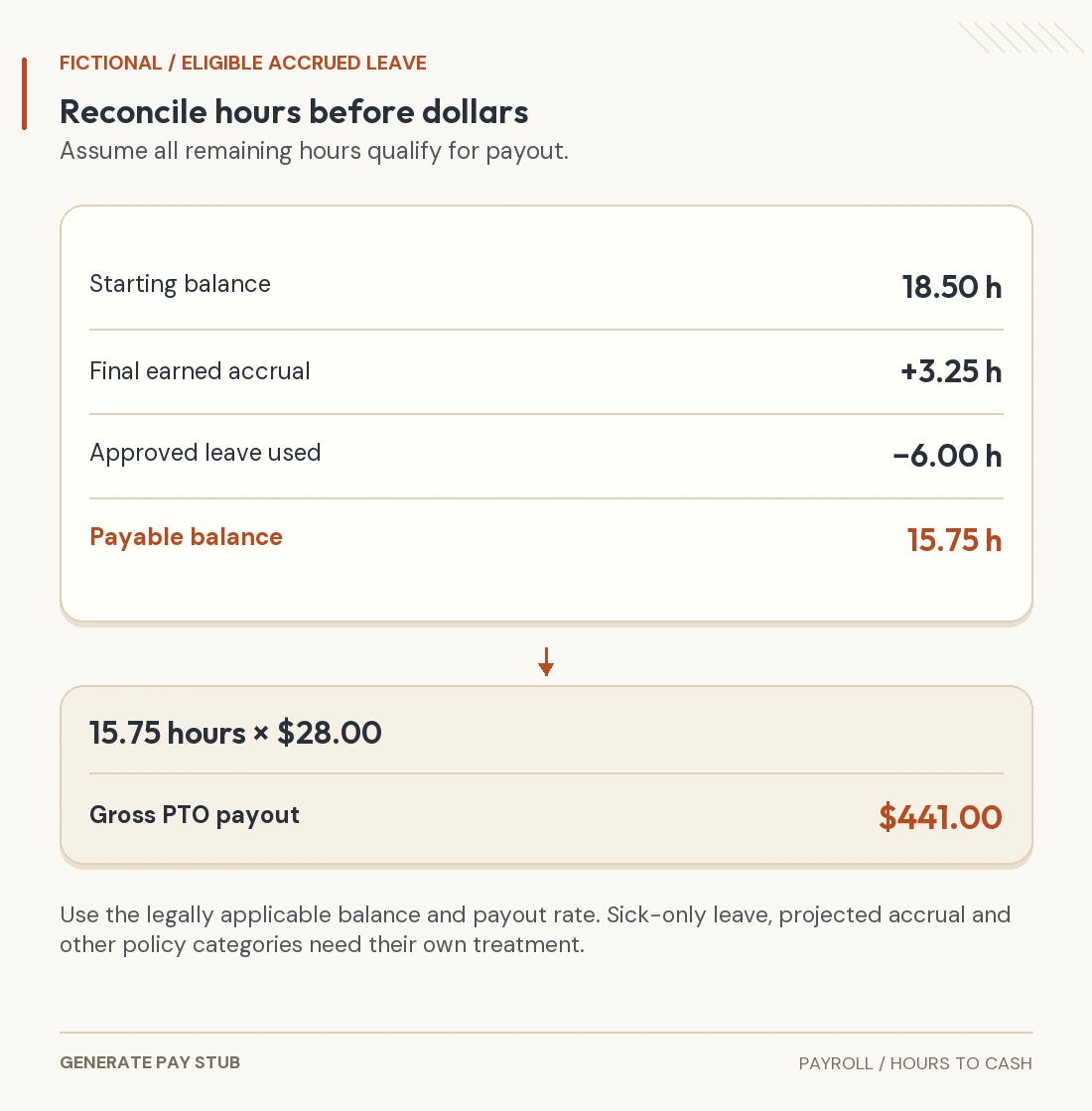
Assume a fictional employee has an established right to cash out all remaining accrued vacation at $28 per hour. The opening verified balance is 18.50 hours. Final earned accrual adds 3.25 hours, and 6.00 hours of approved leave have been used. There are no disputed adjustments or other payable leave categories.
| Step | Hours |
|---|---|
| Verified opening balance | 18.50 |
| Final earned accrual | +3.25 |
| Leave actually used | −6.00 |
| Eligible hours remaining | 15.75 |

The arithmetic is 18.50 + 3.25 − 6.00 = 15.75 hours, followed by 15.75 × $28 = $441.00. That is the gross leave payout, not the employee’s take-home amount. Preserve the fractional hours until the payout calculation is complete rather than discarding 0.75 hour.
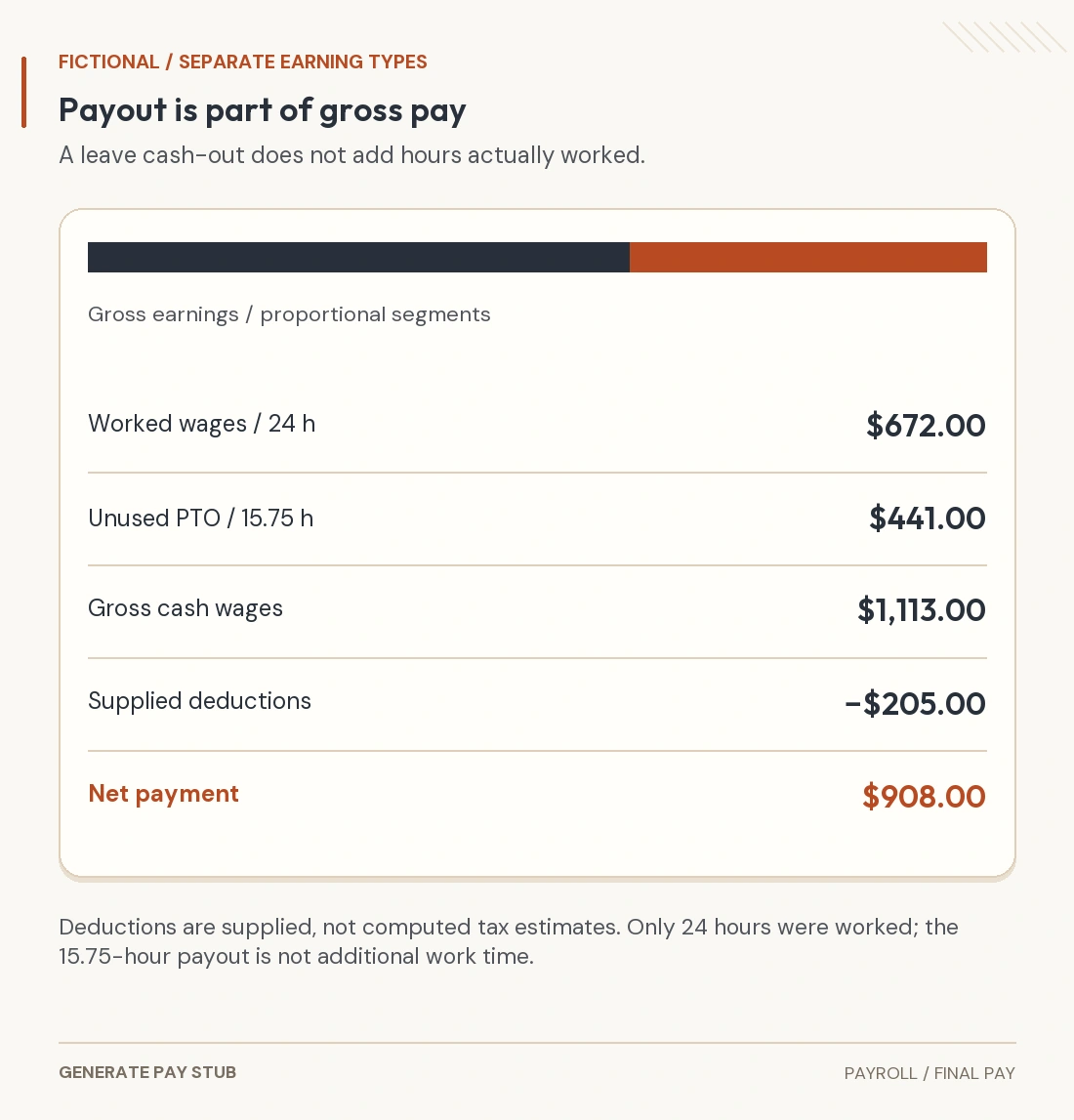
Now assume the final statement also includes 24 hours actually worked at $28, producing $672.00 of regular wages. Gross cash wages are $672.00 + $441.00 = $1,113.00. If supplied lawful employee deductions total $205.00, net pay is $908.00. The deduction figure illustrates reconciliation; it is not a calculated tax estimate.

How should a PTO payout appear on the final pay stub?
Look for a clearly identified leave-payout earning line, the payable quantity and rate where applicable, current gross pay, applicable taxable wage bases, employee deductions and net pay. Reconcile it with any separate final regular-wage payment rather than counting an included payout twice.
IRS Publication 15 distinguishes ordinary vacation wage payments from supplemental vacation payments. A cash-out is not automatically tax-free, and the federal withholding method is not the employee’s final annual tax rate. Applicable Social Security, Medicare and state treatment also need the worker’s actual facts.
Do not add payout hours to hours actually worked when testing federal overtime. The DOL hours-worked explanation distinguishes paid leave from work time. The example therefore does not turn 24 worked hours into 39.75 worked hours. Classification of a particular payment for the regular-rate calculation is a separate issue; its label alone does not decide that treatment.
When must the final paycheck include the leave payout?
Check the jurisdiction and separation circumstances, not just the next ordinary payday. California’s final-wage guidance generally requires immediate payment on discharge. For a covered quit without a definite-term written contract, at least 72 hours’ notice generally makes wages due at quitting; without that notice, the general rule is within 72 hours. The agency identifies special situations and payment requirements.
Those California deadlines are not a national schedule. A disagreement over the leave balance should be documented and handled under the applicable wage-claim process; do not assume that a disputed payout authorizes withholding every undisputed wage.
What should you do if unused PTO is missing or wrong?
Keep the final statement, earlier balance, leave transactions, effective handbook or agreement, separation notice and any rate-change record. Ask payroll for the balance reconciliation, payout rule, rate and payment date. Identify the exact mismatch: omitted accrual, double-counted leave use, an incorrect conversion or the wrong rate.
Request correction of the underlying payroll record and issued statement. Our pay-stub correction guide explains how to make that request specific. For a broader explanation of ongoing balances and leave earnings, see PTO on a pay stub. If the employer does not resolve an unpaid-wage issue, use the relevant labor agency’s official process and applicable deadlines.
Common unused-PTO payout questions
Does being fired always cancel my vacation payout?
No. The answer depends on the applicable law and enforceable terms; California generally protects earned vacation regardless of the reason employment ends.
Does my final PTO balance equal the payout in dollars?
No. Confirm payable hours, the applicable rate and deductions. Projected or sick-only balances can need different treatment.
Will the payout create extra overtime hours?
A leave cash-out does not itself create hours actually worked. Review actual work hours and the applicable overtime rules separately.