A new EIN after a business acquisition does not automatically restart Social Security withholding. In a qualifying predecessor-successor transaction, certain wages paid before the transfer count toward the successor’s annual wage-base calculation. An ordinary move to an unrelated employer generally follows a different rule.
This guide addresses U.S. federal payroll and uses fictional 2026 examples. It helps employees identify the questions to ask and payroll teams distinguish imported wage-base data from wages actually paid by each legal employer. It does not classify a particular acquisition.
Does a changed EIN prove you started over for payroll taxes?
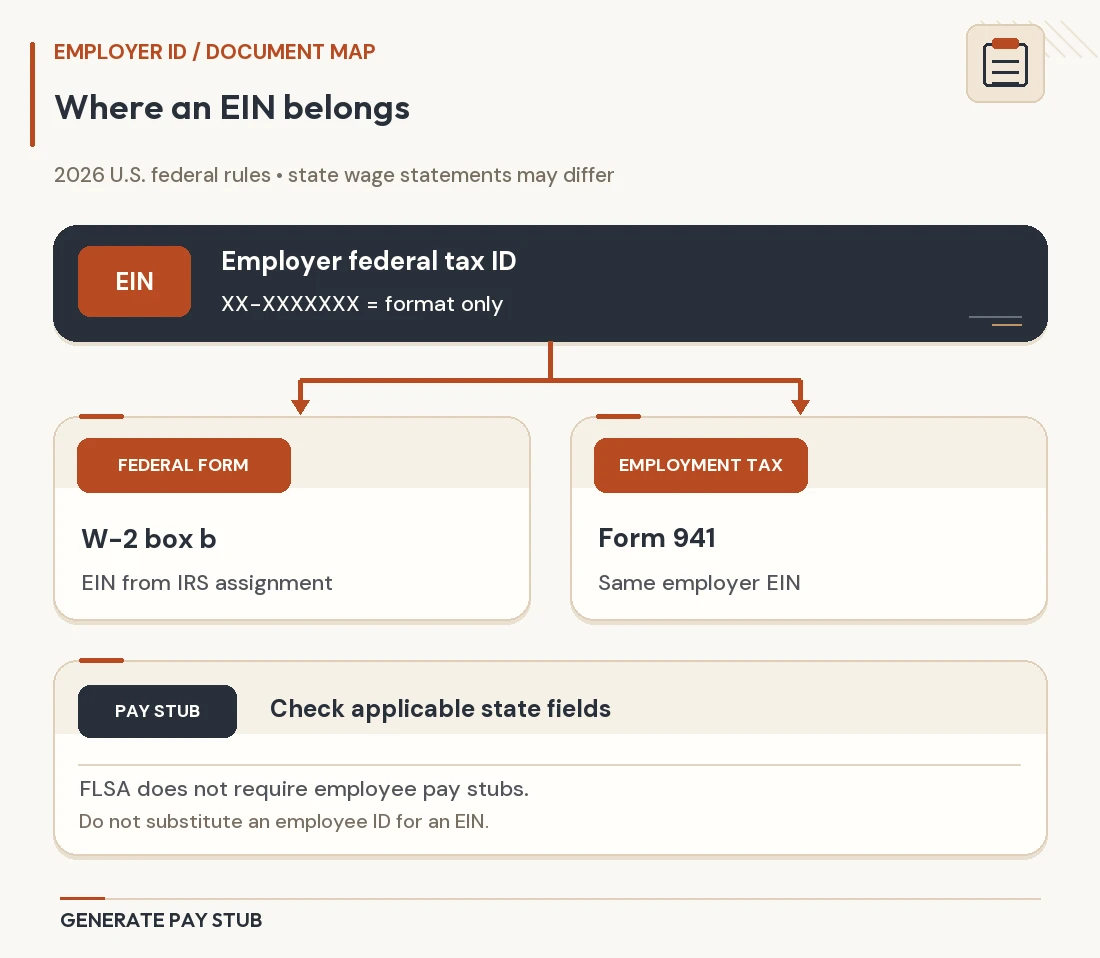
No. An EIN identifies the reporting business; the wage-base treatment depends on the underlying employment and transaction rules. Ask whether the legal employer changed, whether the business was acquired, and whether payroll is applying a documented predecessor-successor treatment. A new payroll portal, bank descriptor or company logo is not enough to answer those questions.
2026 IRS Publication 15 identifies the successor exception and directs employers to the governing regulation. The rule can preserve wage-base credit while the successor reports using its own EIN. The employee should not ask the successor to reuse the seller’s tax identification number or personally change the EIN on an issued document.
For the identifier itself, see EIN and FEIN fields on a pay stub. This article focuses on the different question: what earlier wages the new payroll must consider.
Which acquisition conditions allow predecessor wage credit?
Treasury regulation 31.3121(a)(1)-1(b) describes an acquisition of substantially all the property used in another employer’s business, or a separate business unit. The employee must have worked for the predecessor immediately before the acquisition and for the successor immediately afterward. The relevant predecessor wages were paid earlier in the same calendar year.
That is a transaction-and-employment test, not simply a shared-ownership test. A transfer between companies with similar names, or a rehire after a gap, should not be assumed to qualify without review. The regulation’s historical dollar examples illustrate the mechanics; use the actual wage base for the current payment year.
Another distinct arrangement is a common paymaster. IRS common-paymaster guidance concerns qualifying related corporations, concurrent employment and payment through a common paymaster that is itself an employing corporation. Common ownership or a shared payroll vendor alone does not establish that arrangement. Do not combine employer wage bases merely because the same service processes both checks.
How does the qualifying-successor calculation work in 2026?
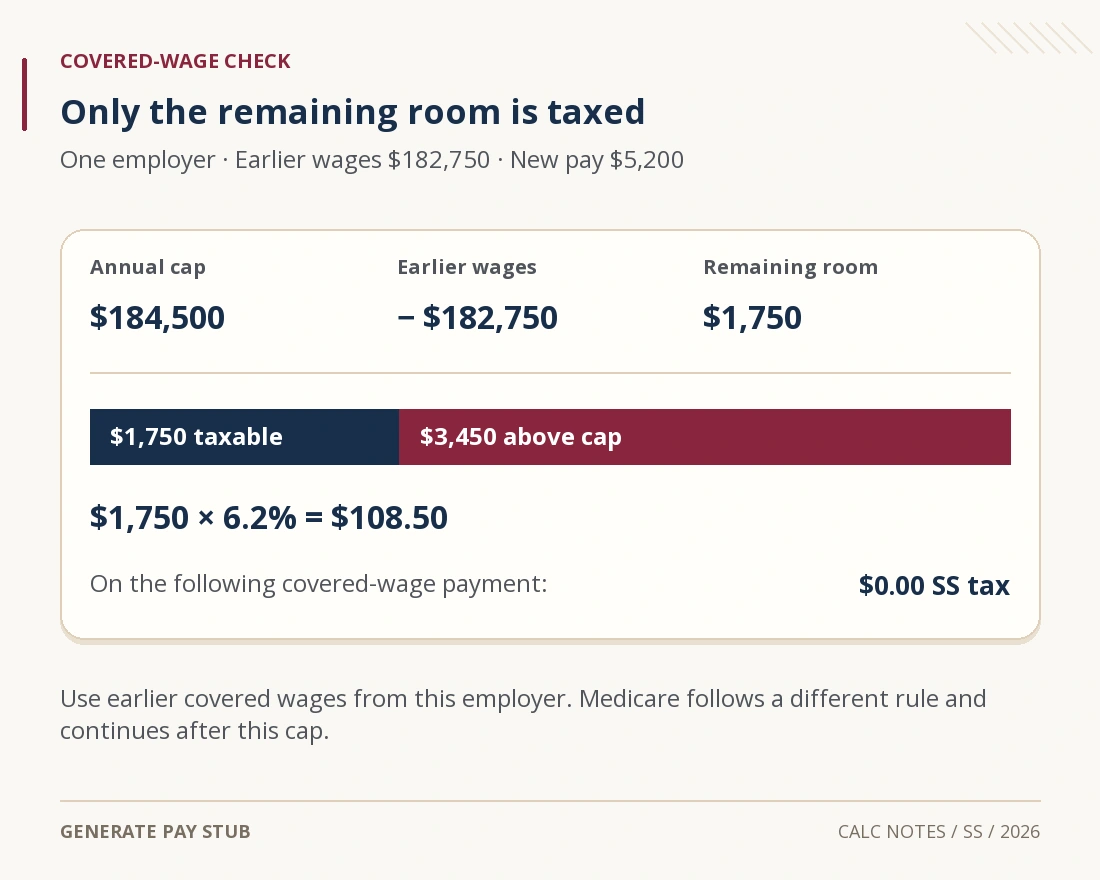
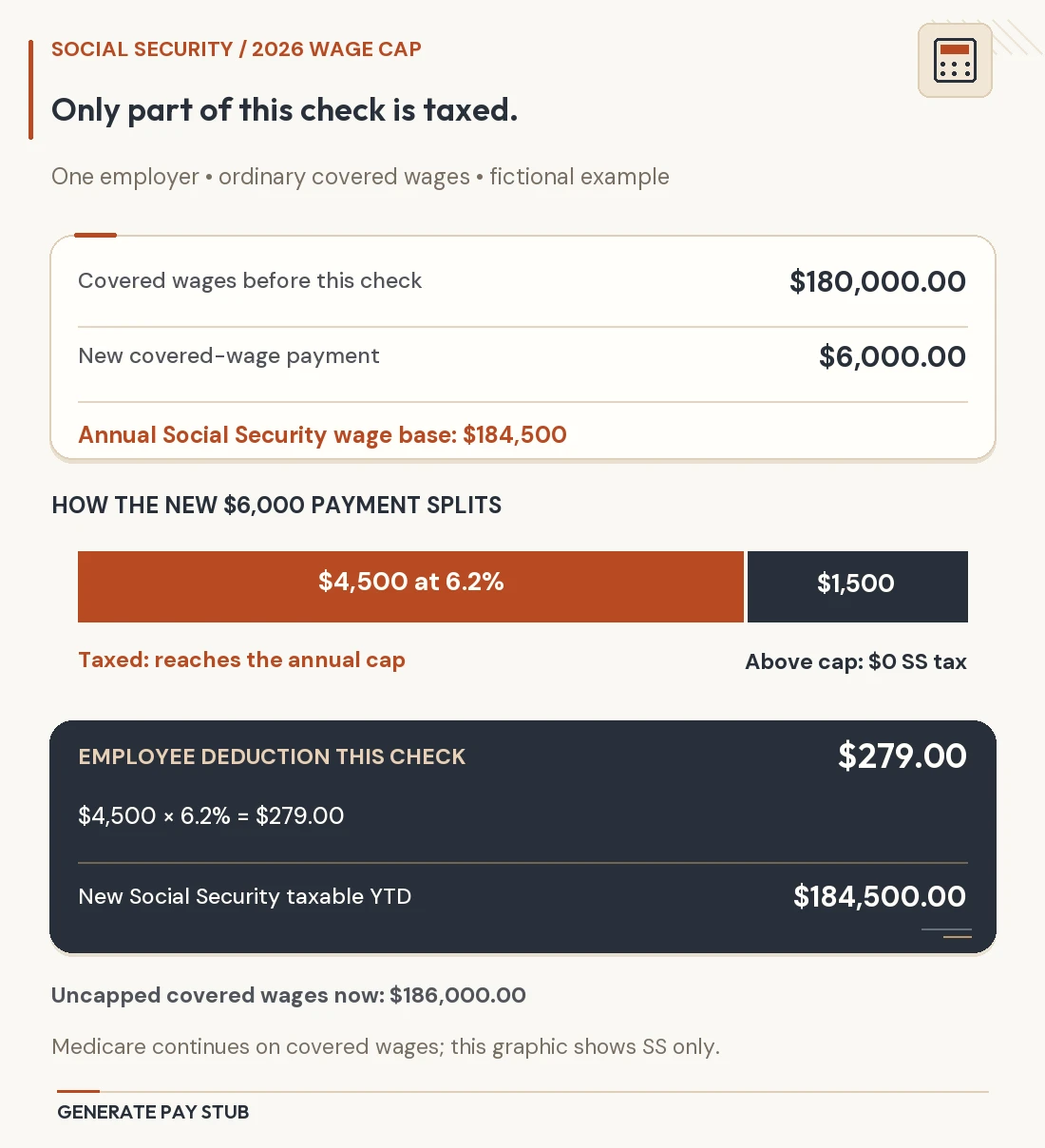
SSA’s annual contribution-and-benefit-base table lists a $184,500 taxable maximum for 2026. The employee Social Security rate is 6.2%. The following example assumes ordinary covered wages, no tips, no earlier adjustments and no railroad compensation.
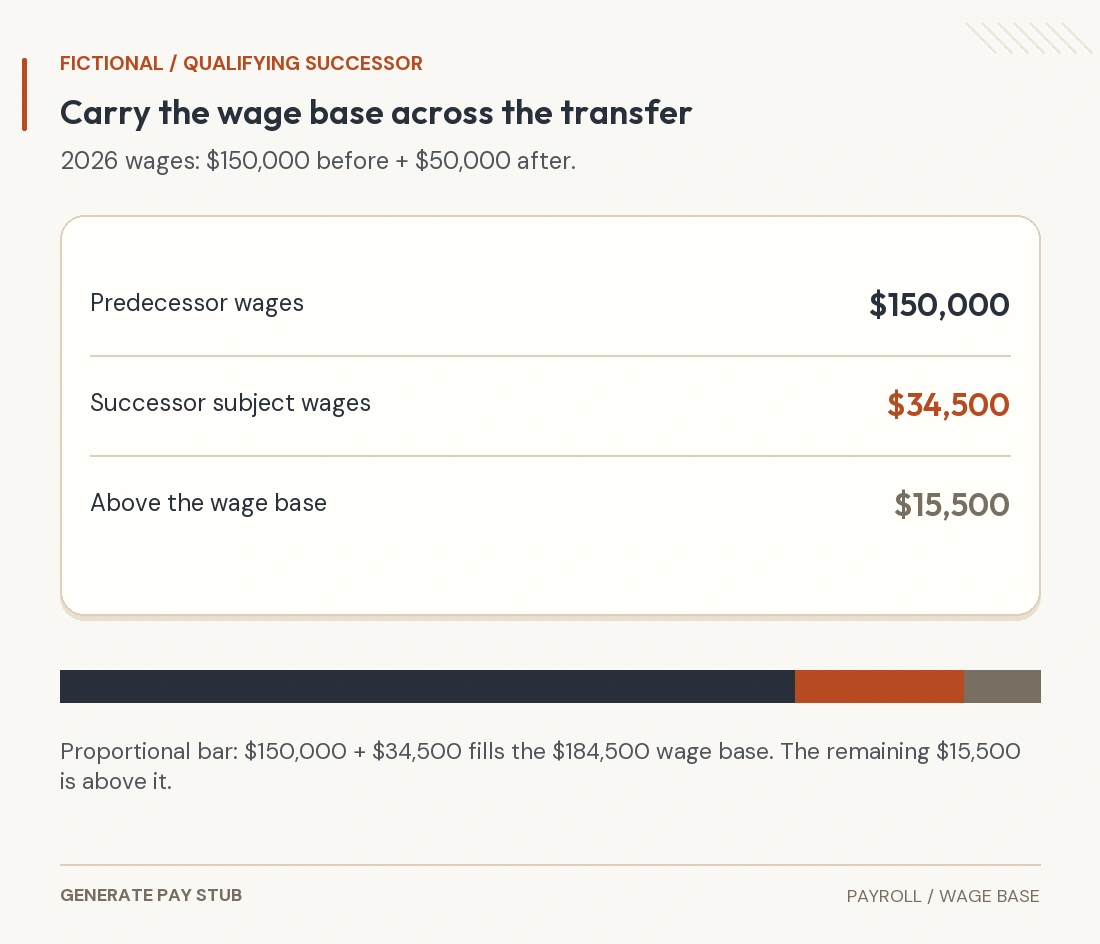
Before an acquisition, Employer A paid the employee $150,000 during 2026 and withheld $9,300 of employee Social Security tax. Employer B then pays another $50,000 that year. In the qualifying-successor scenario, the earlier $150,000 counts against the same annual wage base, leaving $34,500 subject to Social Security tax on B’s payments.
| Calculation item | Qualifying successor | Unrelated employer |
|---|---|---|
| Earlier wages credited toward B’s wage base | $150,000 | $0 |
| Gross covered cash wages B pays | $50,000 | $50,000 |
| Room below B’s applicable wage-base limit | $34,500 | $184,500 |
| B’s wages subject to Social Security tax | $34,500 | $50,000 |
| Employee Social Security withheld by B | $2,139 | $3,100 |
| Employee Social Security withheld by A and B | $11,439 | $12,400 |

Check the arithmetic: $184,500 − $150,000 = $34,500; $34,500 × 6.2% = $2,139. Adding A’s $9,300 gives $11,439, which equals $184,500 × 6.2%. The $15,500 above the limit is still compensation; it is not automatically exempt from income tax or Medicare.
For a genuinely unrelated new employer without an applicable special arrangement, earlier wages generally do not reduce that employer’s withholding base. B’s $50,000 × 6.2% is $3,100. Combined withholding is $12,400, or $961 above the employee’s ordinary 2026 maximum. That mathematical difference does not itself establish an employer mistake.
IRS excess-withholding guidance distinguishes excess arising from multiple employers from an employer’s overcollection. The former may support a credit on the individual return; the latter generally calls for employer adjustment, with a refund procedure if unresolved. Determine the actual transaction treatment before choosing a correction route. Married taxpayers calculate their individual Social Security excess separately.
Does Medicare stop when Social Security stops?
No. Regular Medicare has no annual wage cap. Under the general rule, its employee rate is 1.45% on covered wages. The Social Security ceiling does not switch Medicare off.
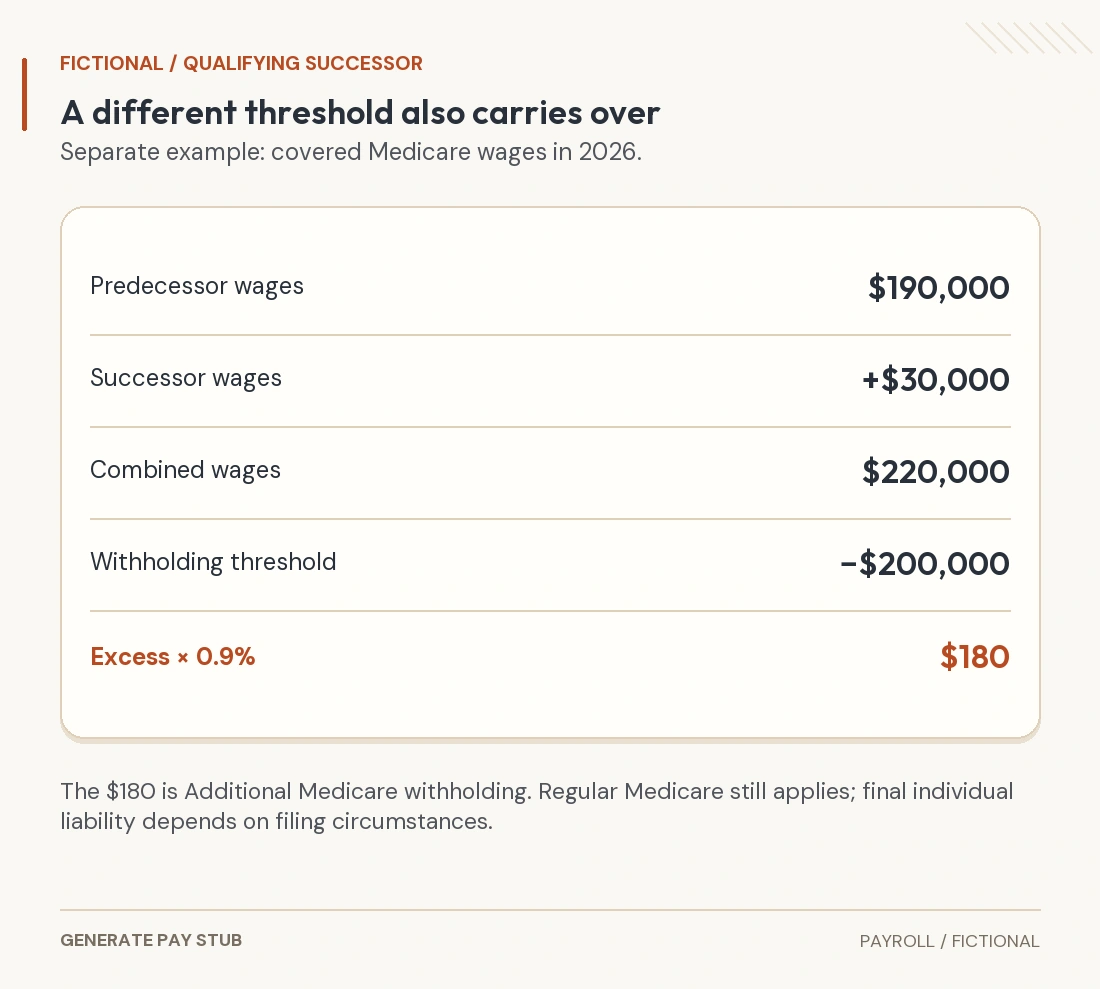
The IRS Additional Medicare Tax FAQ also explains that qualifying predecessor wages count toward the employer’s $200,000 withholding threshold. Treat that employer withholding threshold separately from both the Social Security ceiling and the individual return’s filing-status calculation.
Use a separate fictional case: $190,000 in earlier Medicare wages plus $30,000 from the qualifying successor totals $220,000. The excess over the employer withholding threshold is $20,000; at 0.9%, Additional Medicare withholding on that excess is $180. Regular employee Medicare on the successor’s entire $30,000 is $435, assuming all of it is covered. The two taxes are separate amounts, not alternative calculations.

Can a qualifying acquisition still produce two Forms W-2?
Yes. Revenue Procedure 2004-53 describes standard and alternate reporting procedures. Under the standard procedure, each party handles the wages it paid. An agreed alternate procedure can place the acquired employees’ combined W-2 reporting with the successor. Wage-base continuity and the number of W-2 forms therefore are not the same test.
Ask which reporting procedure applies and what each form includes. Do not add a combined successor statement to predecessor wages already included in it. Conversely, do not discard a legitimate predecessor W-2 just because the successor issued another form. Check the issuing employer and the covered wage totals before entering the records into tax software.
Employers may also need to explain acquisition-related differences between W-2 and quarterly employment returns. The Schedule D (Form 941) instructions describe that reconciliation and its conditions. Schedule D is not an employee claim form and is not required for every business transaction. Current filing deadlines must come from current instructions rather than dates in the older revenue procedure.
What should you check on the first post-acquisition pay stub?
- Identify the legal payer and transfer date. Keep the last predecessor statement and first successor statement together.
- Separate actual wages from carryover information. Ask which YTD fields represent cash paid by the successor and which are tax-calculation balances imported from the predecessor.
- Reconcile the correct wage category. Social Security wages, Medicare wages and gross cash need not be identical.
- Check the remaining limit and current withholding. Use the payment year’s base and documented earlier covered wages.
- Confirm annual reporting. Ask whether standard or alternate W-2 reporting will apply.
- Request an issued correction when needed. Keep payroll’s explanation and corrected records; do not repair official totals by editing the PDF yourself.
A portal that displays only the successor’s wages may still use earlier wages correctly in its tax engine. A large imported YTD figure can also be correct for tax calculations while being misleading if presented as new cash paid. Ask for the reconciliation behind the fields rather than judging only the visible label.
Retirement-plan deductions, health benefits, state unemployment wage bases and paid-leave contributions have their own rules. This federal Social Security exception does not establish their treatment. The broader Social Security pay-stub guide explains ordinary limits and unrelated-employer withholding.
Common post-acquisition payroll questions
Can an employee instruct payroll to stop withholding after reaching the cap elsewhere?
Earlier unrelated employment alone generally does not authorize that instruction. Payroll must apply the actual employer or qualifying arrangement rules.
Does a second W-2 prove the wage base restarted?
No. Reporting procedures and wage-base credit are separate. Ask payroll how the predecessor wages were treated.
Is the $184,500 limit permanent?
No. It is the 2026 limit used in this example. Verify the annual amount for payments in another year.