U.S. and Canadian pay stubs both explain earnings, deductions and take-home pay, but their tax labels and reporting systems differ. A U.S. employee commonly sees federal withholding, Social Security and Medicare. A Canadian employee outside Quebec may see income tax, Canada Pension Plan contributions and Employment Insurance premiums. Matching the names does not mean the programs, rates or taxable earnings are interchangeable.
This guide compares ordinary employee payroll in 2026. It includes two separate fictional calculations in their own currencies. It does not determine cross-border residency, treaty coverage or which country should receive tax on a particular worker’s earnings.
U.S. vs Canadian pay stub terminology
Start with the pay period, payment date and currency before comparing amounts. A dollar sign alone does not tell you whether a statement reports U.S. or Canadian dollars. Gross earnings also need a consistent basis: an hourly rate, annual salary and current payment are different measurements.
| What you are reviewing | Typical U.S. wording | Typical Canadian wording |
|---|---|---|
| Earnings before deductions | Gross pay or gross earnings | Gross pay or gross wages |
| Income-tax withholding | Federal; state or local where applicable | Federal and provincial/territorial income tax; presentation varies |
| Public pension or social-insurance contribution | Social Security; Medicare is a separate FICA component | CPP outside Quebec; QPP for applicable Quebec employment |
| Employment-insurance item | No universal employee EI line; some states have employee program deductions | EI; Quebec can also have QPIP |
| Annual employment-income document | Form W-2 | T4; applicable Quebec reporting also includes RL-1 |
| Cumulative totals | Year-to-date or YTD | Year-to-date or YTD |
The comparison is a reading aid, not a claim that every deduction must appear under these exact abbreviations. Ask payroll to explain an unfamiliar code and the earnings base used for it. A pension-plan deduction offered by an employer is also different from statutory CPP or Social Security.
Are pay statements required in both countries?
The U.S. Department of Labor says the FLSA requires wage records but does not itself require employee pay stubs. State law can impose statement and access requirements. Consequently, a federal recordkeeping rule should not be presented as a complete nationwide employee-statement standard.
Canadian requirements also need the correct jurisdiction. The federal government’s industry and workplace guide distinguishes federal coverage from provincial or territorial employment standards. Working in Canada does not automatically mean one federal payslip rule applies to every employer.
For example, Ontario’s wage-payment guidance requires a statement on or before payday identifying the pay period, wage rate if applicable, gross wages and relevant calculation information, each deduction’s amount and purpose, applicable room or board amounts and net wages. Its written or accessible-email requirements belong to that Ontario framework. Do not transfer them automatically to another province.
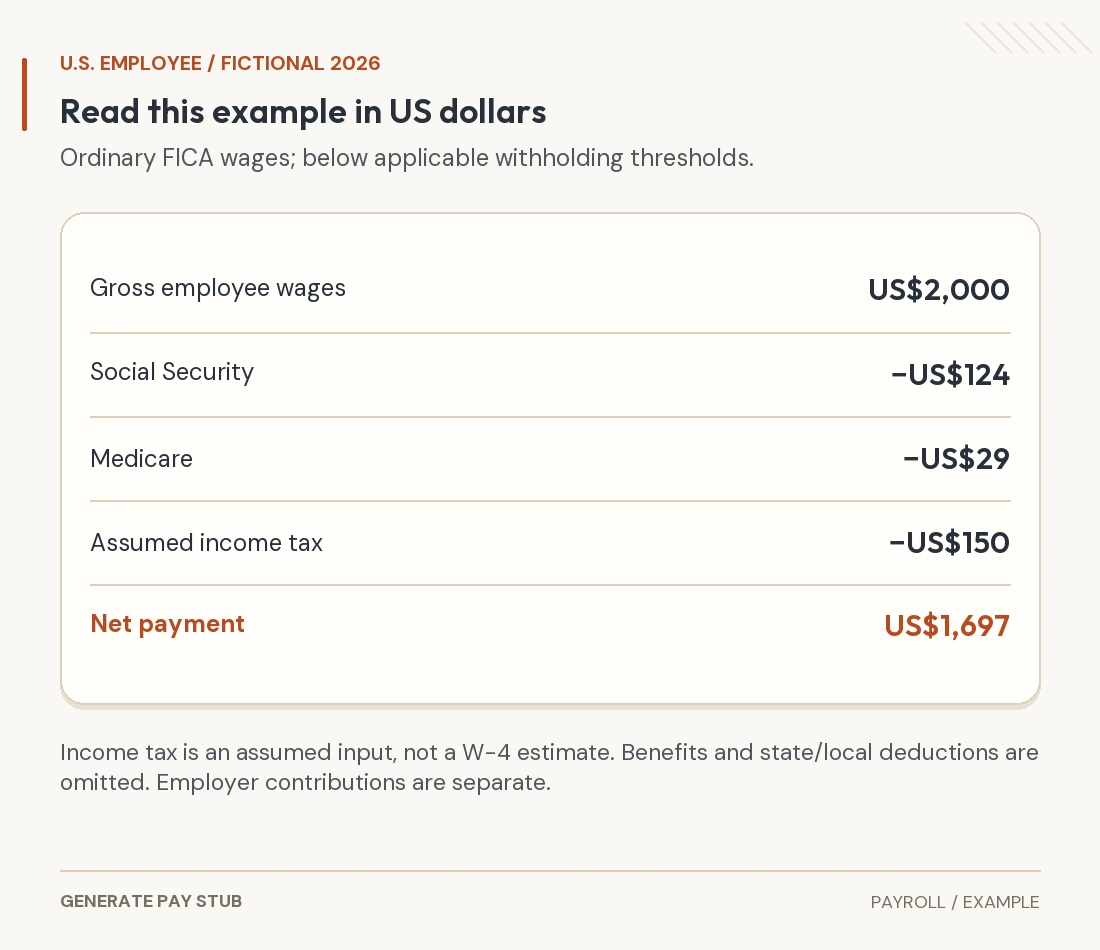
Fictional U.S. employee: US$2,000 gross
Assume ordinary employee wages fully subject to FICA, sufficient remaining Social Security wage-base room, no Additional Medicare Tax withholding and no benefits or other deductions. The 2026 IRS employer tax guide specifies the regular employee rates of 6.2% for Social Security and 1.45% for Medicare. Income-tax withholding below is a supplied fictional input, not the result of a W-4 calculation.

Social Security is US$2,000 × 6.2% = US$124.00. Medicare is US$2,000 × 1.45% = US$29.00. With the assumed US$150.00 income-tax withholding, net pay is US$1,697.00. An employer’s own payroll-tax expense is separate; subtracting it again from this employee’s net would change the stated example incorrectly.
Real withholding depends on elections, applicable wage bases, year-to-date totals and jurisdiction. This example does not estimate state or local tax or suggest that everyone earning US$2,000 takes home the same amount.
Fictional Canadian employee: C$2,000 gross outside Quebec
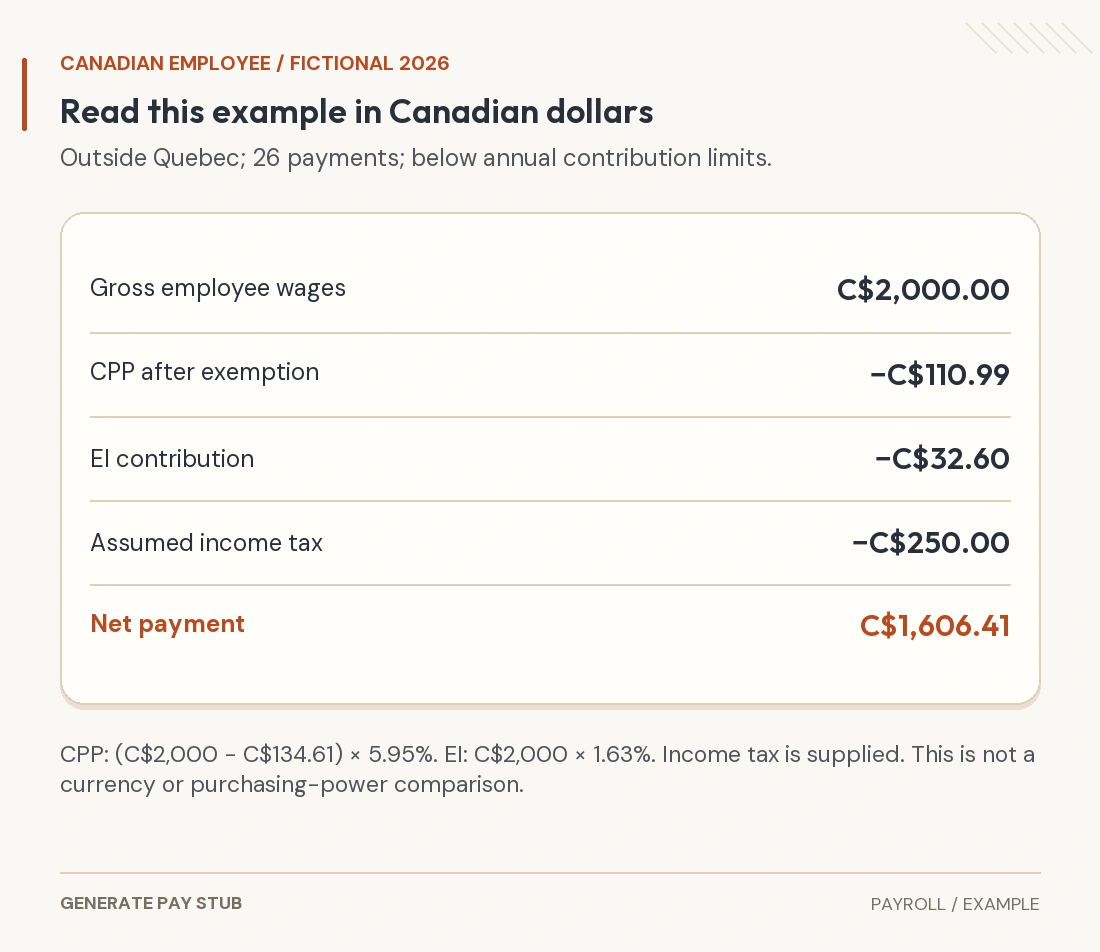
Assume an ordinary CPP-eligible employee, 26 biweekly payments, all C$2,000 pensionable and insurable, no benefits, and sufficient room under the annual CPP and EI limits. CPP2 is not triggered. The CRA’s 2026 Ontario payroll tables list a combined base and first additional CPP rate of 5.95% and an employee EI rate of 1.63% outside Quebec.
Use the CRA basic-exemption chart: a 26-payment biweekly schedule uses C$134.61 per period. CPP is (C$2,000 − C$134.61) × 5.95% = C$110.99 after rounding. EI is C$2,000 × 1.63% = C$32.60. Assume combined income-tax withholding of C$250.00 solely to complete the illustration.

Net pay is C$2,000.00 − C$110.99 − C$32.60 − C$250.00 = C$1,606.41. The two examples use different currencies and assumed income taxes. Their net figures cannot establish which country taxes workers more heavily or which job pays better.
Payroll changes when contribution limits are reached, pensionable or insurable earnings differ, eligibility changes, or second additional CPP applies. A 27-payment schedule also has a different per-period exemption. Use the correct payroll calculation rather than applying this one period’s percentage to every future payment.
Why Quebec needs a separate reading
Quebec is not covered by the Canadian calculation above. QPP and QPIP can appear alongside income-tax deductions and EI under their respective rules. The Revenu Québec RL-1 guide explains employment-income reporting connected with Quebec source deductions and contributions. Do not simply rename CPP as QPP while keeping the same rates or assume an RL-1 replaces every federal reporting obligation.
How W-2, T4 and RL-1 relate to pay stubs
Form W-2 is the U.S. annual wage and tax statement. It serves a different purpose from explaining an individual payment. Canada’s T4 box guide separately identifies employment income, CPP/QPP contributions, EI premiums, income tax deducted, insurable earnings and pensionable earnings.
Taxable benefits and different reporting bases can prevent annual taxable earnings from matching a simple sum of cash deposits. Reconcile like fields: gross cash pay, taxable income, contributions and actual net payments. A final pay stub can support a review, but relabeling it “T4” or “W-2” does not create an employer-filed annual tax document.
A practical review for an unfamiliar country’s payslip
- Confirm the issuing employer, worker and currency without inferring tax residency from an address alone.
- Match the payment date and period, then verify hours, rate and adjustments.
- Separate income-tax withholding from pension, insurance and optional benefit deductions.
- Ask which earnings are taxable, pensionable or insurable and compare current figures with cumulative totals.
- Reconcile net distributions with actual payments and ask payroll about unexplained differences.
For the arithmetic common to both systems, see gross-to-net pay. For the U.S. contribution specifically, use our Social Security pay-stub guide. Neither substitutes for Canadian payroll rules.
Common U.S.–Canada pay stub questions
Is CPP just the Canadian name for Medicare?
No. CPP is a pension contribution, while U.S. Medicare is a separate payroll-tax program. Similar placement in a deductions column does not make them equivalent.
Can I compare two net payments directly?
Only after considering currency, pay frequency, hours, benefits and the withholding assumptions. A larger number on one statement alone does not establish higher annual compensation.
Does moving countries prove payroll should switch immediately?
No. Work location, employer arrangements and cross-border coverage need a separate determination. Ask the employer to confirm its payroll treatment before interpreting an unfamiliar deduction as an error.