Wyoming’s paycheck calculator has no state income-tax deduction, but federal withholding and FICA still affect cash. If you are reviewing a late-year W-4 change, use the calculator to understand the per-payment effect and count the paydays remaining separately. Its annual projection repeats the selected extra across a full modeled year.
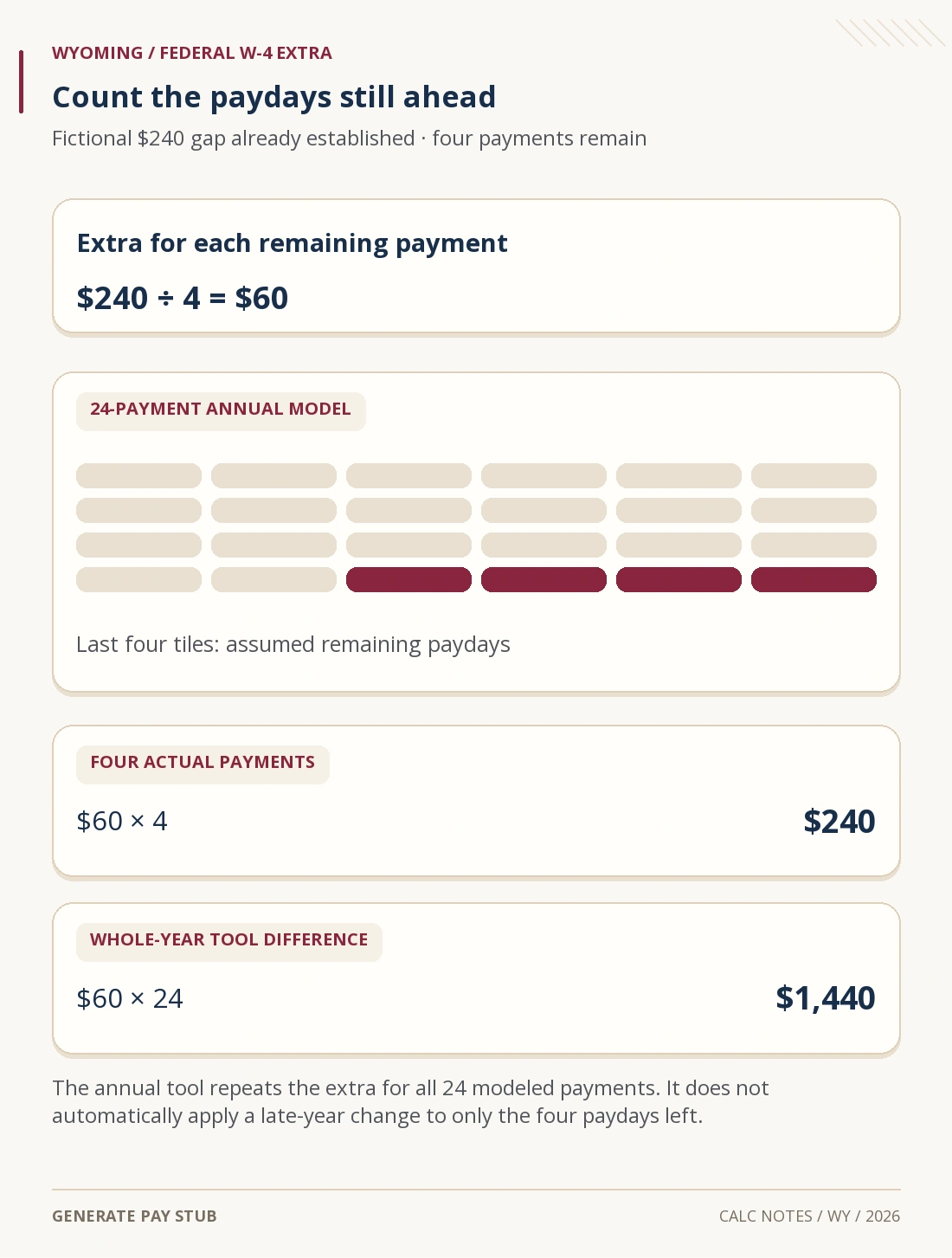
Our fictional $81,600 salary has 24 semi-monthly payments. Adding $60 of federal withholding lowers each modeled payment by $60. If only four actual payments remain after payroll implements a change, the additional collection on those four payments is $240, rather than the tool’s full-year $1,440 difference.
Understand what Wyoming’s zero income-tax line means
The State of Wyoming confirms that it does not impose individual income tax. The calculator therefore does not ask for a Wyoming allowance count or a state extra-withholding election.
That zero does not cancel federal income tax, employee Social Security or Medicare. Nor does it establish that an employee has no insurance premium, retirement election, garnishment or other payroll deduction.
Wyoming’s unemployment insurance agency separately manages employer tax reporting and payments. Employer payroll costs should not be invented as employee deductions to explain a cash estimate.
This guide assumes residence and work in Wyoming throughout the year. Another state’s rules may matter when either location changes. A Wyoming mailing address or employer registration alone does not resolve a cross-state wage question.
Enter the $3,400 semi-monthly wage case
Open the free Wyoming paycheck calculator, select 2026 and enter $81,600 annual wages with Semi-monthly selected. The tool projects 24 equal $3,400 payments.
Choose federal Single, leave multiple jobs disabled and keep annual credits, other income and deductions at zero. Initially set federal additional withholding to zero as well. Known annual local and other cash amounts are zero.
Assume one ordinary private-sector employer, no taxable benefits or benefit exclusions, and equal income-tax and FICA wage bases. The full-year wage amount is below the 2026 Social Security limit and the employer’s Additional Medicare withholding trigger.
These assumptions isolate one control: the federal per-payment extra. They do not establish what any particular household should put on Form W-4.
Check the original gross-to-cash result
| Wage or employee deduction | Per semi-monthly pay | Twenty-four-pay total |
|---|---|---|
| Gross wages | $3,400.00 | $81,600.00 |
| Federal income-tax withholding | $380.08 | $9,121.92 |
| Wyoming income-tax withholding | $0.00 | $0.00 |
| Employee Social Security | $210.80 | $5,059.20 |
| Employee Medicare | $49.30 | $1,183.20 |
| Cash before unentered deductions | $2,759.82 | $66,235.68 |
The payment reconciles as $3,400 − $380.08 − $210.80 − $49.30 = $2,759.82. Annual totals add the 24 rounded payments.
The IRS FICA guidance gives the employee rates used here: 6.2% for Social Security and 1.45% for Medicare. Thus $3,400 × 0.062 = $210.80 and $3,400 × 0.0145 = $49.30.
For the federal income-tax check, the 2026 withholding worksheet reduces this annualized Single wage by $8,600, giving $73,000. The applicable standard schedule gives $5,800 + ($73,000 − $57,900) × 0.22 = $9,122 before division by 24 and rounding to $380.08.
The worksheet adjustment is part of that federal method. Do not subtract another return standard deduction from the same calculation.
Test $60 of federal extra withholding per payment
Keep all other inputs and enter $60 in additional federal withholding. The live tool increases federal withholding from $380.08 to $440.08. Social Security, Medicare and Wyoming’s zero state line remain unchanged.
Each projected cash payment becomes $2,699.82. Repeated across all 24 modeled payments, annual federal withholding becomes $10,561.92 and annual cash becomes $64,795.68.
The annual difference is $60 × 24 = $1,440. The field is an amount per paycheck, unlike the federal annual credits, annual other-income or annual deductions controls.
This calculator run demonstrates the effect of an input. It does not conclude that the worker owes an additional $1,440 on the tax return.
Separate four remaining payments from the full annual projection
Suppose a separate review of the household’s real records has already established a $240 additional-withholding target, and payroll confirms that four payments will remain after a change takes effect.
The simple allocation of that assumed target is $240 ÷ 4 = $60 per remaining payment. If wages and the other settings on those four payments match our case, the extra collected is $240 and cash on those payments falls by $240.

| Additional-withholding comparison | Four remaining pays | Full 24-pay model |
|---|---|---|
| Extra collected at $60 per pay | $240.00 | $1,440.00 |
| Cash without the extra | $11,039.28 | $66,235.68 |
| Cash with the extra | $10,799.28 | $64,795.68 |
The four-payment illustration does not replace the year’s actual first twenty payments. Reconstructing a complete year requires those earlier wages and withholding amounts, plus the real remaining payments.
Timing also matters: four scheduled paydays are useful only if the new election applies to all four. Ask payroll which payment will first reflect the certificate before dividing a target by a remaining count.
Establish the target from actual records before testing an extra
The $240 target above is assumed, not calculated by the Wyoming tool. A real review needs year-to-date wages and withholding, expected remaining earnings, spouse or second-job income where relevant, and applicable credits and deductions.
The IRS Tax Withholding Estimator uses that broader context and asks for recent paystubs and other records. It can help prepare a revised federal W-4 for the employer. Its guidance also recommends checking withholding after major life or income changes.
Do not treat this one-employer annual paycheck estimate as a refund calculation or a guarantee against underpayment. A changing wage pattern, earlier employer or nonwage income can materially change the household result.
If a late-year adjustment is made, review the election again for the new year. Carrying a temporary catch-up amount into every payment of a fresh year can produce a different result from the intended remaining-payday adjustment.
Check benefits, cash deductions and location before comparing a deposit
A health or retirement deduction may affect taxable wages as well as cash. An annual other-deductions entry does not determine that legal treatment. Our pre-tax versus post-tax explanation shows why the distinction matters.
Employer taxes, benefit enrollment and authorization rules are not established by this estimate. Use actual payroll records for those items and confirm any tax obligation in another work or residence state separately.
The free calculator does not submit W-4, reproduce an irregular payroll history or issue verified proof of income. Its useful role here is to compare a controlled regular-payment scenario with and without a known extra.
Wyoming paycheck calculator questions
Why is there federal withholding when Wyoming income tax is zero?
Federal withholding is a separate calculation.
Does $60 of federal extra mean $60 across the entire year?
No. It applies to each modeled payment.
Does the annual tool automatically know that four checks remain?
No. Its semi-monthly projection repeats the settings across 24 payments.
Does the $240 illustration determine my remaining tax bill?
No. That target must be established independently using actual household facts.
Wyoming scope, IRS guidance and both live federal-extra runs reviewed November 6, 2026.