Arizona’s paycheck calculator uses an A-4 withholding percentage plus an optional extra dollar amount for each payment. The percentage applies to gross taxable wages under the state withholding rules. It is an election for making tax payments, rather than a calculation of the household’s final Arizona tax.
This guide compares three 2026 runs for a fictional $65,000 salary: 2.0%, 2.0% plus $10 extra, and 2.5%. It shows how a supplied annual withholding goal translates into the two controls, then explains why changing an election late in the year requires a different calculation.
Set wages, frequency and the A-4 inputs
Open the Arizona paycheck calculator. Select 2026, $65,000 annual gross wages and Biweekly. The example uses 26 equal payments of $2,500. Federal withholding is Single, with multiple jobs unchecked and the W-4 dollar adjustments at zero.
For the first state run, choose 2.0% and no extra withholding. Known annual local withholding and other cash deductions are zero. Assume one employer for the whole year, Arizona residence and work, ordinary wages and no benefits changing the tax bases.
The current 2026 Form A-4 lists seven nonzero percentage options, from 0.5% to 3.5% in half-percentage-point steps. It also has a separate place for extra dollars from each paycheck. Use the actual supported election; a smaller cash deduction does not by itself make an election sufficient.
The Arizona individual withholding guidance explains the 2.0% default when a new employee fails to provide the election within the required period. That default is not a personalized finding that 2.0% will cover the worker’s final tax.
Translate a supplied full-year withholding goal into two controls
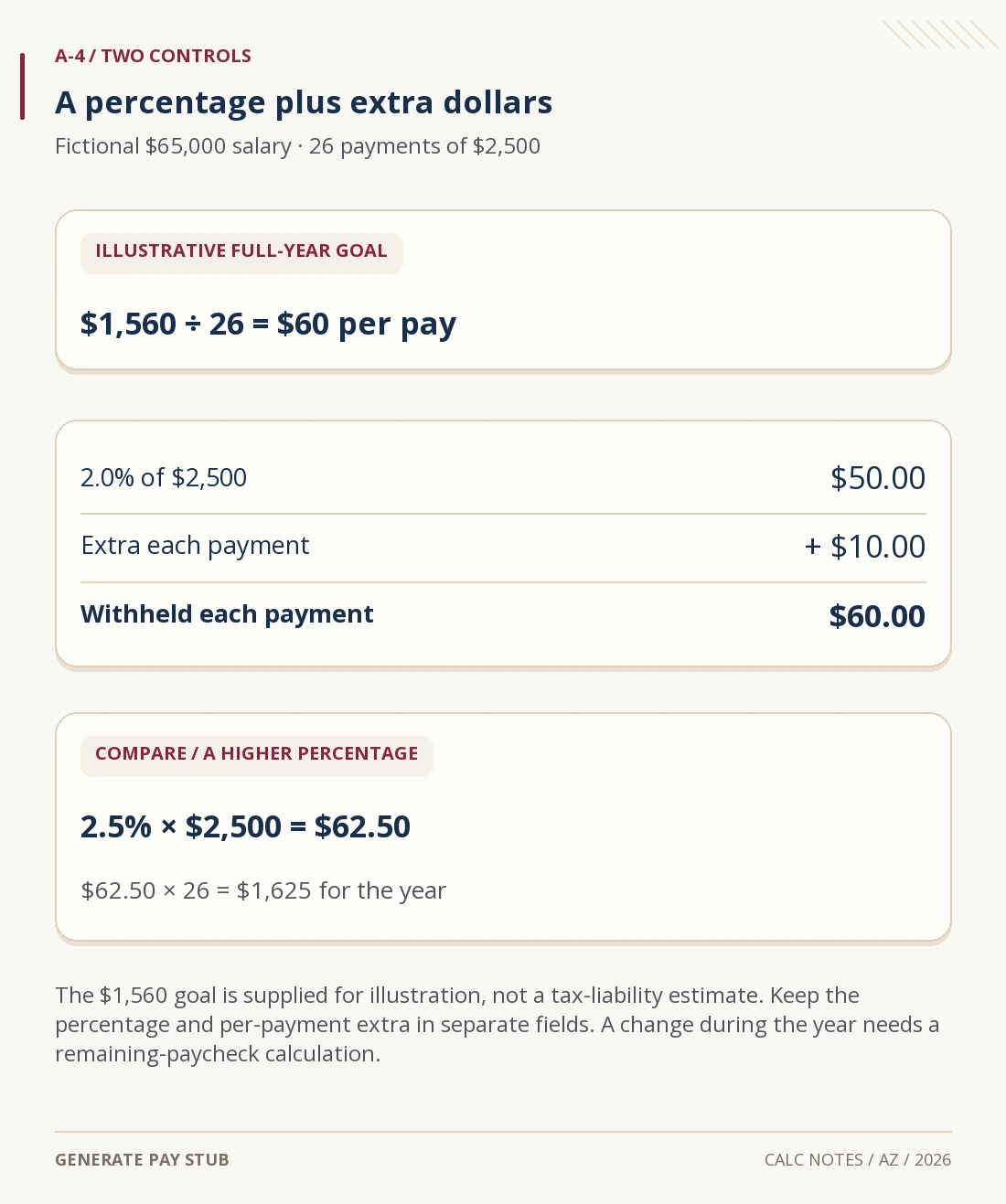
For illustration, suppose the worker has independently established a $1,560 Arizona withholding goal for a complete year of these wages. The goal is supplied for this example; the paycheck calculator does not determine that it is the correct tax liability.
Spread $1,560 across 26 payments to get $60 per payment. A 2.0% election on $2,500 gives $50. The remaining $10 can be represented by the separate extra-withholding input. That produces ($2,500 × 2.0%) + $10 = $60 per payment.

A 2.5% election without extra withholding instead produces $62.50 each payment and $1,625 over the year. That is $65 above the supplied goal, or $2.50 per payment more than the 2.0%-plus-$10 comparison.
Do not enter $260 in the per-payment extra field to request an additional $260 annually. On this schedule, $260 per payment would add $6,760 over 26 payments. The calculator’s field expects the payment-level dollar amount.
Compare the three checked calculator estimates
These live runs change only the state percentage and extra dollars. Each keeps federal withholding at $216.15, Social Security at $155 and Medicare at $36.25 per payment.
| A-4 assumptions | State tax/payment | Net/payment | Annual net |
|---|---|---|---|
| 2.0%; no extra | $50.00 | $2,042.60 | $53,107.60 |
| 2.0%; $10 extra | $60.00 | $2,032.60 | $52,847.60 |
| 2.5%; no extra | $62.50 | $2,030.10 | $52,782.60 |
The middle run’s cash arithmetic is $2,500 − $216.15 − $155 − $36.25 − $60 = $2,032.60. Multiplying by 26 gives $52,847.60. Its annual withholding and federal payroll deduction amounts reconcile as follows:
| Component | Amount |
|---|---|
| Gross wages | $65,000.00 |
| Federal income tax withholding | $5,619.90 |
| Arizona income tax withholding | $1,560.00 |
| Social Security | $4,030.00 |
| Medicare | $942.50 |
| Estimated take-home pay | $52,847.60 |
More withholding reduces current cash in this comparison. It is a payment toward a potential return liability, rather than proof that the employee owes more total tax. A final refund or balance also depends on the return, credits, deductions, other income and other payments.
Use remaining payments when reviewing a change during the year
The Department of Revenue’s withholding worksheet includes the annual goal, amount already withheld and number of paychecks remaining. Those inputs address a different question from the full-year projection above.
For a separate fictional catch-up illustration, suppose the same $1,560 goal has $1,200 already withheld and six $2,500 payments remaining. The uncollected amount is $360, so the remaining-payment target is $360 ÷ 6 = $60 each. A 2.0% election plus $10 extra would match that arithmetic under those assumptions.
If only four payments remained, the same $360 balance would require $90 per payment. At the assumed wage amount, that could be represented by 3.5% giving $87.50 plus $2.50 extra. This is arithmetic illustrating the worksheet’s units, not a certificate recommendation.
The reviewed paycheck tool does not collect prior Arizona withholding and remaining pay dates to solve that catch-up calculation. Do not infer from its annual result that an election first applied near year-end will produce the displayed total for the whole current year.
Confirm the wage base before applying the percentage
The 2026 employer instructions explain gross taxable wages for Arizona withholding, generally the wages included in federal W-2 box 1. That can differ from headline gross pay after relevant pre-tax deductions.
The calculator’s simplified scenario assumes the relevant tax bases match the entered gross wages. It does not construct every benefit adjustment. If actual gross pay is $2,500 but the supported Arizona taxable amount differs, multiplying the headline gross by the elected percentage may not explain the real deduction.
The pre-tax and post-tax deduction guide can help identify why wage bases and cash deductions differ. A number entered in the calculator’s other-cash-deductions field does not automatically change the tax base.
Arizona’s 2.5% income-tax rate on taxable income and an A-4 percentage applied to gross taxable wages are not the same calculation base. Matching the percentage numerically does not prove withholding will equal the final tax.
Understand the tool’s zero-election limitation
Arizona law allows a zero withholding election under the conditions certified on A-4. The reviewed version of this calculator supports the seven nonzero choices and does not model that zero-election certificate.
Do not substitute 0.5% for a valid zero election and call the result exact. Likewise, do not assume that preferring zero withholding establishes eligibility. The actual form explains the expected-no-liability condition, renewal requirements and the need to change the election if circumstances change.
Using a calculator does not deliver A-4 to an employer. Submit actual election changes through payroll’s accepted process and keep the relevant certificate records.
Check the assumptions behind the Arizona projection
The model does not determine household tax liability, choose a withholding goal, calculate a refund or establish a credit claim. Federal W-4 choices remain a separate part of the result; the federal withholding walkthrough shows a controlled way to examine them.
One full-year employer and a regular schedule are assumed. Cross-border work, special employment exceptions, midyear changes and irregular payments require their own facts. The current result has no additional supported statewide employee contribution, which does not eliminate real insurance, pension, union or garnishment deductions.
Choose the actual frequency. Biweekly here means 26 payments; semimonthly means 24. A fixed extra amount has a different annual effect on each schedule, even when annual salary is unchanged.
Arizona paycheck calculator questions
Is the extra field an annual amount?
No. It adds dollars to every modeled payment. Multiply by the number of payments to check its full-year effect.
Does 2.0% mean I owe exactly 2.0% Arizona tax?
No. It is a withholding election applied to its specified wage base. Final tax uses return rules and the full facts.
Will changing the percentage now rewrite earlier withholding?
No. Use actual prior withholding and remaining payments when reviewing a change during the year.
Can this tool determine my zero-election eligibility?
No. That certificate treatment is outside the reviewed version, and eligibility requires the form’s actual conditions.
2026 Arizona forms, official guidance and three live calculator runs reviewed November 6, 2026. All goals and wages in the examples are fictional.