Qualified employer adoption assistance can be exempt from federal income-tax withholding while still being subject to Social Security and Medicare taxes. For 2026, the potential federal income exclusion is up to $17,670 per eligible child, subject to income limits and other requirements. W-2 code T identifies employer-provided adoption benefits; it does not by itself prove the entire amount is excludable on the employee's tax return.
Reviewed November 2, 2026, this guide addresses U.S. federal employee payroll and adoption-benefit coordination. State treatment may differ. All examples are fictional, with eligibility and wage-base assumptions stated. An employer's benefit policy and the tax-law exclusion are separate limits.
How much employer adoption assistance can be excluded in 2026?
The maximum potential exclusion is $17,670 for an eligible child's adoption, with an income phaseout. Revenue Procedure 2025-32 supplies the 2026 inflation-adjusted amounts. The exclusion begins to phase out when modified adjusted gross income exceeds $265,080 and is fully phased out at $305,080 or more.
| Rule | 2026 amount |
|---|---|
| Maximum potential exclusion per eligible child | $17,670 |
| MAGI threshold above which phaseout begins | $265,080 |
| MAGI at which the exclusion is fully phased out | $305,080 |
Do not treat the per-child maximum as a fresh allowance every calendar year for the same adoption. Prior excluded benefits and the applicable year must be considered. An employer also may offer less than the federal ceiling. A $6,000 employer benefit promise does not become a $17,670 payment simply because that is the statutory maximum.
Our MAGI guide explains why one paycheck's gross amount is not a complete modified adjusted gross income calculation. Use the adoption-specific return instructions; the definition and adjustments must match the benefit being tested.
What makes an employer adoption program and expense qualified?
The tax treatment requires more than an employer calling a payment an adoption bonus. Publication 15-B for 2026 describes a separate written adoption assistance plan, eligibility and nondiscrimination requirements, limits on benefits for specified owners, reasonable notice and substantiation of qualifying expenses.
The current Form 8839 instructions, the 2025 edition, describe reasonable and necessary expenses connected with legally adopting an eligible child. Examples include adoption fees, qualifying legal and court costs, and related travel. Surrogacy arrangements and adopting a spouse's child do not qualify under these rules. Expenses reimbursed elsewhere or used for another federal tax benefit require coordination.
An eligible child generally is under 18 or physically or mentally incapable of self-care, under the applicable rules. More-than-2% S-corporation shareholders have a separate exclusion restriction described in Publication 15-B. Do not assume that an owner or family member automatically receives ordinary employee treatment; see our shareholder benefit guide for the importance of ownership classification.
Why can Social Security and Medicare be withheld on adoption assistance?
Federal income-tax withholding and FICA use different rules for this benefit. Publication 15-B instructs the employer to exclude qualifying adoption-program payments from wages subject to federal income-tax withholding, while including them in Social Security, Medicare and FUTA wages. Ordinary wage-base limits and Additional Medicare withholding rules still apply where relevant.
This payroll rule is distinct from the employee's final income exclusion. The 2026 W-2 instructions direct reporting of qualified program benefits in box 12 using code T, including amounts above the $17,670 exclusion, rather than including those benefits in box 1. The employee uses the applicable return process to determine any taxable portion. No income-tax withholding on the benefit does not guarantee no income tax will be due.
FUTA is an employer tax, not an additional deduction from the worker's take-home pay. An unrestricted cash bonus that fails the adoption-plan and expense rules should not receive these settings merely because the employee plans to use it for adoption costs.
How can an employer payment to an agency affect the paycheck?
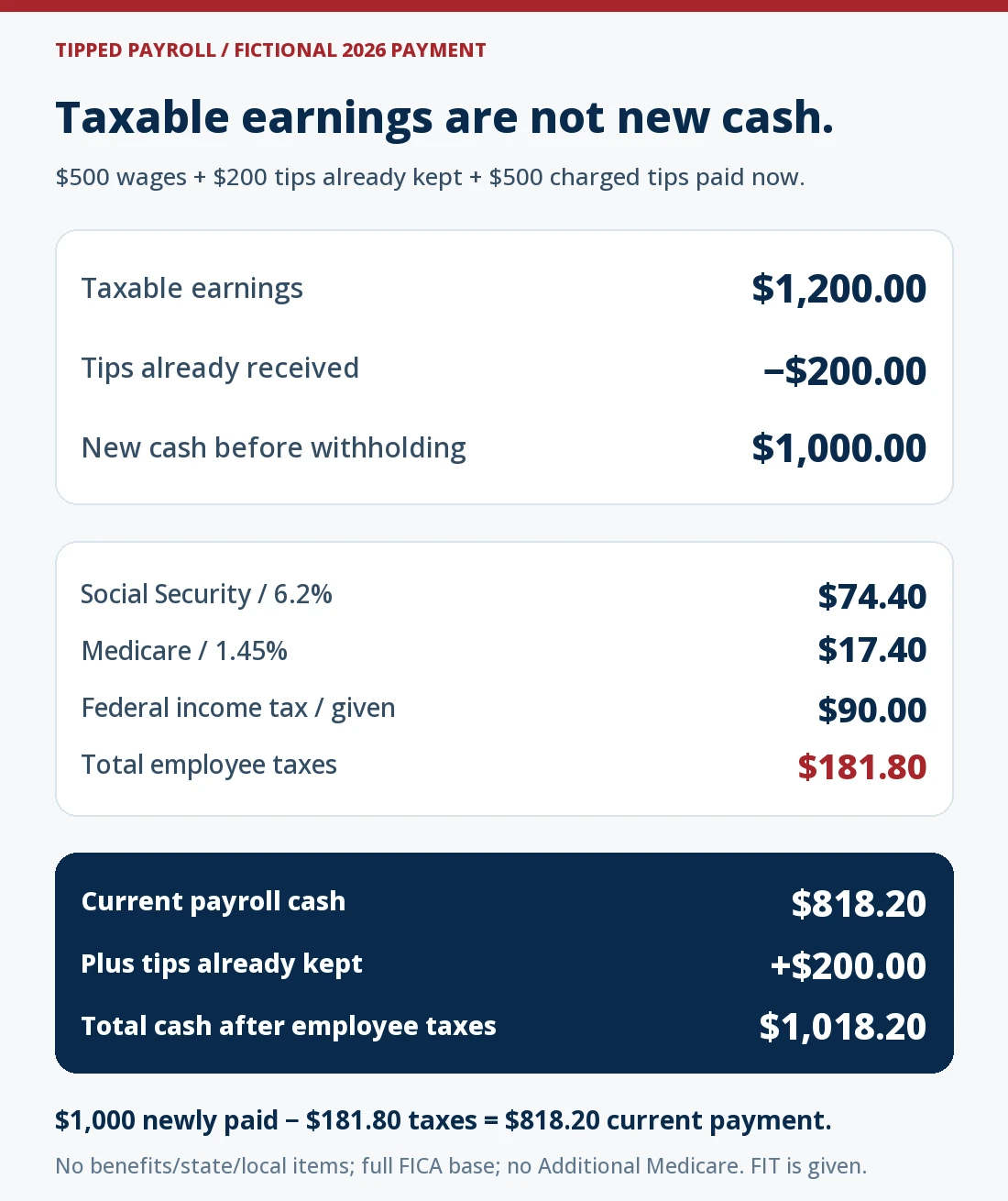
The benefit may be noncash to the employee while still creating FICA wages. Suppose a fictional employer pays $6,000 directly to an adoption agency for verified qualifying expenses under its qualified plan. The employee also receives $2,000 ordinary cash wages in the same payroll. Assume the employee qualifies for the full exclusion, no other wage adjustments apply, the Social Security base remains fully available and no Additional Medicare withholding is triggered.
Federal income-tax withholding wages are $2,000, while Social Security and Medicare wages are $8,000 each. Given $180 federal income tax withheld on the cash wages, employee Social Security is $496 and Medicare is $116. Total employee taxes are $792. With no state/local tax or other deductions assumed, the cash deposit is $1,208.
| Payroll measure | Amount |
|---|---|
| Cash wages | $2,000.00 |
| Qualifying payment directly to adoption agency | $6,000.00 |
| Federal income-tax withholding wages | $2,000.00 |
| Social Security and Medicare wages / each | $8,000.00 |
| Given federal income tax withheld | $180.00 |
| Employee Social Security / 6.2% | $496.00 |
| Employee Medicare / 1.45% | $116.00 |
| Total employee taxes | $792.00 |
| Cash deposit / no other deductions | $1,208.00 |

The $8,000 wage-base display does not mean an $8,000 bank deposit. Cash is $2,000 − $792 = $1,208. If a payroll display starts from $8,000 combined earnings and benefits, it must account for the $6,000 already sent to the agency before calculating cash still payable. Our taxable-wage comparison and gross-to-net guide explain the two separate checks.
A reimbursement paid directly to the employee has a different cash destination and needs its own reconciliation. Do not reuse the agency-payment offset for a reimbursement that the employee actually receives. Any benefit-related tax gross-up is another payment requiring its own calculation; none is assumed here.
Does code T mean the whole benefit is tax-free?
No. Code T reports the benefit; Form 8839 determines the allowed exclusion. A high-income employee, benefits above the remaining limit, a foreign-adoption timing issue or another eligibility problem can produce taxable income despite the employer's correct withholding treatment.
The IRS adoption-benefits guide explains claiming the exclusion and credit. Keep the code T amount, plan records and qualified-expense evidence. Do not automatically ask payroll to move a properly reported qualified benefit into W-2 box 1 solely because a personal income limit reduces the exclusion.
Review the tax-return result and withholding separately. An employee expecting a taxable portion may need an appropriate withholding or estimated-tax adjustment. Our year-end withholding review helps organize that check, without treating a pay-stub exclusion as a final annual tax calculation.
Can one expense support both employer exclusion and the adoption credit?
The same qualified expense cannot be used for both benefits. For a separate fictional allocation, assume $20,000 of otherwise qualifying adoption expenses and a $6,000 employer payment fully eligible for exclusion. After assigning $6,000 to the excluded employer benefit, $14,000 of expenses remain for credit review. That is not a guaranteed $14,000 credit or refund.

For 2026, the IRS guide identifies a maximum adoption credit of $17,670 per qualifying child, with up to $5,120 potentially refundable, subject to the applicable requirements. The nonrefundable portion depends on the tax-return calculation and carryforward rules. The employer exclusion is not itself a refundable tax credit.
Prior years' benefits, credit claims, more than one adopting taxpayer or more than one child can change the allocation. Preserve separate expense schedules for each child and benefit year. A benefit ceiling is not permission to claim the same invoice twice or ignore an earlier exclusion.
Do domestic, foreign and special-needs adoptions follow identical rules?
No. Benefit timing must match the type of adoption and the specific tax benefit. Employer-provided benefits for an eligible U.S. child are generally reviewed in the year received. Adoption-credit timing for expenses incurred before a domestic adoption becomes final can differ. Do not transfer the credit's timing rule automatically to the employer exclusion.
For a foreign adoption, finalization matters; benefits received in earlier years can require the special prior-year-benefit process described in the Form 8839 instructions. An unsuccessful foreign adoption does not create the same credit treatment as an unsuccessful domestic attempt. Use the applicable filing-year instructions and retained prior-year records before assuming an exclusion is available.
Special-needs rules can permit a maximum credit or exclusion without ordinary expense amounts when all conditions are met. The IRS guide describes an eligible U.S. child, a qualifying state or Indian tribal government determination and, for the employer exclusion, the written qualified program requirement. A medical diagnosis alone does not establish that federal adoption-tax classification.
What records should you check before preparing or correcting a statement?
- Confirm the written program and eligibility. Identify the plan, covered worker and substantiated qualified expenses.
- Identify who received the money. Distinguish an agency payment from an employee reimbursement or unrestricted bonus.
- Check all federal wage bases. Do not assume the income-tax withholding rule also exempts FICA.
- Reconcile code T and the return. Review limits, income, prior benefits, adoption type and timing under the applicable instructions.
- Allocate expenses once. Keep the employer exclusion and credit schedules from claiming the same cost.
Use our pay-stub correction guide if the records disagree. Generate Pay Stub can display verified benefit, wage and tax figures. It cannot qualify an adoption plan, determine a child's tax status or calculate a household's final exclusion and credit from payroll data alone.