A 403(b) deduction and a 457(b) deduction can both fund retirement, but they do not share every payroll rule or contribution limit. Traditional salary deferrals generally reduce federal income-tax wages without removing otherwise covered wages from Social Security and Medicare. Designated Roth deferrals remain in income-tax wages. A qualifying 457(b) limit is separate from the employee's combined 401(k)/403(b) elective-deferral limit.
Reviewed November 3, 2026, this U.S. guide focuses on payroll records and 2026 contributions. Most worked examples use a governmental 457(b), not a nongovernmental tax-exempt-organization plan or a 457(f) arrangement. Plan eligibility, compensation definitions, contribution elections and special catch-ups must be checked individually.
What do 403(b) and 457(b) mean on a pay stub?
They identify different retirement-plan arrangements, not interchangeable names for one deduction. IRS Publication 571, revised January 2026, explains 403(b) plans available to eligible school, tax-exempt-organization and certain minister employees. The employer must actually maintain an eligible arrangement; an employee cannot create one merely by entering a deduction on a statement.
The IRS 457(b) overview covers eligible state/local-government and tax-exempt-organization plans. Governmental and nongovernmental plans differ, including their ability to offer designated Roth accounts. A label such as “deferred comp” needs a plan document or payroll-code explanation before you apply a tax rule.
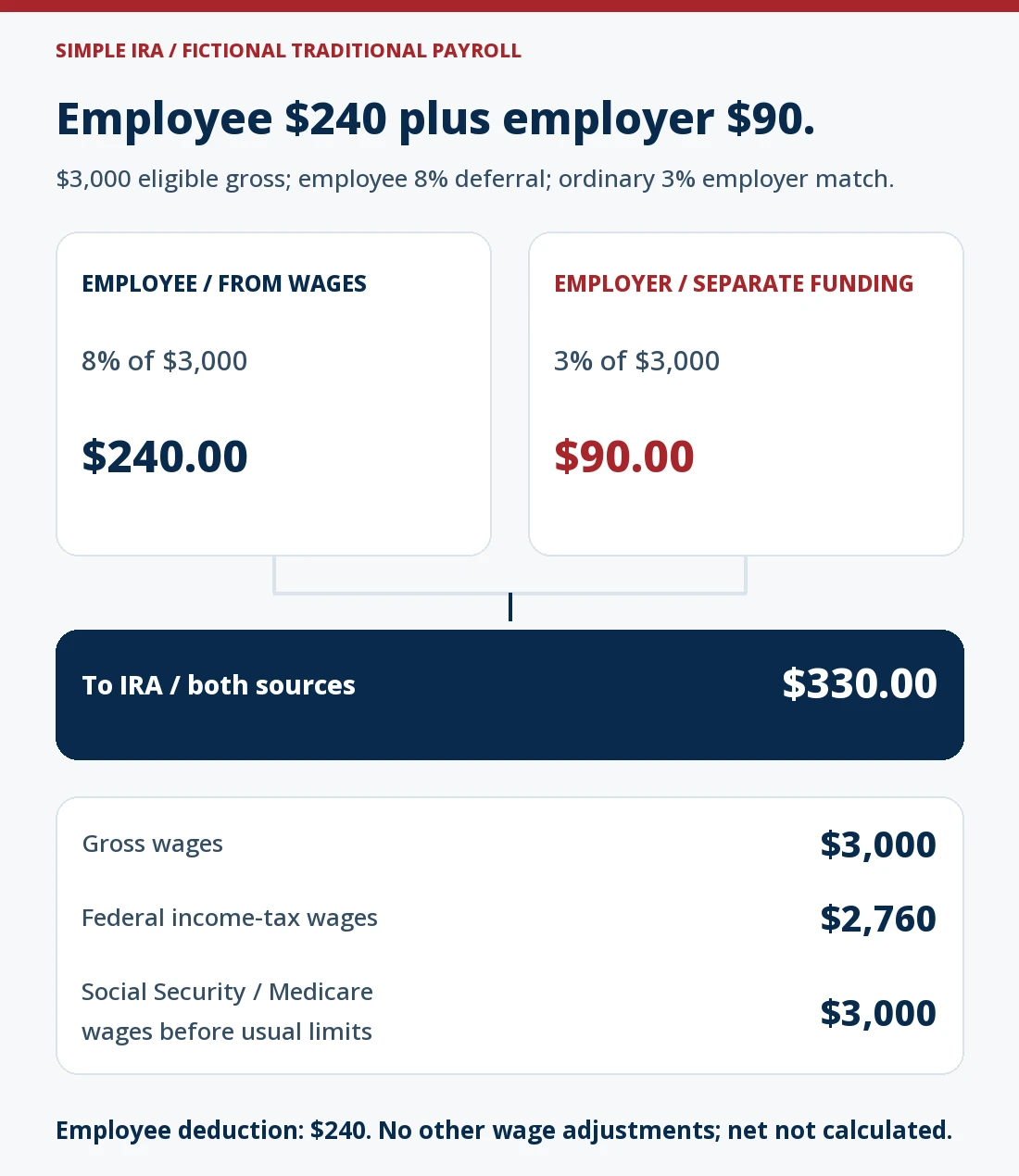
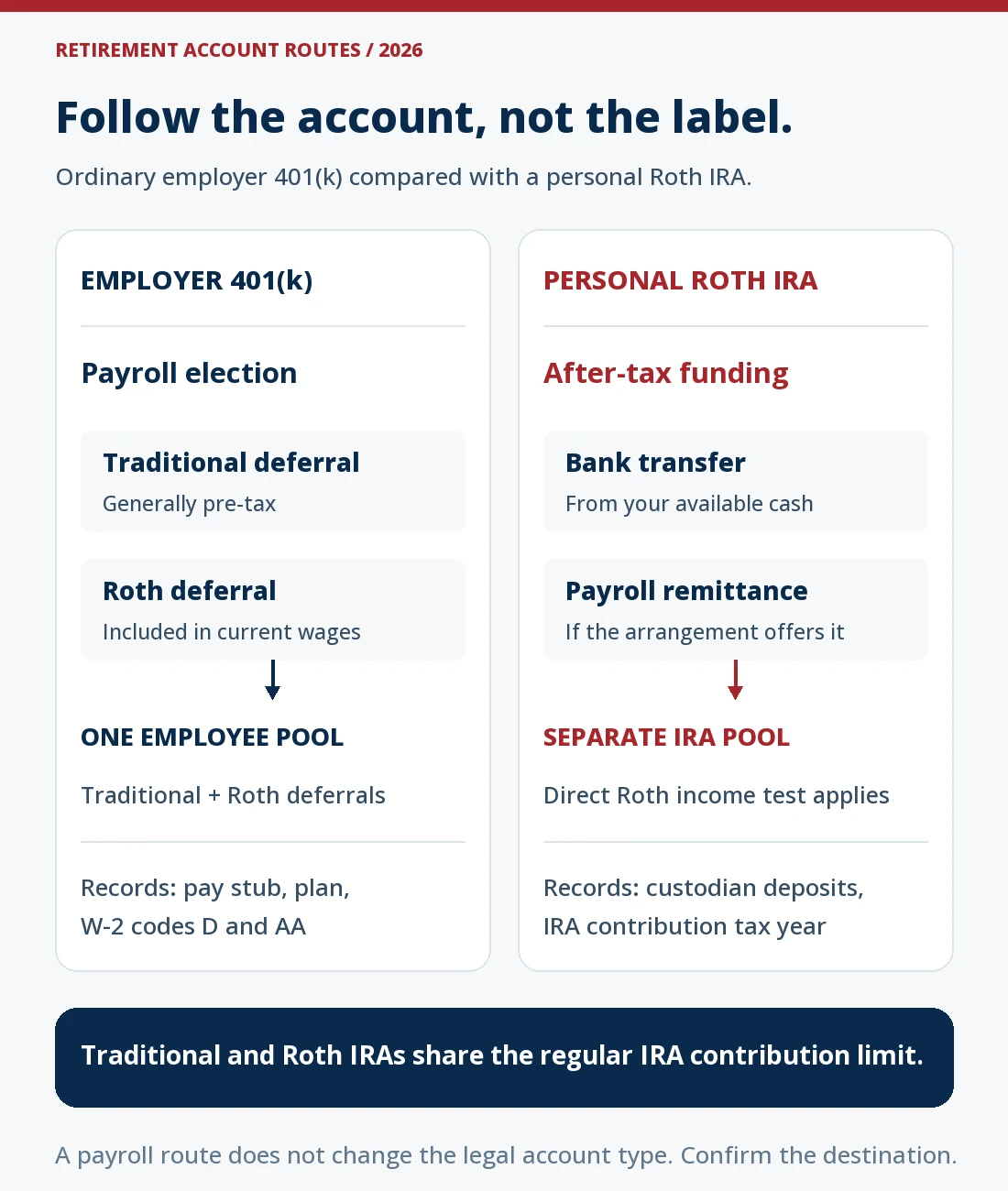
Separate employee deferrals from employer contributions, investment earnings, loan repayments and retirement distributions. Only the first category reduces this example's current cash wages by employee election. The loan-repayment guide explains why repaying an existing loan is not a new deductible retirement contribution.
Do these deductions reduce Social Security and Medicare wages?
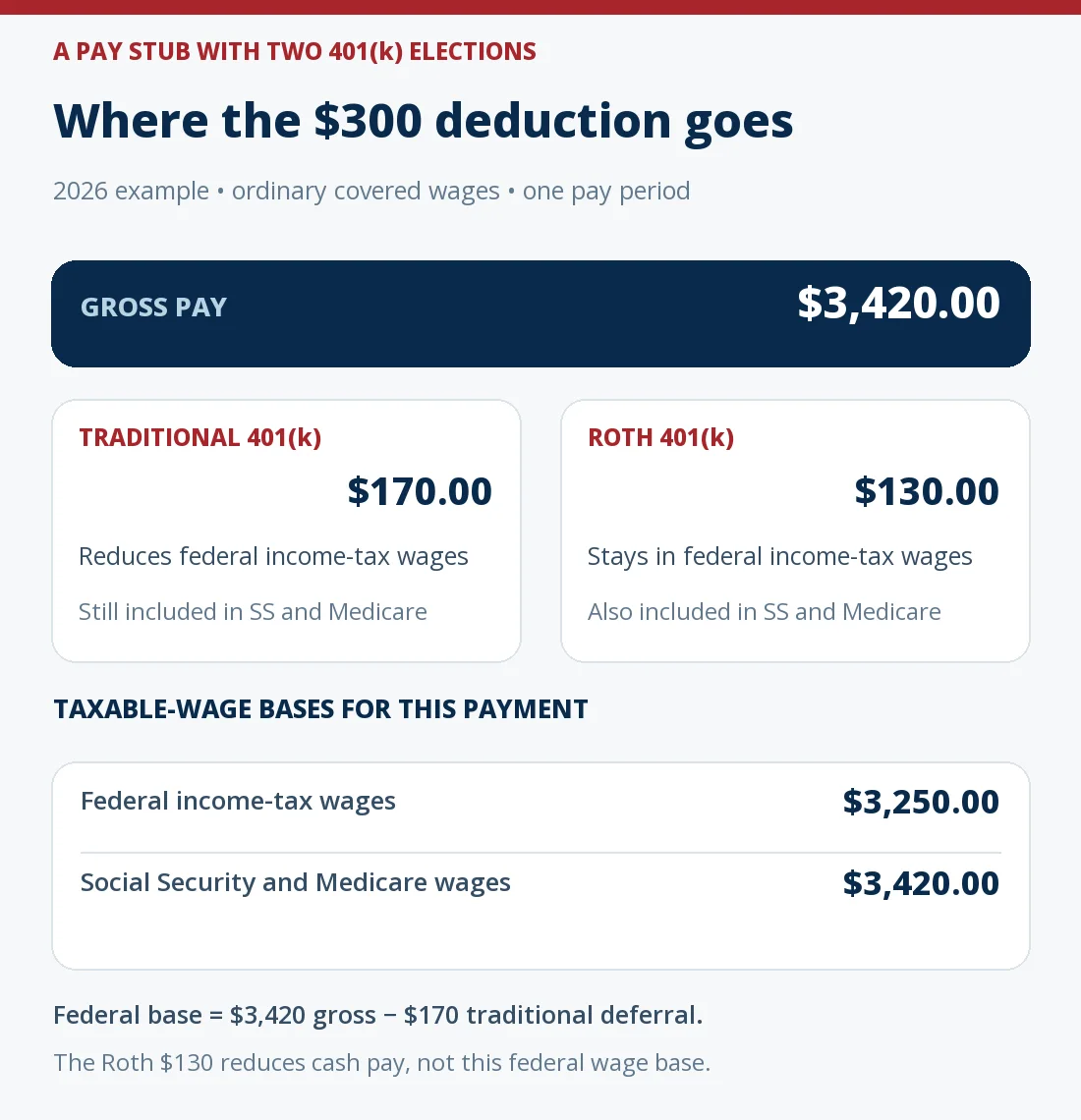
Ordinary salary deferrals generally remain in otherwise applicable FICA wages. The 2026 employer tax guide distinguishes income-tax exclusion from employment-tax treatment for retirement salary reductions. A traditional deferral can reduce income-tax wages while the employee's Social Security and Medicare wage bases remain unchanged.
Our gross versus taxable wages guide explains the separate bases. A designated Roth contribution has different income-tax treatment: it does not reduce current federal income-tax wages. “After tax” still does not mean the employer should calculate the contribution as a percentage of the net deposit; the valid plan election determines the amount or eligible compensation percentage. See our Roth payroll explanation for the basic distinction.
Public-employer Social Security coverage and specialized deferred-compensation timing can alter an actual case. A 457(b) deduction alone does not prove the worker has Social Security-covered employment. The example below explicitly assumes ordinary covered wages and currently vested salary deferrals; it should not be applied mechanically to a nongovernmental arrangement with forfeiture conditions.
How does a paycheck with both plans reconcile?
Use cash wages, each contribution and each tax base as separate ledger items. Assume one fictional 2026 paycheck has $4,000 cash wages, $300 traditional 403(b), $200 traditional governmental 457(b) and $100 designated Roth 403(b) deferrals. All elections are valid and within applicable limits. Assume no employer contribution on this check, other benefits, state/local tax or other deductions.
The traditional contributions total $500, making federal income-tax wages $3,500. The $100 Roth contribution does not reduce that base. Social Security and Medicare wages remain $4,000, assuming available Social Security wage-base capacity and no Additional Medicare withholding trigger.
Assume federal income tax withheld is $320; this is a given amount, not a withholding-table calculation. Social Security is $248 and Medicare is $58. The employee contributes $600 in total and has $626 withheld in federal taxes, leaving $2,774 cash: $4,000 − $600 − $626.
| Reconciliation item | Amount |
|---|---|
| Cash wages before deductions | $4,000.00 |
| Traditional 403(b) salary deferral | −$300.00 |
| Traditional governmental 457(b) deferral | −$200.00 |
| Designated Roth 403(b) contribution | −$100.00 |
| Given federal income tax | −$320.00 |
| Employee Social Security on $4,000 | −$248.00 |
| Employee Medicare on $4,000 | −$58.00 |
| Cash available after these deductions | $2,774.00 |

The $600 retirement total is not subtracted twice. It already includes the two traditional contributions and the Roth contribution. An employer's account deposit can also contain employer funding, but that does not establish an additional employee payroll deduction. Our net-pay guide explains the cash reconciliation.
Can someone contribute to a 403(b) and a governmental 457(b) in 2026?
Potentially yes, subject to each plan and compensation limit. The IRS 2026 retirement-limit announcement sets a $24,500 basic elective-deferral limit for the covered plan types. The IRS multiple-plan guidance explains which arrangements share a limit and why 457(b) uses a separate bucket. Its older year-specific examples are not the source for this article's 2026 dollar amounts.
For a fictional worker under age 50 with no special catch-up, suppose $18,000 has gone into 403(b) employee deferrals and $4,000 into another employer's ordinary 401(k). The shared bucket contains $22,000, leaving $2,500 against the $24,500 basic limit. Switching employers or choosing Roth for the next contribution does not reset that shared limit.
Separately, assume the worker's governmental 457(b) has $19,000 employee deferrals and $2,000 vested employer contributions counting toward its limit. That bucket contains $21,000 and leaves $3,500. These are remaining-limit illustrations, not a recommendation or permission to contribute more than compensation, plan elections or another applicable restriction allows.

Does a 403(b) employer contribution use up the employee's $24,500?
It normally belongs to a different annual-additions calculation. The IRS 403(b) limit explanation separates employee elective deferrals from combined annual additions. For 2026 the general annual-additions ceiling is the lesser of $72,000 or 100% of the relevant includible compensation, with additional rules and catch-up treatment.
Do not read $72,000 as permission for an ordinary employee to defer $72,000 from salary. Conversely, the 457(b) limit generally counts employee and employer deferrals together. Matching amounts, vesting and other plans can therefore affect the two arrangements differently. Ask the administrator to identify the exact limit being tested.
What about age 50, ages 60–63 and long-service catch-ups?
These are separate eligibility reviews. For 2026, an available age-based catch-up generally adds $8,000, or an enhanced $11,250 for a participant attaining age 60, 61, 62 or 63 during the year, if the applicable plan permits. The enhanced amount replaces the ordinary age-based catch-up; it is not added on top of it.
A qualifying 403(b) long-service rule can allow up to another $3,000, but requires the eligible employer, service history, prior contributions and plan permission; the formula can allow less or zero. A 457(b) special catch-up for the three years before plan normal retirement age has a different unused-deferral calculation. It cannot simply be stacked with that plan's age-based catch-up.
The IRS catch-up guidance also explains 2026 Roth requirements for affected higher-paid participants. Prior-year employer wages, the indexed threshold and the type of catch-up matter. A Roth-only requirement for a covered age-based catch-up does not automatically convert every regular or special catch-up deferral to Roth. Have the administrator verify the classification before changing payroll elections.
Which W-2 codes identify the contributions?
Use the actual plan and contribution type. The IRS code-error guidance warns against assigning one retirement code to unrelated plan types. The 2026 W-2 instructions supply the reporting rules.
| Contribution type | Code | Important distinction |
|---|---|---|
| Traditional 403(b) salary deferral | E | Different from a traditional 401(k) code. |
| Designated Roth 403(b) | BB | Remains in current income-tax wages. |
| Reportable 457(b) elective and nonelective deferrals | G | Can include employer amounts; forfeiture conditions matter. |
| Designated Roth governmental 457(b) | EE | Not a Roth option for a nongovernmental 457(b). |
A current pay-stub deduction and annual Box 12 total need not match without a year-to-date reconciliation. Nongovernmental 457(b) distributions and special FICA timing also need their own treatment; they are not the ordinary governmental payroll example used here. Retirement contributions do not become a second personal deduction simply because a pay stub and W-2 both show them.
What should you check before asking payroll for a correction?
- Identify both plans. Confirm 403(b), governmental or nongovernmental 457(b), and traditional versus Roth elections.
- Match current deductions to cash. Separate employee amounts from employer account funding.
- Reconcile wage bases. Check income-tax wages separately from Social Security and Medicare coverage.
- Combine annual records correctly. Include relevant former-employer deferrals and distinguish the shared bucket from the separate 457(b) limit.
- Ask the administrator about exceptions. Verify catch-ups, compensation, vesting and timely excess-contribution correction.
Use the YTD reconciliation guide and W-2 comparison guide to organize records. Generate Pay Stub can present supported payroll figures; it cannot establish plan eligibility, authorize excess contributions or replace the administrator's correction process.