An “after-tax 401(k)” deduction can mean a voluntary non-Roth employee contribution, or it can be an employer’s shorthand for a designated Roth deferral. Both come from pay already included in federal taxable wages. They are different plan sources, however, with different contribution-limit and distribution rules. The deduction name alone cannot tell you which account received the money.
This guide covers ordinary U.S. 401(k) payroll records and 2026 federal limits. The examples assume a participant under age 50; they do not cover SIMPLE 401(k) plans, catch-up eligibility or state tax differences. Use your plan’s source definitions, election confirmation and transaction history to identify your deduction.
What does after-tax 401(k) mean on a pay stub?
Ask whether the payroll code means designated Roth elective deferrals or voluntary non-Roth after-tax contributions. A label such as “401K AT” is an employer-specific abbreviation, not a standardized tax code. Even two employers using the same abbreviation may send the deduction to different sources.
The IRS explanation of designated Roth accounts describes Roth deferrals as elective contributions included in current income and separately accounted for by the plan. The word “after-tax” by itself does not establish that Roth designation.
| Source | Current federal payroll treatment | Contribution category |
|---|---|---|
| Traditional pre-tax deferral | Generally excluded from federal income-tax wages; still subject to applicable Social Security and Medicare taxes. | Elective deferral; counts toward the combined pre-tax/Roth deferral limit. |
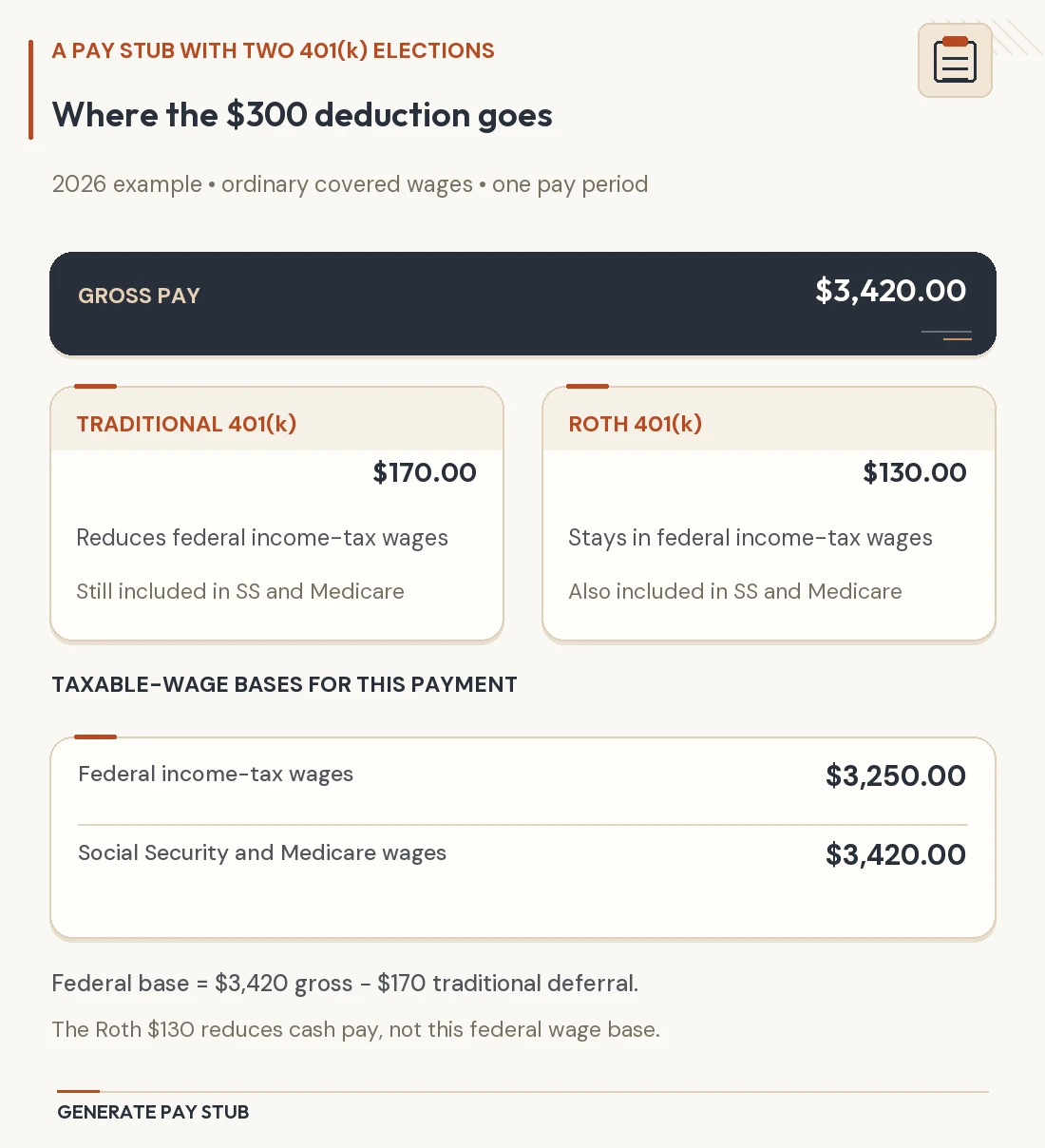
| Designated Roth deferral | Included in federal income-tax wages and applicable FICA wages. | Elective deferral; shares the same deferral limit with traditional deferrals. |
| Voluntary non-Roth after-tax contribution | Included in federal income-tax wages and applicable FICA wages. | Employee contribution outside the elective-deferral limit; included in annual additions. |
A retirement-plan loan repayment is another possible after-tax payroll deduction, but repaying a loan is not the same as making a fresh retirement contribution. See how 401(k) loan repayments appear on a stub. An IRA transfer or a Roth conversion also needs its own records; neither is established merely by an after-tax payroll label.
A worked paycheck: three deductions, two wage bases
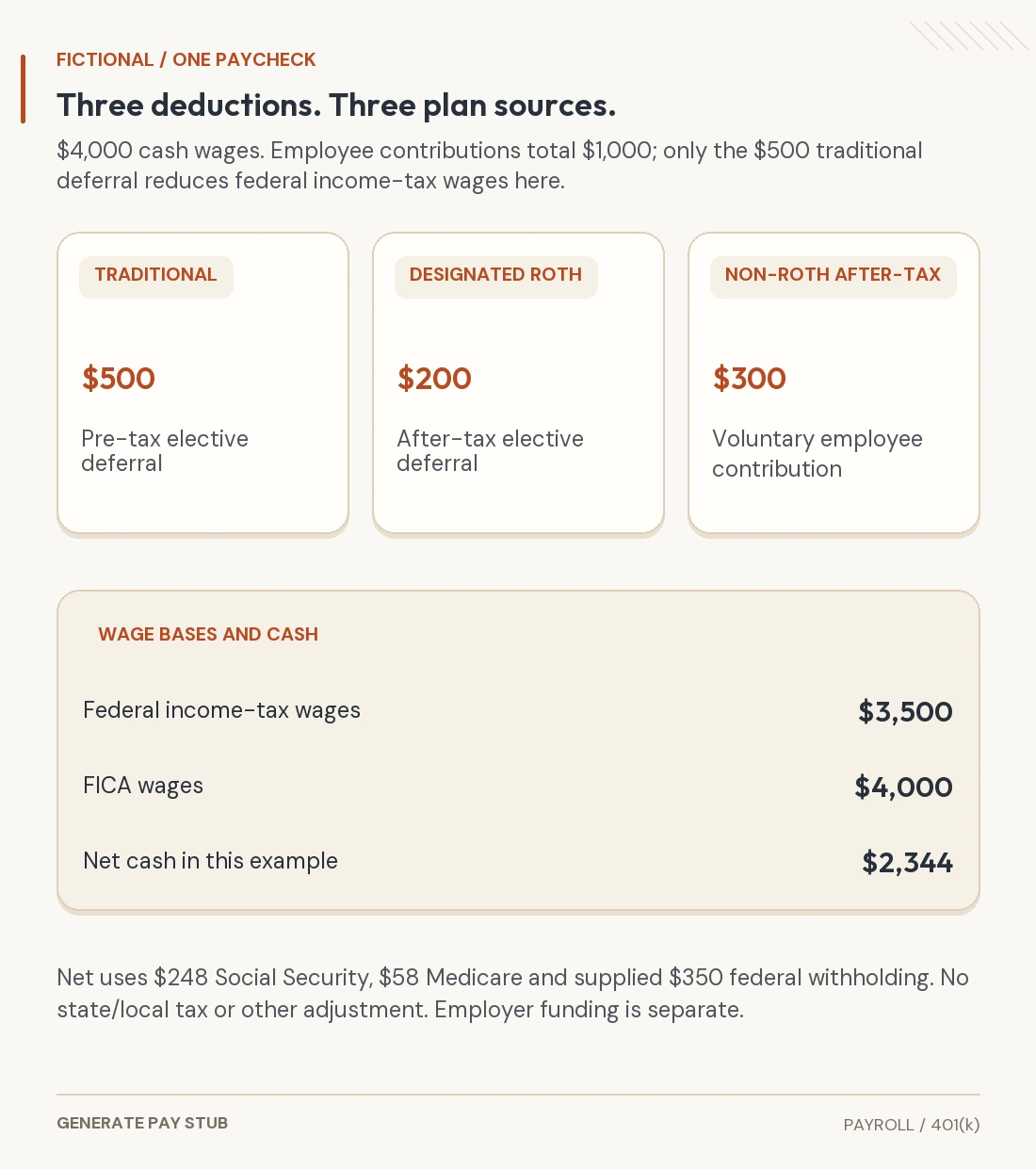
Assume $4,000 of ordinary cash wages, a $500 traditional deferral, a $200 designated Roth deferral and a $300 voluntary non-Roth contribution. There are no other benefits, earnings adjustments or deductions. The employee is below the applicable Social Security wage base and Additional Medicare withholding threshold.
Only the $500 traditional deferral reduces this example’s federal income-tax wages: $4,000 − $500 = $3,500. Social Security and Medicare wages remain $4,000. Publication 15’s 2026 payroll-tax guidance explains the FICA treatment of ordinary 401(k) deferrals and the 6.2% employee Social Security and 1.45% Medicare rates used here.

| Paycheck item | Amount |
|---|---|
| Gross cash wages | $4,000.00 |
| Traditional 401(k) deferral | −$500.00 |
| Designated Roth 401(k) deferral | −$200.00 |
| Voluntary non-Roth after-tax contribution | −$300.00 |
| Social Security: $4,000 × 6.2% | −$248.00 |
| Medicare: $4,000 × 1.45% | −$58.00 |
| Federal income tax withheld: supplied assumption | −$350.00 |
| Net cash; no other deductions in this illustration | $2,344.00 |
The $350 federal withholding is an assumed payroll result, not a flat tax rate calculated from these facts. Actual withholding requires the applicable Form W-4 and payroll method; state/local taxes and other deductions could change the deposit. Employee contributions total $1,000, while only $700 is elective deferrals ($500 + $200).
Any employer match belongs in a separate employer-funded category. It does not reduce the employee’s $2,344 deposit in this example. Whether an after-tax contribution earns a match depends on the plan. Our employer match guide explains why the payroll deduction and employer funding need separate checks.
The 2026 after-tax 401(k) limit is not a separate $72,000 allowance
Two calculations matter. For an ordinary 401(k), the IRS 2026 contribution-limit page lists a $24,500 employee elective-deferral limit and an annual-additions ceiling of the lesser of $72,000 or 100% of applicable compensation. Traditional and designated Roth deferrals share the first limit; that is not $24,500 for each.
Voluntary non-Roth after-tax contributions enter the second calculation along with relevant employee deferrals, employer contributions and allocated forfeitures. The IRS’s annual-additions explanation identifies these sources and the importance of the plan’s limitation year. Its historical dollar examples should not be substituted for the 2026 amounts above.
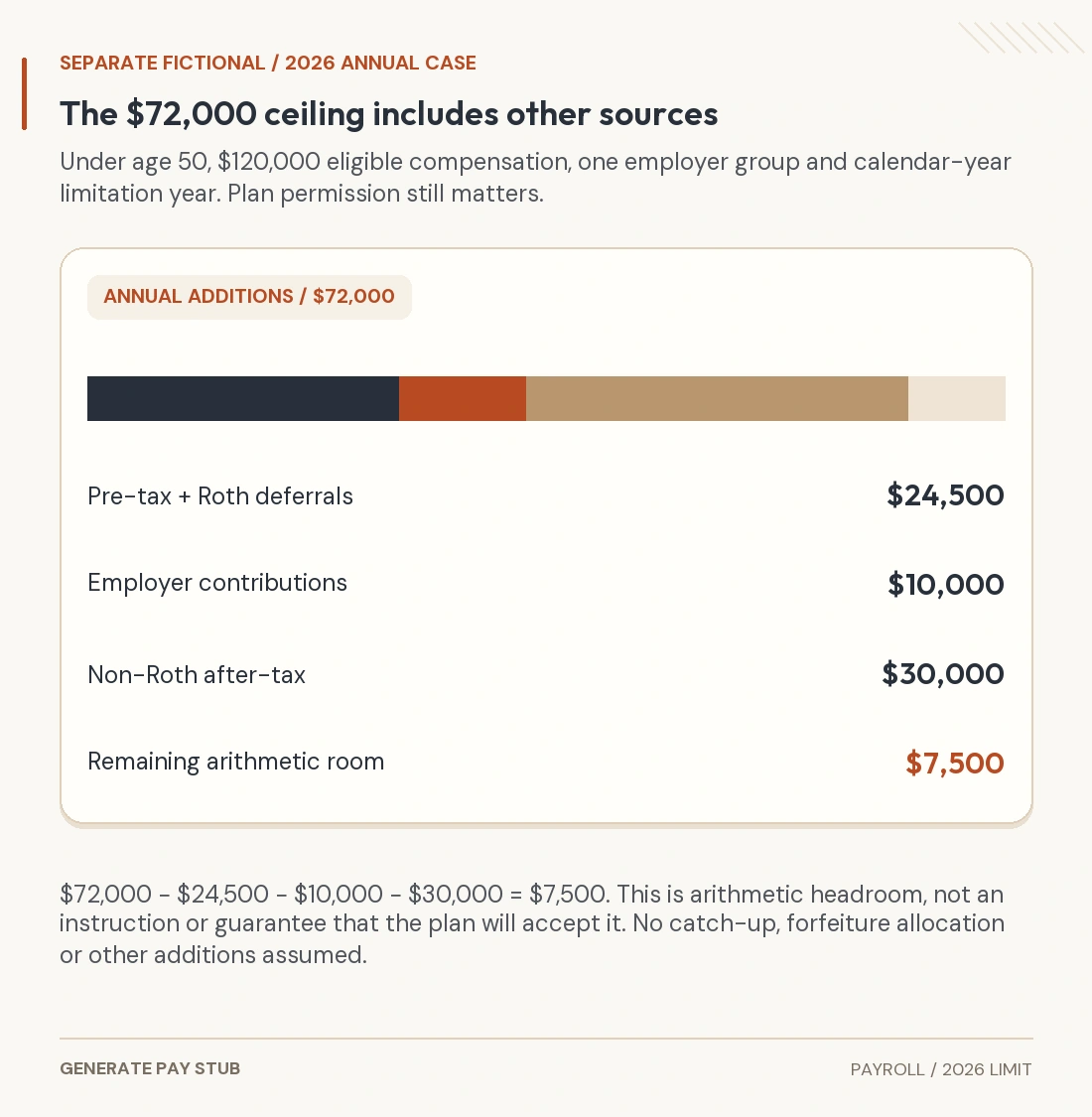
Here is a separate annual illustration, not an annualized version of the earlier paycheck: a participant under 50 has $120,000 in eligible compensation, one employer group and a calendar-year limitation year. Assume no catch-up amounts, forfeiture allocations or other additions.
| Contribution source or comparison | Amount |
|---|---|
| Traditional elective deferrals | $18,000 |
| Designated Roth elective deferrals | $6,500 |
| Combined elective deferrals: $18,000 + $6,500 | $24,500 |
| Employer contributions | $10,000 |
| Voluntary non-Roth after-tax contributions | $30,000 |
| Annual additions: $24,500 + $10,000 + $30,000 | $64,500 |
| Applicable annual-additions ceiling in this case | $72,000 |
| Remaining arithmetic room: $72,000 − $64,500 | $7,500 |

Before the $30,000 voluntary contribution, the arithmetic room was $37,500: $72,000 − $24,500 − $10,000. After it, $7,500 remains. Neither figure is permission to contribute. The plan must offer this source and may impose percentage limits, compensation definitions, contribution cutoffs or a lower available amount.
After-tax employee contributions can also be limited by nondiscrimination testing. The IRS discussion of ADP and ACP tests distinguishes elective-deferral testing from the matching/after-tax contribution calculation. Ask the administrator about your plan’s testing restrictions before treating the arithmetic ceiling as usable room.
Changing jobs adds another reconciliation: elective deferrals generally must be monitored across relevant plans, while annual-additions aggregation depends on employer relationships and other rules. Do not assume each new payroll resets every limit. See excess 401(k) contributions when changing jobs and the separate catch-up contribution guide for cases outside these under-50 examples.
Where should non-Roth after-tax contributions appear on Form W-2?
For 2026 Form W-2, traditional 401(k) elective deferrals ordinarily use box 12 code D, and designated Roth 401(k) contributions use code AA. Voluntary non-Roth after-tax contributions are not reported in box 12; employers may report them in box 14a. The IRS makes that extra reporting optional in its 2026 W-2 and W-3 instructions.
Therefore, the absence of a voluntary contribution from box 14a does not by itself mean payroll lost the money. Compare the deduction’s year-to-date total with the plan’s contribution-source history. A stub shows amounts withheld; the retirement account should show where and when the plan credited them. A timing difference requires the payroll and posting dates, not a guess based on one screen.
Use annual totals when reconciling the W-2. The $500, $200 and $300 amounts in our first example are for one paycheck, not annual reporting instructions. Keep the original deduction elections and year-end source totals, including any correction statements, rather than reclassifying a line yourself.
After-tax contributions do not make all future earnings tax-free
A voluntary non-Roth contribution creates after-tax investment in the plan, often called basis. Earnings associated with that contribution are generally pre-tax amounts. That differs from designated Roth money, whose qualified distributions can include tax-free earnings when the applicable requirements are met. See our Roth 401(k) payroll guide for that source.
The IRS’s after-tax rollover guidance explains that distributions generally contain proportional pre-tax and after-tax amounts and describes allocating an eligible distribution among destinations. It does not mean every employee can withdraw at any time or take only basis while leaving all pre-tax amounts behind.
A “mega backdoor Roth” strategy therefore requires more than seeing “after-tax” on the stub. Available distributions or conversions, plan accounting and the receiving account’s rules must be checked separately. A payroll deduction does not itself execute a Roth conversion. Retain the plan’s basis and distribution documents; a self-prepared earnings statement cannot replace them.
How to resolve a deduction you cannot identify
- Collect the actual evidence. Save the pay date, deduction code, current and year-to-date amounts, election confirmation and matching plan transaction. Share sensitive records through the employer’s approved channel.
- Ask payroll to name the source. Request an explicit answer: traditional elective, designated Roth elective, voluntary non-Roth after-tax, or loan repayment. Ask when the amount was transmitted.
- Ask the administrator what arrived. Confirm the contribution source, credited amount, available voluntary contribution feature and remaining permitted room.
- Reconcile the tax record. Check current wage bases and annual W-2/source totals. If a source or amount is wrong, request the employer’s or administrator’s correction process.
- Keep the correction trail. A revised payroll statement, corrected tax document or plan notice serves a different purpose. Do not edit a stub to make an unsupported contribution appear valid.
Short answers about after-tax 401(k) deductions
Can a non-Roth after-tax contribution lower my federal taxable pay?
No current federal wage exclusion arises merely because an employee contributes from after-tax pay. In the worked example, only the traditional deferral reduces federal income-tax wages.
Does the Roth contribution use the voluntary after-tax room instead?
A designated Roth deferral remains an elective deferral. Do not move it outside the combined deferral limit because both types are funded after tax.
Is an after-tax plan deduction proof that I made an IRA contribution?
No. A workplace contribution and an IRA contribution are different transactions. A later rollover also requires its own documentation and should not be inferred from the payroll code.
What is the best first question to ask?
“Which exact plan contribution source receives this deduction?” Once payroll and the administrator agree on that answer, compare the wage treatment, relevant limit and annual records. Recheck dollar limits for the applicable year rather than carrying the 2026 figures into a later year.