A SIMPLE IRA deduction on your pay stub usually represents money you elected to contribute from salary to a workplace retirement account. It is separate from the employer’s matching or nonelective contribution. Traditional and Roth SIMPLE contributions can affect taxable wages differently, and a payroll deduction is not proof that the money has reached the IRA.
This U.S. guide was reviewed October 26, 2026 and uses 2026 contribution limits. It covers employee payroll records for SIMPLE IRA plans, rather than treating a SIMPLE IRA, SIMPLE 401(k) and ordinary personal IRA as the same arrangement. Examples are fictional and assume eligibility, sufficient compensation and the stated plan contribution formula.
What is a SIMPLE IRA contribution on a pay stub?
Separate the employee salary reduction from the employer contribution. SIMPLE stands for Savings Incentive Match Plan for Employees. In a SIMPLE IRA arrangement, salary-reduction contributions are amounts directed to the account instead of current cash wages. The employer separately provides the applicable matching or nonelective contribution.
The IRS SIMPLE IRA plan overview explains plan eligibility and funding. Generally, eligible employees include those with at least $5,000 of compensation in any two preceding calendar years who are expected to earn at least $5,000 in the current year; a plan may use less restrictive conditions, and specific exclusions apply. Obtain the actual plan notice rather than deciding eligibility from the presence or absence of a payroll code.
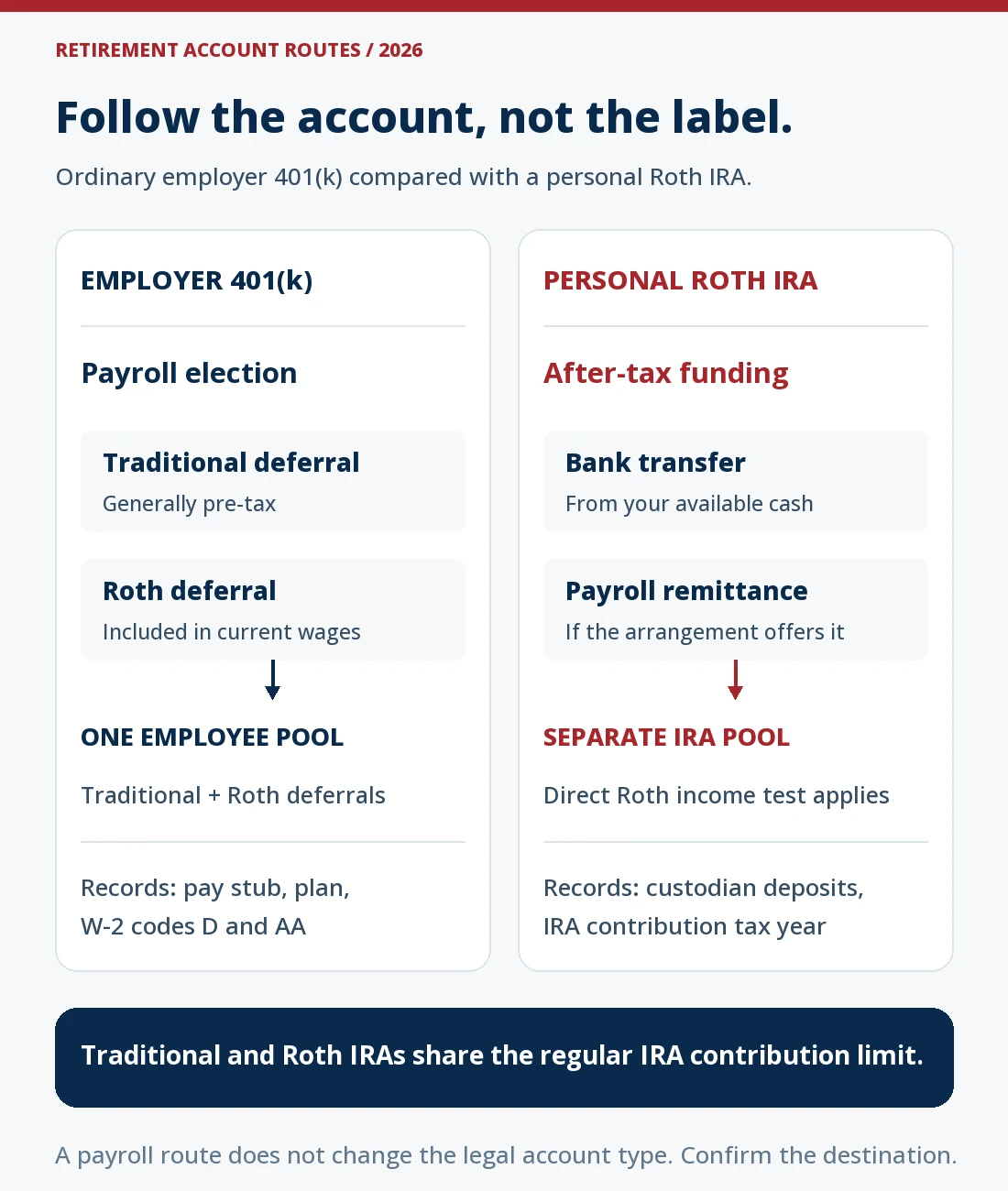
A statement may show an employee deduction labeled SIMPLE, SIMPLE IRA or retirement, plus a separate informational employer amount. Confirm whether the employee election is traditional or Roth, whether it is a percentage or fixed dollar amount, when it takes effect, and which financial institution holds the account. A payroll deduction sent to an ordinary personal IRA can be a different arrangement with different limits.
Does a traditional SIMPLE IRA deduction reduce Social Security and Medicare wages?
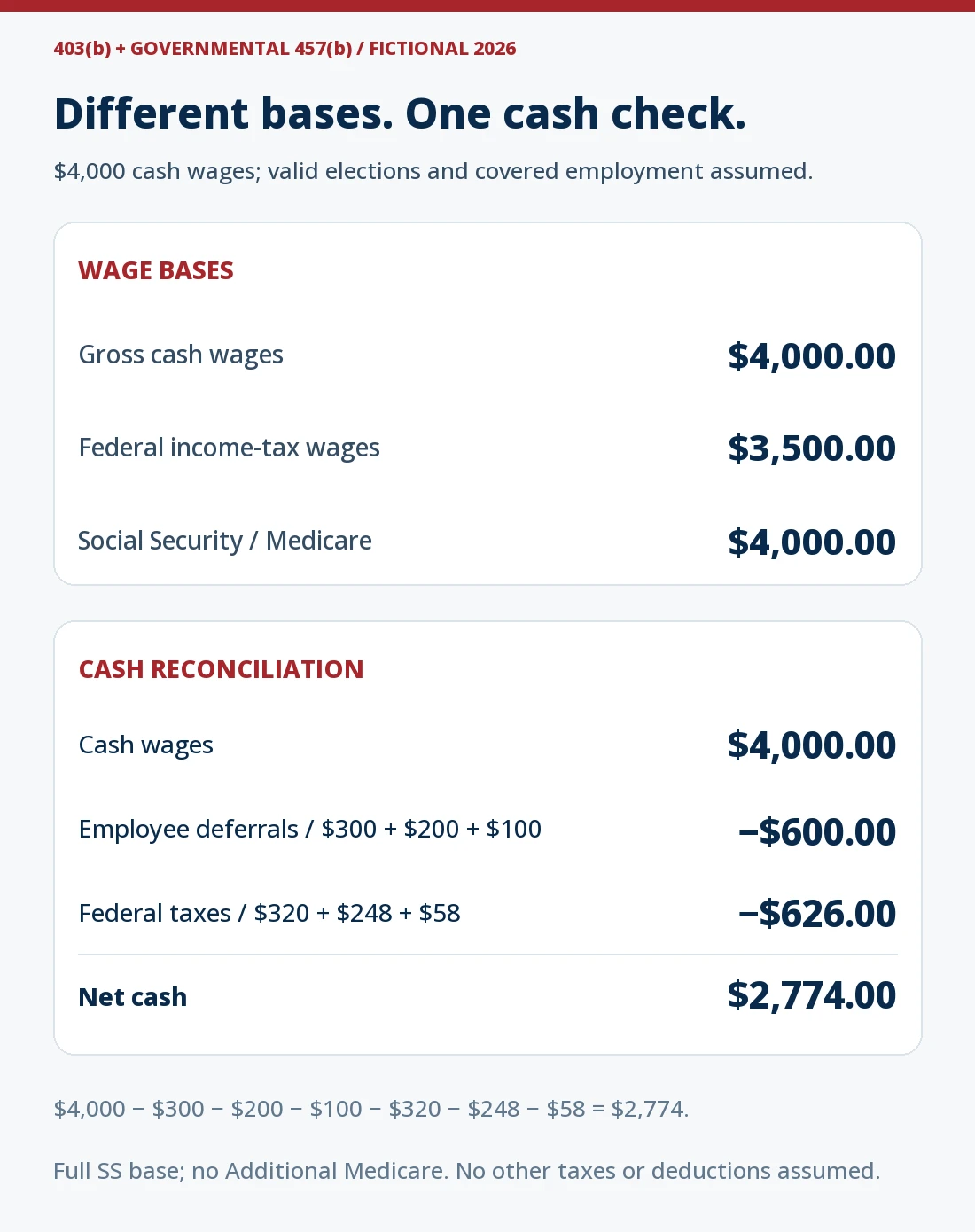
Generally, no. Traditional employee salary reductions reduce federal income-tax wages but remain subject to Social Security and Medicare. The retirement contribution is not a universal reduction of every payroll wage base. IRS Publication 560, currently the 2025 edition with 2026 updates, describes traditional and Roth SIMPLE taxation and reporting. State treatment should be checked separately.
For a fictional monthly paycheck, assume $3,000 of eligible gross wages and an 8% employee contribution: $3,000 × 8% = $240. There are no other wage-base adjustments, and this payment fits within the employee’s available Social Security wage base. With a traditional contribution, federal income-tax wages are $2,760 while Social Security and Medicare wages remain $3,000, subject to the usual applicable limits and rules.
If the plan offers a Roth SIMPLE option and the employee validly elects it, the same $240 employee contribution does not reduce federal income-tax wages. In this otherwise identical example, the three wage bases remain $3,000. The actual change in take-home pay depends on the resulting withholding; it is not correct to assume a $240 contribution always reduces cash by precisely $240 after taxes.
| Field | Traditional SIMPLE | Roth SIMPLE |
|---|---|---|
| Gross wages | $3,000.00 | $3,000.00 |
| Employee contribution, 8% | $240.00 | $240.00 |
| Federal income-tax wages | $2,760.00 | $3,000.00 |
| Social Security wages | $3,000.00 | $3,000.00 |
| Medicare wages | $3,000.00 | $3,000.00 |

The first visual uses the traditional example only. It assumes ordinary pre-tax employer funding, not an employer Roth election. Our deduction-tax treatment guide explains the separate wage bases, while the net-pay guide explains the final cash calculation.
How much can an employee contribute to a SIMPLE IRA in 2026?
The ordinary 2026 salary-reduction limit is $17,000; certain qualifying plans use $18,100. The applicable catch-up amount also depends on age and the plan’s increased-limit status. IRS Notice 2025-67 supplies the 2026 amounts, including the $4,000 ordinary SIMPLE catch-up, the $3,850 catch-up for certain increased-limit plans, and the $5,250 age-60-through-63 catch-up.
| Age attained during 2026 | Ordinary plan total | Qualifying increased-limit plan total |
|---|---|---|
| Under 50 | $17,000 | $18,100 |
| 50–59 | $21,000 | $21,950 |
| 60–63 | $22,250 | $23,350 |
| 64 or older | $21,000 | $21,950 |
The permitted deferral also cannot exceed eligible compensation. The totals add one applicable catch-up to the relevant basic limit. The age-60-through-63 amount replaces the ordinary catch-up; it is not an additional $5,250 on top of another catch-up. The increased-limit plan’s ordinary $3,850 catch-up is intentionally different from $4,000 in 2026. Do not “correct” it by assuming every enhanced amount must be 110% of this year’s ordinary figure.
Notice 2024-2, section E, explains increased-limit eligibility, including qualifying small employers and the election for certain employers with 26–100 employees tied to a 4% match or 3% nonelective contribution. The test also considers covered retirement plans maintained for substantially the same employees in the three taxable years before the first SIMPLE plan year. Employee-count and related-employer rules, grace periods and notices matter. Obtain confirmation of the plan’s status before using the higher column; your current department headcount is not the complete legal test.
Traditional and Roth salary reductions share the employee’s applicable limit. Employer funding is separate. Participation in another employer’s plan can also require coordinating the overall elective-deferral limit; the IRS SIMPLE contribution-limit page identifies the $24,500 overall limit for 2026, with applicable catch-up rules considered separately. A new job does not automatically restart annual limits.
The high-earner Roth catch-up requirement discussed for some other workplace plans should not be imported automatically into a SIMPLE IRA: the notice’s specified rule excludes section 408(p) arrangements. Check the actual SIMPLE provision and plan elections. Nor should an employee enter a payroll SIMPLE contribution as a second ordinary deductible IRA contribution just because both accounts have IRA in their names.
Is the employer contribution always a 3% match?
No. Confirm the formula in the applicable annual notice. The usual alternatives are a dollar-for-dollar match up to 3% of compensation or a 2% nonelective contribution for eligible employees, including those who make no salary reduction. For the 2% method, the 2026 compensation cap is $360,000. The standard 3% match does not use that compensation cap in the same way.
The ordinary match can be reduced within specific rules, including a minimum 1% and limits on the number of reduced-match years, with required notice. Increased-limit elections for certain larger eligible employers can require the enhanced formula described above. Additional nonelective funding is also possible under separate provisions; do not assume every employer amount has the same percentage or counts against the employee’s deferral ceiling.
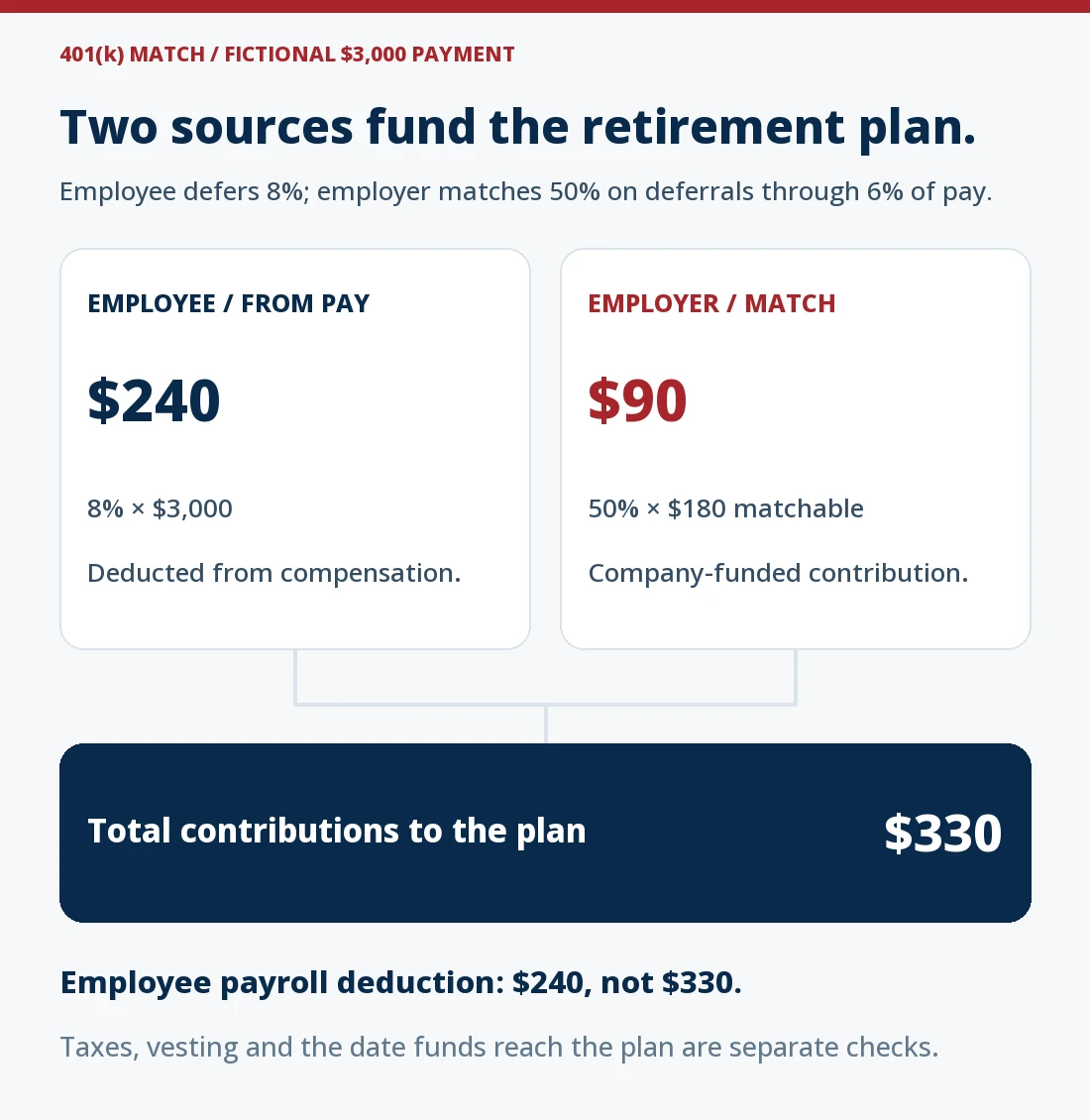
The IRS SIMPLE IRA FAQs explain matching, nonelective contributions and compensation. Under the first example’s assumed 3% formula, the $240 employee contribution supports a $90 employer match for that $3,000 payment. The account receives $330 total from the two sources. Under a separate standard 2% nonelective formula, employer funding on $3,000 would be $60 instead, including for an eligible employee contributing zero.
SIMPLE IRA contributions are immediately fully vested. That means ownership is not subject to a multi-year employer vesting schedule. It does not mean every withdrawal is tax-free or penalty-free. Rollovers and distributions have separate IRA rules, including special restrictions during the first two years; do not treat a payroll election change as permission for an unrestricted account withdrawal.
Why should you review the employer match using annual compensation?
A per-paycheck employer line may not show the complete annual obligation. Assume a different fictional employee is eligible for the full year, earns $36,000 across twelve equal monthly payments and has a standard 3% annual matching formula. Three percent of annual compensation is $1,080.
If that employee contributes 8% all year, employee deferrals total $2,880 and the employer match is $1,080. If instead the employee contributes only $1,000 in total during two final paychecks, the annual dollar-for-dollar match is $1,000, since it is below $1,080. It is not automatically limited to $90 on each of those two paychecks.
| Employee annual deferral | 3% annual compensation | Required annual match |
|---|---|---|
| $2,880.00 | $1,080.00 | $1,080.00 |
| $1,000.00 | $1,080.00 | $1,000.00 |
| $0.00 | $1,080.00 | $0.00 |

If only $180 of employer match was funded on those two checks, another $820 would complete the assumed $1,000 annual match. That balance is not necessarily late on the paycheck date: employer contribution deadlines differ from employee-deferral deposit rules. The annual examples exclude reduced-match elections, enhanced formulas and eligibility changes.
Under the alternative standard 2% nonelective formula, employer funding for this assumed $36,000 eligible annual compensation would be $720, whether the employee contributed $2,880, $1,000 or nothing. Our employer 401(k) match guide covers a different plan type; do not use a 401(k)’s plan-specific vesting or matching terms to replace SIMPLE rules.
When must payroll deductions reach the SIMPLE IRA?
Check the IRA transaction history as well as the paycheck. The IRS limit page describes the statutory employee-contribution deadline of thirty days after the month in which the employee would have received the money in cash. For arrangements subject to Department of Labor rules, an earlier deposit obligation generally applies: funds should be transferred as soon as they can reasonably be segregated from the employer’s assets.
The DOL SIMPLE IRA guide explains that a plan covering fewer than 100 participants can use the safe harbor by depositing withheld deferrals within seven business days. A safe harbor is not a statement that every plan has exactly seven days or that an employer may always hold money for the full statutory month-based period. Employer matching and nonelective contributions generally are due by the business’s federal return deadline, including an applicable extension.
A deduction date, transfer initiation date, account posting date and investment transaction date can differ. Ask payroll for the remittance detail and the institution for the account entry if the amounts do not reconcile. Also check whether the employer contribution is being calculated and displayed now but funded later within the applicable deadline.
How do the pay stub, W-2 and IRA statements fit together?
Use each record for its purpose without adding the same contribution twice. Employee salary reductions belong in payroll records and relevant W-2 reporting; the financial institution’s records confirm actual contributions. Traditional salary reductions generally reduce W-2 box 1 wages, remain in applicable Social Security and Medicare wages, and are identified with code S.
Roth salary reductions remain taxable wages. Employer matching and nonelective contributions made to a Roth SIMPLE IRA have separate reporting: the IRS SECURE 2.0 reporting explanation describes Form 1099-R reporting for the year those contributions are made. They should not simply be copied into the employee’s ordinary wage deduction. A Roth designation does not eliminate the associated income-tax consequence.
Form 5498 and the IRA contribution history may reflect the year deposits were actually received, while payroll tracks the compensation and deferral year. Ask about the contribution’s designated year and deposit date before deciding that a total is an excess contribution. Our YTD guide and W-2 reconciliation guide help compare cumulative payroll figures without double counting.
What should you do if a SIMPLE IRA deduction looks wrong?
- Confirm the plan and election. Identify traditional or Roth treatment, eligible compensation, the selected percentage or dollars, and the effective date.
- Recalculate the current deduction. Apply the election to the proper compensation; distinguish employee and employer money.
- Check annual limits and other jobs. Use the correct 2026 plan category, age and YTD employee contributions.
- Reconcile the employer formula annually. Verify annual compensation, employee deferrals and employer amounts already funded.
- Trace the deposits and reporting. Compare payroll, the financial institution’s transactions and annual forms; request the proper correction procedure for a missed or excess amount.
Do not try to fix an apparent payroll contribution error by making an unrelated personal IRA deposit or changing a statement’s wage figures. Keep the election, annual notice, pay stubs and account entries. The pay-stub correction guide helps organize discrepancies. Generate Pay Stub can display verified payroll amounts, but it cannot establish a retirement plan, transmit contributions or resolve an excess contribution through a document edit.