Whether a business owner should receive a pay stub depends on the owner’s relationship to the business and its tax classification. A sole proprietor’s withdrawal is different from a working corporate officer’s wages. “LLC” describes a legal entity, but does not by itself tell you which federal owner-pay rules apply.
This U.S. guide reviews the federal classification framework available in November 2026. It helps you choose the right payroll or owner-payment record; it does not recommend an entity, approve a tax election or calculate a reasonable salary for your business. State employment, tax and entity-law requirements still need their own review.
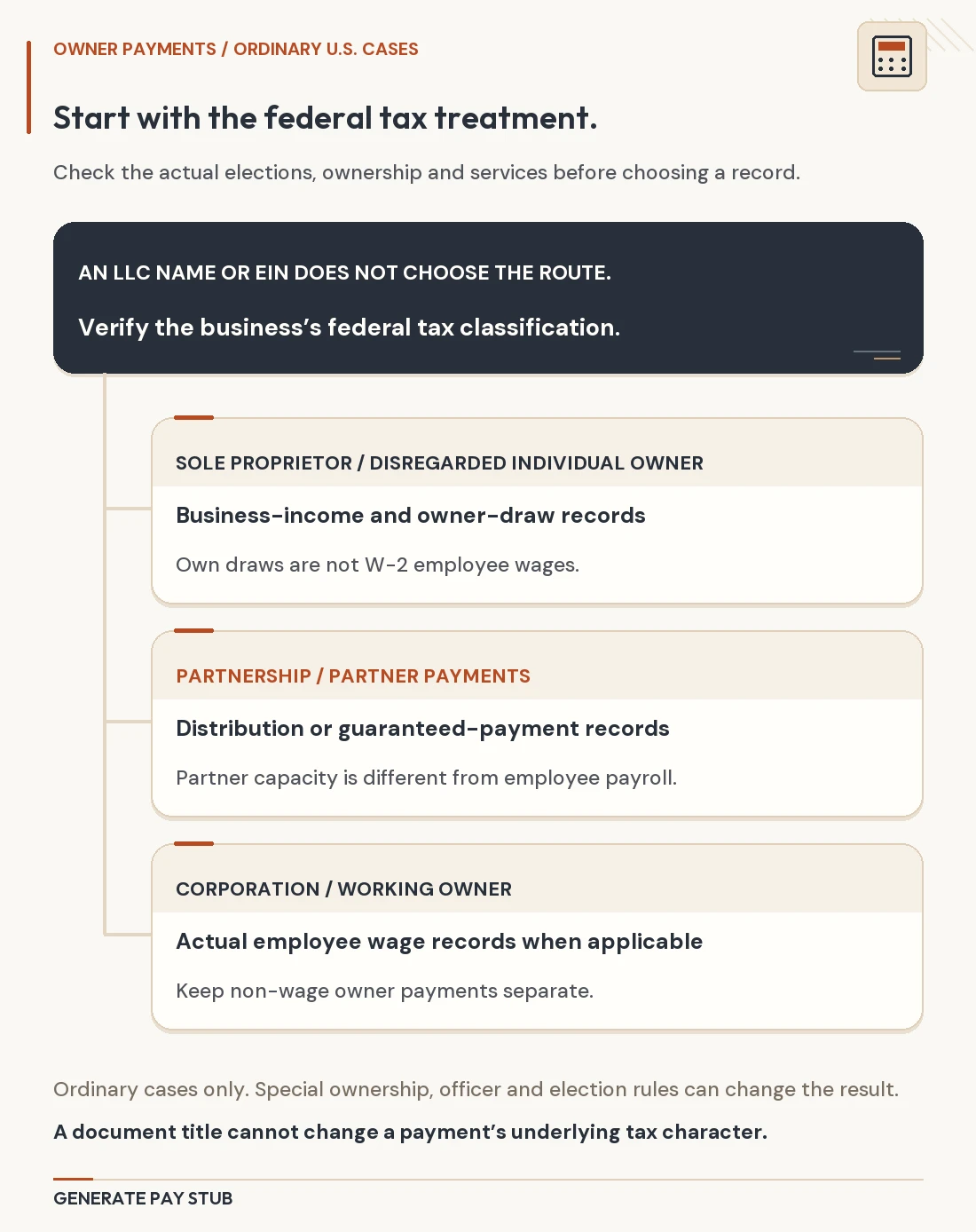
Start with tax classification, not just the business name
The IRS business-structure overview lists common ways businesses are organized. For payroll, identify both the legal entity and the federal tax treatment in effect for the payment period. A bank account ending in “LLC” or an EIN confirmation does not establish that an S corporation election is effective.
The IRS LLC guidance explains that member count and elections affect federal classification. For the ordinary domestic cases covered here, a single-member LLC can be disregarded for income tax, while a multi-member LLC defaults to partnership treatment unless corporate treatment is elected. Exceptions and special ownership arrangements need separate analysis.
An eligible LLC can also elect S corporation treatment. Publication 3402 explains that an eligible LLC filing Form 2553 for S corporation treatment generally does not first need a separate Form 8832 corporate election. Keep the actual election and effective-date records; do not infer tax status from software settings.
Which owner payments normally belong in payroll?
| Business treatment | Owner’s payment record | Payroll implication |
|---|---|---|
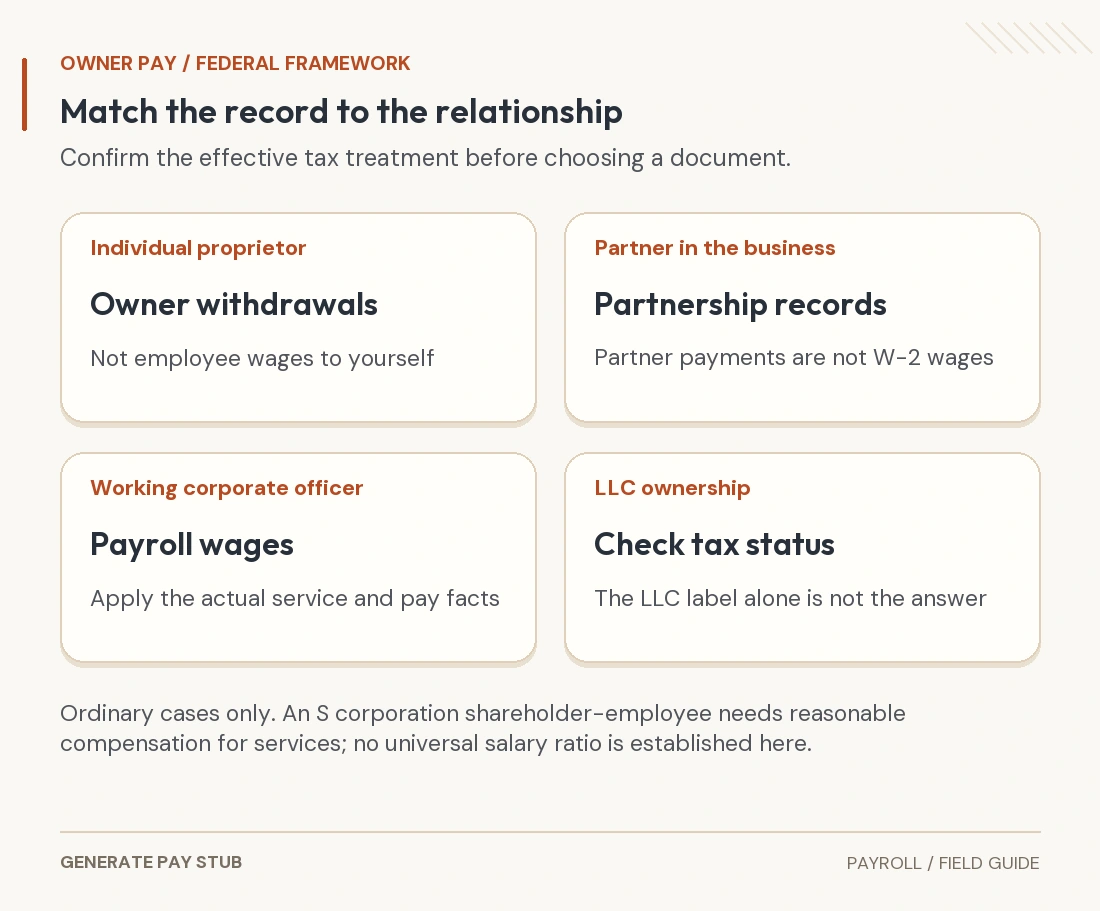
| Sole proprietorship | Draw or withdrawal tracked in the owner’s records | The proprietor is not their own employee |
| Single-member LLC, disregarded; individual owner | Owner withdrawal and business-income records | Do not assume the owner becomes an employee because the LLC has an EIN |
| Partnership or LLC taxed as a partnership | Partner distribution, guaranteed-payment and capital records as applicable | Partners are not employees of that partnership for federal tax purposes |
| S corporation with a working shareholder-employee | Payroll wage records, with separate records for actual non-wage distributions | Apply reasonable-compensation rules to services |
| C corporation with a compensated working officer | Wage records for employment; separate records for genuine ownership transactions | Ownership does not eliminate employee payroll treatment |

Sole proprietors: a withdrawal is not a salary paid to yourself
IRS Publication 334 explains that a sole proprietor is not an employee of their own business. Moving money from the business account to a personal account does not turn that transfer into payroll wages. Keep the withdrawal identifiable in your books and keep business receipts and expenses supported separately.
For an individual owner of a disregarded single-member LLC, the IRS single-member LLC guide describes the income-tax treatment and the separate employment-tax identity used when the LLC has employees. That distinction is easy to miss: the LLC can have real employee payroll without treating its individual owner as a W-2 employee merely because it is an LLC.
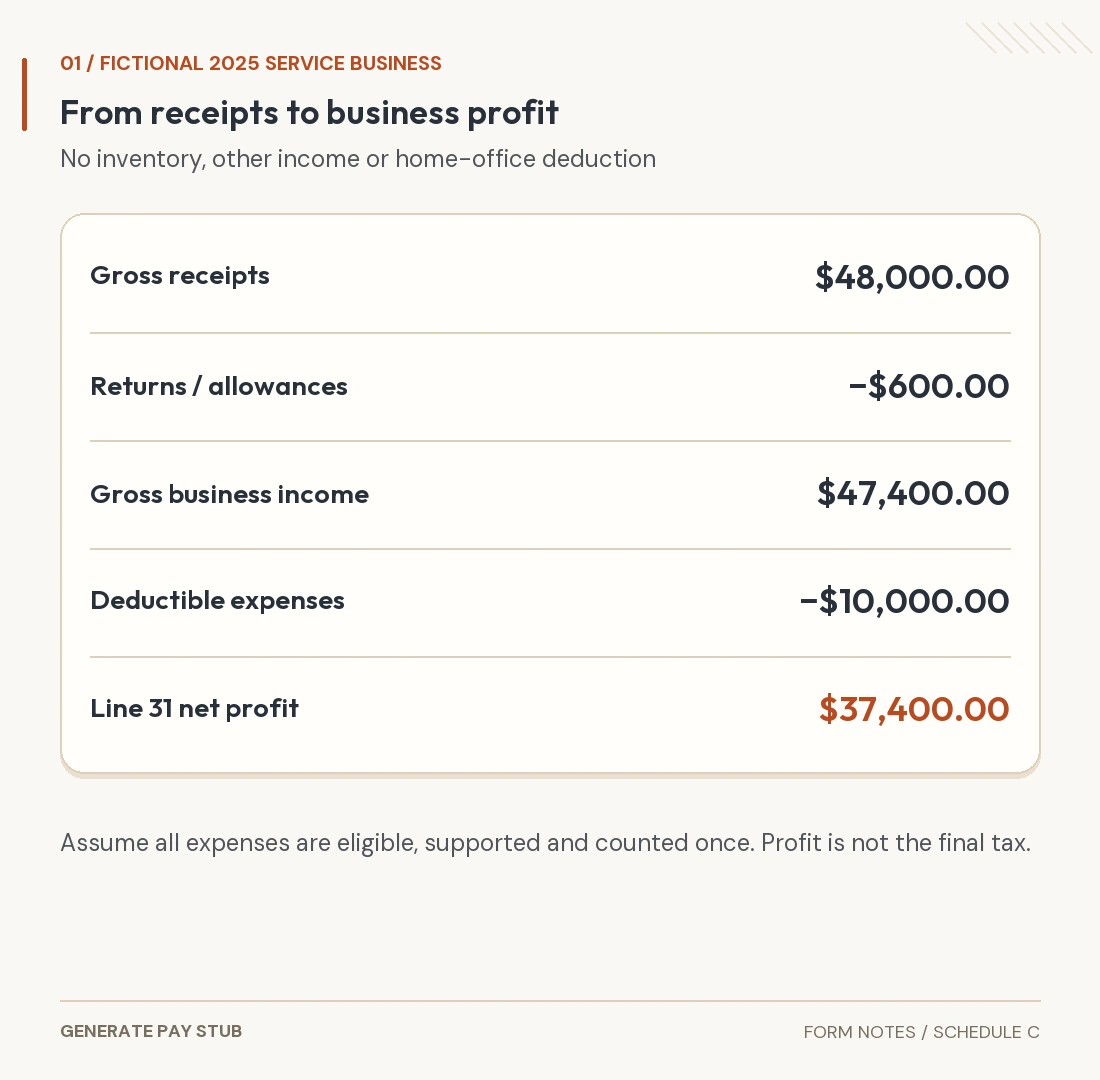
Owner cash withdrawals also do not measure business profit. A transfer may be larger or smaller than the period’s earnings because cash includes prior profits, borrowing, contributed capital or other sources. For income verification, describe the actual record and ask the recipient what business-income evidence it accepts.
Partners: use partnership records for partnership payments
The IRS partnership overview says partners are not employees and should not receive W-2s for that partner relationship. It distinguishes the partnership’s information return and partners’ Schedule K-1 reporting from employee payroll.
A partner’s payment can involve a distribution or a guaranteed payment under the applicable arrangement. Those categories should be recorded accurately rather than grouped into a made-up employee salary. A guaranteed payment is not converted into W-2 wages simply because it arrives on a regular monthly schedule.
A partnership can separately employ non-partners. If the owner of a different business also works for the partnership, identify whether that person is actually a partner here before applying the owner-pay rule. Similar names or an informal “business partner” label do not replace the legal and tax facts.
Corporate owners: separate compensation for services from ownership payments
The IRS paying-yourself guidance explains that corporate officers are generally employees, while an officer providing no or only minor services and neither receiving nor being entitled to compensation is an exception. The SSA corporate-officer explanation likewise distinguishes ordinary officer employment from services solely as a director.
For S corporations, the IRS reasonable-compensation guidance requires compensation for shareholder-employee services before non-wage distributions are used in place of that compensation. The IRS can reclassify amounts characterized as distributions when they are actually payment for services.
There is no universal salary percentage approved by this article. The work performed, time devoted, responsibilities and comparable compensation matter. An arbitrary “salary/distribution split” from a blog cannot establish a reasonable wage for a specific shareholder-employee.
A C corporation also needs to distinguish employment compensation from genuine ownership transactions. A dividend, bona fide loan or reimbursement has its own facts and documentation; changing the bank-transfer memo is not enough to change its substance. Resolve the classification before generating the supporting record.
Fictional example: one bank transfer can contain different payment types
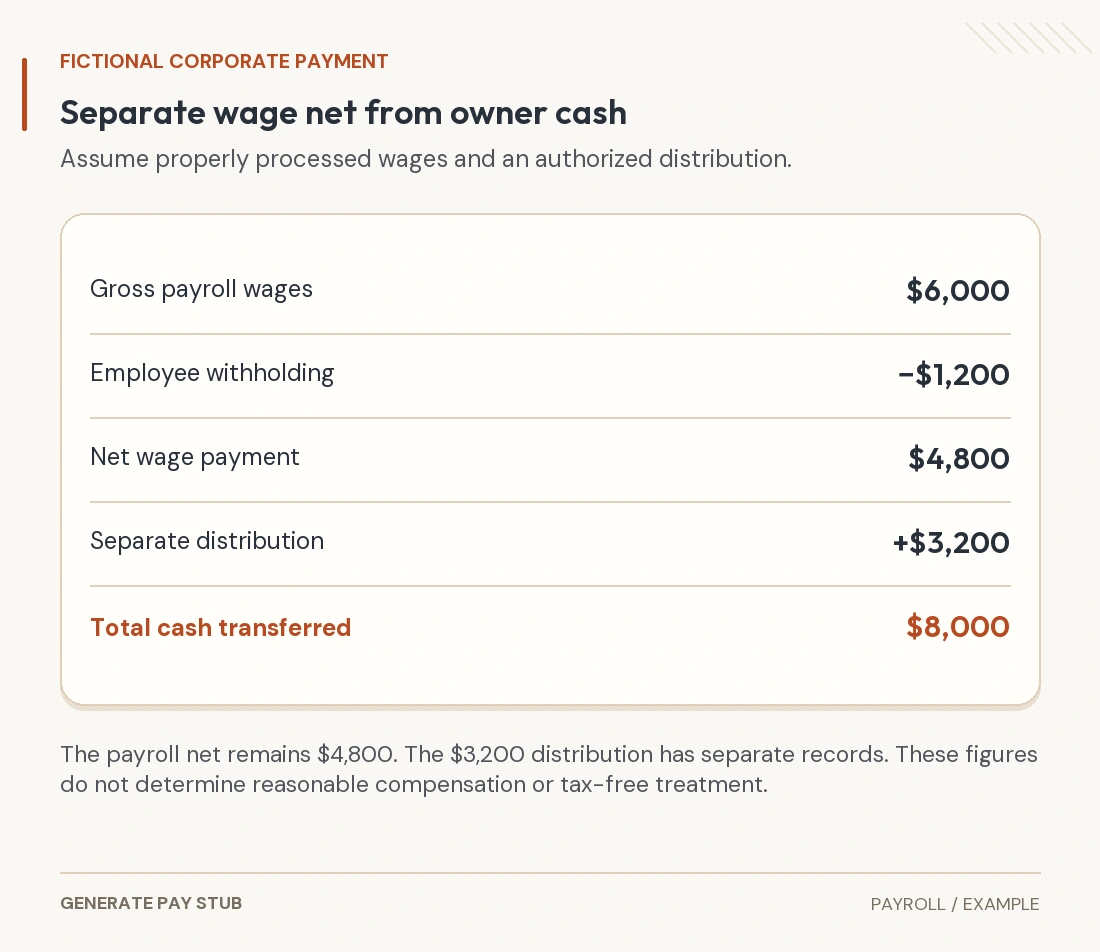
Assume a corporation has already established and processed $6,000.00 of actual gross wages for a working shareholder-employee. Fictional employee withholding is $1,200.00, leaving $4,800.00 wage net. Separately assume a properly authorized $3,200.00 non-wage ownership distribution. This example does not determine whether the wage is reasonable or the distribution is available or tax-free.

The combined cash movement is $8,000.00. The payroll record still reports $6,000.00 gross wages, $1,200.00 deductions and $4,800.00 net wages. The separate $3,200.00 distribution belongs in its own corporate and shareholder records. Calling the entire bank movement “net salary” would obscure what happened.
If a sole proprietor instead withdraws $8,000.00, that similar-looking bank transfer does not create the same wage record. The business classification and actual transaction matter more than the transfer amount. Our payroll and financial-statements guide explains why expenses, liabilities and cash also need distinct records.
A practical owner-pay record checklist
- Confirm the exact paying entity, owner role, ownership arrangement and tax treatment effective for the period.
- Identify what the payment actually represents: compensation, withdrawal, distribution, guaranteed payment, reimbursement, loan or another transaction.
- For genuine wages, reconcile earnings, withholding and net payment with the processed payroll and required employer reporting.
- For ownership payments, retain the appropriate authorization, ledger and tax-support records without inventing employee deductions.
- Review a change in members, role or election before continuing the old payment method automatically.
If a recipient asks for a pay stub but you do not receive employee wages, ask which alternative income documents it accepts. Business returns, financial records and bank evidence answer different questions. A pay stub generator should document genuine payroll; its output does not establish an employment relationship or make an ownership payment into wages.
Common owner-pay questions
Does every LLC owner qualify for a W-2?
No. Review the effective tax classification and the person’s role. A disregarded LLC, a partnership-taxed LLC and a corporation-taxed LLC can have different owner-pay treatment.
Can I issue a 1099 instead of processing required officer wages?
A document label does not override the actual employment relationship. Resolve the treatment of the services rather than choosing a form to avoid payroll.
Does an S corporation distribution mean no tax is due?
No such conclusion follows. Wage treatment, pass-through income, shareholder basis and distribution treatment are separate questions. Keep the records distinct and review the actual facts.
Can one business have both owner records and employee pay stubs?
Yes. A business can have owners whose payments are recorded outside employee payroll and other people who are genuine employees. Determine each relationship individually.