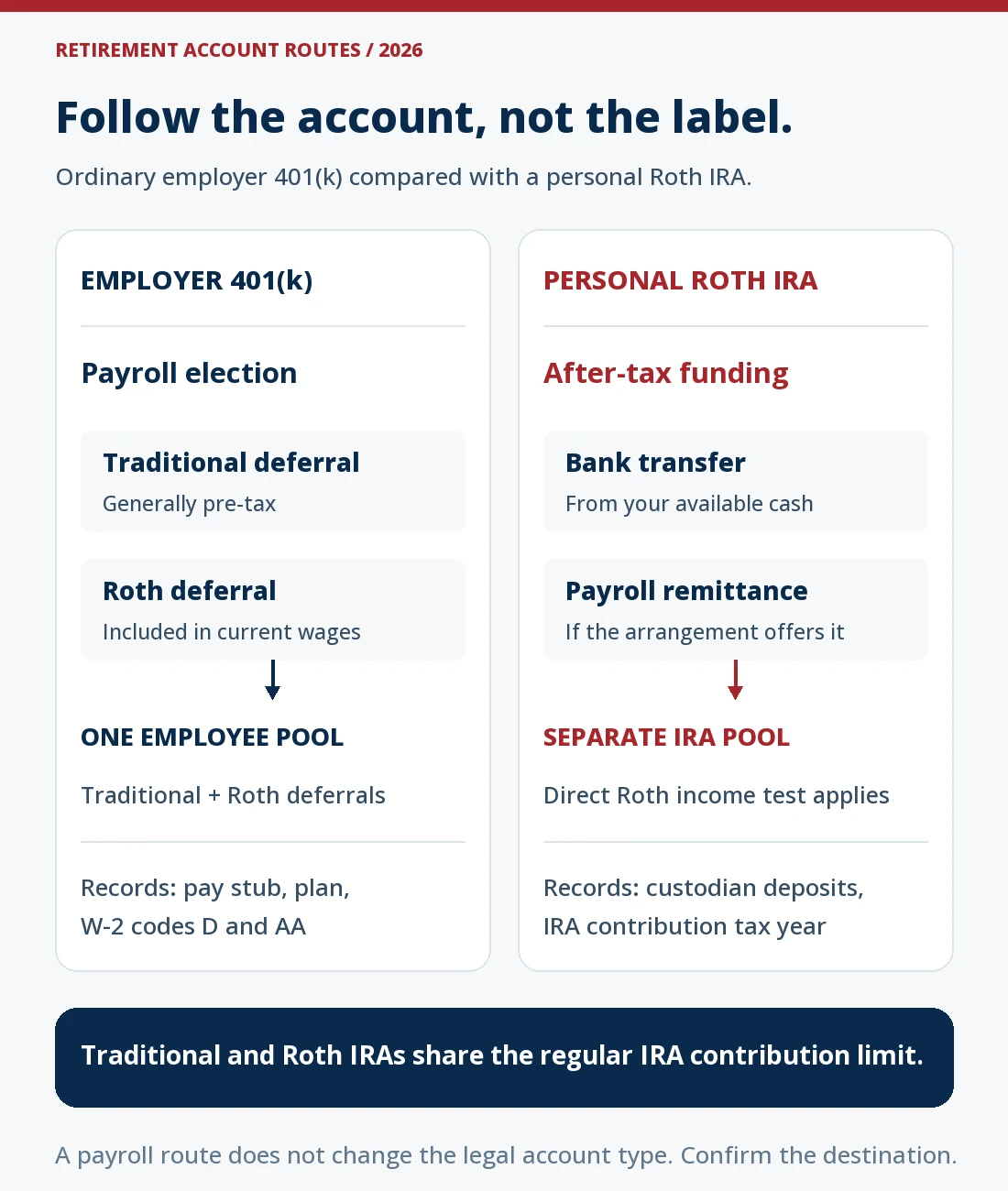
A self-employed income summary is not automatically an employee pay stub. A sole proprietor normally takes owner draws rather than wages from that same business. A working owner of a corporation can instead receive genuine payroll wages, with a wage statement and tax reporting. The business’s federal tax classification and the actual transaction determine the record—not the document title or how regularly money is transferred.
This U.S. guide was reviewed October 20, 2026. It focuses on ordinary individual-owner businesses, owner payments, and truthful supporting records. The IRS guidance on paying yourself explains why corporate officers and partners receive different treatment. The examples are fictional; none establishes an appropriate salary, a final tax bill, or a lender’s qualifying income.
Can you create a pay stub if you are self-employed?
You can organize verified income records, but should identify whether the document records employee wages, business profit, or owner withdrawals. Those amounts answer different questions. A sole proprietor’s transfer to personal checking does not become employee compensation just because it happens every other Friday.
If your corporation actually employs and pays you, its wage statement can show earned wages, authorized deductions, withholding, pay dates, and net payroll payment. If you are an individual sole proprietor or a partner receiving nonemployee owner payments, a clearly labelled business-income or owner-draw summary is a different record. It should not imply an employer withheld payroll taxes that were never withheld.
Self-employment and wage employment can coexist. A person may have a W-2 job with an unrelated employer and also run a sole proprietorship. Keep the two records separate. A genuine employee role in a corporation you own also differs from taking draws from a disregarded sole-owner business.
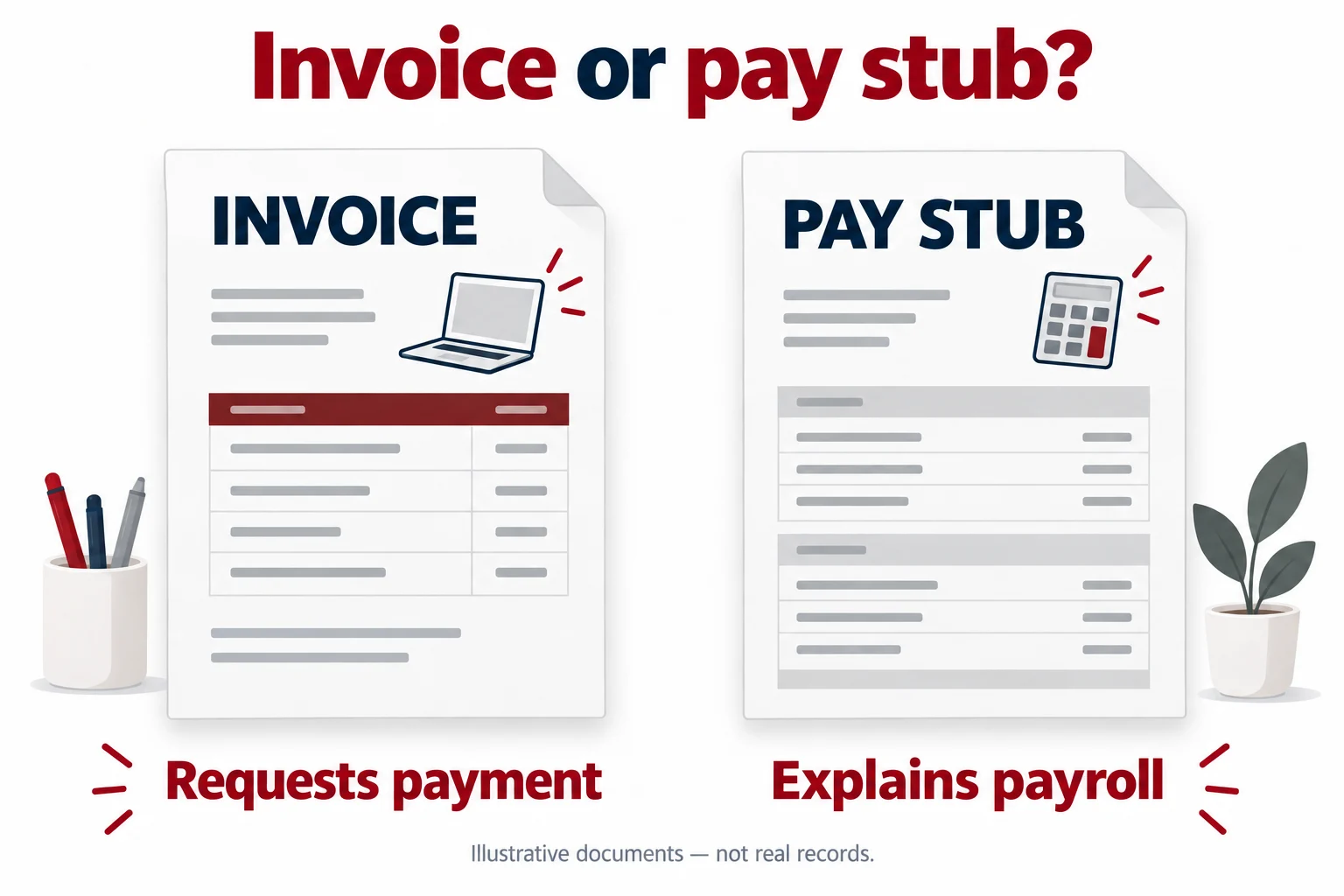
Client invoices, payment receipts, a profit-and-loss statement, and a draw ledger each add evidence. An invoice requests payment; it is not automatically a receipt. A draw ledger tracks money moved to an owner; it is not automatically the business’s earnings. Our invoice-versus-pay-stub guide covers the billing distinction.
Does an LLC owner get a W-2 or take owner draws?
“LLC” describes a legal form, not one universal federal tax treatment. The IRS entity FAQ explains default classifications and elections. Check the actual classification and effective dates before entering yourself into payroll.
| Business treatment | Owner-payment distinction | Record to verify |
|---|---|---|
| Individual sole proprietor | Own withdrawals are not employee wages from that business | Income/expense records and owner-draw ledger |
| Individual-owned disregarded single-member LLC | Owner generally treated as self-employed, despite the LLC name | Classification, receipts, expenses and owner transfers |
| Partnership, including an LLC taxed as one | Partners generally receive distributions or guaranteed payments, not W-2 wages for partner services | Partnership books, agreement and Schedule K-1 information |
| Corporation, including an LLC taxed as one | Working officer/owner can receive employee wages; capital payments remain separate | Payroll records and applicable owner distribution/loan records |

The IRS single-member LLC guidance specifically distinguishes an individual owner’s self-employment treatment from the LLC’s obligations as an employer of other workers. An LLC can have genuine employee payroll without making its disregarded individual owner an employee.
A qualifying corporate election can change the analysis prospectively under its effective rules. Opening a bank account, obtaining an EIN, or choosing a payroll software setting does not make that election. Multiple owners, spouse-owned businesses, community-property arrangements, foreign ownership and special elections need their actual classification reviewed rather than being forced into a default one-owner example.
Is an owner draw the same as business profit or take-home pay?
No. A sole proprietor’s draw is a movement of owner funds, not a deduction that reduces business profit. The IRS small-business tax guide explains that the proprietor is not an employee of that business and cannot deduct their own salary or personal withdrawals as employee pay. Its currently posted 2025 edition supplies this continuing distinction; no older annual rate or limit is used here as a 2026 amount.
In this original example, an individual sole proprietor has one fictional month of $9,000 collected service revenue and $3,500 deductible operating expenses. Assume all revenue is earned and collected, all listed costs are paid and deductible in that month, and there are no other transactions, opening cash, receivables, inventory, debt, asset purchases, depreciation, sales taxes, or tax payments. The simplified business profit is $5,500.
Compare two alternative draw choices for that same month. They are not two consecutive months and should not be added together.
| Measure | Choice A | Choice B |
|---|---|---|
| Collected revenue | $9,000.00 | $9,000.00 |
| Deductible operating expenses | $3,500.00 | $3,500.00 |
| Business profit before owner taxes | $5,500.00 | $5,500.00 |
| Owner draw to personal account | $3,000.00 | $1,000.00 |
| Business cash left under these assumptions | $2,500.00 | $4,500.00 |

Subtracting the $3,000 draw as another operating expense would incorrectly reduce Choice A’s illustrated profit to $2,500. Reporting $9,000 as personal take-home pay would also ignore the $3,500 costs. Reporting only the $3,000 transfer as business income would miss the profit/cash distinction in the opposite direction.
The assumptions make profit and pre-draw cash surplus equal in this example. Real accounts often differ: an equipment purchase, loan proceeds, principal repayment, unpaid invoice, or prior-period bill can change bank cash without changing current profit by the same amount. Do not use this simplified illustration as a rule that a bank balance always equals taxable profit.
A regular draw can help budget personal spending, but it is not necessarily sustainable income. Review operating cash needs, seasonal collections, upcoming costs and tax obligations. The monthly-income guide explains the separate problem of converting wage frequencies; do not apply a salaried employee’s annualization to one unusually strong month of business receipts.
When should a business owner receive a real payroll wage statement?
A corporate officer who performs services is generally an employee, subject to the relevant exceptions and compensation rules. The IRS’s paying-yourself guidance identifies the exception for an officer who performs no or only minor services and neither receives nor is entitled to compensation. Ownership alone does not mean every transfer is wages, and calling all compensation a distribution does not avoid employee treatment.
For S corporations, the IRS reasonable-compensation guidance requires reasonable compensation for shareholder-employee services before non-wage distributions. Duties, time, experience, comparable pay and the sources of business receipts matter. A fixed “60/40” or “50/50” rule is not a substitute for that analysis.
Separate corporate cash example: assume a legitimate payroll pays $5,000 gross wages and withholds a given $800 total employee taxes, with no other payroll deductions. Net wages paid are $4,200. The corporation also makes a separately authorized $1,500 shareholder distribution, assuming all relevant compensation and distribution requirements have been reviewed. The owner receives $5,700 cash, but that does not make $5,700 or $6,500 the payroll gross.
| Component | Record | Amount |
|---|---|---|
| Gross employee wages | Payroll wage statement | $5,000.00 |
| Employee taxes withheld | Given payroll result | $800.00 |
| Net employee wages | Payroll cash after withholding | $4,200.00 |
| Separate owner distribution | Corporate distribution ledger | $1,500.00 |
| Total cash to owner | Two documented payment categories | $5,700.00 |
The $5,000 is an assumption for illustrating record separation, not a recommendation or a finding of reasonable compensation. The $800 is also given, not calculated for an unspecified W-4 or state. Employer payroll taxes are additional employer obligations, not automatically part of this employee withholding figure. The 2026 employer tax guide explains ordinary payroll withholding, deposits and reporting.
Non-wage does not mean universally tax-free. The IRS S corporation basis guidance explains why distributions and stock basis require tracking. Pass-through income can be taxable even when cash is not distributed; distribution taxation depends on applicable facts and rules. C corporation dividends have a different framework. Keep compensation, distributions, loan repayments and expense reimbursements separately supported.
A document generator does not make a payroll payment, calculate a defensible owner salary from an arbitrary target, or perform every employer filing. Confirm which service actually runs payroll and remits taxes. See the generator-versus-payroll-service comparison.
Should partners receive pay stubs for guaranteed payments or draws?
Partners generally are not employees of their partnership for payments made in their partner capacity. The IRS paying-yourself guidance says not to issue a W-2 in place of Schedule K-1 for distributions or guaranteed payments. A fixed recurring payment is not necessarily a salary just because it resembles a paycheck.
Publication 541 explains guaranteed payments, distributive shares and distributions. They are distinct transactions with their own accounting and tax effects; guaranteed payments generally involve amounts determined without regard to partnership income. Self-employment tax can depend on the type of partner, payment, activities and applicable exceptions. Do not copy a blanket “every partner distribution is payroll” or “every LLC distribution is tax-free” rule.
Other transfers also need substance checked. An owner’s contribution is not a client sale, and genuine loan proceeds are not automatically earned revenue. A documented business reimbursement is different from compensation or a draw. If the business pays a personal bill, ask how it was booked rather than assuming it was a deductible business expense. Our reimbursement guide covers the separate employee arrangement.
How do you prove self-employed income without pretending to have an employer?
Build a traceable summary that connects earnings to business and payment records. Start by asking the recipient which documents and periods it accepts. A lender’s request, a rental screening process and a tax return are not interchangeable. A professionally formatted self-prepared page is not guaranteed acceptance.
- Identify the business and ownership. State the relevant entity/tax treatment and whether the summary is self-prepared or comes from an independent preparer.
- Show the reporting period and basis. Label cash receipts versus invoices earned or billed. Keep current-period and year-to-date figures separate.
- Support revenue. Reconcile paid invoices, client remittances, processor settlements and business bank deposits. Separate transfers, loans and owner contributions.
- Support expenses and profit. Maintain receipts and a consistent profit-and-loss statement. Do not classify the same expense twice.
- List owner payments separately. Show the dates, amounts and category of draws, distributions, guaranteed payments, reimbursements or genuine payroll.
- Supply requested annual evidence. Tax returns, applicable schedules, information returns and transcripts can substantiate a broader history than one selected month.
Publication 583’s recordkeeping guidance describes supporting documents and separate business records. Its older publication date is not used for current annual thresholds. A processor’s net settlement may exclude fees, and an information return can report transactions differently from your ledger; reconcile the difference rather than treating every deposit as a new sale.
Mortgage underwriting can also use a different definition of self-employment from payroll. Fannie Mae’s self-employed borrower guide treats a person with at least 25% ownership as self-employed for its analysis and evaluates business cash flow and stability. Consequently, an owner’s genuine W-2 does not necessarily eliminate business-document requirements. This is one mortgage program’s framework, not a universal rule for all applications. See the loan-income documentation guide for broader context.
Should estimated taxes appear as deductions on an owner-draw summary?
A personal tax reserve is not employer withholding. The IRS self-employed tax center explains income tax, self-employment tax and estimated payments. For a sole proprietor, net business earnings generally drive the analysis, not how much was withdrawn. The exact return calculation can involve adjustments, wage limits and other income; applying 15.3% to every bank deposit is not a complete tax calculation.
If you set aside $600 personally, describe it as a reserve or transfer unless and until it is actually paid and recorded as the relevant tax payment. Do not show it as federal payroll tax withheld by a nonexistent employer. An estimated payment also needs its actual payment date, tax period and confirmation. Keeping earnings, reserves, payments and corporate withholding distinct makes reconciliation possible.
A client information return is another record, not a self-issued payroll deduction. Moving money from a disregarded sole proprietor’s business account to their own personal account does not by itself create a new client payment to report to themselves on Form 1099-NEC. Payments from actual customers still need their proper reporting. Our 2026 contractor reporting guide covers that separate payer obligation.
What should you check before generating an owner income record?
- Confirm tax treatment and effective dates. Verify actual elections and ownership instead of inferring them from LLC, EIN, or a bank label.
- Classify each payment. Separate employee wages, sole-proprietor draws, partner payments, distributions, loans and reimbursements.
- Reconcile business results. Match revenue and expenses to the stated period and accounting basis before computing profit.
- Reconcile cash separately. Explain opening balances, owner transfers, debts and other items that make deposits differ from profit.
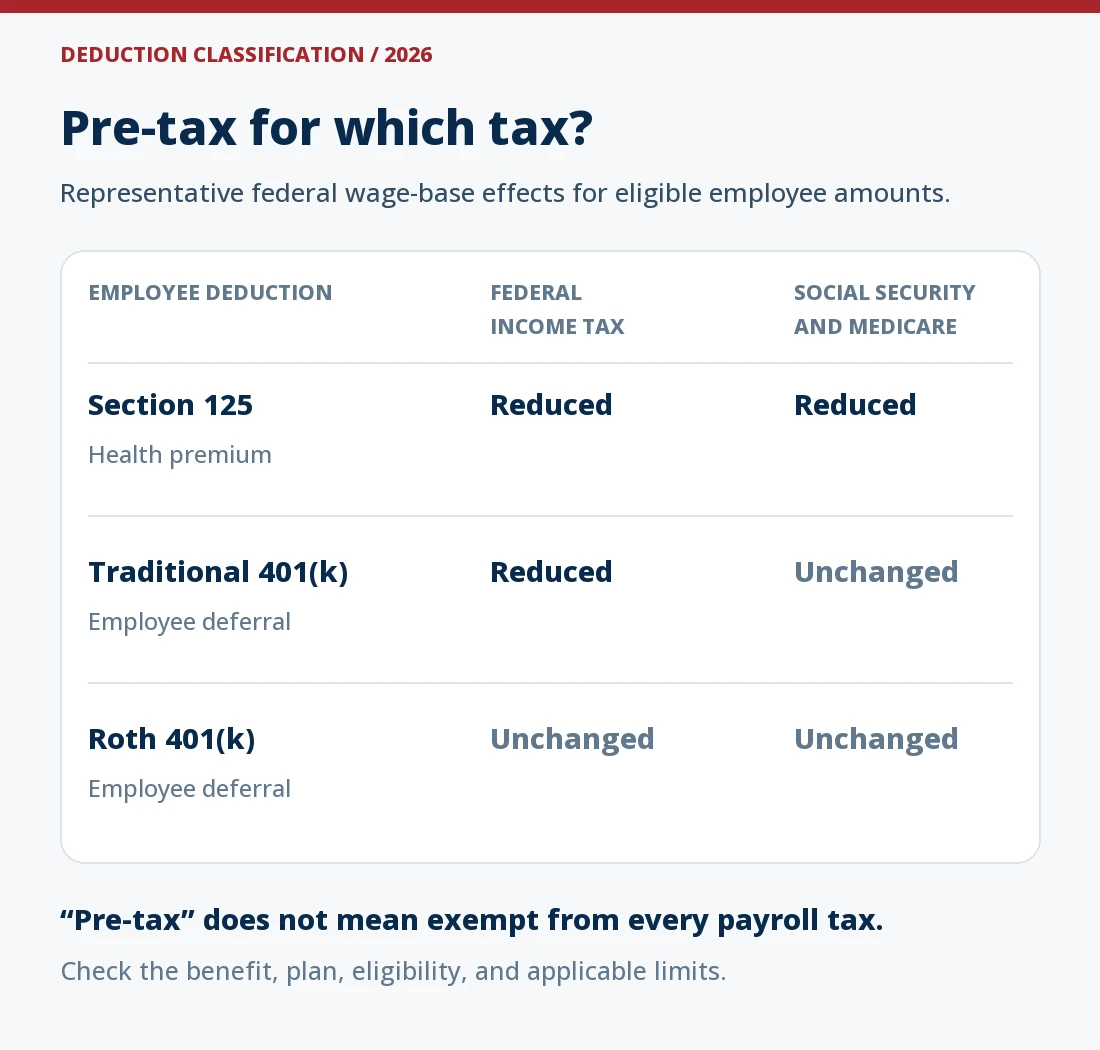
- Use truthful tax descriptions. Distinguish actual withholding, estimated payments and money merely reserved.
- Confirm the recipient’s evidence requirements. Supply source records and accurately identify self-prepared material.
- Preserve corrections. Fix the ledger, payroll or tax reporting as appropriate; changing a PDF alone does not correct the underlying transaction.
Use Generate Pay Stub for a wage statement when actual employee payroll supports its entries. When documenting nonemployee business income or draws, choose a clearly identified summary suited to the records and recipient, without implying a W-2 employment relationship. Keep verified figures and source references with the preparation checklist, and use the correction guide when an existing wage record is wrong.