Schedule C reports a sole proprietor's business income and expenses, producing a net profit or loss that connects to the individual tax return. Start with reconciled business records, use the appropriate accounting method and expense categories, and review any required supporting forms. The result is business profit, not a paycheck, cash balance or final tax bill.
A reliable Schedule C should explain how sales became profit. It should also keep personal spending, owner withdrawals, inventory costs and deductions claimed elsewhere from being counted incorrectly.
Reviewed November 5, 2026. This guide uses the final 2025 Schedule C available in the linked builder. The fictional example is a cash-method U.S. service business with one sole proprietor, material participation, no inventory, no home-office or vehicle deduction, no statutory-employee income and no loss limitations to apply.
Who uses Schedule C, and when is a different return needed?
Schedule C generally reports a sole proprietorship's business or professional activity. The IRS sole-proprietor overview identifies the connection to Form 1040, Schedule SE and estimated-tax requirements.
The 2025 Schedule C instructions distinguish an ongoing business operated for income or profit from a hobby or sporadic nonbusiness activity. They also cover certain statutory-employee and qualified-joint-venture situations.
Do not assume an LLC always files this schedule. An entity's federal tax treatment matters, including whether a corporate election applies. Partnerships generally use Form 1065; corporate reporting follows different rules. Spouse-owned activities and community-property arrangements need their specific review.
Use a separate Schedule C for each separate business. Several clients within the same business do not, by themselves, require one schedule per client.
Which records should you reconcile before entering amounts?
Reconcile the books and supporting documents for the reporting year. The IRS business-records guide describes the relationship between transaction records and income and expense entries.
- Sales, invoices, receipts, refunds and allowances.
- Bank and processor reports, including fees and settlement adjustments.
- Relevant 1099s and any corrected information statements.
- Expense receipts, bills and evidence supporting the business portion.
- Asset, inventory, vehicle and home-use records where applicable.
- Payments to workers and other payees requiring separate reporting review.
Reconcile overlapping evidence instead of adding every document total. One customer payment can appear in the sales ledger, a bank statement and a 1099 without becoming three receipts. Our contractor payment-record guide shows how invoices, partial payments and deposits can differ.
Confirm the accounting method too. The cash and accrual approaches in Publication 538 can recognize income and expenses at different times. A bank-only summary is not automatically a complete accrual-method record.
What belongs in Schedule C's business-information fields?
Identify the proprietor and the actual activity, then answer the accounting and reporting questions from the facts. Review the proprietor's name, appropriate taxpayer identifier, business description and activity code.
A separate business name, EIN or business address should be entered where applicable under the instructions. The activity code describes the principal business; do not select an unrelated code because it appears first in a list.
Check the accounting-method choice, material-participation question and whether the business started or was acquired during the year. Questions about required Forms 1099 concern your payments to others, not only the 1099s clients sent to you.
For 2025 payment-reporting decisions, use 2025 rules. A later threshold change does not alter an earlier year's obligation. The NEC preparation guide includes a year comparison and explains the underlying vendor packet.
How do receipts and returns lead to gross business income?
Follow the income section's separate steps. The official 2025 Schedule C distinguishes receipts, returns and allowances, cost of goods sold, gross profit and other income.
For a simple service business without inventory, gross receipts less supported refunds may lead directly to gross profit. A business selling goods can need a separate cost-of-goods-sold calculation. Other business income can then affect the total.
Do not use only the sum of received 1099s as the sales figure. Reconcile all applicable business income, including payments not shown on a form. Also identify transfers, loans or other bank activity that is not a customer sale.
How should you review Schedule C expenses?
Use the allowed business expense, not simply the amount that left an account. Publication 334 for 2025 explains the ordinary-and-necessary standard and the need to distinguish expenses from costs with different treatment.
Review the nature, business use, year and documentation for each item. A mixed personal/business cost requires its appropriate allocation. An asset, improvement or prepaid amount may need different timing or capitalization rather than immediate deduction.
Place an expense in the correct category and count it once. If a processor fee was already removed when you recorded net deposits as income, first reconcile the gross receipts and fee so you do not deduct it a second time.
“Other expenses” is for eligible items not already deducted elsewhere. Give each one a clear description. Personal costs do not become deductible merely because you enter a business-sounding label.
What does a worked 2025 service-business Schedule C look like?
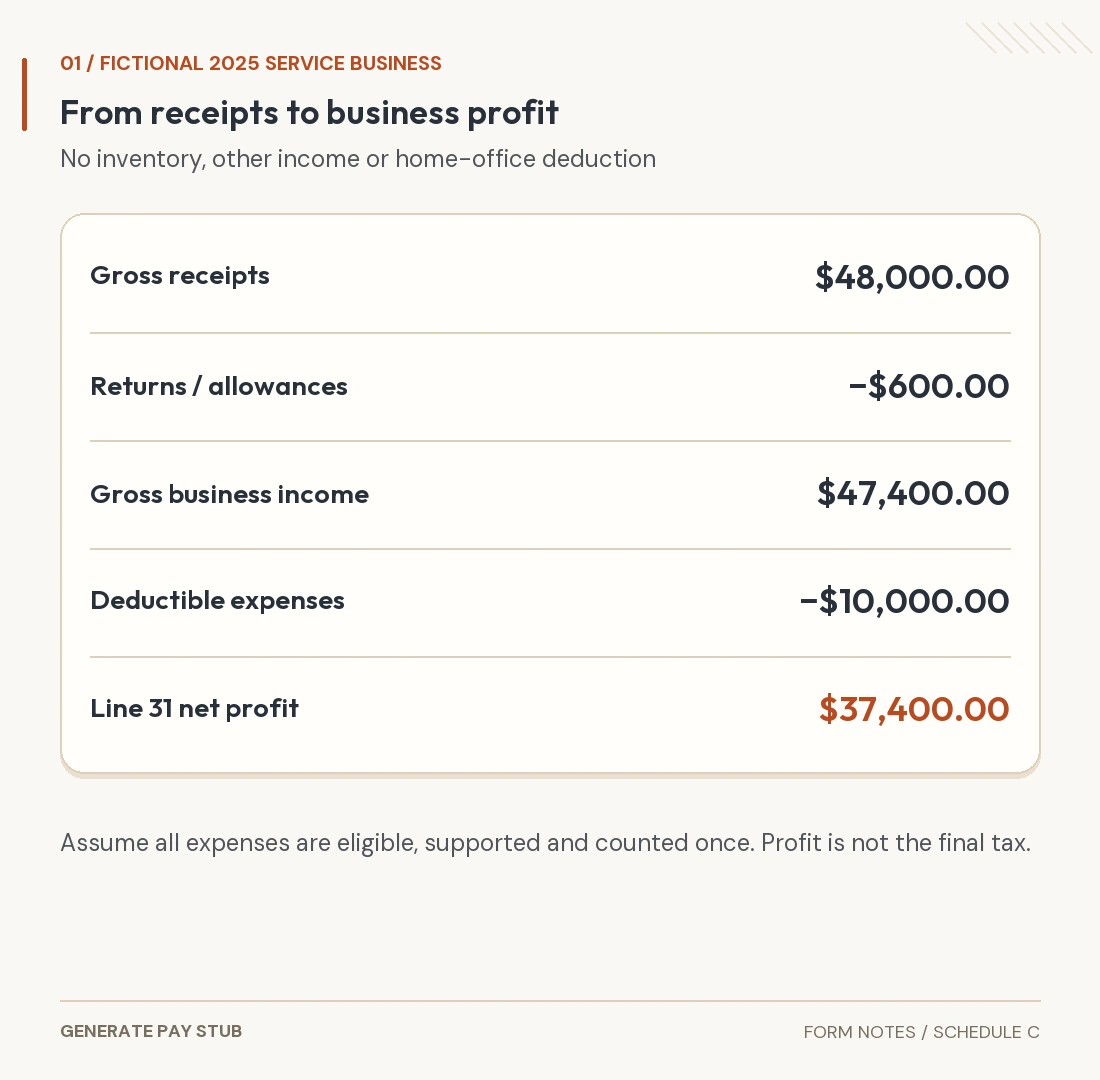
Separate the income reconciliation from the expense total. Assume this fictional cash-method business has $48,000 in gross receipts, recorded before processor fees, and $600 in supported customer returns or allowances. There is no cost of goods sold or other income, so gross business income is $47,400.
Assume the following expenses are fully eligible for 2025, supported, correctly classified and not counted in another category. The software entry represents ordinary current business subscriptions, not a capital asset.
| Expense | 2025 Schedule C category | Amount |
|---|---|---|
| Advertising | Line 8 | $1,200.00 |
| Payment-processing commissions and fees | Line 10 | $900.00 |
| Independent contract labor | Line 11 | $4,200.00 |
| Office expense | Line 18 | $600.00 |
| Business supplies outside COGS | Line 22 | $1,300.00 |
| Eligible business utilities | Line 25 | $840.00 |
| Current business software subscriptions | Part V total to Line 27b | $960.00 |
| Total assumed deductible expenses | Line 28 | $10,000.00 |
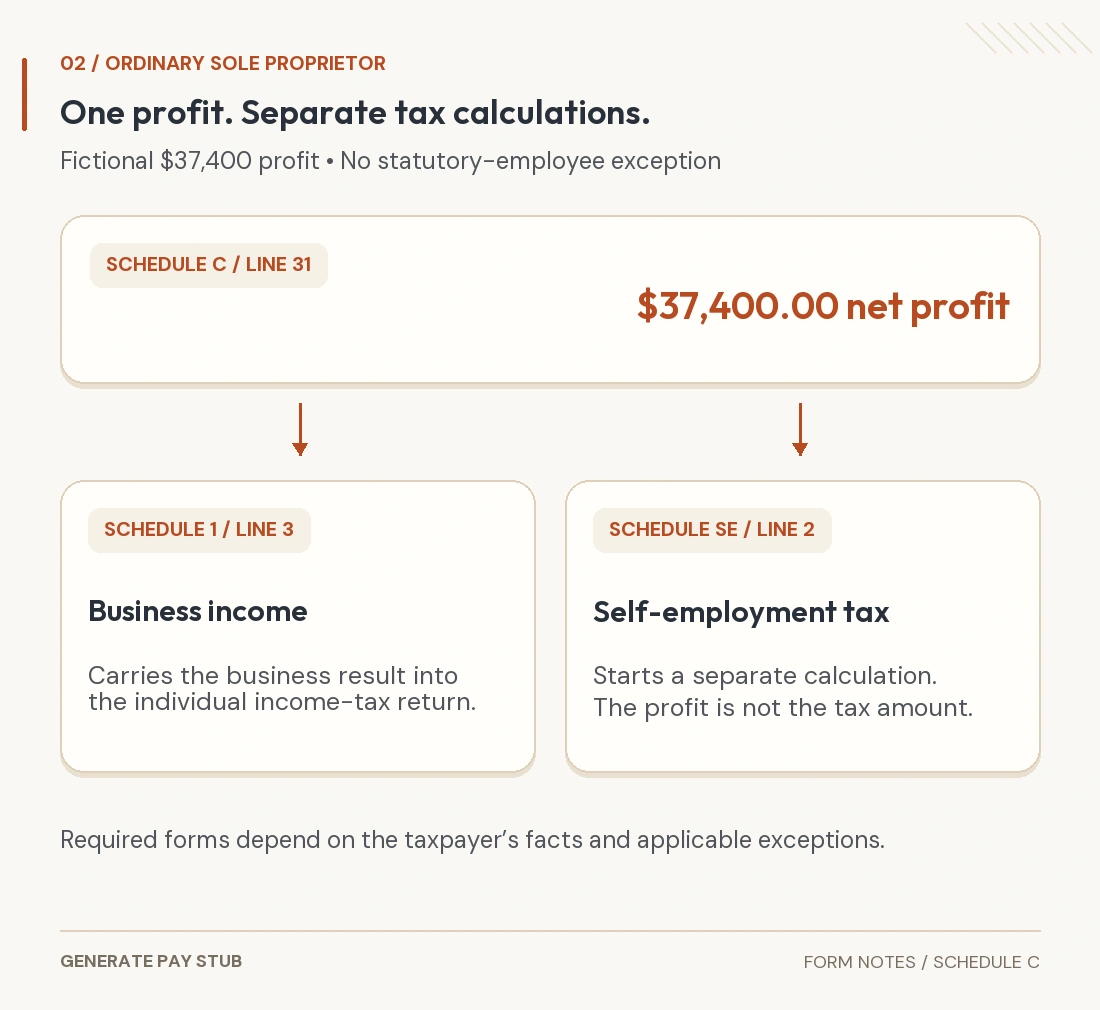
The expenses total $1,200 + $900 + $4,200 + $600 + $1,300 + $840 + $960 = $10,000. Subtracting them from $47,400 gives $37,400 before home-office expenses. With no home-office deduction, Line 31 net profit remains $37,400.

This result does not calculate the taxpayer's income tax or self-employment tax. Other household income, deductions, credits, payments and relevant limitations belong in the subsequent return calculations.
Does withdrawing money for yourself reduce Schedule C profit?
No. A proprietor's own withdrawal is not deductible employee wages paid to someone else. If this fictional owner moves $12,000 from the business account to a personal account, that transfer alone does not reduce the $37,400 business profit.
Keep the transfer in the appropriate accounting record. Do not place it on the wages or contract-labor line to lower the displayed profit. Our owner-draw guide explains the distinction between business-owner transfers and actual payroll.
Similarly, the owner's personal tax reserve is not a payroll withholding deduction on Schedule C. Tax payments and any permitted return-level deductions need their own treatment.
What changes for inventory, vehicles and a home office?
These categories require their own records and calculations. They should not be added to the service example by copying a convenient number.
Inventory and cost of goods sold
Use Part III when applicable. Review opening inventory, purchases, relevant labor and other costs, personal withdrawals and closing inventory. Do not deduct the same inventory cost again as ordinary supplies or another operating expense.
Car and truck expenses
Check the permitted method, business use and documentation. For the 2025 standard-mileage method, the business rate is 70 cents per mile, subject to eligibility rules. Commuting and personal mileage are distinct. Vehicle information may belong in Schedule C Part IV or a separate Form 4562 under the instructions.
Business use of the home
Check eligibility before choosing an actual or simplified calculation. The allowed home-use deduction goes on Line 30. Do not repeat the same costs in other expense fields. Form 8829 or the applicable worksheet can be needed separately.
Depreciation and other special deductions
Asset costs, Section 179, depreciation and specialized deductions can trigger separate forms. A tool's expense field does not determine whether expensing is allowed. Qualified tip or other Schedule 1-A deductions also have their own place on the individual return rather than being inserted as a second Schedule C expense.
Where does Schedule C net profit go next?
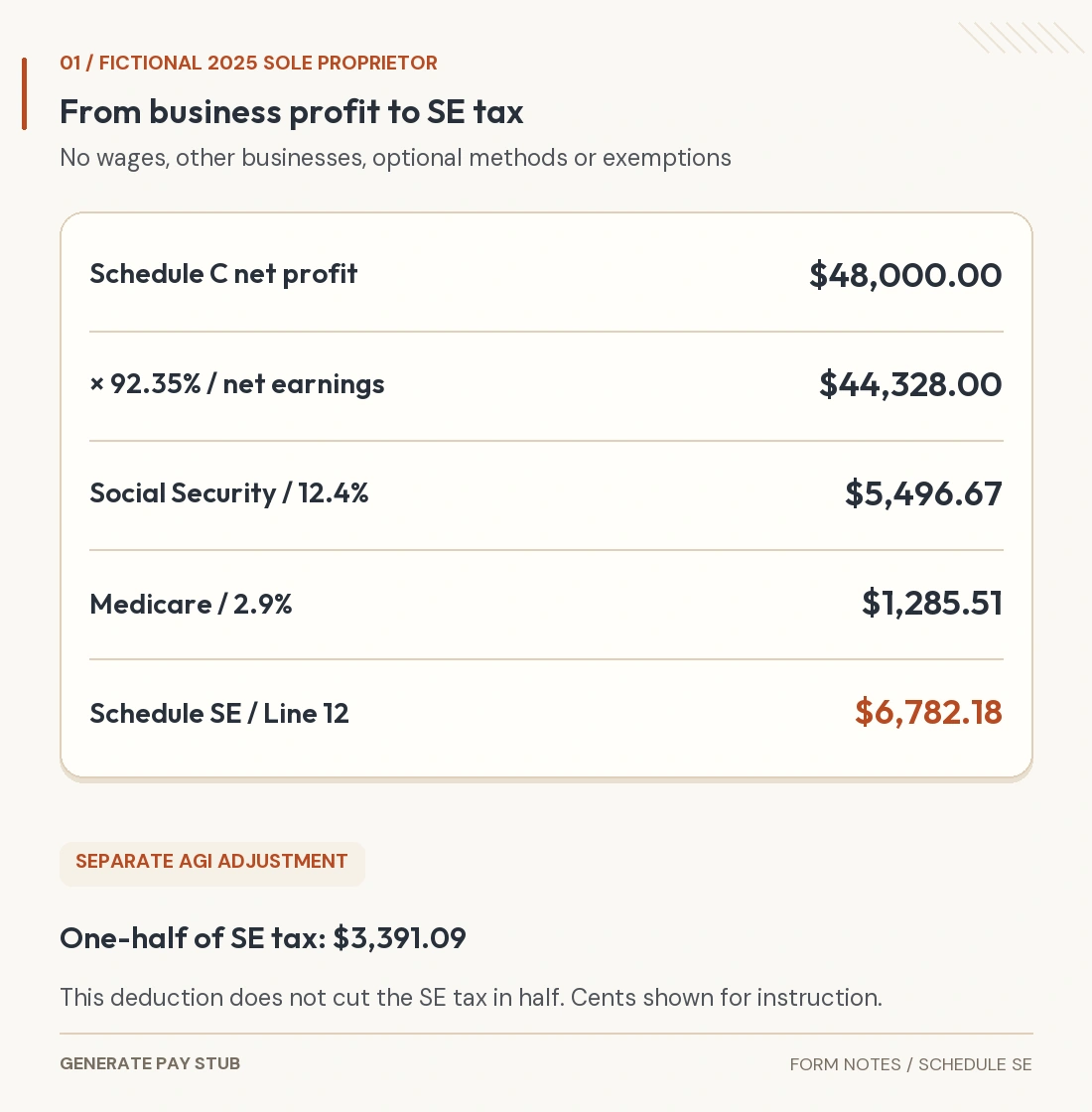
For an ordinary individual sole proprietor, the business result feeds further return calculations. In the 2025 instructions, Line 31 generally carries to Schedule 1, Line 3, and is considered in Schedule SE, Line 2, subject to applicable exceptions.

A W-2 statutory employee is an important exception to the ordinary self-employment route. The instructions describe separate treatment for that income and require separate schedules when statutory-employee and ordinary self-employed activities coexist. Do not apply the example automatically to every Schedule C.
The potential qualified-business-income deduction is also a separate calculation. It does not mean you can reduce Schedule C receipts or profit by an automatic percentage. The Form 1040 roadmap shows how the individual return brings those separate items together.
The IRS self-employed tax center describes the broader income-tax, self-employment-tax and estimated-payment process.
What if expenses produce a loss?
A calculated negative amount is not automatically a fully deductible loss. Review the at-risk, passive-activity and excess-business-loss rules and any other applicable limitation. Participation and ownership facts can affect the result.
Keep the relevant worksheets, carryovers and supporting forms. Do not assume a document builder's arithmetic has applied every limitation to the amount that belongs on the individual return.
How do you prepare and attach the reviewed schedule?
Complete the business calculation, review the supporting forms and attach the schedule to the appropriate return. Schedule C has no separate taxpayer signature line; the main return's signing and filing requirements still matter.
The Schedule C document guide links to the Schedule C builder. It currently offers the final 2025 edition and accepts business details, income, categorized expenses and relevant optional sections.
Use reviewed deductible amounts and inspect both original pages. The tool can organize your entries and arithmetic, but eligibility, limitations, inventory, depreciation and other required forms still need their proper review. The main return, conditional attachments, IRS filing and tax payments are separate.
Because the ordinary 2025 filing dates have passed as of this review, use the applicable late, amended or relief procedure when relevant. Do not assume preparing a new schedule alone completes a return or changes an existing filing.
General U.S. tax information. The fictional service example assumes deductible current expenses and excludes special industries, foreign issues, losses and other limitations. Use the complete instructions and appropriate professional help for unusual facts.