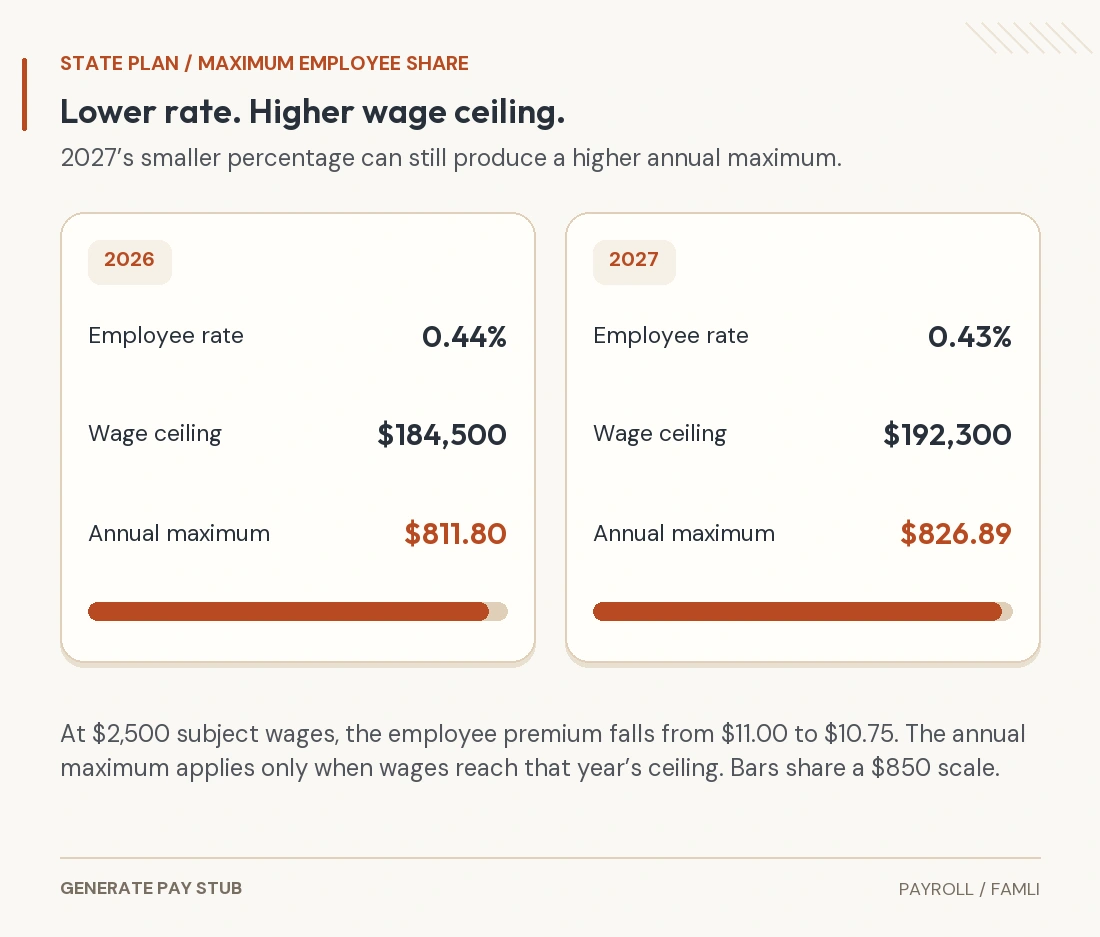
A Colorado FAMLI deduction funds paid family and medical leave insurance; it is separate from Colorado income-tax withholding. Under the state plan, the maximum employee share is 0.44% of subject wages in 2026 and 0.43% in 2027. The combined rate falls from 0.88% to 0.86%, but the annual wage ceiling rises—so a smaller percentage does not necessarily mean a smaller annual maximum.
Reviewed November 21, 2026. This guide checks Colorado state-plan payroll premiums and the announced 2027 change. Examples assume covered wages, the maximum employee share and no employer subsidy of that share. Approved private plans, elective coverage, work-location questions and actual benefit claims require their own review. The calculations do not estimate a complete paycheck.
What does FAMLI mean on a Colorado pay stub?
FAMLI stands for Family and Medical Leave Insurance. The Colorado program’s employer overview describes funding through employee and employer premiums. A payroll system may use “CO FAMLI,” “paid leave” or a provider-specific code. Ask for the code legend before treating an unfamiliar state-related line as income tax.
Keep three kinds of records separate: a premium withheld from working wages, the employer’s own premium obligation, and a benefit paid during approved leave. A deduction does not itself establish a benefit award or the amount a person will receive. FAMLI is also distinct from a PTO hours bank and from an employee’s Form DR 0004 income-tax withholding instructions.
If the questioned line is Colorado income-tax withholding, use the DR 0004 withholding guide. If it is accrued or used leave hours, start with the PTO balance guide. Changing an income-tax election is not a way to elect a different FAMLI premium rate.
The 2027 rate decreases, but the wage ceiling increases
Colorado’s October 21, 2026 FAMLI Business Brief announces a 0.86% combined premium effective January 1, 2027, down from 0.88% for 2026. With the standard equal split, the employee percentages are 0.43% and 0.44%, respectively.
The state’s premium explanation ties the premium ceiling to the federal Social Security wage cap. The SSA’s published 2027 fact sheet lists $184,500 for 2026 and $192,300 for 2027. Using that shared ceiling does not make FAMLI the same deduction as Social Security tax.
| Year | Combined rate | Employee rate | Wage ceiling | Annual employee maximum |
|---|---|---|---|---|
| 2026 | 0.88% | 0.44% | $184,500 | $811.80 |
| 2027 | 0.86% | 0.43% | $192,300 | $826.89 |
The last column is arithmetic at the full applicable ceiling: $184,500 × 0.0044 = $811.80, compared with $192,300 × 0.0043 = $826.89. The $15.09 difference concerns an employee whose subject wages reach each year’s ceiling and whose employer withholds the full employee share. It is not a prediction that every worker’s annual deductions increase; actual paycheck rounding can also affect accumulated cents.

A regular-paycheck example: $2,500 of subject wages
Assume a covered employee has $2,500 of FAMLI-subject wages on a payment, remains below the annual ceiling and pays the full employee share. For 2026, multiply $2,500 by 0.0044: the employee premium is $11.00. At the same subject wage amount in 2027, $2,500 × 0.0043 produces $10.75.
The reduction is 25 cents on that otherwise identical payment. Do not multiply the employee’s wages by the combined rate and deduct both shares from the employee. At the standard split in 2026, a separately required employer contribution would also be $11.00; together they total $22.00. That employer cost is not another $11 deduction from take-home pay.
Use the program’s wage definition and payroll’s subject-wage record. Do not start with the bank deposit, subtract every benefit automatically, or assume federal income-tax wages must equal FAMLI wages. Different payroll bases answer different questions; our gross-versus-taxable-wages guide explains why a common earnings total can feed different calculations.
What happens when a paycheck crosses the annual ceiling?
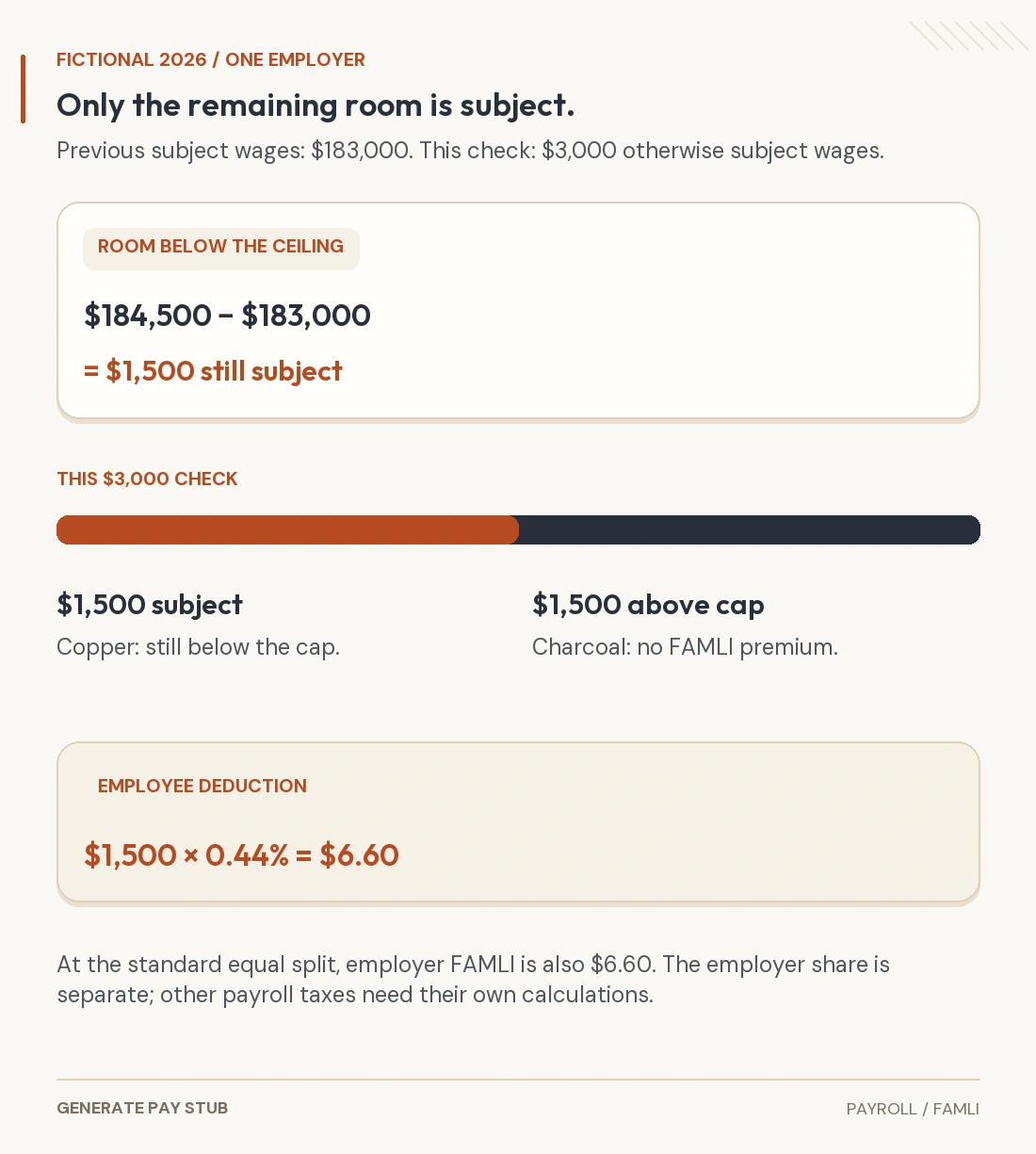
Use only the remaining subject-wage room. In a separate fictional 2026 case, the same employer has already reported $183,000 of subject wages. The current $3,000 payment would otherwise be fully subject. The $184,500 ceiling leaves $1,500 of room, so only half this payment enters the premium calculation.
| Checkpoint | Amount |
|---|---|
| Annual wage ceiling | $184,500.00 |
| Subject wages before this payment | $183,000.00 |
| Remaining room | $1,500.00 |
| Current otherwise subject wages | $3,000.00 |
| Current wages subject after the cap | $1,500.00 |
| Employee premium at 0.44% | $6.60 |
The other $1,500 is above this premium ceiling. It is not automatically exempt from Medicare, income-tax withholding or other deductions. At the standard split, the employer FAMLI amount in this illustration is also $6.60, making $13.20 combined. Keep the two shares separate when reconciling the pay stub and employer records.

A YTD total should identify its category and employer scope. If payroll moved systems, ask whether the opening subject-wage history was imported. If you changed employers or work locations, obtain the program’s applicable treatment rather than subtracting an unrelated job’s YTD total yourself. The payroll-provider transition guide explains the evidence needed to detect a missing opening balance.
Does a small employer still collect employee premiums?
Yes. The official Small Business Corner distinguishes the employer-share exemption for businesses with fewer than ten employees from employee contributions and reporting. A small employer’s exemption does not mean its covered employees receive an automatic zero premium or lose access to benefits.
Use the program’s headcount rules, not the number of people on one shift. The source describes a preceding-year, 20-calendar-workweek counting framework; that headcount test is different from when a new worker’s premiums begin. For a payroll dispute, ask which employer category and coverage arrangement were applied. Do not try to infer total employer headcount from one store or department.
An employer may pay some or all of the employee share. A smaller employee deduction can therefore be intentional. Confirm the arrangement and the applicable tax treatment before treating a blank deduction as a mistake. Approved private-plan arrangements also need their own payroll and plan-document check.
Premium deductions are not the same as taxes on leave benefits
Employee contributions and employer “pick-up”
IRS Revenue Ruling 2025-4 treats mandatory employee contributions under the described state PFML arrangement as included in federal wage income. A withheld premium is not a traditional pre-tax retirement deferral. The ruling also distinguishes the employer’s required contribution from voluntarily paying the employee’s obligation: that voluntary pick-up is additional employee compensation under the ruling’s facts.
Why the payment year matters for medical benefits
IRS Notice 2026-6 extends specified transition relief through calendar 2026 for the employer-funded portion of state medical-leave benefits and associated tax/reporting duties. It does not extend the employer-pick-up relief to 2026. A statement that “all new paid-leave tax rules are delayed” would therefore be too broad.
The October 2026 Colorado bulletin describes additional employer FICA/FUTA and reporting responsibilities on certain state-plan medical-leave benefits beginning in 2027. Benefit type, payment year, funding source and plan arrangement matter. Preserve program statements and ask payroll how a benefit and any employer wage supplement are reported. Do not insert the same benefit into wage earnings twice or assume that a payroll premium equals the tax on a later benefit. Private-plan treatment and a recipient’s individual return require separate advice.
A five-record check for an unexpected FAMLI line
- Identify the code: confirm whether it is an employee premium, employer informational line or benefit-related tax entry.
- Confirm the year and arrangement: state plan, approved private plan, employee share and any employer subsidy.
- Get the wage base: ask for this payment’s subject wages and the preceding YTD subject-wage amount.
- Recalculate the rate and cap: use the correct year, remaining ceiling and documented rounding sequence.
- Resolve the record: request the corrected deduction, cumulative amount and any actual refund or collection explanation, as applicable.
If you prepare payroll documents for an authorized business, reconcile these records before entering them in a pay stub maker. Formatting the line does not determine coverage, settle the employer’s premium obligation or submit a claim. For a disputed existing statement, use the issuer’s correction process and our payroll discrepancy checklist.
Common Colorado FAMLI paycheck questions
Can the full 0.88% be deducted from my 2026 wages?
Do not assume the combined state-plan percentage is all the employee’s responsibility. Under the maximum standard employee share used here, the employee rate is 0.44%. Ask payroll to explain any larger FAMLI-labelled employee deduction and the plan or adjustment it represents.
Why can the deduction stop before year-end?
One possible explanation is that the applicable annual subject-wage ceiling has been reached. Other explanations include changed coverage, an employer subsidy or a correction. Check the subject-wage history and plan facts rather than deciding from a zero alone.
Will every employee save money in 2027?
On the same below-cap subject wages, the smaller rate lowers the maximum employee premium. Across a full year, earnings, the higher ceiling, coverage and employer subsidies can change the comparison. The annual-maximum example above shows why the percentage alone is insufficient.
Does paying premiums guarantee a particular benefit amount?
No. Contributions and a benefit calculation are different records. Use the program’s current claim and eligibility guidance for an actual leave request; this guide does not decide eligibility or calculate a benefit award.