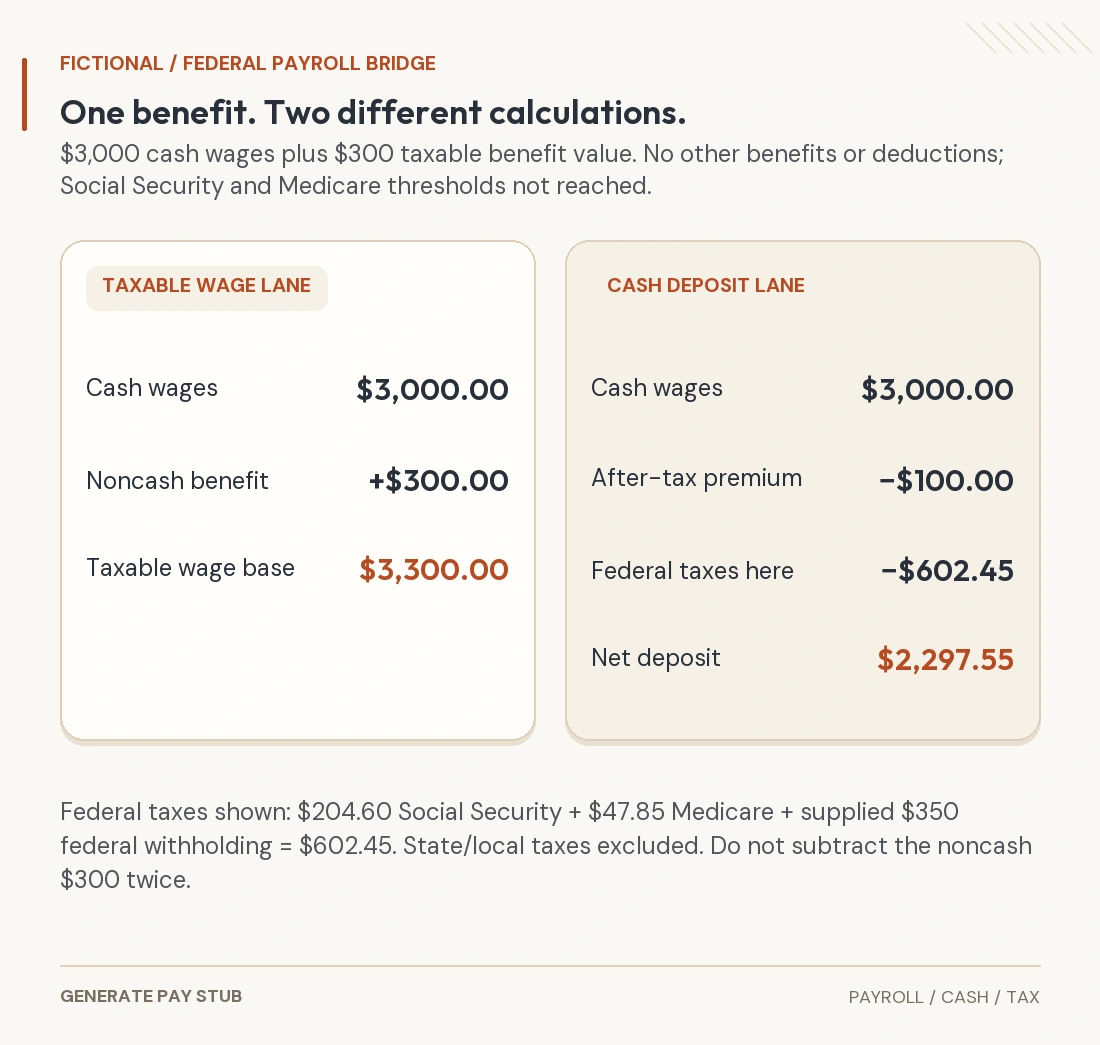
Domestic partner health insurance can add taxable, noncash income to your pay stub when the covered partner is neither your spouse nor your dependent under the federal health-benefit rules. You may also pay a separate after-tax premium. The premium, imputed benefit value and tax withheld are different amounts; adding them together as if all three were insurance charges can make a correct paycheck appear wrong.
This guide explains U.S. federal payroll treatment using a fictional 2026 example for an ordinary employee. State tax treatment and plan eligibility can differ. A benefits enrollment category does not, by itself, determine federal tax status.
What does domestic partner imputed income mean?
“DP imputed,” “domestic partner taxable benefit,” or another employer-specific label may represent the taxable value of coverage supplied to your partner. It is an addition to a tax calculation, not necessarily additional money paid to you. Your employer can cover someone under the benefit plan while the federal tax rules still require including that person’s coverage value in your wages.
The 2026 IRS fringe-benefit guide explains the general rule: a taxable employee fringe benefit enters pay unless an exclusion applies. Benefits provided to a family member can be treated as benefits received by the employee. Our broader imputed income guide explains other noncash benefit codes; the partner-coverage rules need the separate checks below.
| Stub item | What it represents | What to check |
|---|---|---|
| After-tax employee premium | Money deducted from the employee’s cash pay for coverage. | The amount allocated to partner coverage and the correct pay period. |
| Imputed benefit value | Taxable noncash coverage value after applicable exclusions and employee payments. | The employer’s valuation and whether a health-benefit dependent exception applies. |
| Additional withholding | Tax collected through payroll using the relevant taxable wage base. | Tax rates/thresholds and income-tax withholding method; this is not the premium itself. |
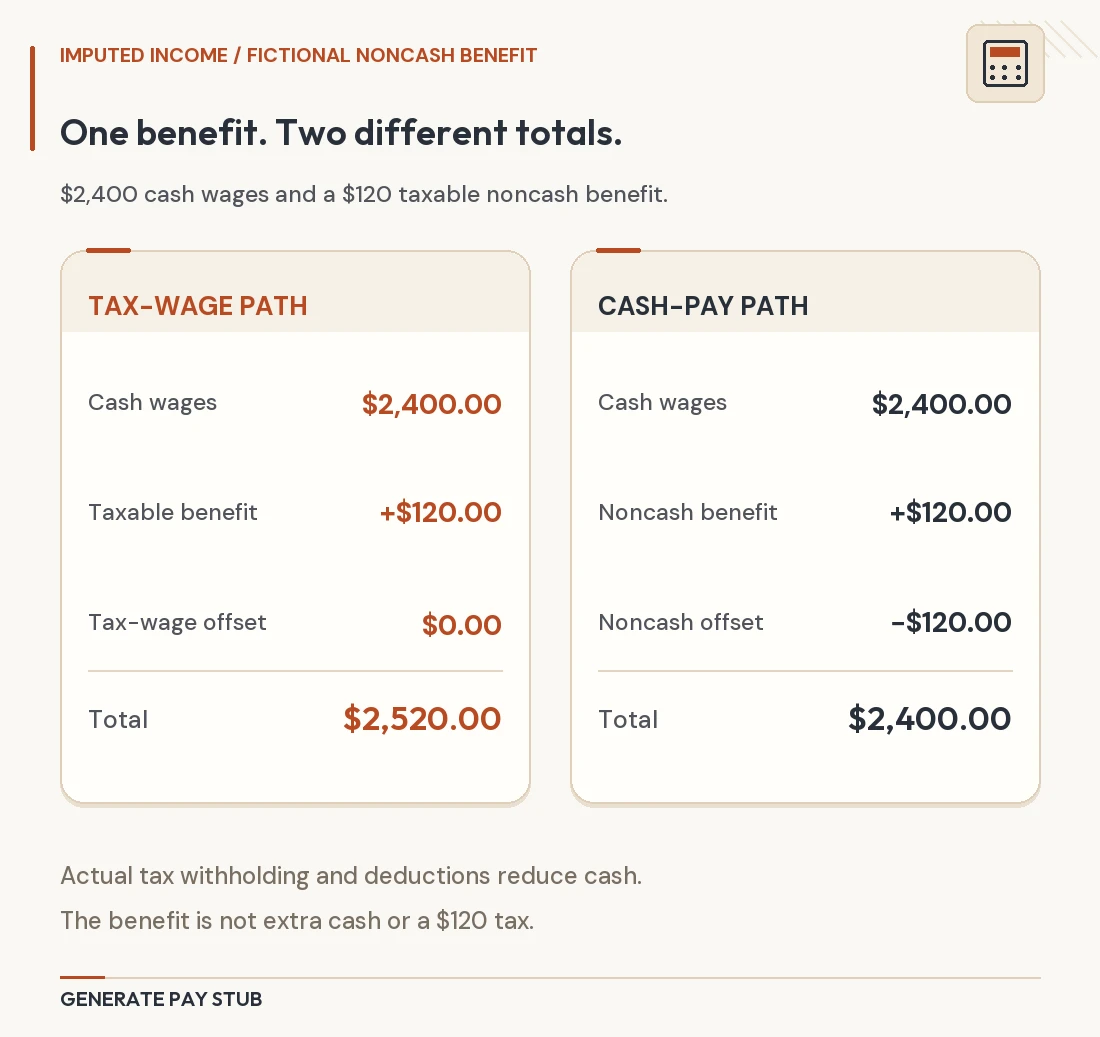
Payroll may show a noncash addition and a matching offset so the benefit enters taxable wages without becoming cash earnings. Another system may display the benefit only in a tax or memo section. Read the employer’s code definitions before deciding that an offset is an extra deduction.
When can a domestic partner’s health coverage be excluded?
A domestic partnership or civil union that is not a marriage does not make the partners spouses for federal tax purposes. A legally recognized marriage is a different category. The IRS’s registered domestic partner questions and answers explains this distinction and the special medical-benefit dependency rules.
A partner can nevertheless qualify as a dependent for the health-benefit exclusion. The IRS’s explanatory letter on domestic partner health coverage describes the usual conditions: the person is not another taxpayer’s qualifying child, meets the applicable citizenship or residency condition, belongs to the employee’s household for the full tax year and receives more than half of their support from the employee. This general IRS explanation is not a determination of any reader’s eligibility.
The health-benefit test is not identical to the tax-return qualifying-relative test. The IRS FAQ specifically explains that the medical-care rule does not apply the usual qualifying-relative gross-income ceiling. A partner having income does not automatically settle the health-benefit question. Equally, sharing rent or checking a “domestic partner” box does not prove that the employee supplied more than half of total support.
For registered partners in community-property situations, the FAQ also explains why support paid entirely from community funds may not establish that one partner supplied more than half of the other’s support. If this affects you, ask a qualified tax adviser to review the actual support facts. Do not use a household budget total as a substitute for that analysis.
Ask benefits administration which certification and supporting records its process requires, how it handles changes during the year and what happens if the year-end facts differ from the certification. A partner’s child may have a different exclusion analysis; do not automatically copy the partner’s tax status to every person on the coverage tier.
How is the taxable coverage amount calculated?
The general valuation framework in 26 CFR 1.61-21 starts with fair market value and subtracts amounts paid for the benefit and amounts specifically excluded by law. Fair market value is not automatically the employee’s preferred value, the employer’s cost or the difference between two advertised enrollment premiums.
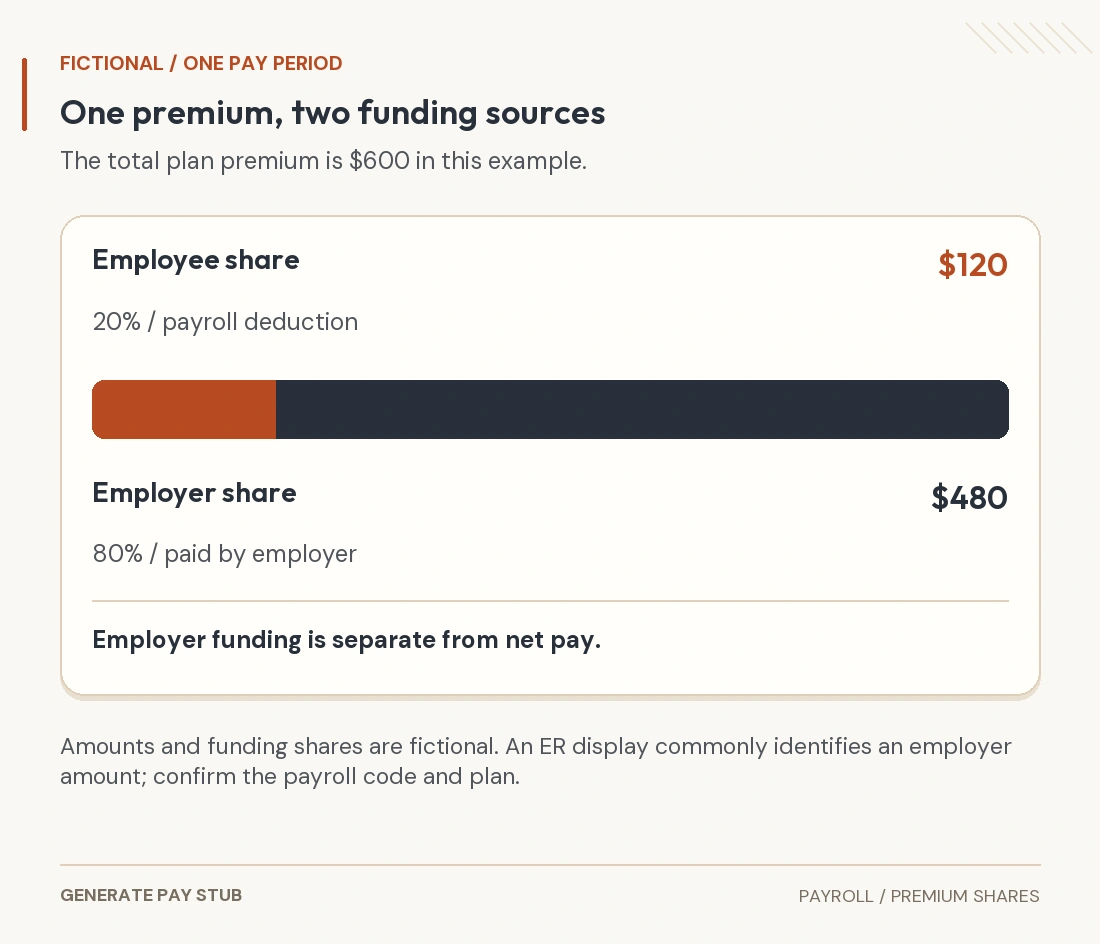
For a nonqualifying partner, the employee contribution for that taxable coverage is generally collected after tax. Ask payroll to distinguish any eligible pre-tax employee coverage from the nonqualifying partner’s portion. Our health insurance deduction guide explains why “EE,” “ER,” pre-tax and after-tax columns serve different purposes.
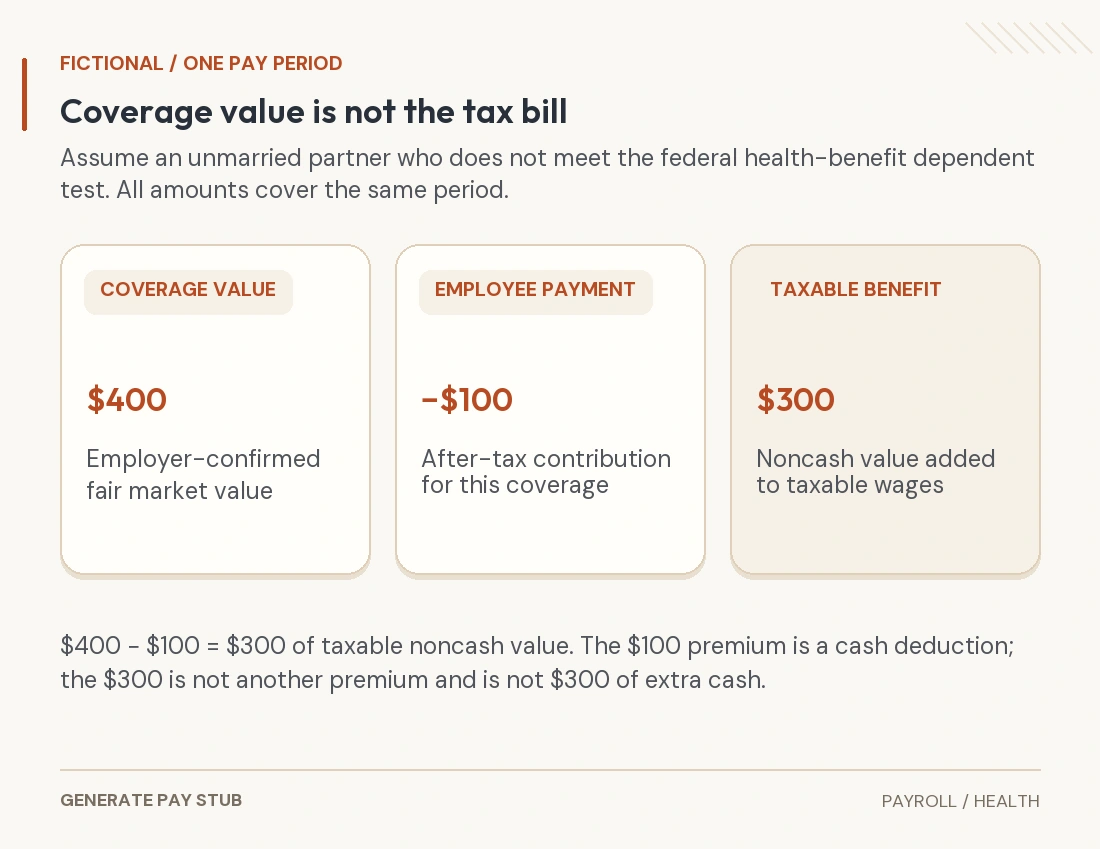
Assume the employer confirms $400 of fair market value for the partner’s coverage for one period, the employee pays $100 after tax for that same coverage, and no exclusion applies. The taxable noncash benefit is $300: $400 − $100. This is an illustration, not a universal valuation method or a quote for coverage.

If the employee pays the entire fair market value after tax, this general calculation leaves no remaining taxable fringe value. Confirm that result with the employer’s valuation rather than assuming that paying any premium eliminates imputed income. Also ask whether the amount labelled “imputed” has already been reduced by the employee payment; subtracting it again would understate the taxable benefit.
Why can taxable wages rise while the deposit falls?
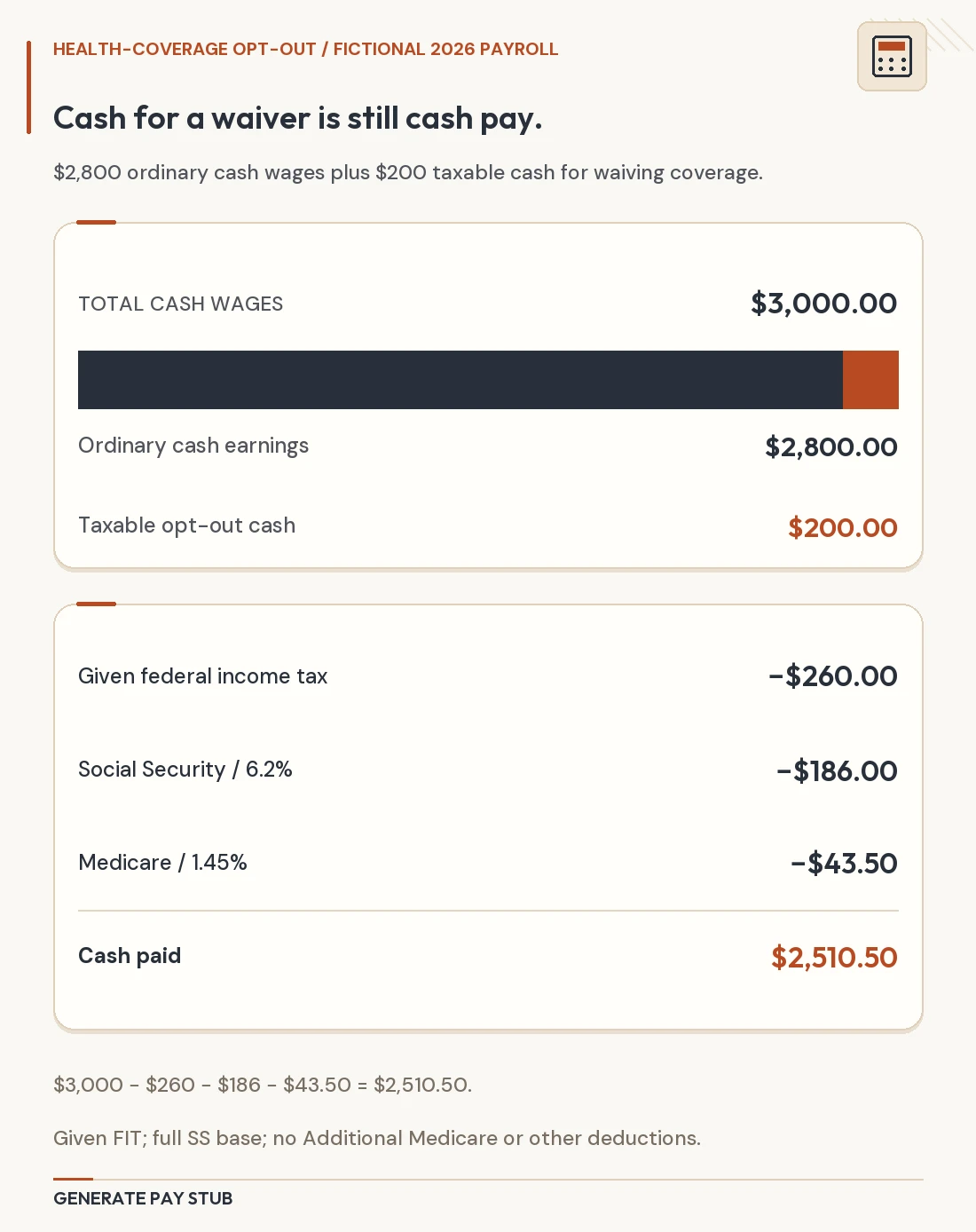
Keep cash and taxable wages in separate calculations. In this fictional check, the employee earns $3,000 cash wages and has the $300 taxable partner benefit calculated above. There are no other wage exclusions or adjustments. Federal income-tax and FICA wages are therefore $3,300, while available cash starts at $3,000.
Assume the employee is below the Social Security wage base and Additional Medicare withholding threshold. The 2026 federal payroll guide supplies the 6.2% employee Social Security and 1.45% Medicare rates. Federal income tax withheld is a supplied $350 assumption; an actual payroll calculation needs the applicable withholding method and Form W-4. No state/local tax is included.
| Item | Amount |
|---|---|
| Gross cash wages | $3,000.00 |
| Noncash benefit included in taxable wages | +$300.00 |
| Federal income-tax and FICA wage base in this example | $3,300.00 |
| Employee premium deducted from cash after tax | −$100.00 |
| Social Security: $3,300 × 6.2% | −$204.60 |
| Medicare: $3,300 × 1.45% | −$47.85 |
| Federal income tax withheld: assumed | −$350.00 |
| Net cash: $3,000 − $100 − $204.60 − $47.85 − $350 | $2,297.55 |

The noncash benefit adds $18.60 of Social Security and $4.35 of Medicare in this below-threshold illustration, compared with taxing $3,000 alone: $300 × 6.2% and $300 × 1.45%. It does not mean the employee owes $300 of extra tax. The income-tax withholding difference cannot be determined simply by multiplying the benefit by a universal rate.
To verify the deposit, either begin with $3,000 cash wages or begin with $3,300 displayed total earnings and remove the $300 noncash amount once. Do not begin with cash wages and subtract the noncash value again. This is the same distinction described in gross pay versus taxable wages.
What should you check on the W-2 and year-to-date totals?
Taxable coverage ordinarily enters the applicable annual wage boxes, including federal box 1 and the relevant Social Security/Medicare wage totals, subject to their rules. A dedicated box labelled “domestic partner” is not required to establish that the amount was included. Compare payroll’s annual taxable-benefit total with the wage reconciliation and ask about the treatment of any corrections.
Box 12 code DD is different. The IRS’s employer-sponsored health coverage reporting guidance explains that reporting coverage cost is informational and does not itself make the coverage taxable. Its chart includes domestic partner coverage that is included in gross income. Do not deduct code DD from wages or assume that it equals the imputed income figure.
Timing matters too. A monthly benefit value may be spread over selected payrolls or adjusted on a later check. Compare matching coverage months, deductions and taxable-benefit entries rather than dividing one monthly number by an assumed number of checks. For a large retroactive line, request the months, valuation rate, prior amounts already included and the reason for the adjustment.
State and local rules may recognize an exclusion differently from federal law. Different federal and state wage bases are therefore a question to investigate, not automatic proof of error. This article does not supply a state-by-state tax determination. Owners and more-than-2% S corporation shareholders also require separate rules; see the S corporation health insurance guide.
A practical message to payroll or benefits administration
Provide the pay date and the benefit-code names through the approved support channel. A useful request is:
Please explain the domestic partner premium and imputed-income entries on my [pay date] statement. Which coverage period do they represent, what fair market value was used, and has my after-tax payment already reduced the taxable value? Please confirm the federal and state wage treatment, the certification process for the health-benefit dependent exception, and any year-to-date correction included.
Include the election confirmation if needed, but do not send a partner’s identity documents, health details or full tax records through an unsecured message. Ask for the minimum evidence and approved upload method. If payroll needs to correct the record, retain its written explanation and the revised official statement.
Common questions about domestic partner deductions
Can I have both an after-tax premium and imputed income?
Yes. The premium is your payment for coverage; imputed income is the remaining taxable benefit value. Check the valuation before concluding that the two entries duplicate each other.
Is a registered domestic partner automatically a spouse for federal payroll tax?
No. A partnership registration and a marriage are different federal tax categories. The health-benefit dependent exception is a separate possible basis for exclusion.
Should I change a payroll code to reduce withholding?
Request a documented review instead. The correct treatment depends on the relationship, support facts, coverage valuation and applicable law; an edited label cannot establish the exclusion.
What should I retain after the issue is resolved?
Keep the enrollment notice, relevant certification, valuation explanation, matching pay statements and any correction documents. Those records explain why the taxable wages and cash deposit differ.