
Imputed income on a pay stub usually means the employer has assigned a taxable value to a benefit you received without receiving that value as cash. It can raise a tax-wage figure while leaving the cash wages for that pay period unchanged. The key question is not “Where is the extra money?” but “What benefit was valued, which taxes apply, and how did payroll keep it out of the cash deposit?”
This guide explains the U.S. federal payroll treatment for 2026, with a worked pay-stub bridge and a group-term life insurance example. A line labeled “imputed income,” “fringe,” or “GTL” is only a clue: the employer’s benefit records and tax treatment determine the correct amount. The IRS’s 2026 Publication 15-B is the main federal source for fringe-benefit exclusions, valuation, withholding, and reporting.
What is imputed income in payroll?
A fringe benefit is generally taxable compensation unless a tax rule excludes it. The taxable portion is the benefit’s value under the applicable IRS method, reduced by an available exclusion and, where relevant, what the employee paid for it. “Imputed income” is a common payroll label for that taxable noncash portion. It is not a second cash paycheck, and it is not automatically the employer’s full cost of the benefit.
The label also does not mean every employer-provided benefit is taxable. Qualified employer accident and health coverage is generally excluded for an ordinary employee, subject to important exceptions. Business use of a company vehicle may be a working-condition benefit, whereas personal use can be taxable. The 2026 IRS fringe-benefit guide has separate rules for each type; payroll should identify the specific benefit before assigning a taxable amount.
Why can taxable pay rise when the deposit does not?
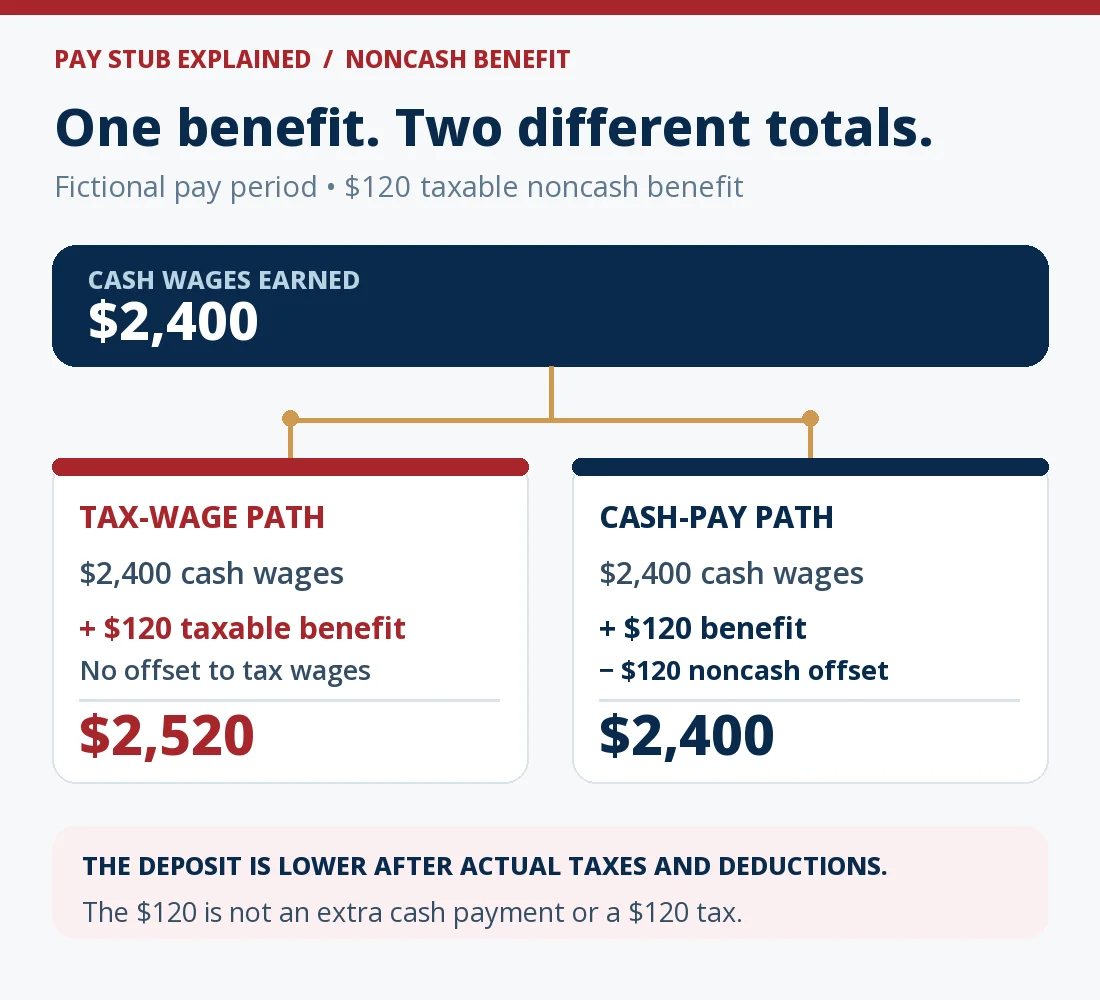
Consider a fictional pay period with $2,400 in cash wages and a $120 taxable, noncash benefit. Assume for this illustration that the $120 is included in federal income-tax, Social Security, and Medicare wages, that no other wage adjustments apply, and that the employee is below the Social Security wage base. A payroll system might display the benefit as an earnings addition and a matching noncash offset so it is counted for tax purposes but is not paid again in cash. Other systems may show a separate informational line or different labels.
| Step | Illustrative amount | What it means |
|---|---|---|
| Cash wages earned | $2,400 | Cash compensation before taxes and deductions |
| Add taxable noncash benefit | +$120 | Raises the applicable tax-wage bases to $2,520 in this example |
| Noncash offset | −$120 | Removes the benefit value from the cash-payment calculation; it is not a second charge for the benefit |
| Cash available before taxes and other deductions | $2,400 | The deposit then depends on actual withholding and other deductions |
The offset is a display and accounting convention, not a universal legal requirement or an extra employee deduction. Withholding on the taxable benefit may reduce take-home cash. The exact reduction cannot be calculated from $120 alone: income-tax withholding depends on the benefit type and payroll method, while Social Security and Medicare depend on the employee’s wage and tax situation. An employer may have special federal income-tax withholding choices for particular benefits, including group-term life coverage over $50,000 and personal use of an employer-provided highway motor vehicle. See Publication 15-B’s reporting rules. A lower deposit does not mean the employee “paid” the full benefit value.
Which benefits may produce an imputed-income line?
| Benefit | Potential payroll treatment | What to verify |
|---|---|---|
| Employer-paid group-term life insurance | The IRS-calculated cost of coverage over $50,000, less applicable employee payments, is generally included in wages. | Coverage amount, employee age for the IRS table, months covered, employee contribution, and W-2 code C. |
| Personal use of an employer-provided vehicle | Taxable value of personal use may be included; substantiated business use can qualify for an exclusion. | Mileage or other records and the permitted valuation method. |
| Employer accident and health coverage | Generally excluded for an ordinary employee under qualifying rules; special exceptions exist, including certain S corporation shareholder-employees. | The plan, eligible person covered, and any special tax status. Do not infer taxability from a premium amount alone. |
| Other perks or reimbursements | Treatment varies. A cash-equivalent gift card, for example, is not excluded as a minimal-value benefit merely because its amount is small. | The precise benefit and any applicable statutory exclusion or accountable-plan rule. |
These are examples, not a complete benefits classification chart. The IRS overview and exclusions in Publication 15-B cover additional benefits and restrictions. For an individual stub, ask payroll for the benefit name and valuation method instead of treating every line with “imputed” in its name alike.
How is group-term life insurance imputed income calculated?
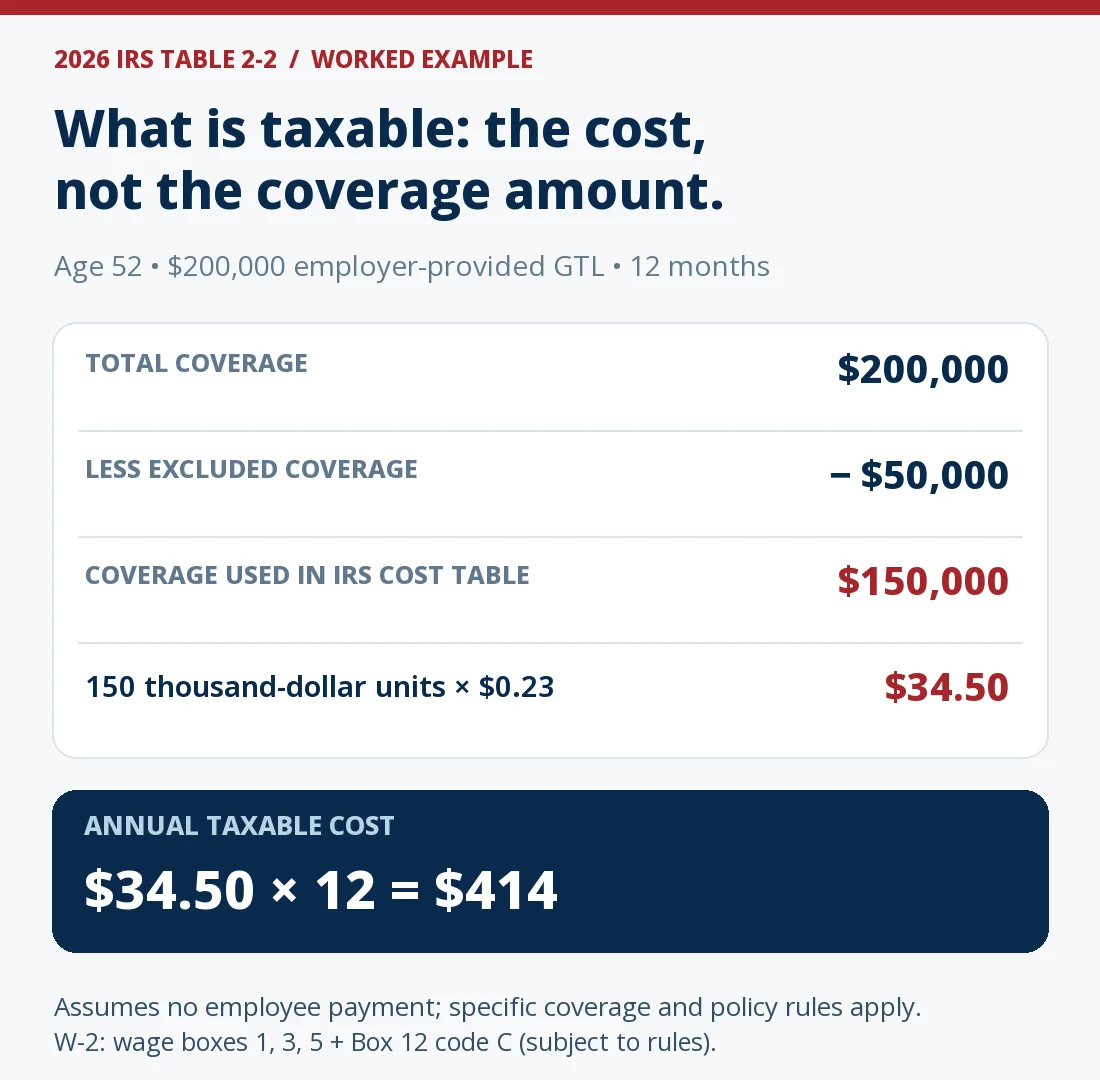
Group-term life insurance, often abbreviated GTL, is a useful example because the IRS provides a specific table. In general, the cost of the first $50,000 of qualifying employer-provided coverage is excluded. The cost of coverage above that limit is calculated using Publication 15-B, Table 2-2 and reduced by what the employee paid for the insurance. The excess coverage amount is not itself the amount added to wages.
Suppose a fictional employee is 52 at the end of the tax year, has $200,000 of qualifying employer-provided group-term life coverage for all 12 months of 2026, and pays nothing toward it. The exclusion leaves $150,000 of coverage above $50,000. Table 2-2 gives the age-50-through-54 rate as $0.23 per $1,000 of excess coverage per month. The taxable cost is 150 × $0.23 = $34.50 per month, or $414 for the year if those facts remain unchanged. A different age, coverage period, employee payment, or policy structure changes the result; payroll may allocate the annual amount across pay periods under the applicable timing rules.
For a current employee, the IRS says the taxable GTL cost is reported in W-2 Boxes 1, 3, and 5 and again in Box 12 with code C; the Box 3 amount remains subject to the Social Security wage base. Social Security and Medicare taxes apply to that cost. The employer may choose whether to withhold federal income tax on it, so a GTL line does not always cause an extra federal income-tax withholding amount on that particular stub. See the 2026 Publication 15-B group-term life section and the 2026 W-2 instructions. Former-employee coverage has separate collection and W-2 code rules.
Where should the amount appear on a pay stub and W-2?
A stub may use “imputed income,” “GTL,” “fringe benefit,” “noncash compensation,” or an employer-specific abbreviation. Some systems show an earning and matching offset; others separate taxable wages from cash gross. The IRS reporting rules do not prescribe one universal pay-stub layout. Look for the benefit’s current-period value, the applicable taxable-wage bases, any noncash offset, and the year-to-date totals. Our gross pay versus taxable wages guide explains why those bases can differ even without a noncash benefit.
For the annual W-2, the IRS instructions generally require taxable fringe benefits in Box 1 and, when applicable, in Boxes 3 and 5. Some benefits need an additional code or disclosure: taxable GTL cost uses Box 12, code C. Do not confuse this with code DD, which reports the cost of certain employer-sponsored health coverage for information and is not taxable income merely because it appears there. A Box 12 amount can already be included in a wage box; adding it again would double count it. Our final pay stub versus W-2 guide provides a full year-end wage-box reconciliation.
When might the line appear?
Taxable noncash benefits do not always appear in the same period in which an employee first notices the benefit. The IRS timing rules permit many such benefits to be treated as paid by pay period, quarter, semiannual period, annually, or another interval, but at least once a year. A limited special accounting rule can shift qualifying benefits actually provided in the final two months into the following tax year. These rules have conditions and do not mean that an employer can freely delay every taxable benefit. An annual vehicle-use adjustment, for example, can make a late-year stub look different from earlier ones.
If a line appears unexpectedly, ask which benefit period it covers and which payroll date was used to treat it as paid. For a year-end question, compare the employer’s benefit valuation schedule and W-2 records rather than multiplying one stub’s current amount by the number of paychecks.
How to check an imputed-income line without guessing
- Identify the benefit. Ask payroll what the abbreviation stands for and whether it represents a noncash benefit, cash pay, or an adjustment.
- Get the valuation basis. Request the relevant coverage amount, vehicle-use record, employee contribution, benefit dates, and IRS valuation method. For GTL, ask for the Table 2-2 age band and calculation.
- Check the exclusion. Confirm why the benefit is taxable, partly taxable, or excluded under the applicable rule. Do not assume the full employer cost is taxable.
- Trace both paths. Compare cash wages and deposit with taxable-wage lines. If an equal and opposite noncash offset appears, confirm that it removes the benefit from cash payable without removing it from the relevant tax bases.
- Compare withholding by type. Review federal income tax, Social Security, Medicare, and state withholding separately. Federal income-tax withholding is not identical for every fringe benefit.
- Reconcile year-end reporting. Check the applicable W-2 wage boxes and benefit-specific codes. If the employer confirms an error after issuing a W-2, request its formal correction process rather than editing a pay stub or tax form yourself.
For a useful payroll inquiry, send the pay date, exact line label, amount, benefit period, and the specific wage or withholding figure you cannot reconcile. Keep the employer’s written explanation with your records. A user-created pay stub can organize known figures, but it cannot establish the employer’s benefit valuation or replace an employer-filed W-2.
Common questions
Does imputed income increase my take-home pay?
Usually no: the noncash benefit can raise applicable taxable wages without adding cash wages. Taxes attributable to it can lower the cash deposit, depending on the benefit and withholding method. Check the actual stub rather than assuming every $1 of imputed income reduces the deposit by $1.
Is imputed income the same as a deduction?
No. The taxable benefit value is an addition to an applicable wage base. A matching noncash offset on some stub layouts prevents paying the benefit value again in cash; it is not the same thing as an employee-funded premium or tax withholding. The labels and layout vary by payroll system.
Why is GTL in Box 12 code C and Box 1?
Code C identifies the taxable cost of qualifying group-term life coverage over $50,000. The IRS also requires that taxable cost in Box 1 and applicable Social Security and Medicare wage boxes. The code C amount is a disclosure of the wage item, not extra wages to add a second time.
Can a lender treat imputed income as cash earnings?
It depends on what the lender asks to verify. A W-2 taxable-wage figure may include noncash compensation, while a request for cash pay or funds available for repayment asks a different question. Give the unaltered employer records and explain the line; let the lender apply its own documentation rules.