A health FSA deduction on a pay stub is usually an employee’s pretax salary reduction for an employer-sponsored medical reimbursement benefit. When the arrangement qualifies under federal rules, the deduction generally reduces federal income-tax, Social Security, and Medicare wages. The payroll amount is not necessarily the benefit available to spend: a health FSA can reimburse eligible expenses up to the annual coverage amount before all scheduled deductions have been collected.
This U.S. guide was reviewed October 18, 2026 and addresses ordinary health flexible spending arrangements for plan years beginning in 2026. It separates federal rules from employer plan choices and uses fictional calendar-year examples. A health FSA, dependent-care FSA, HSA, HRA, and health-insurance premium are different benefits. State tax treatment, special participant rules, and the written plan require their own checks.
What does FSA mean on a pay stub?
Identify the actual benefit behind the code. HEALTH FSA, MED FSA, HCFSA, or FLEX MED may identify a health FSA election. Employers choose their own abbreviations. A generic FSA label could instead refer to dependent care, so ask for the plan name and deduction description rather than inferring the tax rules from three letters.
A health FSA is an employer-established arrangement that reimburses eligible out-of-pocket medical expenses. The employee elects an annual salary reduction, payroll collects it according to the plan’s schedule, and the administrator processes claims. An employer can also provide funding under the plan. The HealthCare.gov FSA overview explains the basic purpose and notes that employer funding is optional.
Keep four records distinct: the annual election, the current paycheck deduction, YTD deductions, and the administrator’s remaining reimbursement benefit. They answer different questions. An informational employer-benefit line should not automatically be subtracted from your wages a second time.
An FSA debit-card transaction or claim reimbursement is also different from a payroll deduction. A qualified reimbursement ordinarily pays an eligible expense from the benefit; it is not a new salary reduction or additional taxable salary merely because it reaches your bank account. Keep the claim explanation with the receipt, especially if reimbursement is delivered through a payroll channel.
What is the health FSA contribution limit for 2026?
The federal employee salary-reduction ceiling is $3,400 for a health FSA plan year beginning in 2026. The employer can set a lower election maximum. The 2026 IRS fringe-benefit guide states the current limit; Revenue Procedure 2025-32, section 4.15, supplies both the salary-reduction figure and the indexed carryover ceiling.
| Rule | What the figure limits | Federal ceiling |
|---|---|---|
| Employee salary reduction | New employee health FSA election for the plan year | $3,400 |
| Optional carryover | Unused amount from that plan year allowed into the following one | $680 |
The $680 is not an automatic payment or an extra $680 payroll deduction. It is the maximum optional carryover associated with the 2026 plan year. A plan may allow less or no carryover. Do not use this table as a prediction of the next plan year’s new election limit.
The ceiling applies per employee, not per covered family member. Having a spouse and two children does not multiply one employee’s election limit by four. If both spouses are eligible through their employment, each can have a separate employee election, subject to their plans. Employers in the same controlled group are combined for this rule; genuinely unrelated employers can have separate limits. IRS Notice 2012-40 explains those structural rules. Its original dollar figures are historical; use the current 2026 amounts above.
A non-calendar plan year is not automatically a short plan year. An ordinary July-to-June year still lasts 12 months; check its start year for the applicable limit. The federal ceiling is prorated when the plan itself has a short year, which is different from an employee simply enrolling or joining employment partway through a normal year. Let the administrator apply the actual plan and eligibility rules before increasing a remaining-paycheck deduction.
Does employer funding count against the $3,400?
Qualifying employer nonelective funding can be separate from the employee salary-reduction limit. Notice 2012-40 distinguishes that funding from flex credits an employee can choose to receive as cash or a taxable benefit: the latter count as salary reductions for this test. An employer-labeled amount is therefore not automatically outside the ceiling. Plan design and other benefit rules still matter.
Similarly, an allowed carryover does not reduce the following year’s permitted new salary-reduction election. That does not mean every old balance carries over, that the employee receives it in cash, or that the administrator has already finalized the carryover before pending old-year claims are processed.
How does a health FSA affect taxable wages and take-home pay?
A qualifying pretax health FSA generally reduces all three ordinary federal payroll wage bases. This differs from a traditional 401(k) deferral, which generally does not reduce Social Security or Medicare wages. The IRS cafeteria-plan and accident/health exclusions explain the federal treatment. Our deduction classification guide explains why the actual arrangement matters.
Consider one fictional 2026 paycheck with $2,400 of otherwise taxable cash wages and a $100 qualifying employee health FSA salary reduction. Assume no retirement deferral, other pretax benefit, state/local tax, garnishment, or other deduction. All wages fit below the remaining Social Security cap and do not cross the employer’s Additional Medicare withholding threshold. Federal income-tax withholding is given as $185; this is not a withholding-table calculation for an unspecified W-4.
| Payroll item | Calculation or treatment | Amount |
|---|---|---|
| Cash gross wages | Starting earnings | $2,400.00 |
| Employee health FSA | Qualifying pretax salary reduction | $100.00 |
| Federal income-tax / FICA wages | $2,400 − $100 | $2,300.00 |
| Federal income tax withheld | Given payroll result | $185.00 |
| Employee Social Security | $2,300 × 6.2% | $142.60 |
| Employee Medicare | $2,300 × 1.45% | $33.35 |
| Total employee taxes | $185 + $142.60 + $33.35 | $360.95 |
| Net cash paid | $2,400 − $100 − $360.95 | $1,939.05 |

The employee FICA rates follow IRS payroll-tax guidance. The example reconciles cash and wage bases; it does not say every employee saves a fixed percentage or receives the same withholding result. An actual paycheck needs the person’s W-4, payment frequency, wage history, other benefits, and applicable state/local rules.
Do not subtract $100 from gross to calculate taxable wages, then subtract it again from the $2,300 cash remaining after the benefit deduction. The complete cash equation starts with $2,400 and deducts the FSA once, plus applicable employee taxes. See our gross versus taxable wages guide and net-pay reconciliation for that distinction.
Does the FSA appear in W-2 box 12 with code W?
Code W identifies HSA employer/cafeteria-plan contributions, not ordinary health FSA salary reductions. The 2026 W-2 instructions make that distinction. A qualifying health FSA is generally reflected through the applicable wage exclusions rather than a new code W amount. An employer may provide additional informational detail; that does not change what code W means.
The ordinary pretax election should not be deducted again on the tax return as a new medical contribution. A qualified expense already reimbursed by the FSA cannot also support an itemized medical deduction. Special distributions or a confirmed payroll error can have different reporting, so obtain the actual correction explanation rather than manually changing wage totals.
Why can the available FSA benefit exceed payroll deductions collected?
A health FSA normally provides uniform coverage across the coverage period. Eligible claims can be reimbursed up to the annual elected benefit before the employee has completed every payroll deduction. This is not a bank-account rule requiring each dollar to be deposited first. The IRS FSA distribution guidance explains this availability rule; its posted 2025 dollar limits are not used as 2026 limits here.
In a separate fictional calendar-year 2026 plan, the employee elects $2,400 over 24 scheduled deductions of $100. The employer adds $600 of qualifying nonelective funding, and the plan provides the combined $3,000 annual reimbursement benefit from the coverage start. Assume continuous eligibility, no carryover, no previous claims, and no plan-specific restriction affecting this example.
After two paychecks, employee deductions total only $200. An eligible, properly substantiated $1,200 expense incurred during coverage can nevertheless be reimbursed from the annual benefit. That leaves $1,800 of reimbursement benefit, while $2,200 of the employee’s elected salary reductions remain scheduled. Track the remaining benefit and the remaining salary-reduction obligation separately.

Using the full available benefit does not by itself cancel the remaining election or stop payroll deductions. Likewise, an employer contribution displayed for information should not be added to cash wages or withheld from the employee unless the actual payroll treatment requires it. Match the plan’s funding record instead of treating every benefits-page amount as a current-period cash transaction.
Which medical expenses and receipts qualify?
The benefit generally covers qualifying unreimbursed medical expenses incurred during the coverage period, such as eligible deductibles, copayments, prescriptions, dental care, or eyeglasses under the plan. Health insurance premiums, long-term care expenses, and amounts already paid by another health plan generally cannot be reimbursed from a health FSA. Publication 969’s qualified-expense section explains these boundaries.
The service date, amount, patient eligibility, and independent supporting documentation matter. A later invoice or card-processing date does not automatically move an expense into a different coverage year. The FSA cannot reimburse an expense merely projected for next year. A debit card also does not remove substantiation requirements; keep an itemized receipt or explanation of benefits and respond to the administrator’s requests. Do not submit one expense to two reimbursement arrangements or count it twice on a tax return.
How do carryover, a grace period, and a run-out period differ?
Carryover and a grace period can permit some new-year expenses; a run-out period generally only permits submission of claims for the earlier coverage period. These terms are not interchangeable. The plan may offer a carryover or a health FSA grace period, but generally cannot offer both for the same plan year. Neither feature is required.
IRS Notice 2013-71 distinguishes carryover from the claim-submission run-out period. Notice 2020-33 indexes the carryover ceiling to 20% of that plan year’s salary-reduction limit. Use the 2026 $680 maximum rather than the notices’ original historical dollar examples.
| Feature | What it can allow | What it does not establish |
|---|---|---|
| Carryover | A permitted unused amount can reimburse eligible expenses in the following plan year | No automatic cash refund or unlimited balance transfer |
| Grace period | If adopted, up to 2½ months after plan-year end to incur additional eligible expenses using old-year funds | Not a second carryover provision for the same health FSA year |
| Run-out period | Additional time specified by the plan to submit claims for expenses incurred in the applicable coverage period | Does not by itself extend the date for incurring an expense |
Fictional run-out example: a calendar-year plan has no grace period or carryover but allows 2026 claims to be submitted through March 31, 2027. An eligible December 10, 2026 service submitted February 5, 2027 can still be considered a 2026 claim. A January 15, 2027 service does not become a 2026 expense simply because the paperwork deadline is in March.
Alternative grace-period plan: if the employer instead adopts the full ordinary 2½-month grace period for its 2026 calendar year, qualifying new expenses through March 15, 2027 can use remaining 2026 funds under its terms. The claims-submission deadline is a separate date to confirm.
Alternative carryover plan: if $600 remains after eligible old-year claims are settled and the plan allows the full 2026 carryover, that $600 can move into the following plan year. It is not another $600 deducted from pay. If the plan permits only $400, do not assume the federal $680 ceiling entitles the employee to carry all $600. These are different fictional plans, not three features combined in one account.

Pending claims can change the carryover amount. The administrator may reserve old-year funds while processing claims; a provisional year-end number is not necessarily the final available carryover. Amounts that cannot be used or carried under the actual plan are generally forfeited rather than refunded as ordinary cash. Special statutory exceptions need their own review; do not treat historical pandemic extensions as the default 2026 rule.
Can you use a health FSA and still contribute to an HSA?
General-purpose health FSA coverage can make someone ineligible to contribute to an HSA. Having an HSA-qualified high-deductible policy alone does not resolve other-coverage restrictions. Coverage through a spouse’s general-purpose FSA can matter when it can reimburse your expenses. This is a coverage issue, not just whether you personally swiped an FSA card.
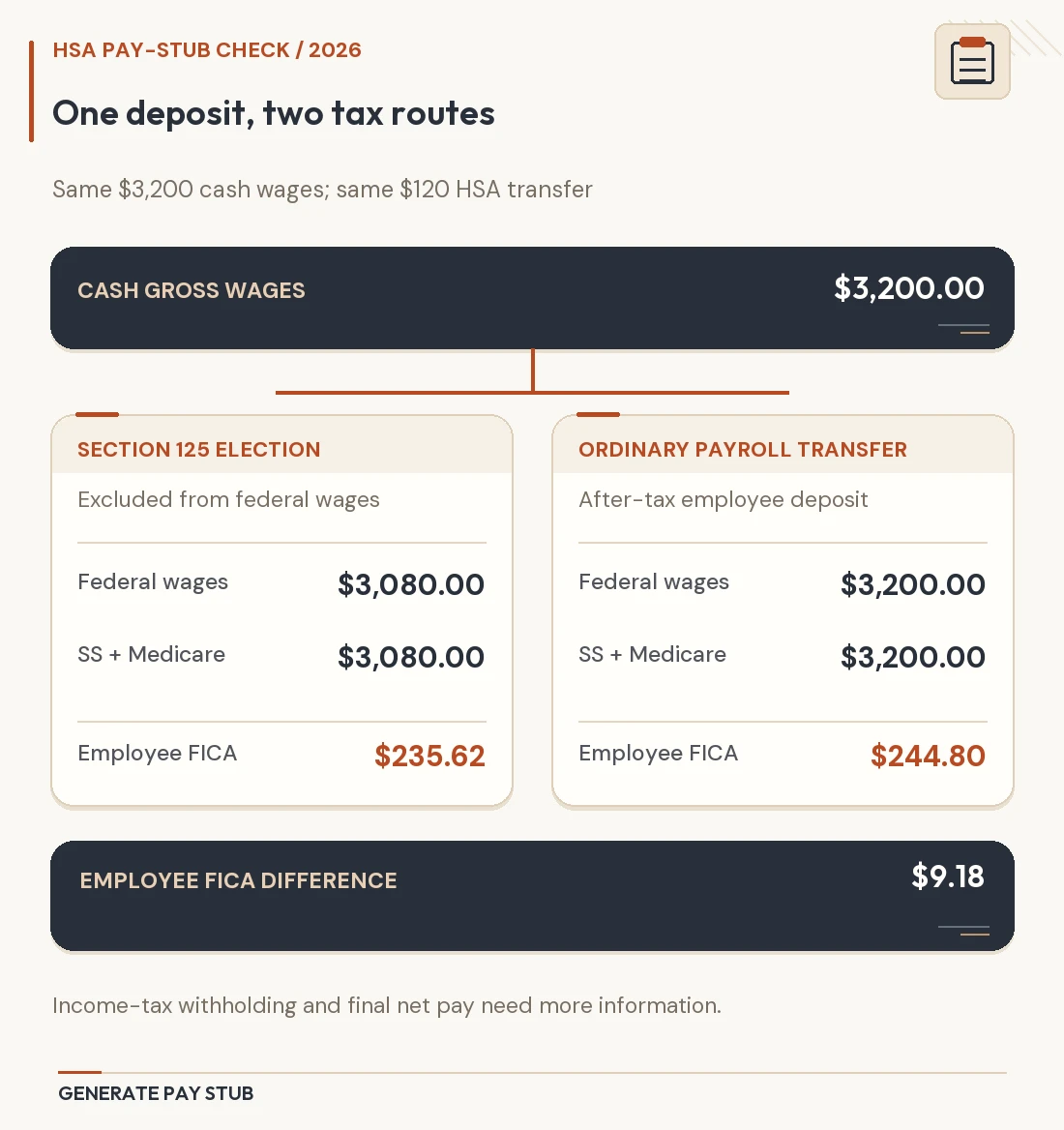
Limited-purpose arrangements, commonly restricted to eligible dental and vision expenses, and qualifying post-deductible arrangements can work differently. Grace-period or carryover coverage can also affect the timing of HSA eligibility. The IRS HSA eligibility guidance explains the relevant coverage distinctions. Confirm the plan’s actual design and transition terms with both administrators before starting or increasing HSA contributions. Our HSA pay-stub guide covers that separate deduction and reporting workflow.
Unlike an HSA, an ordinary health FSA does not itself require an HSA-qualified high-deductible policy. Participation depends on the employer’s plan and employee eligibility; self-employed individuals are not eligible for this employee benefit merely by creating a payroll deduction.
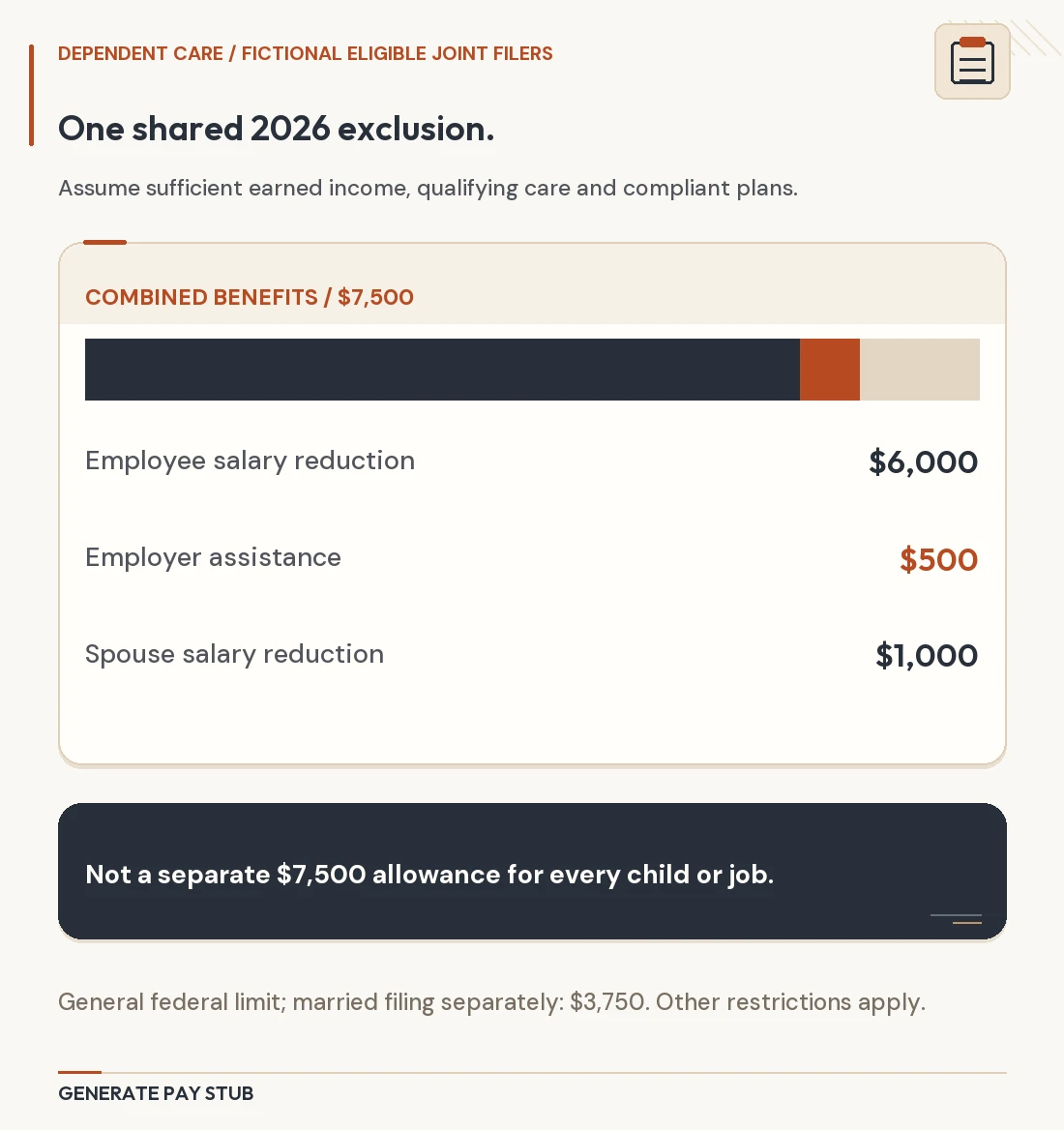
A dependent-care FSA serves a different expense category and has different limits, reimbursement rules, and W-2 reporting. An HRA is generally employer-funded rather than an employee salary-reduction account. Do not combine all FLEX codes into one contribution total or apply this article’s health FSA ceiling to childcare benefits.
Can you change the election, stop deductions, or keep the FSA after leaving?
A health FSA election is generally fixed for its coverage period unless both the law and the plan allow a change. The cafeteria-plan election regulation permits specified changes; it does not require every plan to allow every change. A permitted status change must meet the applicable consistency rules. An unused balance, a lower expected medical bill, or a desire for a larger paycheck does not by itself establish a right to stop deductions.
Health FSA elections also do not follow every cost/coverage-change rule available for ordinary health insurance or dependent care. Send benefits staff the event date and requested change; obtain the approved effective date and revised remaining-paycheck schedule. If a deduction was simply entered incorrectly, distinguish an error correction from an elective midyear change.
What if a paycheck is missed or the employee takes leave?
A zero-pay period, leave, payroll-frequency change, or delayed enrollment setup can make a simple annual-election-divided-by-checks calculation wrong. Ask whether coverage continues, what payment method applies, whether catch-up deductions are required, and which remaining checks the plan uses. Do not invent a new election from the number of checks left or cancel coverage solely because the latest payroll deduction was zero.
What happens when employment ends?
Obtain the actual FSA coverage-end date, the last date to incur eligible expenses, and the claim-submission deadline. They may differ from the final paycheck date and from the dates for other insurance. Prior eligible claims can still have a submission window; that does not automatically make post-coverage expenses reimbursable.
Health FSAs have special continuation-coverage rules. The COBRA regulation, Q&A-8, limits certain health FSAs’ obligations based on the plan and remaining-benefit conditions. Do not assume every balance receives 18 months of continuation or transfers to a new employer. Ask for the applicable notice, premium, election deadline, and coverage period. The DOL worker COBRA FAQ explains the broader process.
Unused amounts are generally not a departing employee’s cash savings account. Any permitted continuation and timely eligible claims need to be settled under the actual plan. Keep the last payroll statement, election, claim history, coverage notice, and administrator’s determination together. Our pay-stub access guide can help preserve records before portal access ends.
How do you check an FSA deduction before accepting the totals?
- Confirm the benefit type. Separate health FSA, limited-purpose FSA, dependent care, HSA, HRA, and insurance premiums.
- Identify the plan year. Save the coverage dates, annual election, allowed employer funding, remaining payroll schedule, and any approved change.
- Reconcile payroll. Match the current deduction and plan-year collection total to the election. A calendar-year pay-stub YTD total may not equal a non-calendar plan-year total.
- Check wage treatment. Review federal and applicable state tax bases, employee withholding, and net cash without deducting the benefit twice.
- Match benefit use separately. Review claims, substantiation, reimbursement dates, employer funding, pending items, and remaining coverage.
- Write down every deadline. Distinguish dates for incurring expenses, filing claims, allowed grace/carryover provisions, and termination or continuation.
- Check annual reporting. Do not treat an ordinary health FSA as W-2 code W or deduct the same pretax amount again on the return.
A useful payroll question is: “My approved health FSA election is $2,400 over 24 deductions. Which checks were included in the YTD total, and does that total follow the calendar year or the plan year?” A useful benefits question is: “What is my remaining reimbursable benefit after pending claims, and which service and submission dates apply?”
If records disagree, request a documented correction from payroll or the administrator. The pay-stub correction workflow helps preserve the original record and exact issue. When preparing a statement with Generate Pay Stub, enter verified payroll figures and label the real deduction. A generated document cannot create benefit eligibility, approve a claim, or extend an FSA deadline. Use our source-record checklist to keep the statement traceable.