A healthcare pay stub should be checked against actual work time, the applicable overtime system and every earning component that affects the regular rate. Being paid every two weeks does not, by itself, mean overtime starts after 80 hours. Some eligible hospitals and residential-care employers can use a specific federal “8 and 80” arrangement, with conditions that differ from ordinary weekly overtime.
This U.S. guide reviews federal rules and selected state context available in November 2026. Its worked examples concern covered nonexempt employees. Professional exemptions, collective agreements, employer policies and state protections can change the analysis; a medical job title alone does not settle it.
Do not decide overtime status from a healthcare title alone
The DOL’s nursing exemption guidance distinguishes hourly registered nurses, potentially exempt salaried registered nurses meeting the required tests, and licensed practical nurses who generally do not meet the learned-professional exemption. Different healthcare occupations and duties require their own analysis.
Ask payroll which status and overtime arrangement actually apply to you. A salary amount, an RN license or a “per diem” job label is not a complete explanation of the applicable rules. Keep the employment terms and any agreement identifying the overtime method with your records.
Then identify the pay-stub codes for ordinary work, additional shifts, night or weekend differentials, callback pay, leave and adjustments. Two lines showing hours can represent different components of the same worked time. Do not add quantities automatically without understanding what each line measures.
Start with the clinical time record, not just scheduled shifts
The DOL healthcare hours-worked guide addresses work before or after a scheduled shift, duty during meal periods, required training and travel between work locations. Time that the employer knows or has reason to know is being worked can matter even when it was not separately approved in advance.
For example, distinguish the shift schedule from actual handoff, charting and other work. Record the dates and tasks that explain a discrepancy. If an unpaid meal was interrupted by required patient care, use the employer’s correction process and preserve what happened rather than assuming an automatic deduction proves the break was duty-free.
State protections can be more specific. Washington’s healthcare labor-standards guidance, for example, addresses covered workers’ meal/rest protections and limits on mandatory overtime. That state framework should not be applied automatically to every healthcare job nationwide.
Weekly overtime and the federal 8-and-80 exception are different systems
Under the ordinary federal framework, covered nonexempt overtime is generally evaluated by workweek. The special hospital/residential-care arrangement is described in DOL Fact Sheet 54: eligible employers need a prior agreement or understanding, and the fixed 14-day system requires overtime for daily work beyond eight hours as well as work beyond 80 hours in the period.
29 CFR 778.601 explains the recurring 14-day period and prohibits switching back and forth merely to exploit whichever system produces a lower overtime obligation for particular schedules. A two-week payday calendar, clinic job or employer’s use of “biweekly” terminology does not itself establish eligibility for the exception.
When the rule is unclear, ask for the workweek or fixed work-period boundaries and the applicable agreement. A pay period can contain parts of different workweeks; reviewing only the total printed at the bottom can hide the relevant daily or weekly pattern.
Fictional 8-and-80 example: six 12-hour shifts
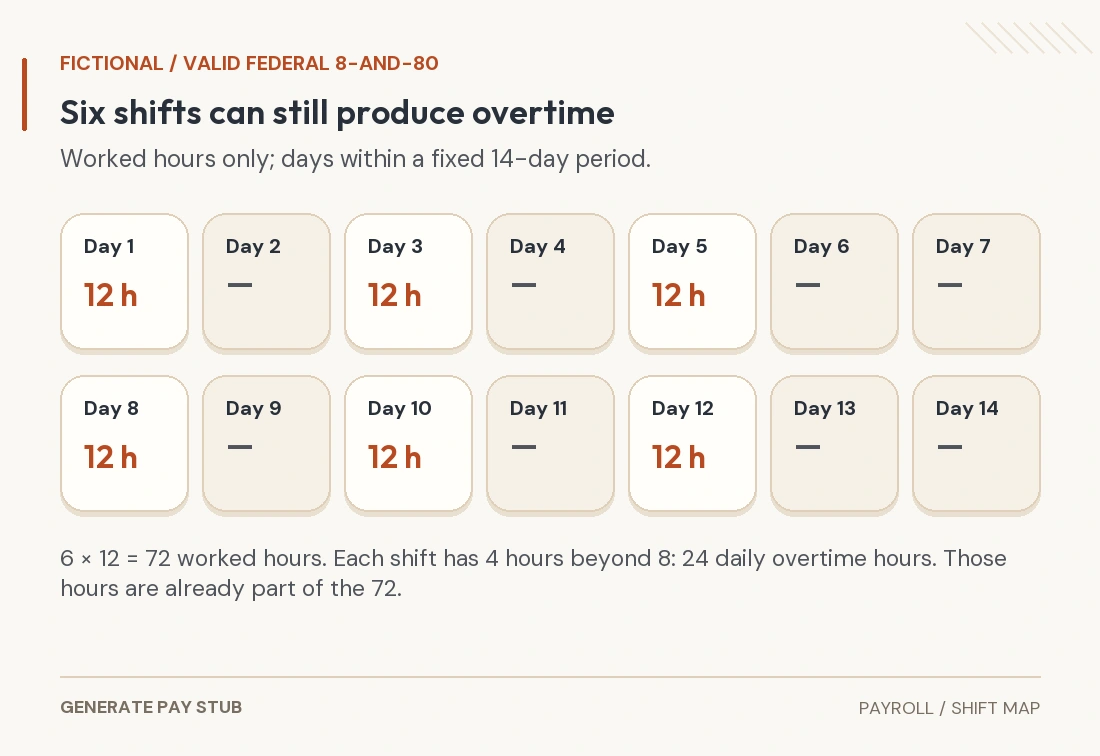
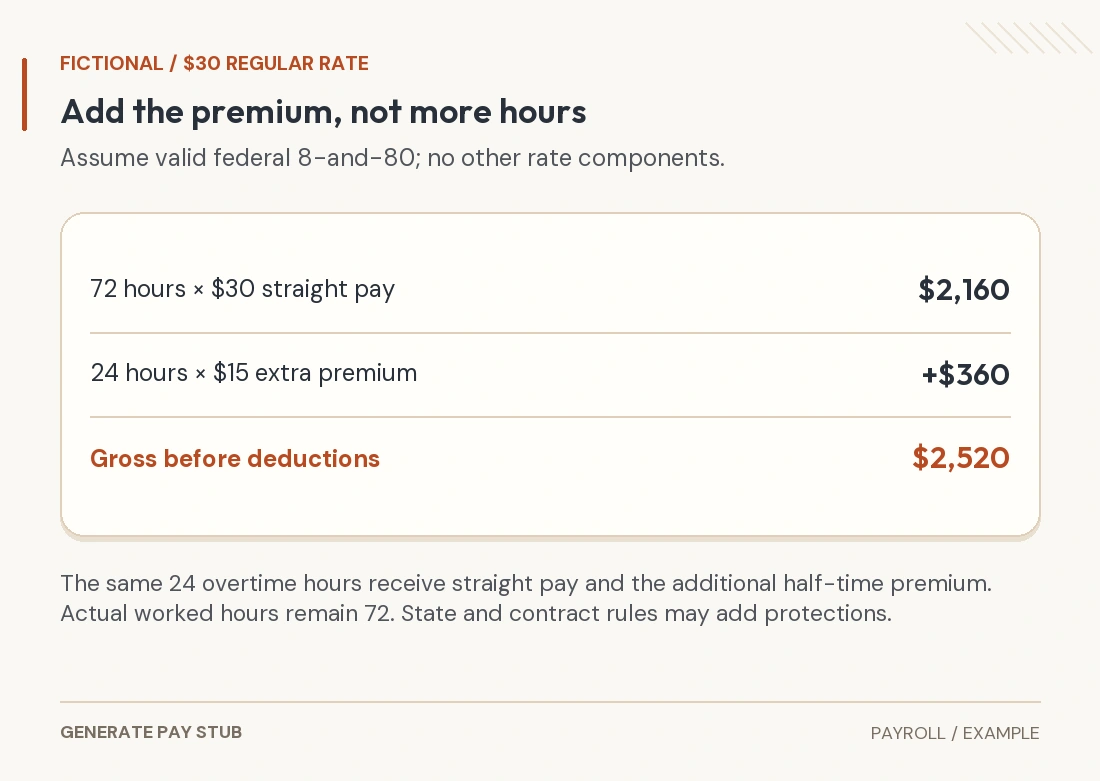
Assume an eligible employer and employee have a valid federal 8-and-80 arrangement. The employee works three 12-hour days in each seven-day half of the fixed period, for six shifts and 72 actual worked hours. Assume a $30.00 regular rate with no other compensation affecting it and no additional state or contract premiums.

Each 12-hour day has four hours beyond eight. Six such days produce 24 daily overtime hours, even though the total is below 80. The hours are not 72 ordinary hours plus another 24 hours worked: the premium attaches to hours already included in the 72.
One valid explanatory presentation is straight-time pay on all 72 hours, plus the extra half-time premium on 24 of those hours. That is $2,160.00 plus $360.00, for $2,520.00 gross. Another presentation can split 48 hours at $30.00 and 24 hours at $45.00; the total is identical.

| Component | Hours | Component rate | Amount |
|---|---|---|---|
| Straight-time component for all worked hours | 72 | $30.00 | $2,160.00 |
| Extra half-time premium for daily overtime | 24 | $15.00 | $360.00 |
| Total gross for 72 actual worked hours | — | — | $2,520.00 |
Under a different, valid ordinary weekly federal arrangement, a 36-hour week followed by another 36-hour week would not create federal over-40 overtime solely from those hours. That comparison explains why identifying the actual governing system matters. It is not permission to switch methods after the work or disregard state daily-overtime protections.
What if both daily overtime and the 80-hour threshold are reached?
The regulation allows qualifying daily overtime premiums to be credited toward overtime due above 80 hours. Do not assume every daily overtime hour and every hour above 80 must be paid twice as two additional premiums.
For a second simplified example, suppose the employee works ten nine-hour days in the same valid 14-day framework at the same $30.00 regular rate. That is 90 actual hours, ten daily overtime hours and ten hours above 80. With the qualifying daily premiums credited, the calculation is 90 × $30.00 plus 10 × $15.00 = $2,850.00. It is not automatically 90 × $30.00 plus 20 × $15.00.
Ask payroll to show the daily calculation, period calculation and any premium credit. Different earning arrangements, state rules and contract requirements can require a more detailed reconciliation than this isolated example.
Why the printed base rate may not be the regular rate
DOL Fact Sheet 54 explains that shift differentials belong in the regular-rate calculation. Other compensation, including applicable nondiscretionary bonuses, also needs appropriate treatment. Multiplying a base hourly rate by 1.5 can therefore be incomplete when the employee earned additional compensation that affects the regular rate.
Identify which shifts earned a differential and the period in which it was earned. Compare an overtime line with all relevant earning components rather than treating the largest single rate on the statement as the entire explanation. Our shift-differential guide provides a separate worked example.
What to send with a healthcare payroll question
- Identify the pay date, employer and complete statement.
- Attach the relevant actual time record, including the dates of disputed handoff, charting, callback or interrupted meals.
- Ask which workweek or fixed 14-day period applies and which agreement supports the method.
- List the questioned earning codes, rates, differentials and adjustment lines.
- Request the calculation, any premium credit and the proposed correction period.
Keep bank-payment questions separate from wage calculations. A correct net deposit cannot show whether all clinical hours were counted. A missing deposit also cannot be explained solely by recalculating daily overtime.
Common healthcare pay-stub questions
Does “per diem” mean overtime-exempt?
No conclusion follows from that label alone. Confirm the actual employment status, duties, pay basis and applicable rules.
Does a biweekly paycheck automatically allow an 80-hour overtime threshold?
No. The special exception has eligibility, agreement, daily-overtime and fixed-period conditions.
Should PTO be added to actual worked hours?
Separate paid leave from work time. The applicable law or agreement determines whether a particular premium calculation counts it; the fictional examples here contain worked hours only.
Can one payroll line settle the whole review?
No. Read it with the time record, other earnings, governing overtime method and any adjustment explanation. Use our payroll-correction checklist when organizing a discrepancy.