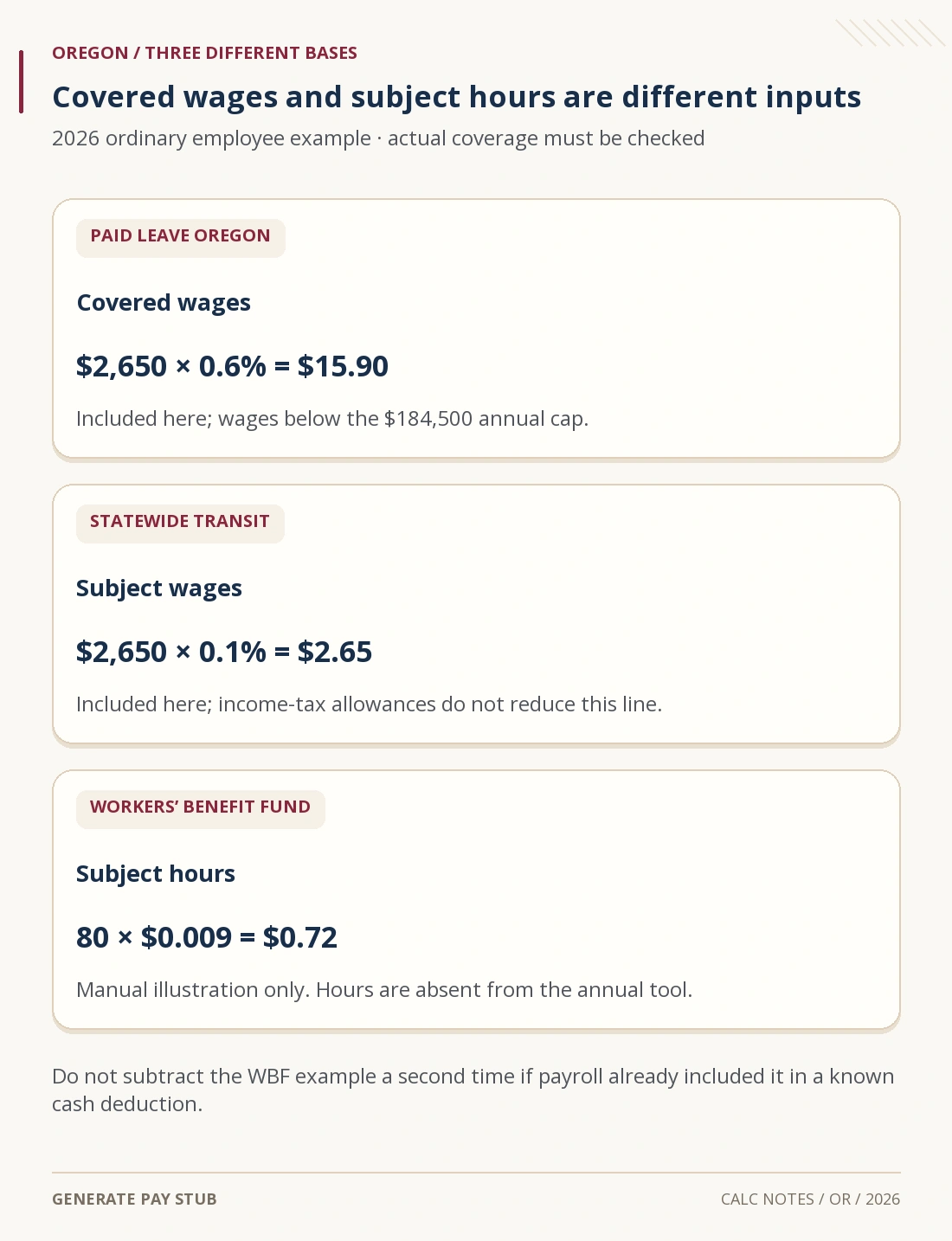
Oregon’s 2026 paycheck estimate combines a state income-tax formula with separate Paid Leave Oregon and Statewide Transit Tax deductions. Federal income tax withheld can affect the Oregon formula, subject to limits. The annual tool excludes the Workers’ Benefit Fund because it has no subject-hours input.
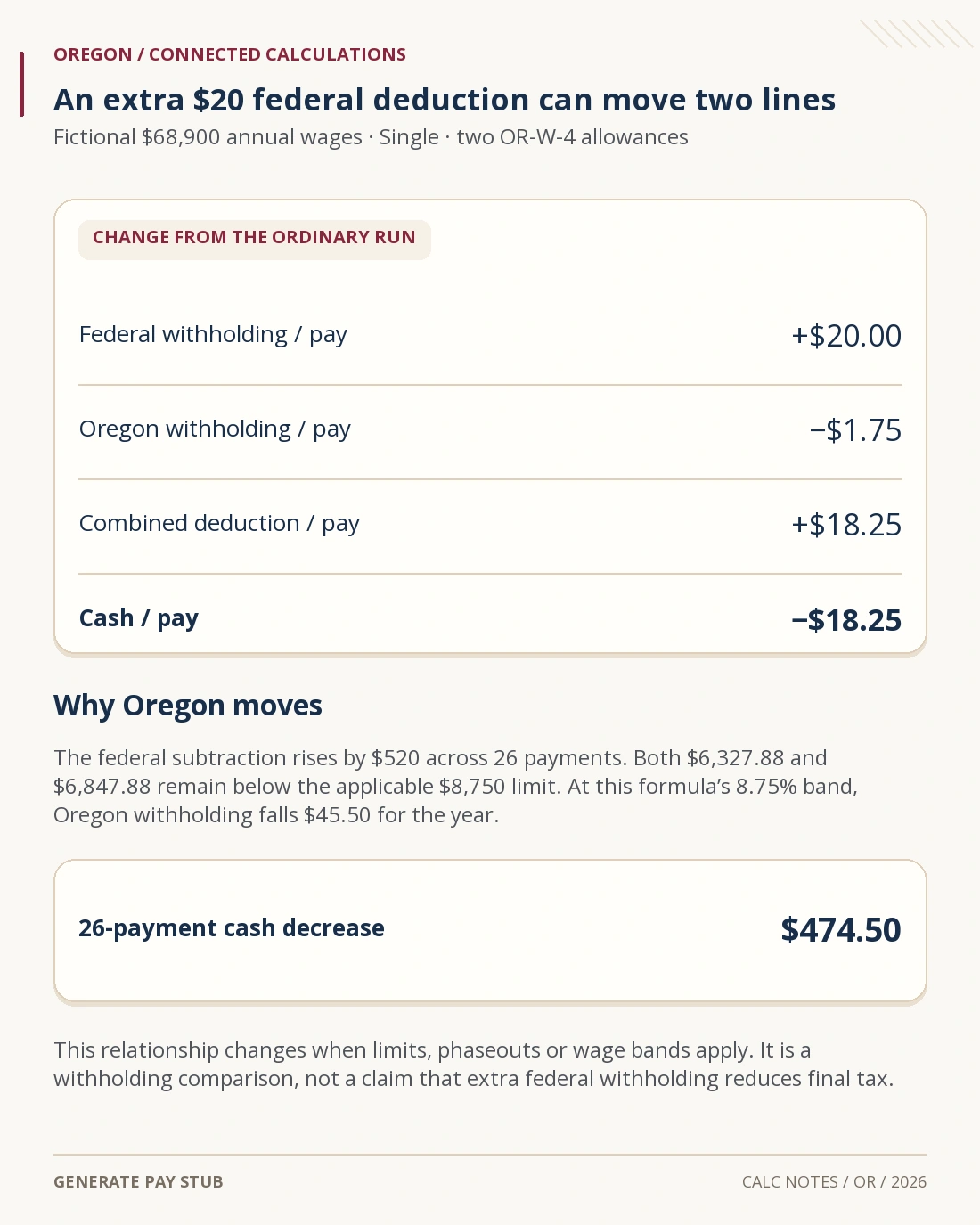
In our checked $68,900 biweekly example, ordinary estimated cash is $2,017.07 per payment before omitted items. Adding $20 of federal withholding lowers cash by $18.25 here because Oregon withholding also changes. That interaction has limits; it is not a tax-saving strategy or a promise about a final return.
Set the $2,650 biweekly wage example
Open the Oregon paycheck calculator, choose 2026, enter $68,900 annual wages and select Every Two Weeks. The model uses 26 payments of $2,650.
Use federal Single, multiple jobs disabled, and zero federal credits, other income, deductions and extra withholding. In the state settings select the Single/head-of-household/higher Single group, two supported OR-W-4 allowances and no extra state amount.
Leave standard employee Paid Leave and transit treatment in place. Known annual local and other cash deductions remain zero. The comparison changes only the federal extra to $20 per payment.
Assume one full-year private-sector employer, Oregon residence and work, ordinary constant wages, standard program coverage and no benefit wage exclusions. All relevant wage bases equal gross in this controlled example.
The result is a projection from those facts. An actual worker’s wages, coverage and certificate elections can require a different calculation.
Trace the Oregon state income-tax formula
The 2026 computer-formula tables subtract allowable federal income tax withholding, then the relevant standard deduction, before applying the table and allowance credits. FICA is excluded from the federal subtraction.
The state’s 2026 payroll reference lists $2,910 for the Single standard deduction. Our two-allowance case uses that amount.
The live federal deduction is $243.38 × 26 = $6,327.88. It is below this case’s $8,750 federal-subtraction limit. Formula BASE is $68,900 − $6,327.88 − $2,910 = $59,662.12.
For this wage band, state formula withholding is $678 + ($59,662.12 − $11,400) × 0.0875 − (2 × $263) = $4,374.9355. Dividing by 26 gives $168.26675, rounded to $168.27 per payment.
The repeated annual deduction is $168.27 × 26 = $4,375.02. Its difference from the formula amount comes from payment-level cents rounding.
Source check: some narrative examples in the current booklet retain older figures. This guide follows its explicit 2026 tables, including the $8,750 limit and $263 credit, rather than copying those inconsistent illustrations.
Test what happens when federal extra withholding rises by $20
| Per-payment or annual output | No federal extra | $20 federal extra |
|---|---|---|
| Federal deduction per payment | $243.38 | $263.38 |
| Oregon deduction per payment | $168.27 | $166.52 |
| Cash before excluded items, per payment | $2,017.07 | $1,998.82 |
| Cash over 26 payments | $52,443.82 | $51,969.32 |
The federal subtraction increases by $20 × 26 = $520. Both federal totals remain below the applicable cap. The state formula stays in the same band, so its annual amount drops by $520 × 8.75% = $45.50, or $1.75 per payment in this comparison.
The combined cash reduction is therefore $20 − $1.75 = $18.25 each payment, totaling $474.50 over 26 payments. Paid Leave, transit and FICA do not change.

At higher income, the federal subtraction phases out. Allowance credits also have income limits. This example’s relationship cannot be extrapolated to every salary.
Separate Paid Leave, transit tax and the hours-based WBF
Paid Leave Oregon’s contribution guidance sets the ordinary employee share at 60% of the total 1% rate: 0.6%. The 2026 employee wage cap is $184,500 for each employer. Here, $2,650 × 0.006 = $15.90 per payment, totaling $413.40.
The current Statewide Transit Tax guidance says to continue withholding 0.1%. That produces $2.65 per payment and $68.90 annually in our case. Regular income-tax allowances do not eliminate this separate tax.
That employee transit tax differs from employer TriMet and Lane payroll taxes. Do not subtract an employer transit expense from the employee’s cash merely because both labels contain “transit.”
For the Workers’ Benefit Fund, the 2026 DCBS rate page states a total assessment of 1.8 cents per subject hour. Its assessment guide limits the employee collection to half: ordinarily $0.009 per subject hour.

For a separate assumed 80-subject-hour payment, employee WBF is 80 × $0.009 = $0.72. It is not 0.9% of wages. The guide distinguishes subject hours from paid leave and provides methods for certain untracked-hour cases; salary alone cannot establish the count.
Reconcile annual cash and identify the excluded WBF amount
| Included ledger line | Annual value |
|---|---|
| Gross wages entered | $68,900.00 |
| Federal income tax withheld | $6,327.88 |
| Oregon income tax withheld | $4,375.02 |
| Employee Social Security | $4,271.80 |
| Employee Medicare | $999.18 |
| Employee Paid Leave contribution | $413.40 |
| Employee Statewide Transit Tax | $68.90 |
| Cash before WBF and other omitted items | $52,443.82 |
The payment calculation is $2,650 − $243.38 − $168.27 − $164.30 − $38.43 − $15.90 − $2.65 = $2,017.07.
If the separate 80-hour WBF assumption applies to every one of 26 payments, $0.72 × 26 = $18.72. Manual cash after that employee assessment becomes $52,425.10. This is a conditional adjustment, not the displayed annual result. Check that it has not already been included in a known deduction.
Review certificate and coverage choices
Oregon uses OR-W-4 elections, which can differ from federal W-4 entries. Single with three or more allowances uses the larger standard-deduction/table group, while its federal-subtraction phaseout still follows Single treatment. The supported two-allowance example avoids that group change.
For program coverage, use actual payroll facts. The Paid Leave employee overview identifies categories that are not automatically covered, including federal employees and independent contractors. A lower-cash comparison cannot determine coverage.
Employer-paid employee shares and approved alternative plans require separate review. Paying a share for an employee may have taxable-wage consequences that a simple cash-only comparison does not model. WBF’s guide expressly addresses employer-paid shares as a taxable benefit.
Check local taxes, benefit bases and special wages
Metro, Multnomah County and Eugene rules are not calculated by this ordinary state estimate. Known annual local amounts can adjust cash after they have been determined; the field does not resolve residence, work location, exemptions or local liability.
The model does not establish eligibility for a state withholding exemption or reproduce missing-certificate flat-rate treatment. Bonus and other special-wage procedures also need their applicable method.
Withholding calculations can use optional whole-dollar rounding at payroll, while this example retains cents. Benefit deductions can create different wage bases; our deduction comparison explains why a cash subtraction alone cannot decide them.
Oregon paycheck calculator questions
Why did state withholding change when I changed the federal extra?
The allowed federal subtraction feeds the Oregon formula. Caps and phaseouts can limit that effect.
Is the employee Paid Leave rate 1%?
The ordinary employee share is 0.6%; 1% is the total contribution rate.
Is WBF included in the annual cash shown?
No. The annual tool excludes it because subject hours are missing.
Can zero regular income-tax withholding remove statewide transit tax?
No. Its wage base and rules are separate.
Oregon sources, two live federal-input runs and conditional WBF arithmetic reviewed November 6, 2026.