A shift differential on a pay stub is extra compensation for working designated hours or shifts, such as evenings, nights, or weekends. To check it, match the employer’s pay policy to the actual eligible hours, then reconcile the differential with gross earnings. For an employee covered by ordinary federal overtime rules, night-shift differential pay also enters the overtime regular rate; it is not a substitute for the overtime premium.
This U.S. employee guide was reviewed October 14, 2026. It explains ordinary hourly-pay and 40-hour-workweek calculations, with fictional examples. State law, a union agreement, specialized industry rules, and public-sector pay systems can require different treatment. The examples assume all shown hours are compensable work, no unpaid breaks, and no other earnings unless stated.
What is shift differential pay, and must an employer offer it?
It is additional pay attached to specified working conditions, not a universal statutory night-pay percentage. An employer might offer $3 for each eligible night hour, a percentage of the base rate, or a fixed amount for a qualifying shift. Codes such as NIGHT, SHIFT DIFF, EVE, or WKND can identify it, but the employer’s code definition determines what the entry represents.
The Department of Labor’s night-work guidance says the FLSA does not require extra pay merely because work occurs at night. The agreement between the employer and the employee or representative determines whether a differential is offered. Applicable state requirements, contract rights, or another wage system may add obligations.
Separate the entitlement question from the overtime question. An employer may not be required by the FLSA to establish a night premium, yet once it pays an includable differential, that payment changes the federal overtime calculation for a covered nonexempt worker. A salary or a “shift lead” title does not establish an exemption. Our exempt versus nonexempt guide explains the classification check.
There is also no reliable nationwide “standard” differential to enter on a statement. Use the applicable policy and effective date. A number remembered from a previous job, another department, or an online discussion is not evidence of the current employee’s rate.
Which hours count toward a night-shift differential?
Start with the policy’s eligibility rule, not the shift’s nickname. One employer pays only hours falling within a defined night window. Another pays the whole shift when a specified portion qualifies. Policies can also address rotating assignments, weekends, holiday overlap, training, paid leave, and whether multiple differentials stack. These are questions to resolve from the applicable terms, rather than assumptions to build into the calculation.
Fictional time-window example: the employee works continuously from 10 p.m. to 6 a.m. The policy pays $3 extra only for hours from 11 p.m. through 5 a.m.; it does not pay the whole shift merely because it begins at night. Base pay is $20 per hour, and the shift falls within a workweek in which no overtime is due.
- Total work: 8 hours.
- Eligible window: 11 p.m. to 5 a.m. = 6 hours.
- Base earnings: 8 × $20 = $160.
- Night differential: 6 × $3 = $18.
- Gross shift earnings: $160 + $18 = $178, before taxes and deductions.

If an unpaid meal falls inside the night window, it can change eligible paid hours; first confirm whether the meal is actually unpaid and noncompensable under the applicable rules. The DOL hours-worked guidance explains why meal and other break time need that check. Do not infer a half-hour deduction from a scheduled break when the employee worked through it or otherwise remained compensably on duty. An overnight clock change also means elapsed work time may differ from a simple subtraction of wall-clock labels.
When a shift crosses midnight, distinguish the calendar date, employer-defined workday, and FLSA workweek boundary. The federal workweek is a recurring 168-hour period and need not start at midnight or on Monday, as the DOL overtime fact sheet explains. Midnight alone does not automatically start a fresh federal overtime count. If the actual workweek boundary occurs during the shift, preserve the time belonging to each week.
How should shift-differential earnings appear on a pay stub?
The statement should make the wages traceable without counting the same work twice. Common presentations include a base-pay line plus an additional differential line, or separate day and night rows showing the applicable full straight-time rates. The required statement fields depend on the jurisdiction; a useful format still connects hours, rates, and earnings to the source time record.
For the eight-hour example, a base line of 8 hours at $20 and a differential line of 6 hours at $3 produces $178. The differential’s six hours overlap six of the eight actual work hours. Adding the displayed 8 and 6 to claim 14 hours worked would be wrong. An alternative straight-time presentation is 2 nonqualifying hours at $20 plus 6 qualifying hours at $23: $40 + $138 = $178. These are two presentations of one payment, not additional earnings to combine.
Keep the units clear when checking the policy:
- Hourly addition: eligible hours × the extra dollar rate. Six hours at $3 gives $18.
- Percentage addition: eligible hours × the specified base × the percentage. If the policy explicitly uses a $20 base and 15%, the extra hourly amount is $3. A different definition of the percentage base changes the answer.
- Fixed shift payment: the agreed amount for a qualifying shift. A fictional $24 for an eight-hour shift is not automatically $24 per hour, and the agreement still needs review for eligibility and overtime treatment.
Check whether an amount is a full earnings rate or only an add-on before multiplying it by hours. If NIGHT RATE is $23 and already includes the $20 base plus $3 differential, adding another $3 for those same hours overstates pay. For other multiple-rate layouts, see two hourly rates on one pay stub.
How do you calculate overtime when some hours earn a differential?
For the ordinary federal method, include night differential in the week’s regular-rate earnings before calculating overtime. 29 CFR 778.207 distinguishes these payments from qualifying statutory overtime premiums. Calling a payment “premium” does not allow payroll to exclude ordinary night pay from the regular rate or credit it against overtime due. A fixed night-shift allowance also generally remains includable compensation; a lump sum unrelated to the number of overtime hours is not made into a qualifying overtime premium by its label.
The DOL health-care overtime guidance demonstrates the inclusion of differentials and the difference between a base rate and the regular rate. Although that fact sheet discusses health care, the night-pay inclusion rule it cites is the federal regulation above. The following is our own example, not the agency’s illustration.
Fictional workweek: a covered nonexempt employee works 45 hours at a $20 base, with a $3 addition for 15 qualifying night hours. The 15 hours are part of the 45, not extra hours. There is no bonus, other includable pay, exclusion, state daily overtime, or specialized overtime method. Straight-time compensation covers every hour.
- Base straight-time earnings: 45 × $20 = $900.
- Night differential: 15 × $3 = $45.
- Regular-rate earnings: $900 + $45 = $945.
- Federal regular rate: $945 ÷ 45 = $21 per hour.
- Five additional half-time premiums: 5 × $21 × 0.5 = $52.50.
- Gross wages: $945 + $52.50 = $997.50.

Simply calculating overtime at half of the $20 base would add $50. The correct premium here is $52.50, so a base-only calculation is $2.50 short even if all $45 of night differential was paid. The regular rate is weighted by the hours actually worked; averaging $20 and $23 equally would incorrectly produce $21.50 because the employee worked twice as many day hours as night hours.
A different payroll layout can still be correct. If the statement shows 40 regular hours and five overtime hours at time-and-a-half of the base, payroll can show a separate differential-related overtime adjustment:
| Earnings line | Calculation | Amount |
|---|---|---|
| Regular base pay | 40 hours × $20 | $800.00 |
| Base overtime line | 5 hours × $30; includes straight-time pay | $150.00 |
| Night differential | 15 qualifying hours × $3 | $45.00 |
| Differential OT adjustment | 5 hours × ($21 − $20) × 0.5 | $2.50 |
| Total gross wages | Four earnings lines above | $997.50 |
The $150 overtime line includes $100 straight-time wages and $50 of premium. Adding the $2.50 adjustment produces the required $52.50 premium. Adding a second full $52.50 on top of that layout would count the base premium twice.
Do not automatically substitute 1.5 times the highest shift rate, the lowest rate, or the rate of the final hour worked. A different authorized overtime method can exist under specific conditions; payroll must establish that basis. The worked example uses the ordinary weekly regular-rate method and does not determine every salary or alternative-rate arrangement.
Why must a biweekly paycheck be checked one workweek at a time?
A two-week payment schedule does not turn the ordinary federal overtime threshold into 80 hours. For an employee subject to the 40-hour rule, hours cannot be averaged across weeks. Each workweek also has its own includable earnings and regular rate. A large differential in one week is not a reason to use that week’s rate for another week.
Separate two-week example: the $20-base employee works 35 hours in Week A, including 10 hours earning $3 differential, and 45 hours in Week B, including 15 differential hours. All hours receive straight-time pay; ordinary federal overtime applies, with no other compensation or special rule. Week B is the same 45-hour calculation above. Week A has no overtime premium due.
| Workweek | Worked hours | Differential | OT premium | Gross wages |
|---|---|---|---|---|
| Week A | 35 | $30.00 | $0.00 | $730.00 |
| Week B | 45 | $45.00 | $52.50 | $997.50 |
| Payment total | 80 | $75.00 | $52.50 | $1,727.50 |
Week A’s gross is 35 × $20 + 10 × $3 = $730. Week B’s gross is $997.50. The combined payment is $1,727.50. Paying only 80 × $20 plus $75 differential gives $1,675, leaving the $52.50 Week B premium unpaid. Both the worked hours and the extra earnings must stay attached to their own week.

If eligible differential hours were omitted and later corrected, payroll should check both the missed straight-time differential and its effect on the relevant week’s overtime. A new earnings line for the missing differential alone may not finish the correction. Keep the original time record, corrected allocation, original premium, and incremental premium together. Our pay-stub correction guide explains how to retain the audit trail.
Are weekend premiums, state overtime, and special pay systems different?
A weekend addition is not automatically an overtime credit
A small weekend differential commonly remains part of the regular-rate earnings. However, 29 CFR 778.203 permits qualifying special-day premiums to be excluded and credited toward federal overtime under its conditions. The premium rate generally must be at least 1.5 times a bona fide rate for comparable work on other days, and the payment must actually be for the specified special-day work.
A $3 weekend addition to a $20 base does not meet that threshold merely because the employer calls it premium pay. Conversely, a qualifying time-and-a-half Sunday premium is not analyzed identically to an ordinary $3 night addition. Payroll must identify the legal basis before treating any extra payment as an overtime credit. Do not delete a weekend earning from gross wages just because its premium component qualifies for a regular-rate exclusion.
State rules can add daily overtime
The California overtime FAQ, for example, describes ordinary daily overtime above eight hours, double time above twelve hours, and seventh-day rules, with exceptions and exemptions. It also includes shift differential in its regular-rate discussion. That is a state-specific example: the federal 45-hour calculation above is not a complete California calculation for every schedule. An alternative workweek or industry rule requires its own review.
Health care can have a valid 8-and-80 arrangement
The DOL health-care guidance describes an alternative for qualifying hospitals and residential care establishments with the required prior agreement or understanding. Under that arrangement, overtime is based on more than eight hours in a workday and more than 80 hours in a fixed 14-day period. It does not authorize every employer using biweekly payroll to replace the ordinary 40-hour workweek rule. Differential pay still needs proper regular-rate treatment.
Federal employee night pay has its own framework
The OPM Federal Wage System night-differential fact sheet describes specific eligibility, time bands, and percentage rules for that pay system. Do not import those percentages into private-sector payroll or assume that every federal employee uses the same system. Employees under a government pay framework should check the rule for their actual position and appointment.
Is shift differential taxable, and does it have a separate tax rate?
Ordinary cash differential pay is generally employee wage income, with applicable payroll withholding. A SHIFT DIFF label does not make earnings tax-free. IRS Publication 15 for 2026 explains the federal wage and employment-tax framework. Income-tax, Social Security, and Medicare wage bases can differ because of lawful exclusions, deductions, or the Social Security wage cap.
There is no universal separate “night-shift tax” to apply to the differential line. For ordinary hourly earnings paid with the current payroll, the employer uses the relevant withholding procedure and employee certificate. The 2026 federal withholding instructions explain those regular-payroll calculations. A separate correction or other special payment can need a different procedure; the existence of an extra earnings code alone does not establish a flat 22% deduction.
A fictional $45 differential added to otherwise unchanged payroll does not guarantee $45 more in the bank. Employee taxes and applicable deductions may change the deposit. Reconcile the earnings first, then move through the employee deductions to cash paid. Our gross pay versus taxable wages guide and net-pay walkthrough explain those separate steps.
Does night pay qualify for the overtime tax deduction?
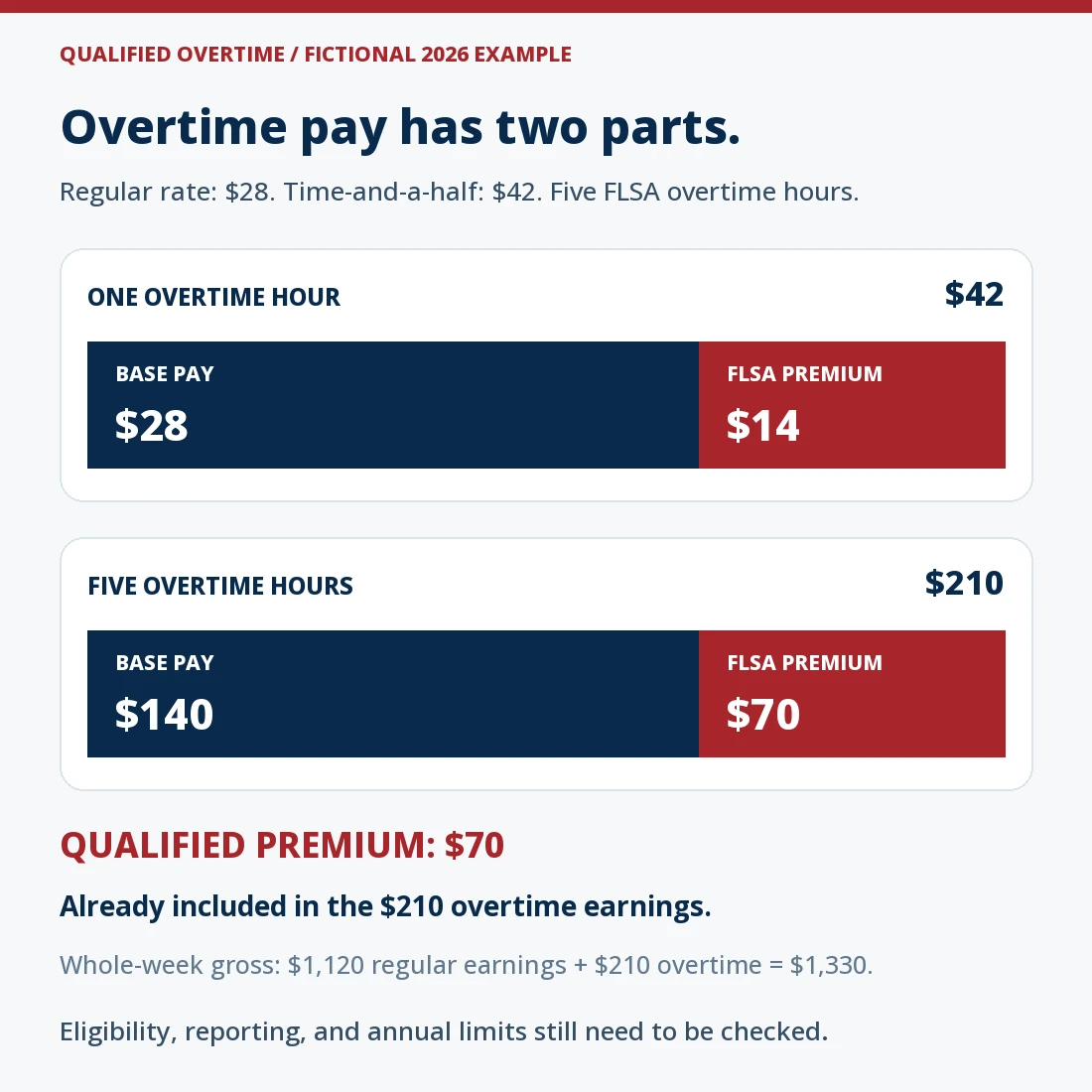
Night work itself does not establish qualified overtime compensation. The 2026 W-2 instructions distinguish the FLSA-required premium above the regular rate from total overtime earnings. An eligible employee’s deduction depends on the applicable premium, reporting, annual limits, and individual tax rules; the straight-time night differential is not qualified simply because it appears beside an OT code. See our 2026 overtime deduction guide for that separate analysis.
Where should differential pay appear at year-end?
Ordinary taxable differential wages are reflected in the applicable W-2 wage totals and withholding boxes; a separate night-pay label does not replace the ordinary wage reporting in Boxes 1, 3, and 5. Compare annual earnings and wage bases, not just the current SHIFT DIFF amount. Employer-defined YTD code totals may help trace the component, but their breakdown does not override the annual wage-reporting rules.
How do you investigate a missing or incorrect shift differential?
Ask payroll to connect the policy, actual time, earning code, and overtime worksheet. A precise request is easier to resolve than comparing only the final deposit with an expected night-pay amount.
- Confirm the rule. Obtain the policy or agreement applying to that work, its effective date, eligible window or whole-shift trigger, rate, and any stacking provisions.
- Reconcile time. Compare clock entries, compensable breaks, location and assignment, overnight boundaries, and weekly totals. Keep eligible differential hours separate from total worked hours.
- Read the code. Establish whether the rate is a full wage rate, hourly addition, percentage, fixed shift payment, or adjustment for earlier work.
- Check the arithmetic. Rebuild the base and differential earnings without double counting overlapping hours or wages already included in another line.
- Review overtime. Identify the applicable legal method and the week-specific regular rate. Confirm whether the differential was included and whether an extra adjustment is still owed.
- Trace the payment. Compare current gross, employee deductions, net amount, actual payment, and YTD balances. Request corrected records and any missing wages where an error is established.
The DOL recordkeeping fact sheet explains the underlying hours and wage data covered employers must retain. If the issue is unresolved, the DOL complaint process addresses federal wage-and-hour violations; state agencies or the applicable agreement may provide routes for other wage disputes. Do not assume that every disagreement about a promised differential is the same as a federal overtime violation.
Should a differential be paid during PTO?
Check the applicable leave policy, agreement, and legal pay system. Do not assume that a payment offered for hours actually worked extends to every paid absence. Conversely, do not remove a benefit that the governing rule provides. Paid leave also should not automatically be counted as hours worked for ordinary federal overtime; our PTO and overtime guide separates those figures.
Can you prepare a differential pay stub without the detailed schedule?
Use established payroll figures backed by accurate time and compensation records. If the eligible hours or overtime method are unresolved, clarify them before presenting a generated statement as a verified wage record. A pay-stub layout can document the result; it cannot establish an employer’s differential policy or decide whether an overtime exclusion is lawful.