Holiday pay on a pay stub can mean pay for time off, wages for working on a holiday, or an extra premium for that work. Those categories have different effects on overtime. Under the ordinary federal rule for covered nonexempt employees, paid holiday time not worked does not add hours toward the 40-hour threshold. A qualifying premium for actual holiday work may count toward the federal overtime premium owed.
This U.S. payroll guide was reviewed October 22, 2026. It separates federal FLSA rules from employer policies, contracts, state law and special government-contract obligations. All calculations are fictional. The DOL holiday-pay explanation is the starting point: the FLSA itself generally does not require pay for a holiday when no work is performed.
What does HOL, HOLIDAY or HOL PREM mean on a pay stub?
Ask what the earning code pays for before calculating overtime or net pay. A code name is not a legal definition. Payroll can display full earnings at an enhanced rate, ordinary earnings plus a premium-only line, or separate pay for a holiday benefit.
- Holiday leave or benefit: pay for a day or hours not worked. For example, the company closes and pays eight hours under its policy.
- Holiday-work earnings: compensation for actual hours worked on the holiday. Those hours are actual work, even if a separate earning code is used.
- Holiday premium: the extra amount above the ordinary rate for qualifying holiday work. It may already be included in a full enhanced-rate line.
- Holiday bonus: a different payment whose regular-rate and withholding treatment depends on its facts, not just the season when it is paid.
Eight holiday hours shown at $37.50 can mean $300 of full earnings, while a separate premium-only line for eight hours at $12.50 can mean $100 added to base earnings recorded elsewhere. Adding both presentations together without checking what is included would overstate pay. Our bonus guide addresses a holiday bonus that is not simply paid leave or a rate premium.
Do paid holiday hours count toward the federal overtime threshold?
Time paid for a holiday without work generally does not count as hours worked under the FLSA. For the ordinary covered nonexempt employee, federal overtime is based on actual hours worked over 40 in a fixed workweek. A pay period containing two weeks does not permit averaging their hours.
The DOL overtime fact sheet distinguishes actual weekly work and explains that a Saturday, Sunday or holiday does not itself trigger federal overtime. Working 32 hours and receiving eight hours of holiday leave is different from working 40 actual hours. Working 40 hours plus receiving eight holiday-benefit hours is still 40 actual work hours.
Conversely, do count actual holiday work. If an employee works eight hours on the holiday and another 36 hours that workweek, the total is 44 worked hours under the ordinary facts. Calling the holiday hours HOL instead of REG does not remove them from the weekly count.
An employer policy or agreement can promise a more generous calculation, including treating paid leave as hours for its contractual overtime. State law can also impose a different obligation. Keep that promised benefit separate from the federal statutory minimum. Our PTO and overtime guide explains the related paid-leave distinction.
How do you calculate holiday leave and overtime in the same week?
Assume a fictional covered nonexempt employee earns $25 per hour, and the employer pays an additional eight hours of holiday leave at $25 under its policy. The employee does not work during those eight leave hours. No holiday-work premium, bonus, differential, daily overtime, special work period or other regular-rate component applies. Federal weekly time-and-a-half is the only overtime rule used.
| Workweek scenario | Hours worked | FLSA OT hours | Gross pay |
|---|---|---|---|
| Short holiday week | 32 | 0 | $1,000.00 |
| Forty actual work hours | 40 | 0 | $1,200.00 |
| Forty-four actual work hours | 44 | 4 | $1,350.00 |
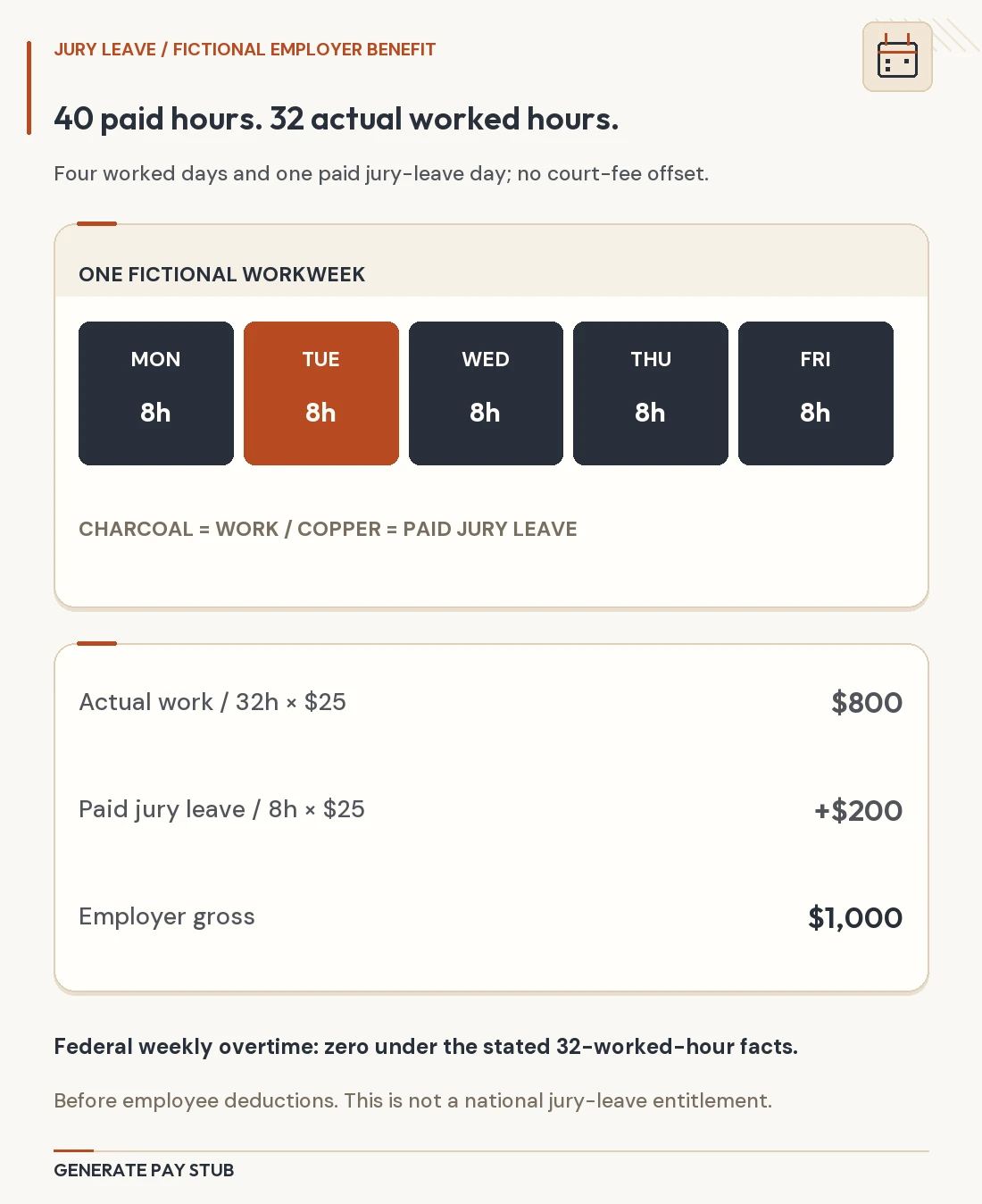
For 32 worked hours, 32 × $25 + 8 × $25 = $1,000. At 40 actual work hours, 40 × $25 + $200 = $1,200. In the 44-work-hour case, 40 × $25 + 4 × $37.50 + $200 = $1,350. There are 52 paid hour units in that last presentation, but only 44 actual hours worked and four federal overtime hours.

A second way to check the last row is 44 × $25 base earnings + 4 × $12.50 extra overtime premium + $200 holiday benefit = $1,350. Do not pay all 44 hours at $25 and add a full four hours at $37.50; that would count the overtime hours’ base component twice.
The DOL regular-rate guidance explains that qualifying payments for occasional holiday time not worked may be excluded from the FLSA regular rate. Such leave payments generally cannot be credited toward the overtime premium owed. Paying a $200 holiday benefit does not erase the separate $50 required overtime premium in this example.
Can a holiday-work premium count toward overtime pay?
A qualifying premium for actual holiday work can be treated differently from pay for an unworked holiday. DOL Fact Sheet 56A explains the federal exclusion and crediting rule for certain premium rates. For holiday work, the rate must be at least one and one-half times the rate established in good faith for like work during nonovertime hours on other days. Only the qualifying extra compensation is the premium under this rule.
Use a separate fictional example: 44 actual work hours, including eight holiday-work hours, at an ordinary $25 rate. The employer pays $37.50 for the eight holiday-work hours, equivalent to $25 base plus $12.50 premium. There is no additional unworked holiday benefit in this example. Assume the holiday premium satisfies the federal conditions, there are no other regular-rate items, and no stronger state, policy or contract stacking requirement applies.
| Component or comparison | Calculation | Amount |
|---|---|---|
| Base pay for all actual work | 44 × $25 | $1,100.00 |
| Qualifying holiday premium paid | 8 × $12.50 | $100.00 |
| Federal weekly premium obligation | 4 × $12.50 | $50.00 |
| Holiday premium credited to that obligation | Lesser of $100 and $50 | $50.00 |
| Additional federal premium still needed | $50 obligation − $50 credit | $0.00 |
| Gross wages: base plus holiday premium | $1,100 + $100 | $1,200.00 |
The $100 qualifying holiday premium is enough to satisfy the $50 federal weekly premium obligation under these assumptions. The employee keeps the entire $100 holiday premium; the employer does not subtract $50 back from earnings. The gross is $1,200, and no additional federal overtime premium is required solely by the stated weekly calculation.

The result does not authorize using the excess against unrelated weeks. Nor does a HOL PREM label make every payment creditable. A fixed holiday lump sum, an insufficient enhanced rate or a payment for time not worked may fail the conditions. If a policy promises both holiday premium and separately stacked overtime, the federal minimum calculation does not cancel that promise.
Compare this $1,200 example with the prior $1,350 example carefully: the prior case paid an extra $200 benefit for eight unworked holiday hours plus required overtime. This case pays $100 of qualifying premium for eight hours that were actually worked. They are different compensation arrangements, not two answers to identical facts.
Which holiday-policy details should you check before disputing pay?
Identify the actual promise and who it covers. A federal holiday calendar does not, by itself, require every private employer to close or give paid leave. A workplace may recognize different holidays, observe a weekend holiday on another date, grant a floating holiday or provide different benefit hours for different schedules.
- Covered employees and start date: full-time, part-time, probationary or other eligible groups, subject to applicable law.
- Benefit amount: eight hours, scheduled hours, a prorated amount or another stated measure.
- Eligibility conditions: attendance rules and their exceptions, approved leave, protected absences and employment agreements.
- Work on the holiday: ordinary pay, an enhanced rate, an additional benefit, substitute leave or a specified combination.
- Overtime interaction: actual-work counting, any promised leave-hour inclusion and whether premiums stack or are credited.
- Observed date and payment timing: which date the benefit applies to and where it appears in payroll.
A published policy cannot waive a statutory wage obligation. Equally, a general statement that federal law does not require holiday benefits is not a complete answer when the employer promised them under an enforceable agreement or state wage law. Ask payroll to identify the applicable policy version and how it was applied to the specific dates.
How do state law, salary status and government contracts change the answer?
State examples: California and Rhode Island are different
The California labor agency’s holiday FAQ says the state does not generally require paid holidays or a special rate merely because the work falls on a holiday. Its ordinary overtime rules can still require daily or weekly premiums. Therefore, the federal-only examples above should not be used to dismiss a California daily-overtime issue.
Rhode Island’s labor agency describes a time-and-a-half requirement for covered Sunday and holiday work. Coverage and exceptions matter: the state’s active wage and holiday regulation includes employer exemptions and special rules. Do not transplant California’s general holiday answer to every Rhode Island employer, or infer that every business everywhere owes the same premium. This guide does not provide a 50-state coverage determination.
Salaried employees: check exemption and salary-basis rules
Salary alone does not establish overtime exemption. A salaried nonexempt employee still needs the applicable hours and regular-rate calculation. For a properly exempt salaried employee subject to the salary-basis rule, an employer’s holiday closure during a week in which the employee performs work generally does not permit docking salary simply because work was unavailable.
DOL Fact Sheet 17G explains the salary-basis rule and its exceptions. The DOL furlough guidance separately explains that an accrued-leave account can be reduced in qualifying circumstances while the required salary is still paid, including when leave is exhausted. A leave-bank entry and a reduction in cash salary are different events. No-work weeks and other permitted exceptions need their own review.
Use our exemption guide and salary-versus-hourly explanation before applying an hourly holiday example to an exempt employee.
Covered government contracts
The DOL holiday-pay page explains that applicable Service Contract Act wage determinations can require holiday/vacation fringe benefits, and Davis-Bacon determinations can specify them for covered classifications. Check the actual contract, wage determination, employee classification and benefit conditions. Neither the general private-sector rule nor one office’s holiday calendar settles a covered contract obligation.
Is holiday pay tax-free or always withheld at a higher rate?
Ordinary holiday wages generally remain wages for payroll-tax purposes. A paid day off does not become federally tax-free merely because it is labelled HOL. The 2026 IRS employer guide explains wage taxation, employee Social Security/Medicare and federal withholding methods. Additional benefits and state/local tax rules can affect the actual deposit.
A larger check can have more withholding without establishing a special final holiday tax rate. Separately identified supplemental payments, ordinary regular payroll and other arrangements may use different permitted procedures. Do not automatically assign 22% to every holiday line or mistake withholding for the employee’s final tax liability.
Also keep a holiday premium separate from the federal deduction for qualified overtime compensation. Working on a holiday or receiving a premium code does not automatically make the entire payment qualified overtime. Our 2026 overtime-deduction guide explains the FLSA-premium, reporting and return-limit questions. Wage entitlement, payroll withholding and the eventual return calculation are separate checks.
How do you check a holiday-pay statement accurately?
- Mark actual work dates and hours. Separate holiday work from paid time not worked, and group actual work into the correct workweeks.
- Identify the promised benefit. Find the policy, contract or wage determination and its eligibility conditions.
- Decode the earning lines. Determine whether each rate is full pay or premium-only and whether base earnings appear elsewhere.
- Recalculate applicable overtime. Check federal weekly rules, any state daily rules, regular-rate inputs and valid premium crediting.
- Reconcile gross before net. Add the right earning components once, then follow actual taxes and employee deductions.
- Request a specific correction. Give the workweek, policy provision, original calculation and expected difference, preserving the payment history.
Keep schedules, time records, the policy version, original statement and payroll’s written explanation. Our correction guide helps distinguish unpaid wages from a statement-only error. If preparing a statement with Generate Pay Stub, enter actual work and benefit categories from verified records; the document cannot create a paid-holiday entitlement or make a nonqualifying premium satisfy overtime. Use the preparation checklist to trace every amount to its source.