Jury-duty pay on a pay stub usually represents wages continued by an employer during a court-related absence. It is different from a juror attendance fee or expense payment issued by the court. To check the statement, identify who paid each amount, whether employer-paid leave was required or promised, how actual worked hours were counted, and whether a court-fee offset or repayment occurred.
This U.S. employee guide was reviewed October 23, 2026. It separates ordinary federal wage rules, properly exempt salary treatment, a Massachusetts state example and court payments. Public employees, collective agreements and other jurisdictions can have additional requirements. Fictional calculations are labelled and do not establish entitlement for every job.
Does federal law require employer-paid jury-duty leave?
The FLSA generally does not require pay for time not worked solely because the employee serves on a jury. The DOL jury-duty overview explains that state laws can require employer payments. A valid employer policy or employment agreement may also provide paid leave. Properly exempt salary-basis rules require a separate analysis below.
Start with four records: the summons, the employer’s jury-leave policy, the applicable state rule and proof of the actual service dates. A JURY code alone does not reveal whether the line is paid leave, an informational time entry or an offset. Likewise, a summons is not always evidence that every scheduled day became a day of actual service; keep the court’s attendance record.
Wage entitlement and protection against retaliation are separate questions. The federal juror-employment protection statute, 28 U.S.C. 1875, protects permanent employees against specified employer discharge, threats, intimidation and coercion because of federal jury service. State jury service and other workers require a separate state-law review. An absence being unpaid does not establish permission to retaliate.
Can an employer dock an exempt employee’s salary for jury duty?
For an employee actually subject to the applicable FLSA salary-basis exemption, jury absence generally does not permit reducing the salary for a week containing work. The DOL salary-basis fact sheet explains full-salary treatment for a week with work and the permitted offset for jury or witness fees. It also explains that an entire workweek with no work need not be paid under the ordinary salary-basis rule.
The Oregon BOLI jury-leave guide specifically distinguishes prohibited jury-absence salary deductions from an offset of jury fees for the same week under 29 CFR 541.602(b)(3). State law or an agreement can add obligations; federal permission for a fee offset is not permission for every deduction in every jurisdiction.
Do not classify every salaried worker as exempt. A salaried nonexempt employee still needs a proper worked-hour and overtime calculation. The salary example also does not mean an hourly worker automatically receives a full week’s pay. Review classification first using our exempt-versus-nonexempt guide.
Reducing a PTO balance does not necessarily mean the employee’s cash salary was reduced. Ask whether a line reduces PTO hours, current gross wages or only a displayed balance, then check the actual policy and applicable law. Do not assume the same action is allowed simply because the employer uses a different earning or deduction code.
How does a state requirement change employer pay?
Identify where the employee works and which court/service rules apply. Massachusetts provides a useful example rather than a national rule. The Massachusetts Office of Jury Commissioner’s compensation guide states that employees working in Massachusetts generally receive regular wages for work missed during the first three days of service, including full-time, part-time, temporary and casual employees.
That guide identifies specific exceptions and hardship procedures, including some unpredictable schedules, nonemployee and out-of-state situations. A company headquartered elsewhere does not automatically escape the obligation for its Massachusetts workers. After the third day, the state may pay $50 per day; continuing employer payments and any turnover condition need separate review. Do not replace the first-three-day wage obligation with an assumed flat $50 employer allowance.
The example is limited to Massachusetts. Other states can use different eligibility, employer-size, duration and payment rules. Employer policies can provide more generous coverage, while federal employee court-leave arrangements can be different again. Use the current court and labor-agency guidance for the actual service rather than importing a rule from an unrelated state.
Do paid jury-duty hours create FLSA overtime?
Ordinary paid jury-leave hours during which no employer work is performed generally are not actual worked hours for federal weekly overtime. The DOL overtime explanation uses worked hours in the established workweek. A policy can promise a more favorable calculation, but a statement’s total paid quantity is not by itself the federal worked-hour total.
Actual job tasks remain a separate matter. If work occurs before or after court or during another interval, record it accurately and assess its compensability. A court attendance certificate does not prove that no job work occurred that day. Equally, a jury-leave earning line should not automatically create eight additional worked hours on top of eight hours already logged for the same time.
Payments for qualifying occasional nonwork leave may also be excluded from the overtime regular rate. The DOL regular-rate guidance explains the leave-payment category. Check the payment’s real character and applicable rules; a code cannot convert compensation for actual work into an exclusion.
For instance, 42 actual worked hours plus eight paid nonwork jury hours still contain two federal overtime hours under the ordinary rule, not ten. If the employer’s agreement counts jury leave toward a contractual threshold, distinguish that promise from the minimum FLSA calculation. Our paid-leave and overtime guide explores the same distinction for other leave.
How can 40 paid hours represent only 32 worked hours?
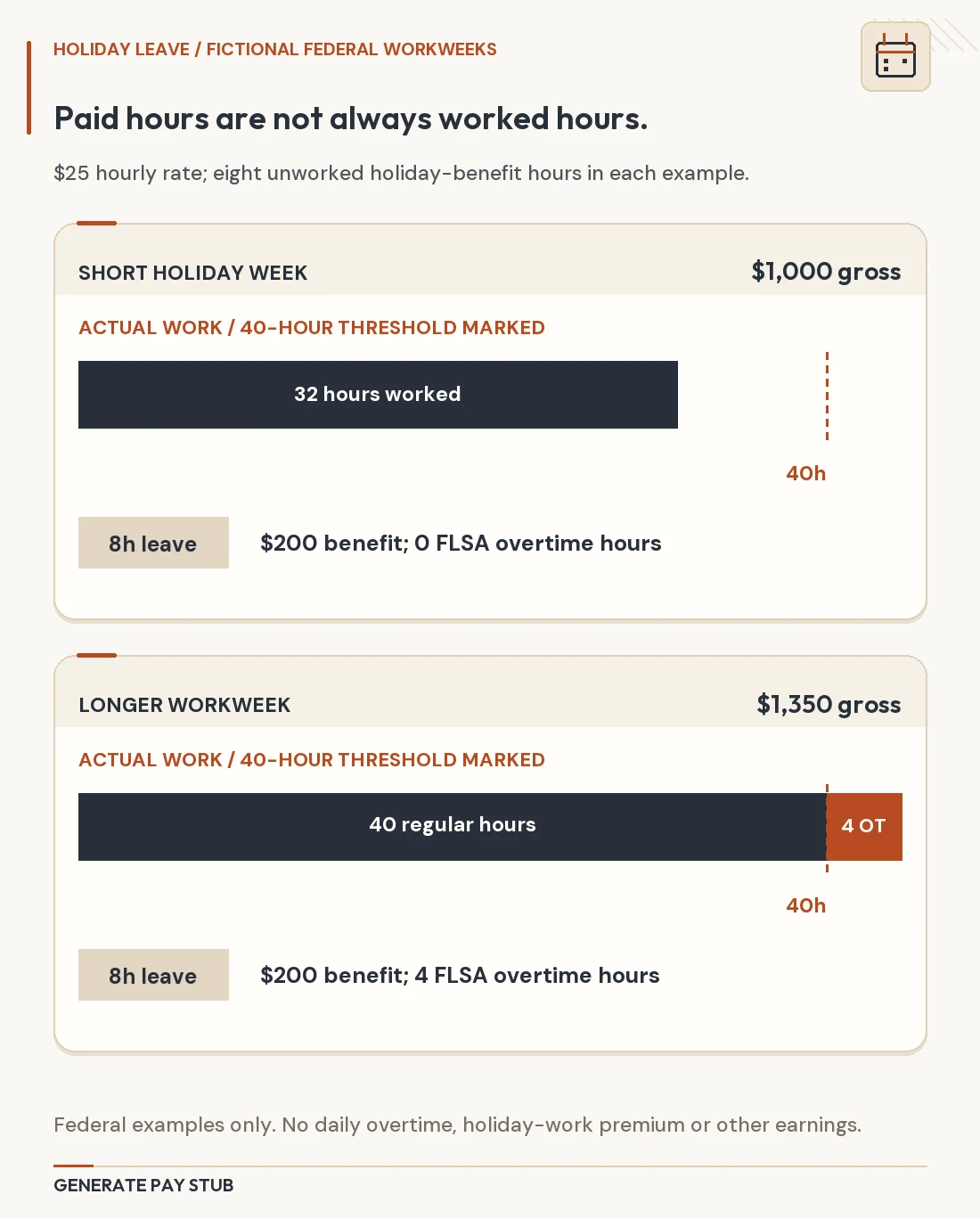
Consider a fictional covered nonexempt employee paid $25 per hour. The employee works four eight-hour days and misses one scheduled eight-hour day for verified jury service. Assume the employer’s valid policy provides eight hours of fully paid jury leave, no other wages or premiums apply, no court-fee offset is used, and the ordinary federal overtime rule applies.
| Employer earning line | Quantity | Rate | Gross |
|---|---|---|---|
| Actual work | 32 hours | $25.00 | $800.00 |
| Paid jury leave, no work | 8 hours | $25.00 | $200.00 |
| Employer total | 40 paid hours | — | $1,000.00 |
The statement contains 40 paid hours but only 32 actual worked hours. Gross employer wages are $1,000 before taxes and deductions. There is no federal weekly overtime in this example. Any court attendance fee is a separate payment; it is not automatically another employer earning line or a credit against wages.

If a time record instead contains 32 worked hours and the statement omits a promised $200 leave benefit, the issue is missing paid leave. If the employer pays the leave but also omits actual work performed that week, that is a separate worked-time issue. Identify which record failed before asking for a corrected total.
How do court fees, salary offsets and fee repayments differ?
A court payment is not automatically salary paid by the employer. The U.S. Courts juror-pay guide identifies a federal attendance fee of $50 per day, possible higher fees after specified service lengths, and separate travel or subsistence provisions. Federal government employees receive regular salary instead of that attendance fee. State court amounts and eligibility differ.
Ask whether the employer uses a permitted salary offset, continues full pay while requiring an actual turnover of fees, or allows the employee to retain court fees. These are different payment histories. Do not combine an offset and a fee repayment so the employer receives the same $100 twice. Also separate court attendance fees from travel reimbursements when reviewing what a policy requires to be surrendered.
Use a separate fictional full-pay-and-turnover example: an employer pays $1,000 gross salary, the employee separately receives $100 court attendance fees, and an applicable valid arrangement requires the employee to remit that $100 to the employer. The employee actually remits it. This models repayment after full salary, not a $100 reduction of gross salary.
| Transaction | Direction | Amount |
|---|---|---|
| Employer gross salary | Employer to employee | $1,000.00 |
| Court attendance fees | Court to employee | $100.00 |
| Required fees actually remitted | Employee to employer | −$100.00 |
| Combined amount before payroll deductions | $1,000 + $100 − $100 | $1,000.00 |

The resulting $1,000 is a combined amount before payroll deductions, not a promised bank deposit. The employer’s withholding and benefits still reduce its salary payment as applicable. If the fee was never received or never remitted, the example’s history is incomplete and the tax result cannot simply be assumed.
Are jury-leave wages and court fees taxable?
Employer-paid leave wages ordinarily remain employee wages subject to the applicable payroll-tax and withholding rules. The 2026 IRS employer guide provides that federal wage framework. A JURY label is not a payroll-tax exemption, and the absence of actual employer work during paid leave does not by itself exclude the wages from tax.
Court attendance fees require separate income reporting. The IRS’s Publication 525 jury-duty section explains inclusion of jury pay in income and an adjustment for amounts actually turned over to an employer because it continued salary. The currently available 2025 publication describes the principle; use the final instructions for the return year being filed rather than assuming its line numbers are unchanged for 2026.
In the full-salary-and-turnover example, the $100 court-fee income and qualifying $100 repayment adjustment are separate items. They do not authorize manually changing $1,000 of employer salary to $900 on a W-2. A lawful payroll salary-offset arrangement has different facts and should be reviewed from its actual records rather than treated as this repayment example.
Keep the court’s attendance-fee and expense breakdown even if no tax form arrives. Do not assume every amount on a combined court check has the same tax treatment, or that the absence of an information form makes taxable fees disappear. No court mileage rate, information-return threshold or flat employee net payment is assumed here.
What records help fix an incorrect jury-duty statement?
- Identify the actual service. Retain the summons and attendance certificate, separating requested days from days actually served.
- Confirm coverage and policy. Review work location, employee classification, court type, employer benefit terms and any applicable state requirement.
- Separate work and leave. Match daily job hours to the timecard and jury-leave hours to the absence record.
- Trace each payer. Distinguish employer wages, court attendance fees, expense payments, salary offsets and actual repayments.
- Reconcile payroll and tax records. Check gross, applicable deductions, YTD wages and separate court-fee reporting without double counting.
- Request a specific correction. State whether the problem is missing leave, missing actual work, an unsupported offset or an incorrect payment record.
Use the correction guide and YTD reconciliation guide to organize the figures. The pay-period and payment-date explanation helps when court fees and employer wages arrive at different times. Generate Pay Stub should reflect verified employer payroll records; it should not present a court check as employer wages or invent a jury-leave benefit. Gather evidence with the preparation checklist.