To prepare a 1099-NEC, verify the recipient's taxpayer details, reconcile the calendar year's reportable nonemployee payments, enter any actual backup withholding and review the correct form revision. Separate payment-card transactions covered by the 1099-K rules and invoices that remain unpaid. Preparing a recipient PDF is separate from filing the return with the IRS.
The useful starting point is a reviewed vendor ledger, not a total copied from an expense account. One vendor can have direct payments, card payments and unpaid bills that belong in different parts of the review.
Reviewed November 5, 2026. This guide focuses on ordinary U.S. business payments for independent-contractor services in calendar 2026, with a comparison to 2025. The examples assume a U.S. individual sole proprietor, no special industry rules, no sales-tax adjustments and no tips or qualified overtime.
Is 1099-NEC the right form for the payment?
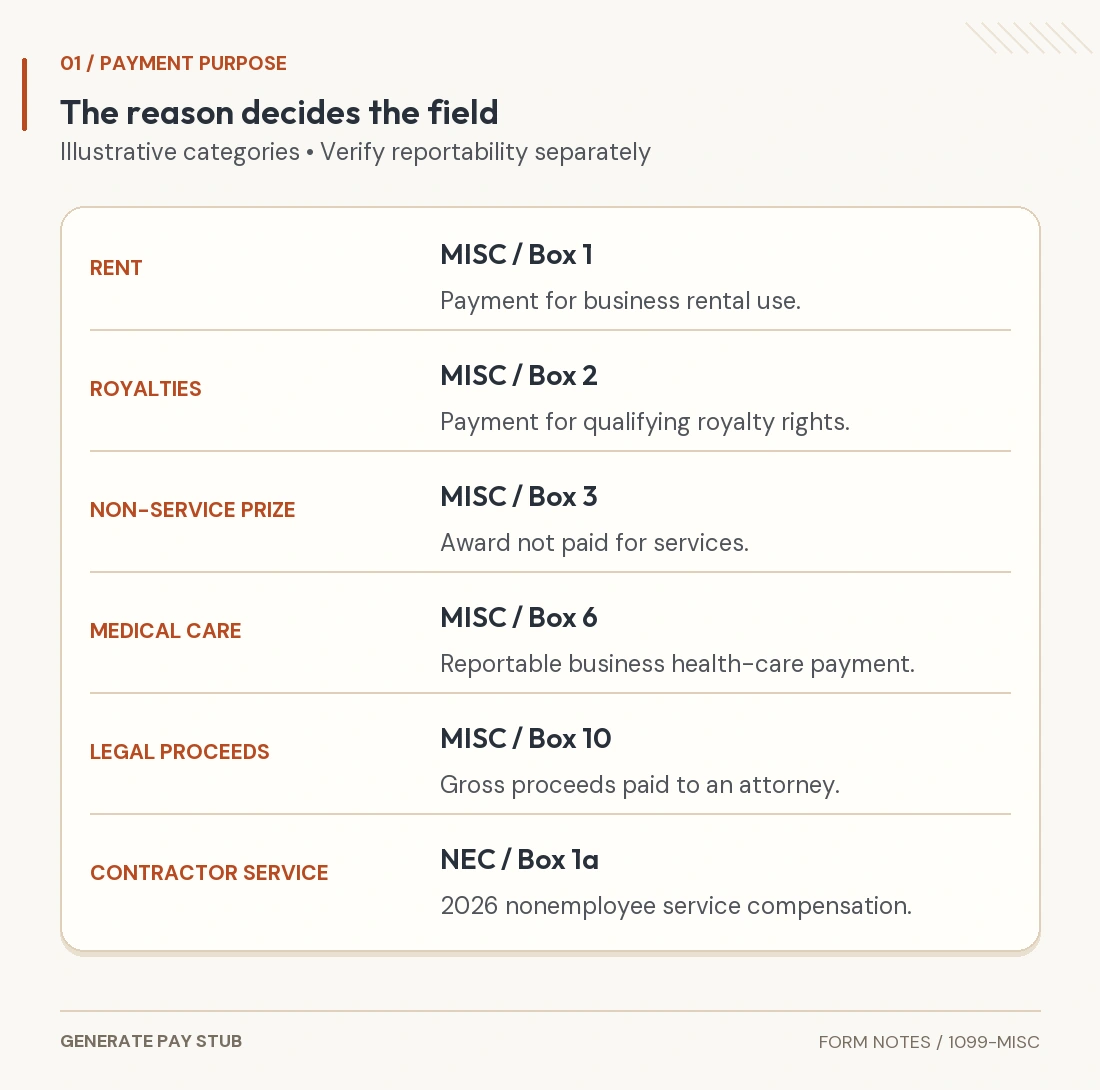
It reports applicable nonemployee compensation, not every payment leaving a business bank account. The IRS form overview identifies that purpose. Employee wages, rent, merchandise and other payments can have different reporting treatment.
The IRS contractor-reporting guide starts with the relationship, business purpose, payee type and applicable payment threshold. A personal purchase is not automatically business reporting because a business owner made it.
Worker classification comes first. The IRS classification guidance considers evidence of control and independence, including behavioral control, financial control and the relationship. Choosing a contractor document cannot turn an employee into an independent contractor. Our guide to the phrase “1099 employee” explains why that wording can confuse the issue.
An LLC suffix does not settle the reporting question either. Check its tax classification and the type of payment. Corporate exceptions have exceptions of their own, including applicable attorney fees. Foreign recipients and foreign-source or treaty questions can require a different analysis and forms.
Which year, reporting threshold and form revision should you use?
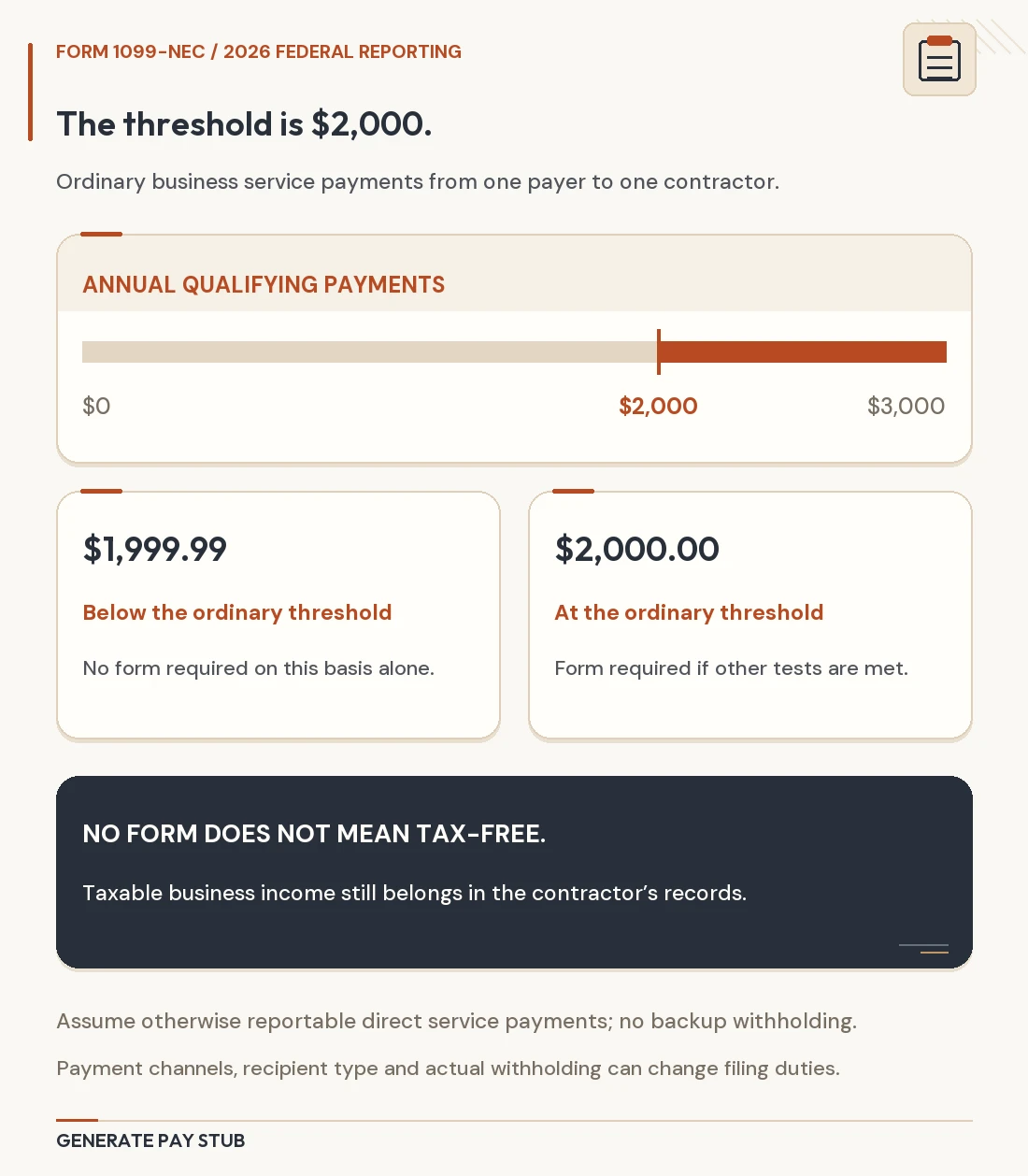
Use the calendar year being reported, not the year you happen to download the document. The 2026 Publication 1099 explains the increase from the earlier $600 threshold to $2,000 for specified payments after 2025. Not every 1099 category shares that threshold.
| Payment year | General service-payment threshold | Compensation field and revision |
|---|---|---|
| 2025 | $600 | Box 1 on the April 2025 revision. |
| 2026 | $2,000 | Box 1a on the December 2026 revision designated for 2026 reporting. |
The 2025 instructions and current 2026 instructions should not be interchanged. Backup withholding and special payment categories can create reporting duties outside the ordinary threshold example.
The current official 1099-NEC packet explains why a revision can be released before its filing season. Its December 2026 revision is designated for 2026 information filed beginning in 2027. Select the appropriate edition rather than relabeling an old form.
For more threshold detail, use our 2026 contractor-payment reporting guide. This article concentrates on preparing the underlying vendor packet and mapping it to the document.
What belongs in a useful vendor review packet?
Keep identity, payment evidence and reporting decisions together. A well-organized packet lets a second reviewer follow the total without guessing what a spreadsheet abbreviation means.
- Taxpayer identity: the reviewed W-9, relevant tax classification and current recipient address.
- Payment ledger: date, invoice or reference, gross payment, method and recipient.
- Supporting evidence: invoices, bank or check records and processor records where relevant.
- Reconciliation notes: exclusions, unpaid items, voided entries and unresolved differences.
- Withholding and state information: actual tax withheld and applicable jurisdiction records.
- Completion record: the reviewed form, recipient-delivery evidence and filing result.
Match the taxpayer name and identifier, rather than assuming the invoice's trading name is the tax name. Our W-9 identity guide covers individual owners and disregarded LLCs. Protect that information and use a verified collection route.
If the vendor changed ownership or taxpayer identity, pause the automatic annual aggregation and establish the proper recipient for each payment. A single display name in accounting software does not prove one taxpayer received everything.
How do you reconcile direct payments and unpaid invoices?
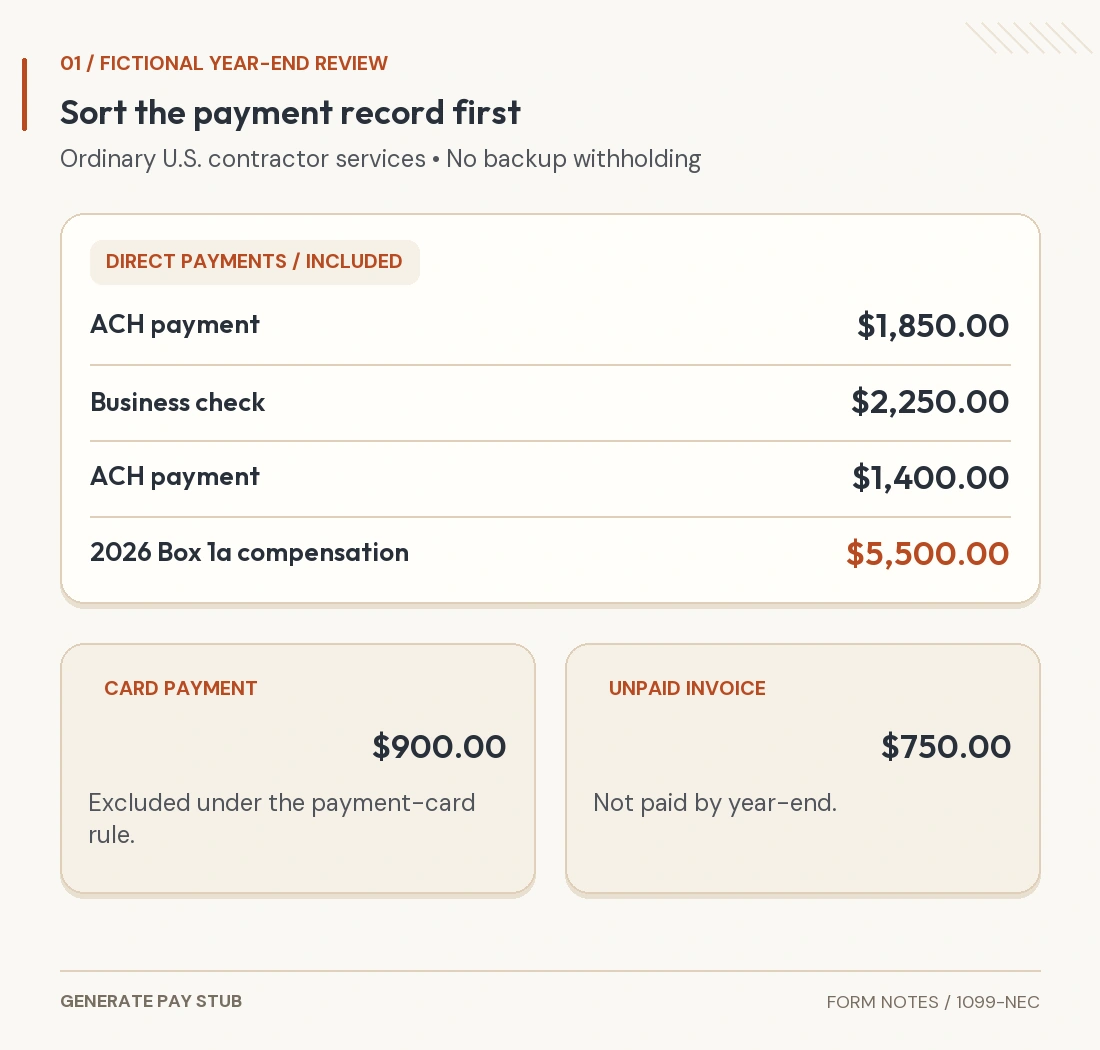
Reconcile amounts actually paid during the reporting year and document the reason for each inclusion or exclusion. Consider this fictional completed 2026 record for one ordinary U.S. contractor:
| Record | Status and treatment | Amount |
|---|---|---|
| ACH service payment | Paid; included in direct reportable compensation. | $1,850.00 |
| Business-check service payment | Paid; included in direct reportable compensation. | $2,250.00 |
| Second ACH service payment | Paid; included in direct reportable compensation. | $1,400.00 |
| Credit-card service payment | Paid; excluded from payer’s NEC total under the payment-card rule. | $900.00 |
| Outstanding service invoice | Unpaid at December 31; not part of this payment total. | $750.00 |
Assume each paid direct item is otherwise reportable, the card transaction falls under Section 6050W, and there are no refunds or other adjustments. The three direct payments total $5,500. Including the card transaction, the contractor was paid $6,400 across the listed methods. The extra $750 invoice remains unpaid; it is not another completed payment in this example.

Keep unpaid invoices in the accounting records with their true status. Revisit the reporting year when payment occurs. Noncash compensation, barter, repayments or unusual reimbursements can need separate treatment; they are outside this cash-payment example.
Do not automatically remove parts and materials from a service payment. The NEC instructions can include incidental parts or materials in service compensation. Likewise, sales-tax treatment can depend on whom the tax is imposed on. Review the applicable rule before changing a gross amount.
Why should payment-card transactions be separated?
Transactions covered by Section 6050W belong to the payment-settlement reporting framework rather than a duplicate payer NEC. The current NEC instructions expressly distinguish payment cards and covered third-party network transactions.
The IRS explanation of 1099-K describes card processors, payment apps and marketplaces. An app's brand name alone is not enough to classify a transfer: determine how that particular transaction was settled.
For the $900 example, the known fact is a covered credit-card transaction. Do not put it back into the payer's NEC merely because the vendor says no 1099-K arrived. Reporting thresholds and a recipient's obligation to report taxable business income are separate questions.
For a bank transfer, establish whether it was a direct payment or a covered settlement transaction. Save the evidence behind that decision so the same amount is not included twice by different reviewers.
What if the contractor received cash after backup withholding?
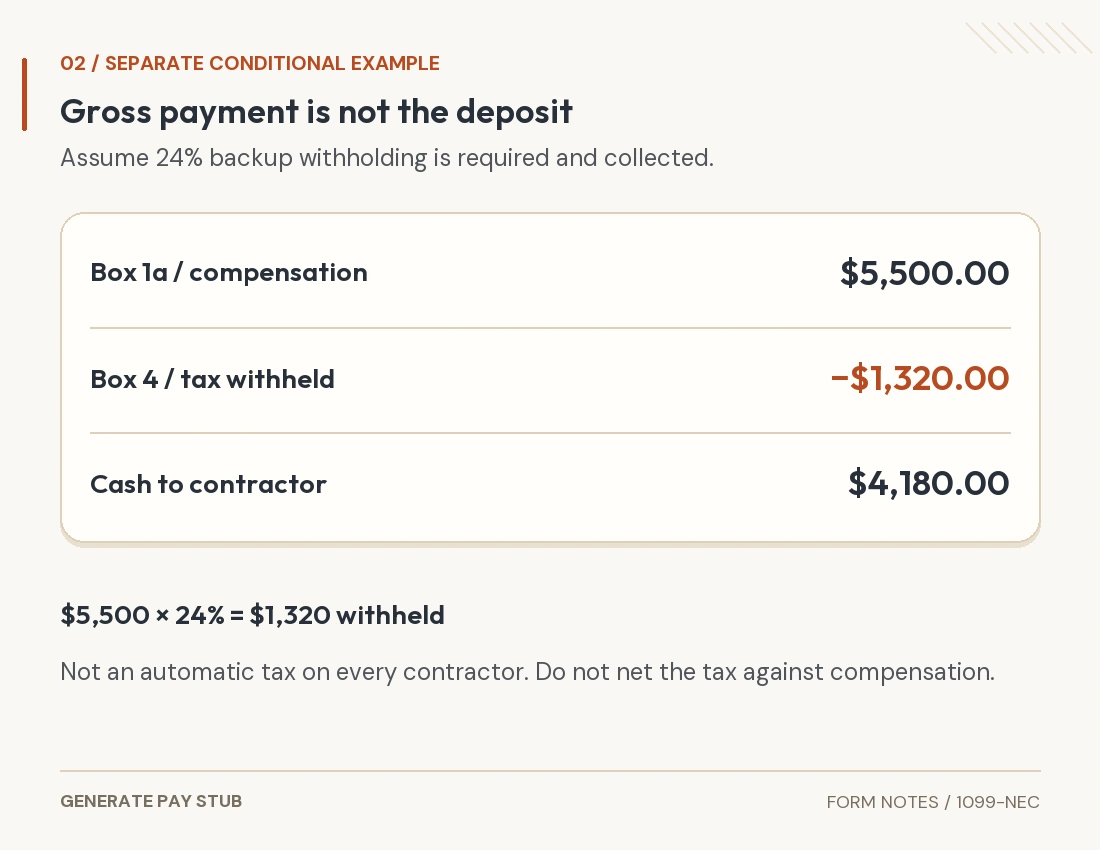
Report the gross compensation and actual tax withheld in their separate fields. Do not replace compensation with the smaller bank transfer.
The IRS backup-withholding guidance describes the 24% rate and triggering circumstances. This is not an automatic payroll tax on every contractor payment.
As a separate conditional example, assume $5,500 of compensation is subject to required 24% backup withholding and the payer actually collects $1,320. The contractor receives $4,180 cash. The compensation amount remains $5,500; Box 4 reports $1,320. These assumptions replace the no-withholding assumption in the earlier ledger.

Missing or incorrect taxpayer details and IRS notices require the applicable procedures. Do not invent a TIN or enter a calculated withholding amount merely to make the document look complete. Any required deposit and tax-return responsibilities also need separate attention.
Which 1099-NEC fields need special attention?
Review every field against its purpose and the selected year's form. The current packet provides the box labels; the specific instructions define when they apply.
- Payer and recipient: use the correct taxpayer identity, identifier type and address.
- Calendar year: match the reviewed payment period.
- Compensation: use the reconciled reportable amount, not the contractor's estimated business profit.
- Federal withholding: use actual applicable backup withholding.
- Special fields: check direct sales, excess parachute, account-number and notice requirements only where relevant.
- State rows: distinguish state account numbers, state payments and state withholding.
The 2026 form also separates cash tips, tipped-occupation codes and qualified overtime information. Those reported tip and overtime amounts are portions already included in total compensation, not additions to be counted again. An extra contractual service fee does not automatically become qualified overtime. This example has none of these special amounts.
The form does not determine whether a worker or payment qualifies for a tax deduction. If a special field seems relevant, read its complete current instructions and resolve classification or eligibility before entering an amount.
When and how do you complete 2026 reporting?
The ordinary 2026 NEC filing and recipient deadline is February 1, 2027. January 31 falls on Sunday, so the next-business-day rule applies. Check any applicable relief or special extension separately; an NEC filing extension is not automatic.
Plan the IRS route early. Publication 1099 says IRIS becomes the intake system for these information returns for the 2027 filing season as FIRE retires at its 2026 year-end shutdown. Use the current IRIS guidance for access, requirements and system status.
Generally, 10 or more covered information returns in aggregate trigger electronic filing. Include relevant form types in that assessment rather than counting only your NECs. A paid filing provider and the IRS's free portal have different service arrangements; establish who is responsible for submission and checking acceptance.
For permissible paper filing, follow official form and Form 1096 requirements. The downloaded informational red Copy A is not an acceptable self-printed scannable filing copy. Providing Copy B to a contractor does not itself file with the IRS or satisfy every state requirement.
What if a form has already been sent or filed incorrectly?
Identify the exact error and the original filing route, then follow the corresponding correction instructions. A wrong amount, wrong taxpayer identity and duplicate filing can require different steps. Keep the original submission and the evidence supporting the correction.
Marking a PDF “CORRECTED” does not update the IRS record. Complete the actual correction process and recipient delivery where required. Do not use the VOID box as a substitute for a filed-return correction.
Before issuing any replacement, reconcile the accounting record and the filing history so the correction does not create another duplicate. Preserve accepted correction results with the vendor packet.
How can you prepare a reviewed recipient copy?
Use the builder after deciding the correct reporting treatment. The 1099-NEC document guide links to the 1099-NEC builder, which currently offers 2025 and 2026 editions.
Select the year, enter reviewed payer and recipient details, then copy the reconciled amounts. The tool accepts actual payment and withholding information; it does not automatically calculate contractor taxes. Review the special fields, state entries and every preview page against the source records.
The current builder states that recipient copies are completed and informational red Copy A stays blank. Follow its current completion instructions and carry out tax-agency filing separately. The tool does not verify worker classification, authenticate the underlying ledger or submit the return.
General U.S. information-reporting guidance. The examples are fictional and limited to their stated assumptions. Seek appropriate review for foreign recipients, legal settlements, special industries, repayment issues or IRS notices.