Use Form 1099-MISC for the specific payment categories it covers, such as reportable rents, royalties, certain other income, medical payments and gross proceeds paid to attorneys. Identify the payment's purpose before choosing a box. Ordinary independent-contractor service compensation generally belongs on 1099-NEC instead.
“Miscellaneous” does not mean a catch-all for every vendor payment. A good review connects each amount to its payment category, recipient, reporting year and delivery obligation.
Reviewed November 5, 2026. This U.S. payer guide emphasizes calendar 2026 reporting and the designated December 2026 form revision. The examples are fictional, assume otherwise reportable direct business payments to U.S. recipients, and exclude card-settlement, foreign-recipient and backup-withholding complications unless discussed separately.
When does a payment belong on 1099-MISC rather than 1099-NEC?
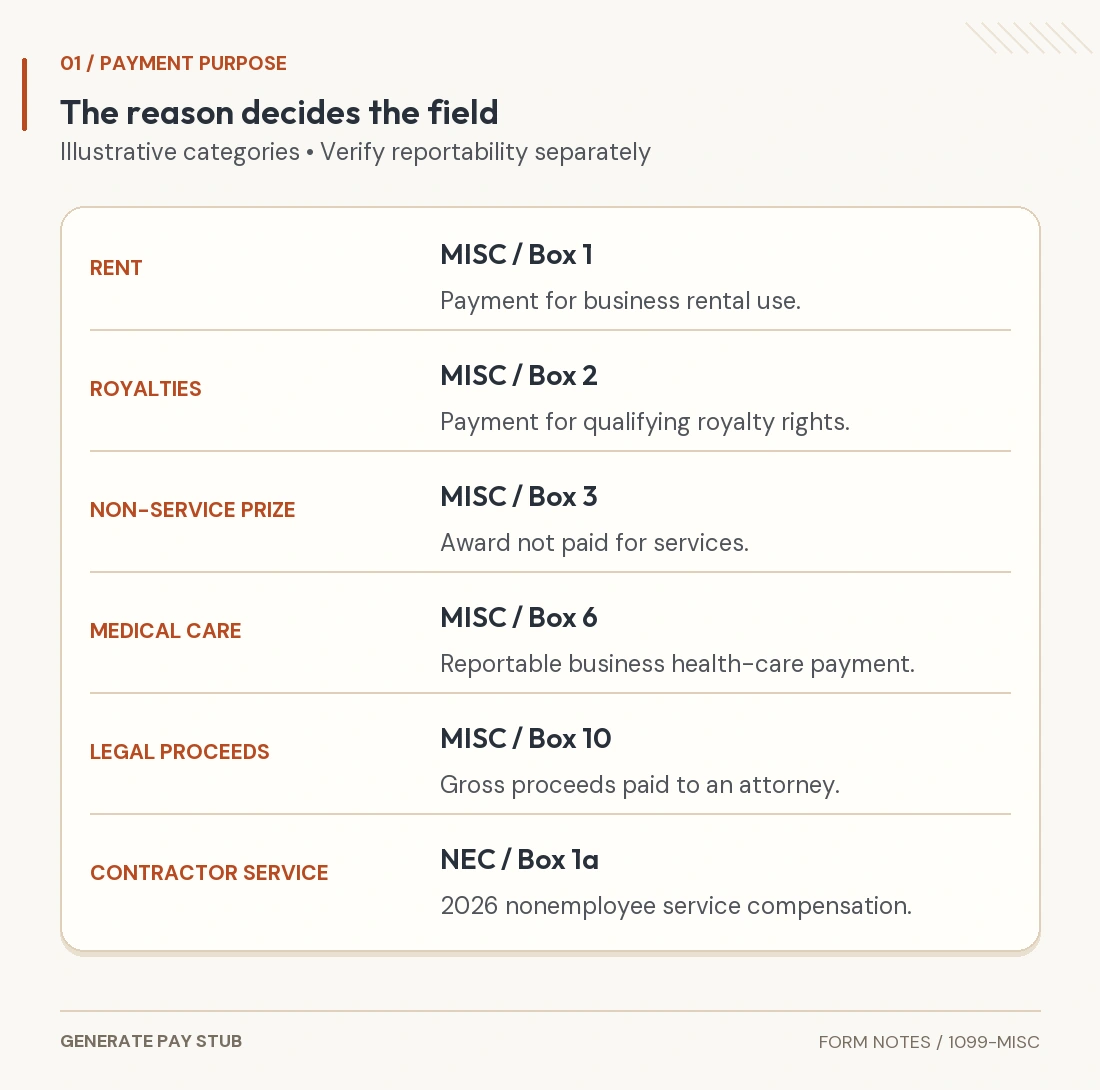
Classify the payment by what it represents. The IRS information-return guide separates categories including rent, royalties, prizes, medical care and attorney proceeds. A vendor's occupation alone does not identify the form.
For example, a business can pay an attorney for legal services or pay gross settlement proceeds to an attorney. Those transactions answer different reporting questions. Similarly, a non-service prize is different from an award paid as compensation for work.
Start with four questions: Was this a business payment? What was it for? Which taxpayer received it? Which specific reporting rule applies? If the answer is ordinary contractor service compensation, use our 1099-NEC preparation guide rather than placing it in MISC Box 3 merely because “other income” sounds broad.

Which reporting thresholds apply to 2026 payments?
There is no single dollar threshold for every MISC box. The current MISC instructions distinguish the following common categories.
| Payment category | Box | General threshold |
|---|---|---|
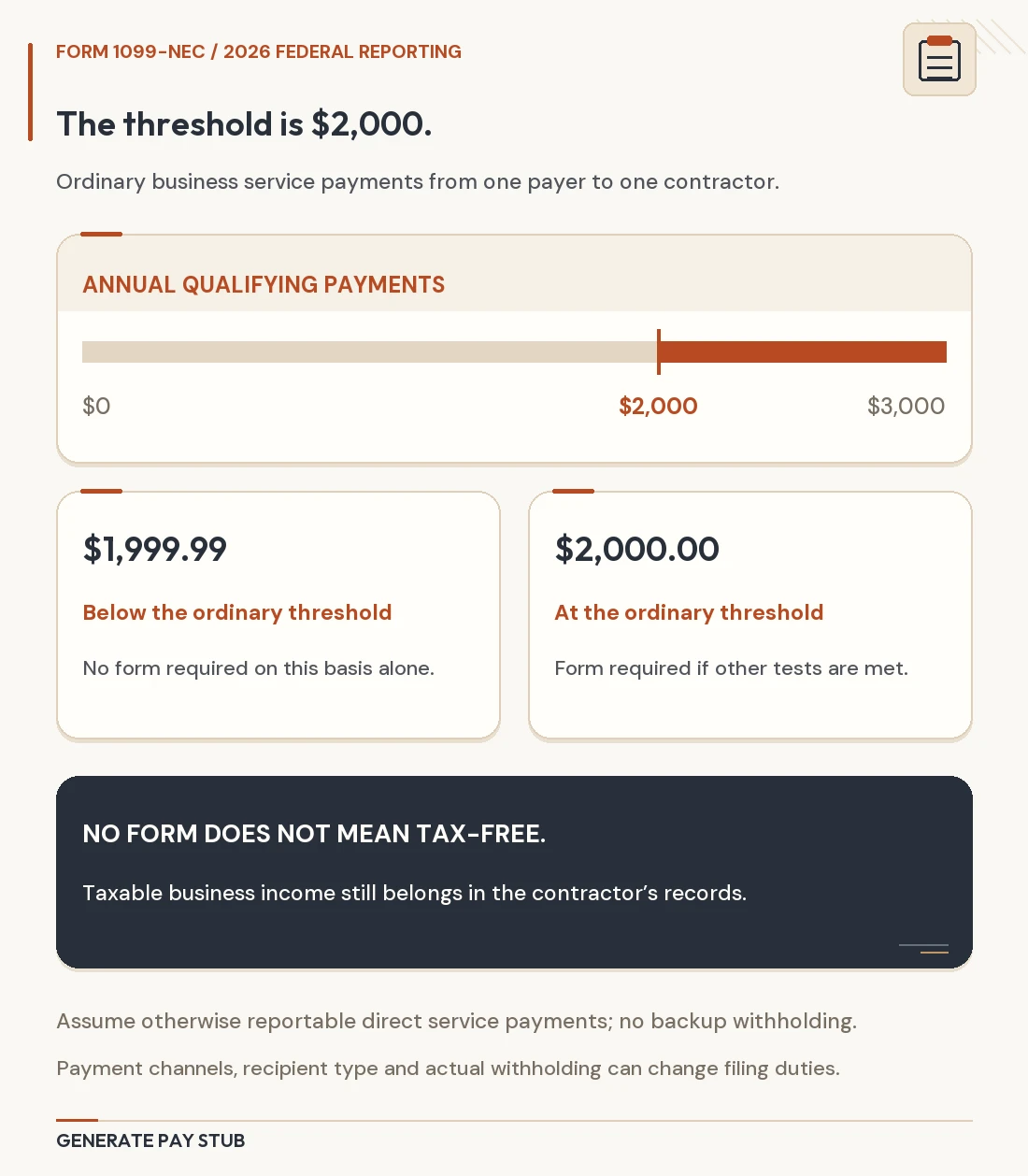
| Rents, specified prizes/other income, medical payments or crop insurance | 1, 3, 6 or 9 | $2,000 |
| Royalties or substitute dividends/interest | 2 or 8 | $10 |
| Gross proceeds paid to an attorney | 10 | $600 |
| Cash purchases of fish for resale | 11 | $600 |
| Fishing-boat proceeds | 5 | Any amount |
These are selected general rules, not a finding that every payee or payment is covered. Backup withholding can require a return regardless of payment size. Specialized categories have additional definitions and exceptions.
Some specified payment thresholds rose from $600 for 2025 to $2,000 for 2026. The 2025 instructions remain relevant when reviewing that earlier year. Do not apply the 2026 increase backward or assume it also changed the royalty or attorney-gross-proceeds threshold.
For payments at a threshold boundary, check the exact rule rather than rounding the annual total first. Keep cents in the supporting ledger and follow the output instructions.
How should you review business rent and royalties?
Review the rental or royalty arrangement and the recipient's tax identity separately. For rent, keep the agreement, payment dates, payee information and evidence supporting the annual total.
Assume a business pays a U.S. individual property owner $850 each month for 12 months in 2026, directly by ordinary bank payment, solely for reportable office rent. There are no deposits, reimbursements or adjustments in the example. The Box 1 rent amount is $10,200.
A refundable security deposit, a utility reimbursement and a lease payment should not be grouped together without examining their actual treatment. Identify what was paid and why. If a property manager or real estate agent is involved, use the specific intermediary rules; the person sending the tenant's payment is not always the person responsible for the ultimate owner's information return.
For royalties, document the rights and the payment calculation. As a separate example, assume an otherwise reportable $120 royalty payment for licensed rights. Its category is Box 2, and the $10 general reporting threshold matters even though $120 is below $2,000.
Do not combine the rent and royalty illustrations as though they are one recipient's actual statement. Each is a separate hypothetical payment review. For a real payee receiving multiple categories, preserve the correct box allocation rather than entering a single unexplained “miscellaneous” total.
How do attorney gross proceeds differ from attorney service fees?
A legal fee and gross proceeds paid to an attorney are different reporting categories. A payment for the lawyer's work generally points to NEC; reportable gross proceeds paid in connection with legal services can belong in MISC Box 10.
Do not assume the entire amount of a settlement check is the attorney's fee. Conversely, do not reduce reportable attorney gross proceeds to the amount the attorney ultimately keeps. Review the payment instrument, settlement agreement and the roles of the payer, claimant and attorney.
Corporate status does not provide a blanket exception for these legal-payment categories. A settlement can also create separate claimant reporting questions. Obtain a transaction-specific review before deciding that one attorney statement completes every reporting duty.
What about prizes, medical payments and the other boxes?
Use the category's definition, not just the shortest available label. The 2026 form packet displays distinct fields for the payment types and reporting selections.
Prizes and other income
Box 3 can cover applicable non-service prizes and awards. If a payment compensates an employee or contractor for services, review the wage or NEC rules instead. Describe the basis for the award in the supporting record so its treatment is understandable later.
Medical and health-care payments
Applicable business payments belong in Box 6. The ordinary corporation exception does not generally remove medical-provider reporting, but the instructions contain specific exclusions, including certain tax-exempt facilities and arrangements. A household's personal medical bill is not automatically the business-payer scenario described here.
Fishing, crop insurance and deferred compensation
Boxes 5, 9, 11, 12 and 15 address specialized categories. The distinction between fishing-boat proceeds and cash fish purchases matters. Nonqualified deferred compensation can also require technical plan and timing analysis. If these fields apply, use the complete instructions and an appropriately qualified reviewer.
Direct sales and reporting selections
The direct-sales indicator concerns qualifying consumer products for resale, not a dollar amount of contractor compensation. Review its $5,000 rule and the permitted form choice; avoid duplicate reporting. FATCA, account-number and notice selections have their own conditions and should not be checked by default.
New 2026 tip and overtime information
For the 2026 revision, cash tips, occupation codes and qualified overtime have specific fields. When applicable, the reported tip and overtime portions are already included in Box 3. Do not add them again as another payment. The presence of a field does not determine worker classification or deduction eligibility.
How do you build a traceable MISC payment record?
Keep the reason, recipient and amount connected from the ledger to the form. This review sequence helps prevent the right total from landing in the wrong box:
- Confirm the calendar year and correct form revision.
- Check the recipient's taxpayer name, identifier, classification and address.
- Group payments by their actual category and method.
- Identify adjustments, exclusions and unresolved items explicitly.
- Apply the relevant threshold and any special reporting rule.
- Compare every completed field with the reviewed source record.
Use a properly collected W-9 where appropriate. The W-9 preparation guide explains why a trading name and taxpayer name can differ. Do not substitute an invoice name for a verified tax identity without checking.
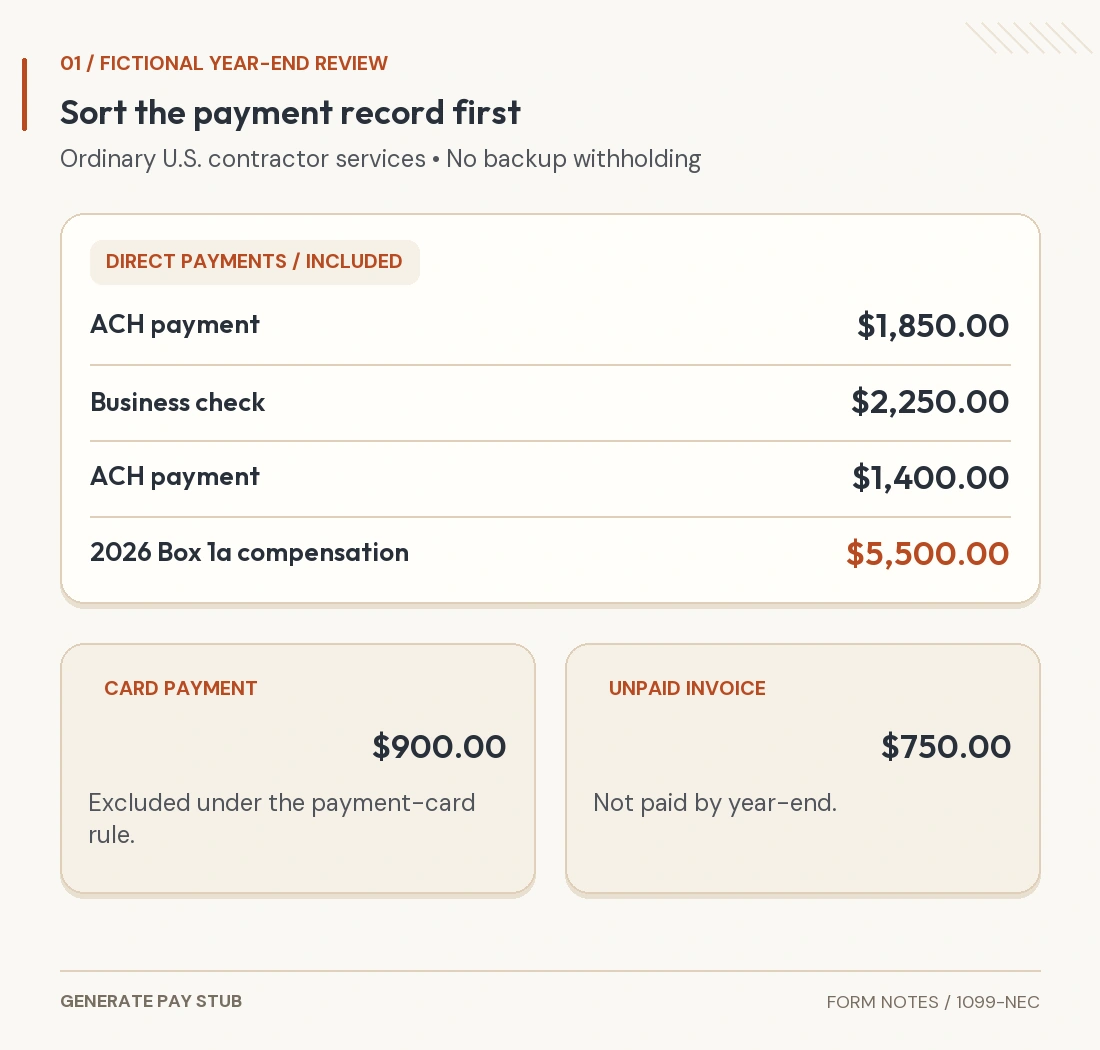
Covered payment-card and third-party network transactions need their separate reporting treatment. Review the actual payment route before adding them to MISC. For withholding, enter the tax actually collected under the applicable rules; a calculator cannot establish a historical withholding fact.
After preparing the statement, retain the reasoning behind each exception. A note saying “excluded” without the payment method, tax classification or other basis is difficult to audit when the vendor asks about a discrepancy.
What are the ordinary deadlines for 2026 MISC reporting?
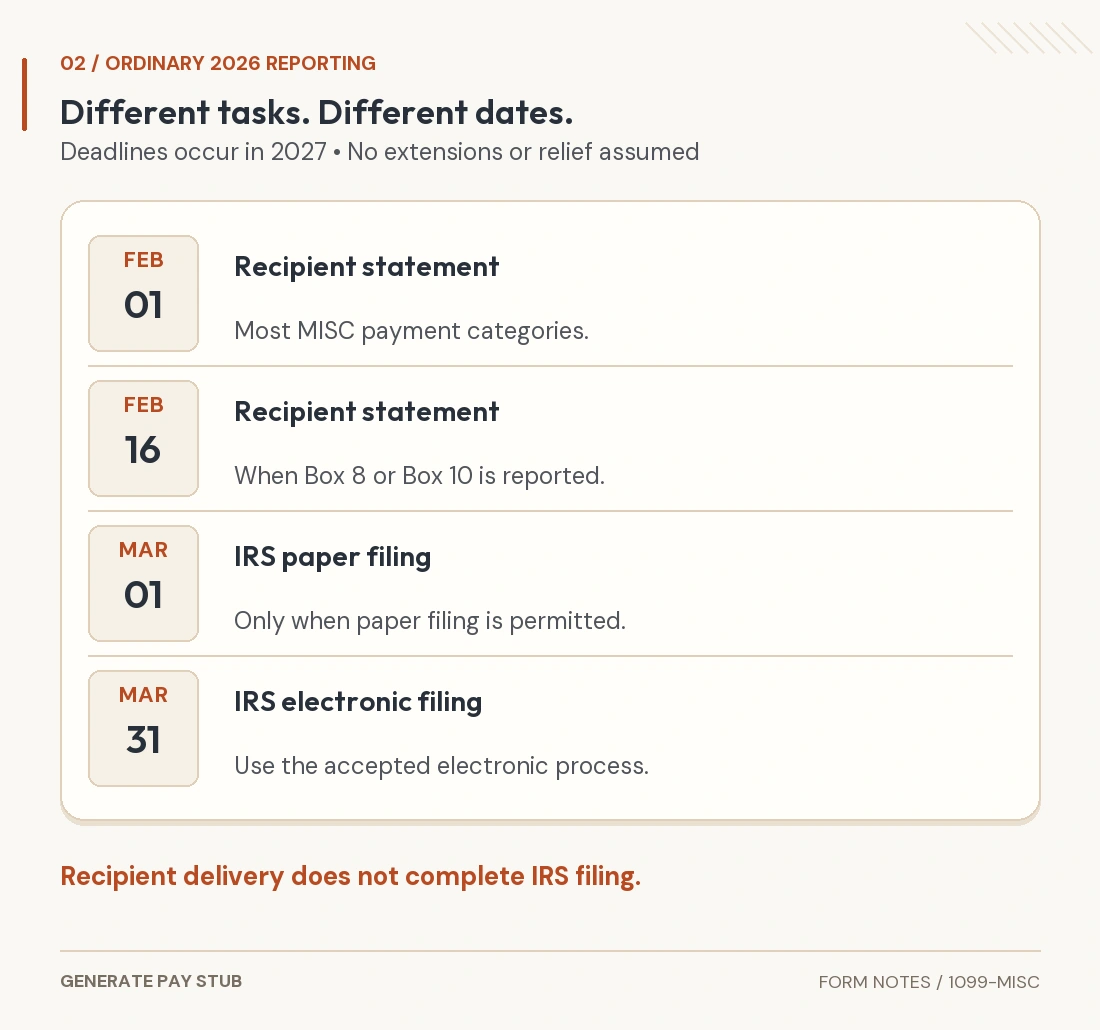
Recipient statements and IRS filing have different due dates. The following dates apply the normal calendar rules, without special relief or an extension.

Publication 1099 for 2026 provides the general due-date and statement rules. The January 31 and February 28 dates fall on Sundays in 2027. The special February 15 statement date also moves because Washington's Birthday falls on that Monday, as shown in the OPM holiday calendar.
Accordingly, most recipient statements are ordinarily due February 1, 2027; statements reporting Box 8 or Box 10 are due February 16, 2027. Permitted paper IRS filing is due March 1, 2027, while electronic filing is due March 31, 2027.
Do not replace the earlier recipient deadline with the later electronic-filing date. If you need an extension, identify whether it concerns IRS filing or furnishing statements, and follow that process before its deadline. One does not automatically extend the other.
What completes the filing and recipient-delivery process?
A finished document needs the required submission and delivery steps. The official packet warns that its informational red Copy A is unsuitable for self-printed paper filing. Use the proper electronic route or compliant paper process when paper is allowed.
Electronic-filing requirements generally begin at 10 covered returns in aggregate. The IRS IRIS resource explains the portal and access requirements. Publication 1099 addresses the transition to IRIS for the 2027 filing season.
Keep recipient-delivery evidence, government submission results and any rejection or correction history. Filling a state row does not by itself send the form to that state. Confirm the applicable state process separately.
How should errors or a missing recipient statement be handled?
Determine whether the document is still a draft, was furnished, or was already filed. Use the proper correction route for the identified error. An edited PDF does not update a previously accepted government record.
If a recipient questions the amount, reconcile payment dates, category and recipient identity with the underlying records. Distinguish a reporting mistake from a legitimate difference between gross payments and taxable profit. A MISC statement does not calculate the recipient's complete return.
If you are the recipient and cannot obtain a missing or corrected form, preserve your own income records and ask the payer for clarification. Do not assume income becomes non-taxable merely because no statement arrived. Obtain tax help where the facts or deadline require it.
How can you prepare a reviewed MISC document?
Enter confirmed payment facts after the reporting decisions have been made. See the 1099-MISC document guide and MISC builder. The current tool offers 2025 and 2026 editions.
Check the selected year, payer and recipient identity, and every relevant payment category. Enter actual withholding and state information when applicable. Review the extra fields and all preview pages, including any tip or overtime portion already contained in Box 3.
The builder prepares recipient copies from your entries and states that red Copy A is left blank. It does not decide reportability, verify the payment record or file with tax agencies. Follow its current document-completion instructions and retain the reviewed copy alongside the separate filing evidence.
General U.S. reporting information. Fictional examples do not determine a particular payment's taxability or filing requirements. Seek specialized review for settlements, foreign payees, deferred compensation and industry-specific rules.