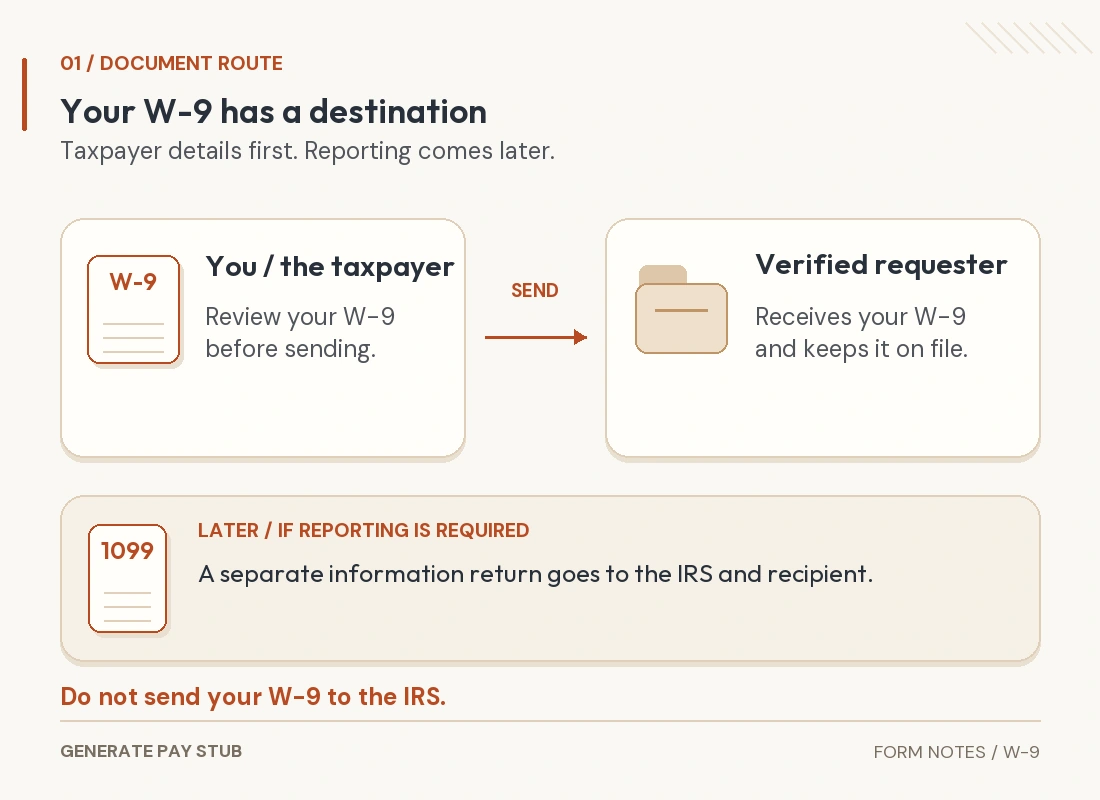
To fill out Form W-9, identify the taxpayer behind the payment, match that taxpayer's name and tax ID, choose the correct federal tax classification, review the certifications, and return the form to the requester. The business paying you usually keeps the W-9; you do not send it to the IRS. The IRS describes W-9 as a way to obtain information needed for information-return reporting, including payments, interest and other transactions. IRS: About Form W-9.
A new client emails, “Please send your W-9 so we can set you up.” You have a business name, an LLC registration and perhaps more than one tax number. Which details belong together? This guide helps you resolve that question before sharing a document containing sensitive information.
Scope and review date: U.S. federal guidance checked November 5, 2026, with an emphasis on freelancers and small-business vendors. The IRS currently lists the March 2024 revision; W-9 is not a separate annual income-tax return. Entity elections, foreign ownership, trusts and IRS notices can require individual advice.
Why did a client ask you to complete Form W-9?
The client is collecting taxpayer information, often before making business payments. The IRS tells businesses to request a W-9 after determining that a worker is an independent contractor, and to retain it for four years. A later Form 1099-NEC, when required, reports nonemployee compensation; the W-9 supplies identifying information for that process. IRS: Contractor forms and recordkeeping.
Think of the client's vendor file as having several jobs: the contract describes the work, the invoice requests payment, and the W-9 identifies the taxpayer. Keep those records connected without attaching your tax ID to every invoice. Our invoice versus pay stub guide explains the payment-document distinction.
A W-9 request does not settle whether you are legally an independent contractor. For federal employment taxes, the IRS examines the actual relationship, including behavioral control, financial control and the parties' relationship. Resolve a disputed classification before treating a new onboarding form as the answer. IRS: Worker classification.

Is a W-9 the same as a W-4 or a 1099?
No. Start with the purpose of the document. Use the comparison below to route your question before entering personal information.
| Document | What it communicates | Who prepares it |
|---|---|---|
| W-9 | Taxpayer identity and applicable certifications. | The payee supplies it to the requester. |
| W-4 | Employee instructions used to determine federal income-tax withholding. | The employee gives it to the employer. |
| 1099-NEC | Reportable nonemployee compensation for a particular tax year. | The business payer prepares the information return when required. |
The IRS W-4 overview explains its employee-withholding role. For contractor reporting thresholds, payment-channel exceptions and the applicable year, use our separate 2026 Form 1099-NEC guide. Do not use a 1099 filing threshold as a reason to ignore a legitimate W-9 request.
W-9 requires U.S.-person status for federal tax purposes, including resident aliens. Foreign persons generally need the appropriate W-8 or Form 8233. W-8BEN concerns foreign individuals; it is not universal. Confirm the right documentation before certifying U.S. status. IRS requester instructions; IRS: About Form W-8BEN.
What should you gather before opening a W-9 form?
Create a small reference packet. This is a practical review method, not a demand to send all these records to your client:
- Name evidence: the taxpayer name used in your tax records.
- Business details: a trade name or LLC name, if applicable, plus records of any federal tax election.
- Tax ID evidence: the relevant SSN, EIN or other applicable TIN record.
- Delivery details: a current mailing address and the client's verified recipient or portal.
- Exception documents: an IRS notice or exemption information if one actually applies.
Compare the records yourself. A contract using your studio's brand name does not explain which taxpayer owns the income. Likewise, a document builder can format an entry without proving that you chose the right entity or identifier.
How do you fill out Form W-9 without mixing identities?
Review the identity fields together before moving on to the address and certification. The following checkpoints help you use the official instructions rather than guessing from the shortest label on the screen.
1. Establish the taxpayer and any separate business name
Line 1 identifies the taxpayer; line 2 accommodates a different business or disregarded-entity name. A sole proprietor uses the owner's name on line 1. The information-return instructions likewise distinguish the owner's name from a trade name. IRS: Recipient names and taxpayer identification numbers.
Read both lines aloud with this question: “If the client reports payments using these details, have I identified the taxpayer or just my public-facing brand?” That check is particularly useful when an invoice displays a trading name in large letters.
2. Identify federal tax treatment before choosing a box
An LLC's state-law label alone does not establish federal income-tax treatment. A single-member LLC is generally disregarded unless it has elected corporate treatment; a domestic LLC with multiple members generally defaults to partnership treatment. Different rules can apply to employment and certain excise taxes. IRS: Single-member LLCs.
Line 3a follows the owner’s classification for a disregarded entity. Other LLCs enter LLC with C, S or P, as applicable. Line 3b addresses foreign partners, owners or beneficiaries when a qualifying flow-through entity gives the form to a partnership, trust or estate in which it has an ownership interest. Overseas customers alone do not trigger it. IRS requester instructions, lines 3a and 3b.
If you cannot explain why the box fits, pause and check your tax-election records or ask your preparer. Do not select S corporation because it sounds preferable, or partnership merely because two people collaborate on a project.
3. Match the tax ID to the taxpayer
A sole proprietor with an EIN may use that EIN or an SSN. For an individually owned disregarded single-member LLC, the IRS specifies the owner's SSN or EIN, rather than the LLC's EIN, for this income-reporting purpose. An LLC's separate employment-tax EIN does not automatically become its W-9 number. IRS: Recipient names and TINs; IRS LLC guidance.
A resident alien ineligible for an SSN uses an ITIN in the SSN space. Check the Part I instructions for that situation.
Do not substitute a client's EIN, an invoice reference, a bank-account number or the last four digits of an identifier. The IRS information-return instructions require the complete TIN when it is requested; permitted truncation on certain recipient statements is a different issue. IRS: General information-return instructions, section J.
4. Review the remaining entries with the official form beside you
Lines 5–6 contain your mailing address; line 7 and the requester-address field are optional. Individuals generally leave exemption codes blank. FATCA exemption codes concern accounts outside the United States. Official W-9 and field instructions.
Use an address where the relevant mail can reach you, then confirm the requester updates its vendor file. For an unfamiliar exemption or unusual ownership chain, use the complete instructions rather than borrowing a code from another person's form.
What does a fictional freelancer's W-9 identity check look like?
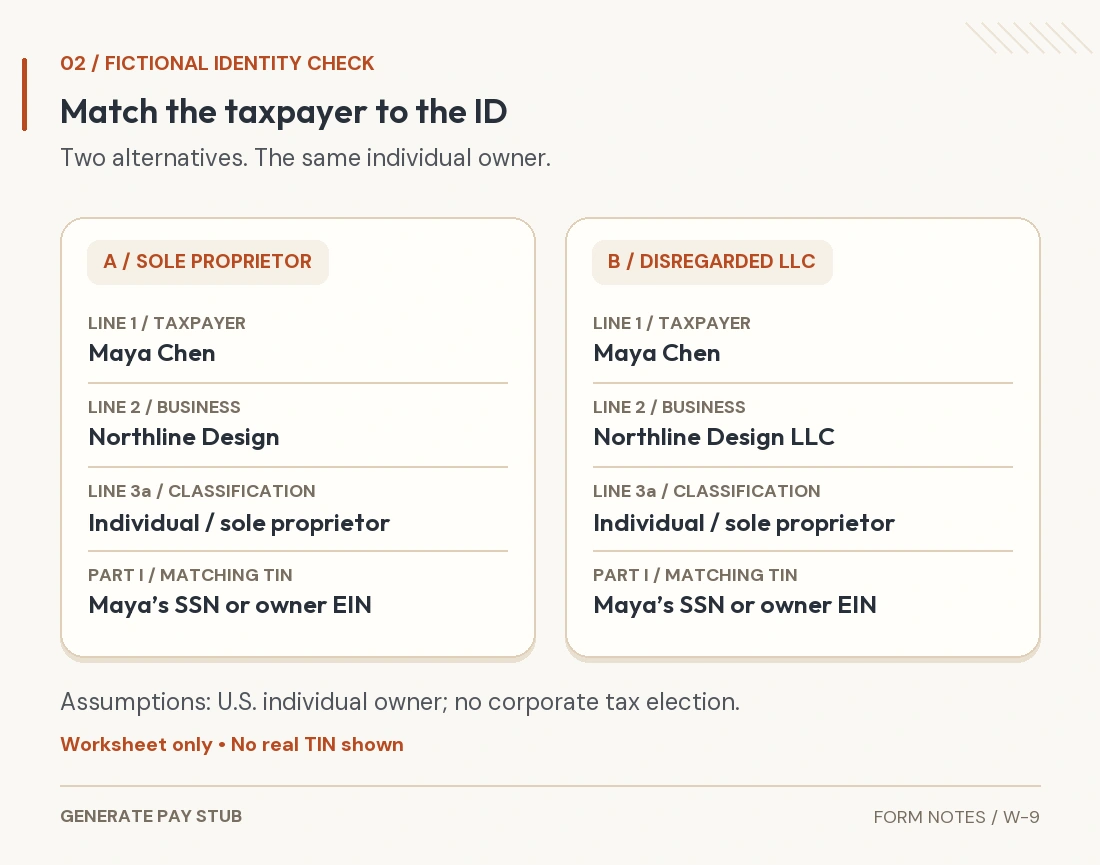
Assume Maya Chen is a U.S. individual working under the trade name Northline Design. The first scenario is a sole proprietorship. A second, alternative scenario uses Northline Design LLC, wholly owned by Maya and disregarded for federal income tax, with no corporate election. These are alternative fact patterns, not steps everyone must follow.

In both examples, the owner is the taxpayer. The second scenario's LLC suffix does not change that result by itself. If Northline instead had a valid S-corporation election, this worksheet would no longer fit: verify the entity's tax name, election and EIN before preparing a new form.
Keep the three-part check in your review notes: whose name, which classification, whose number? Our owner draws versus payroll wages guide explains why the same ownership distinction also matters when documenting business income.
Must every W-9 be signed, and can you sign electronically?
For ordinary nonemployee service payments, a correct TIN is required; a signature is generally unnecessary unless you were notified of a previously incorrect TIN. Other certification rules can require signing, including to establish U.S. status. Check Part II for your situation. W-9, Part II signature requirements.
Electronic collection must meet IRS system and certification requirements. Ask what the requester accepts; a drawn mark alone does not establish compliance. IRS: Electronic submission of Forms W-9.
Read before signing. If the IRS has notified you that interest/dividend underreporting makes item 2 untrue, follow its cross-out instructions. A fresh PDF does not resolve the notice.
Does completing a W-9 mean 24% will be taken from your payment?
No. Backup withholding applies when its legal triggers apply. The current rate is 24%. Missing or incorrect taxpayer information and specified interest/dividend underreporting or certification problems can trigger it; exemptions and payment types matter. A W-9 is not an election to have all freelance payments taxed at 24%. IRS: Backup withholding.
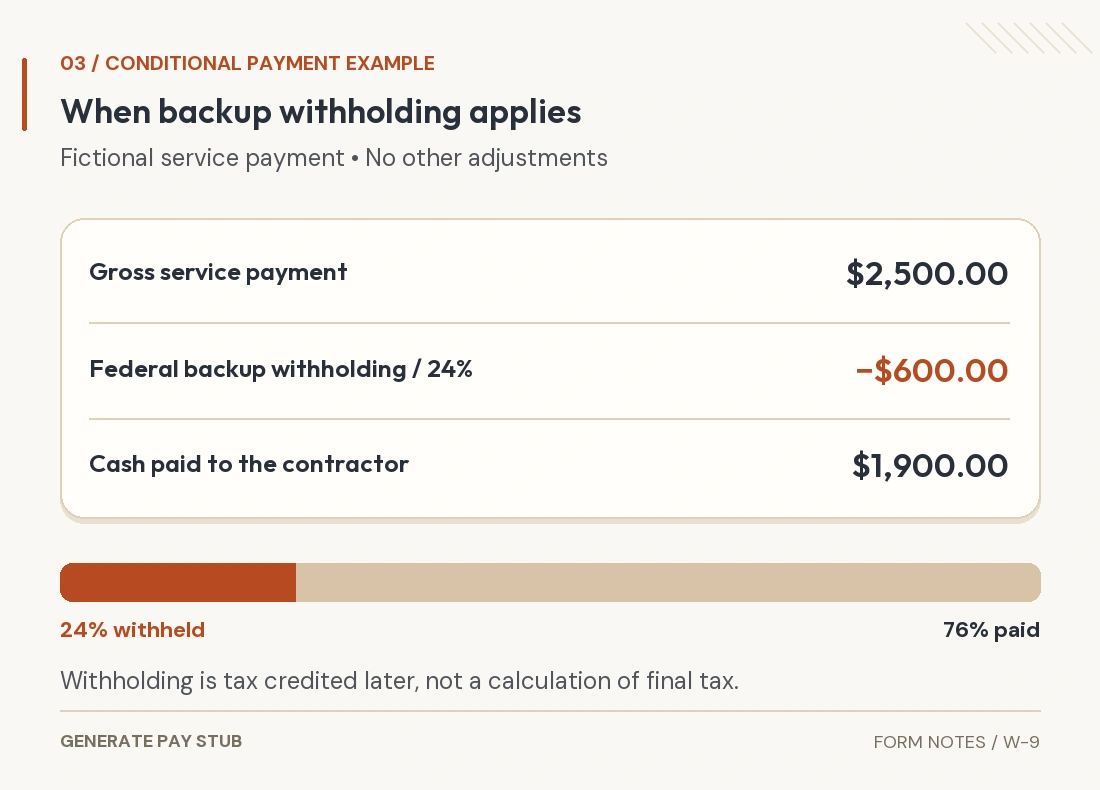
For an independent fictional example, assume a $2,500 reportable service payment is subject to 24% backup withholding, with no other adjustments. Withholding is $2,500 × 24% = $600, leaving $1,900 paid to the contractor. The payment record still needs to distinguish the $2,500 gross payment from the $600 federal tax withheld.

| Payment record | Amount |
|---|---|
| Gross service payment | $2,500.00 |
| Federal backup withholding at 24% | $600.00 |
| Cash paid after that withholding | $1,900.00 |
IRS guidance says backup withholding shown on a Form 1099 is reported as federal income tax withheld on the recipient's return for the year the income was received. It is not automatically the final tax owed or an extra business expense. Partners and S-corporation shareholders have specific allocation rules. IRS Topic 307: Credit for backup withholding.
An awaiting-TIN certificate does not provide a 60-day backup-withholding grace period for reportable nonemployee compensation. The IRS limits that rule to specified investment payments. IRS: TIN applied for.
How do you send a W-9 without casually exposing your tax ID?
Verify the recipient and use an agreed protected channel. The IRS includes both SSNs and EINs among personally identifiable information and recommends limiting disclosure to verified, necessary uses. IRS identity-protection tips.
- Confirm the request independently. Use a client contact or portal address you already trust, especially if the message is unexpected.
- Ask for the approved delivery method. Prefer a verified secure upload portal or another protected method the requester supports. If exchanging an encrypted attachment, agree how its password will be shared separately.
- Check the destination. Review the full address, access permissions and filename before uploading. Keep tax IDs out of email subject lines and public filenames.
- Limit access. Store your retained copy where only authorized people can reach it. Avoid public sharing links and general project folders accessible to unrelated collaborators.
The FTC's business data-security guide recommends access controls and encryption for sensitive information, and warns that ordinary email is not a secure way to transmit it. These are practical precautions; no delivery channel is an absolute guarantee against compromise.
A useful message to a verified client is: “I have the taxpayer information ready. Please confirm the secure upload link and the name of the team receiving it.” There is no need to paste the actual number into that message.
When should you replace a W-9 or correct a mismatch?
Supply a new W-9 when the account’s name or TIN changes. Also update exemption information when the instructions require it. Confirm the requester updates its records. W-9: Updating your information.
Keep a dated record of what you supplied and to whom. If an information return has already been issued, ask whether it also needs correction; replacing the vendor's W-9 does not itself correct an already filed return.
For an incorrect-TIN notice, follow the stated procedure. IRS Topic 307 explains that a second notice from the same payer can require verification beyond simply supplying another certification. An interest/dividend underreporting problem may require resolving the underlying issue with the IRS. IRS: Preventing or stopping backup withholding.
How can you prepare and review a W-9 PDF?
You can obtain the blank official form free from the IRS or use a document-preparation tool. The IRS W-9 page links the current form. Generate Pay Stub's W-9 document guide explains its optional builder, preview and paid PDF download workflow.
In the W-9 builder, prepare the identity fields from your records, inspect the certificate preview, and review any signature choice and the current checkout terms. If you choose to print and sign later, check whether a signature is required before delivering your copy. The tool prepares a document from your entries; it does not send the W-9 to your client, file a tax return or validate your tax classification.
This article is general educational information about U.S. federal forms, not individualized tax or legal advice. The fictional examples contain no real taxpayer identification numbers. Verify unusual ownership, foreign-status, exemption and notice questions against the complete IRS instructions or with a qualified adviser.