Prepare Form 941 by matching the employer, year and quarter to reviewed payroll tax totals, then reconcile tax liability with deposits. The return includes federal income tax withheld and both employee and employer shares of Social Security and Medicare tax. Filing the quarterly return is separate from making required tax deposits.
A reliable review checks more than the final balance. Confirm the taxable wage bases, employee reference-period count, applicable adjustments, liability schedule, deposit credits and authorized signature.
2026 edition; reviewed November 5, 2026. This guide follows the March 2026 Form 941 original. Its fictional third-quarter case is an ordinary U.S. employer with three employees, monthly deposit status, no tips, special credits or adjustments, and no employee reaching an annual withholding threshold.
What does Form 941 report, and who uses it?
Form 941 is the quarterly federal employment-tax return used by employers within its filing rules. The 2026 original Form 941 separately reports compensation, withheld federal income tax, taxable Social Security and Medicare wages, taxes, adjustments and deposits.
It is not an employee's income-tax return or an annual unemployment-tax return. It also is not a substitute for furnishing W-2s and making the related annual wage filings.
Some employers use another return. Form 944 is for eligible small employers under the IRS's annual filing process; do not switch from quarterly filing simply because annual wages seem small. Agricultural, household and other special employers have their own applicable rules.
Once a quarterly filing obligation applies, a no-wage quarter does not necessarily mean no return is required. Check the seasonal and final-return rules. This guide focuses on preparing an ordinary Form 941 after confirming that it is the appropriate return.
Which payroll records should be in the preparation packet?
Use a quarter-end reconciliation with employee-level detail available underneath it. The IRS employment-tax recordkeeping page identifies wage dates, employee data, withholding certificates, tax deposits, filed returns and related supporting records.
- The legal employer identity and EIN.
- Payroll registers for pay dates falling in the quarter.
- Federal income-tax withholding totals.
- Separate Social Security and Medicare wage bases, including relevant tips.
- Employee year-to-date totals used to apply annual thresholds.
- Fractional-cent, sick-pay, fringe-benefit or other applicable adjustments.
- Payroll-tax credit calculations and required forms.
- Liability dates or monthly totals under the correct deposit schedule.
- Actual deposit confirmations and eligible applied overpayment credits.
- Earlier returns or IRS notices relevant to corrections or deposit status.
A payroll register, pay stub and deposit confirmation answer different questions. Our existing pay-stub-to-941 reconciliation guide explains the source-record connection. This article follows the completed return's field and filing review.
Which opening fields are easiest to misread?
Check the year, quarter, employer name and the employee-count reference period. The March 2026 Form 941 instructions explain the period-specific entries.
Line 1 is not simply the number of people ever paid during the quarter. It asks for employees paid for the pay period containing the relevant reference date: March 12, June 12, September 12 or December 12.
Lines 2, 5a and 5c need separate taxable-base review. Their values can differ because of tax treatment and annual limits. Do not copy one gross-pay total into every wage field without checking why it belongs there.
For 2026, the Social Security wage base is $184,500 per employee for the year. Ordinary Medicare wages have no such cap. For employer Additional Medicare withholding, review wages paid by that employer over $200,000; do not enter all Medicare wages on the additional-tax line.
The new aggregate-filer identification applies where appropriate. An ordinary employer should not select an agent or CPEO category merely because it uses payroll software.
What does a checked third-quarter 2026 example look like?
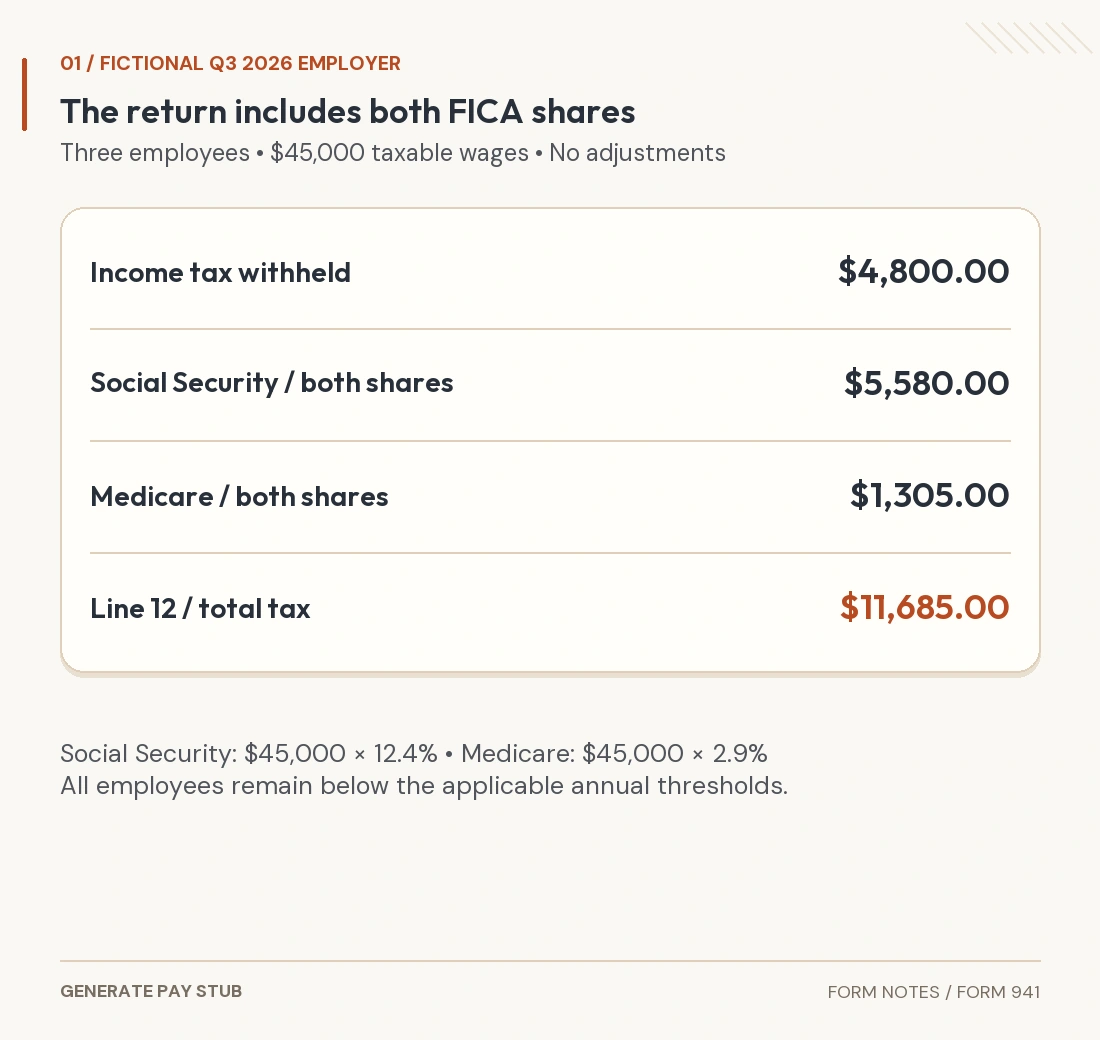
Separate the wage bases, tax components and deposit reconciliation. Assume three employees each receive $5,000 on July 31, August 31 and September 30, 2026. All three are paid for the monthly period containing September 12, so the example's Line 1 count is 3.
Quarterly compensation is 3 employees × 3 payments × $5,000 = $45,000. Assume all of it is subject to the same ordinary federal income-tax, Social Security and Medicare wage reporting, with no pre-tax benefits or other base differences. All employees remain below the relevant annual thresholds.
Actual federal income tax withheld is given as $1,600 in each month, or $4,800 for the quarter. This article does not calculate employees' W-4 withholding elections.
| Entry | Calculation | Tax amount |
|---|---|---|
| Federal income tax withheld, Line 3 | Given actual withholding | $4,800.00 |
| Social Security tax, Line 5a Column 2 | $45,000 × 12.4% | $5,580.00 |
| Medicare tax, Line 5c Column 2 | $45,000 × 2.9% | $1,305.00 |
| Total before adjustments, Line 6 | No tips or notice tax assumed | $11,685.00 |
| Total after adjustments and credits, Line 12 | No adjustments or credits assumed | $11,685.00 |

The two FICA amounts include both shares. Using only employees' 6.2% Social Security and 1.45% Medicare withholding would omit the corresponding employer tax.
Assume all $11,685 was properly deposited for the quarter, with no applied credits. Line 13 deposits then matches Line 12 tax, leaving no balance due or overpayment. This does not remove the need to file the return.
Why are liability dates different from deposit dates?
A liability records when the tax arises; a deposit records when it is paid. IRS Topic 757 explains that deposit schedules depend on prior reported taxes and are based on wage-payment dates, not how often the employer runs payroll.
Assume this employer's applicable 2026 lookback liability is $40,000, it filed only Forms 941 and no next-day rule changes its status. It is a monthly schedule depositor. Under Publication 15 for 2026, the ordinary lookback covers July 1, 2024 through June 30, 2025, and $50,000 or less ordinarily gives monthly status.
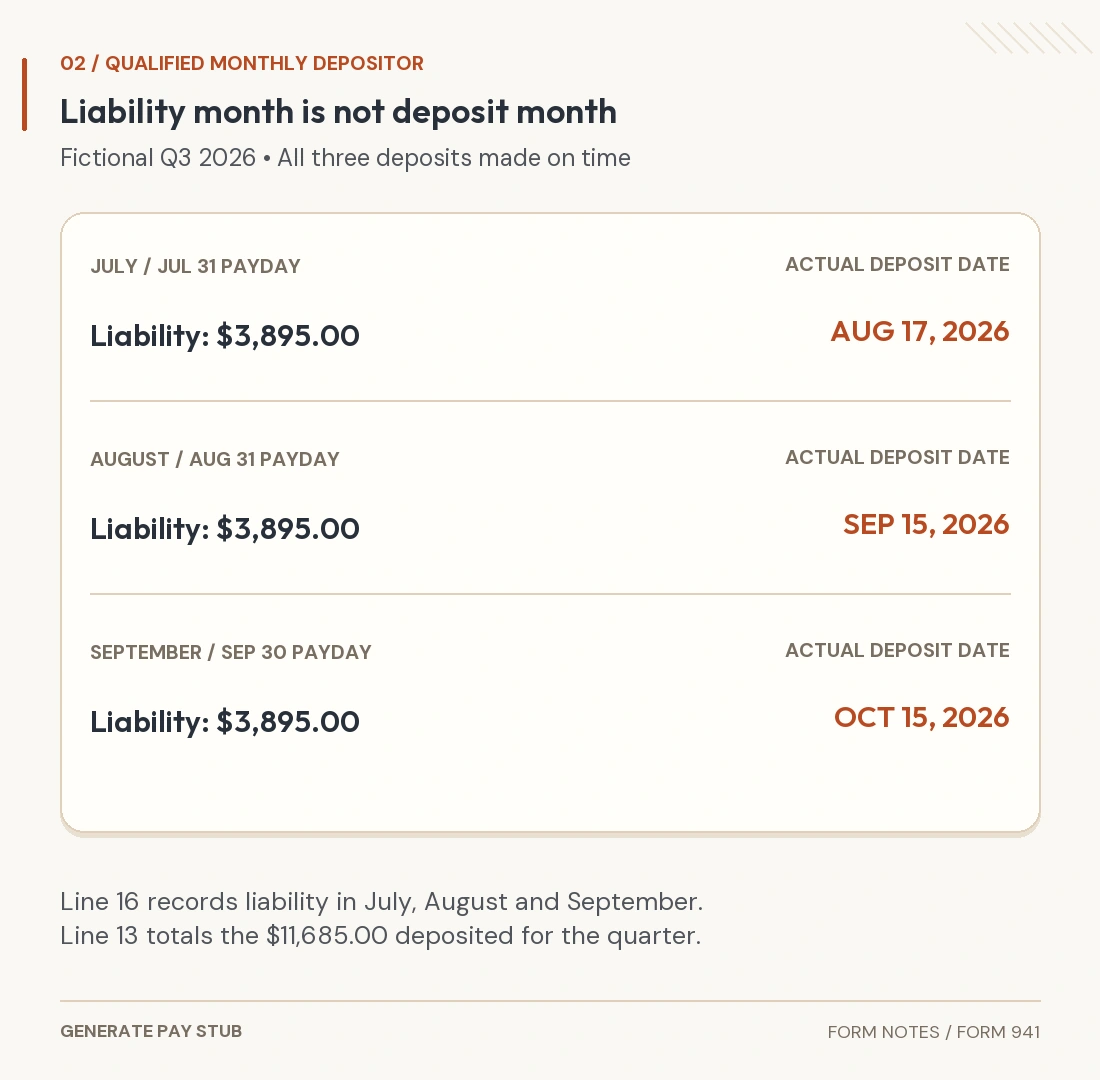
Each fictional monthly payday creates $1,600 FIT + $1,860 combined Social Security + $435 combined Medicare = $3,895 liability. The following month contains the ordinary deposit deadline, with the August weekend adjustment shown below.
| Liability month | Payday | Actual timely deposit | Liability / deposit |
|---|---|---|---|
| July 2026 | July 31, 2026 | August 17, 2026 | $3,895.00 |
| August 2026 | August 31, 2026 | September 15, 2026 | $3,895.00 |
| September 2026 | September 30, 2026 | October 15, 2026 | $3,895.00 |
| Quarter total | Three paydays | All deposited for Q3 | $11,685.00 |

For Line 16, the liabilities remain $3,895 in July, August and September. Do not move July's liability into August just because the tax was deposited then. Semiweekly depositors use a separate Schedule B with the required daily liability detail.
When is the quarterly return due?
The return deadline and deposit deadlines are separate. Ordinarily, Form 941 is due at the end of the month after the quarter, with the next-business-day rule for weekends or legal holidays.
For Q3 2026, October 31 is Saturday, making the ordinary return date November 2, 2026. Employers that timely deposited all tax for the quarter can use the additional filing time described in the instructions—November 10, 2026 for this quarter.
At the November 5 review date, the ordinary Q3 date is past, while the qualifying additional filing date is upcoming. The fictional employer's assumed timely full deposits qualify it for that extra filing time; missing deposits would require a different analysis.
Do not treat the extra filing days as extra deposit days. Also review any actual disaster-relief notice rather than assuming a nationwide postponement.
Which other situations need separate review?
Small-tax payment exception
The exception is conditional. If current- or prior-quarter Line 12 is below $2,500 and no $100,000 next-day deposit obligation arose this quarter, the instructions permit the specified payment-with-return approach. Do not assume every small payroll qualifies or that a balance can always wait until filing.
Next-day deposits and status changes
A $100,000 accumulation can override the normal schedule. A monthly depositor that triggers that rule also becomes semiweekly under the applicable timing rules. Review the daily records and credit rules rather than relying only on the quarter's final net balance.
Adjustments and credits
Use supported, allowed amounts. Fractions-of-cents adjustments, third-party sick pay and certain tips or group-term-life items have specific lines. The research payroll credit requires its Form 8974 calculation. An adjustment field is not a general plug to force deposits and tax to match.
Tips and overtime deductions
Individual deduction provisions do not automatically remove wages from payroll reporting. Review the current withholding instructions. Do not reduce Form 941 wages or tax merely because an employee may qualify for a separate income-tax-return deduction.
Which attachments, status entries and signatures are needed?
Review the full return package. A semiweekly depositor generally needs Schedule B. Aggregate filers can require Schedule R. The research credit and certain final-return situations have their own supporting forms or statements.
For a final return, check the last wage date and required payroll-records statement. For a seasonal employer, follow the seasonal filing instructions. A third-party designee authorization also is different from the employer's signature.
Use an authorized signer and complete the declaration and any required preparer information. A typed name or a blank signature area should not be mistaken for a completed signing step.
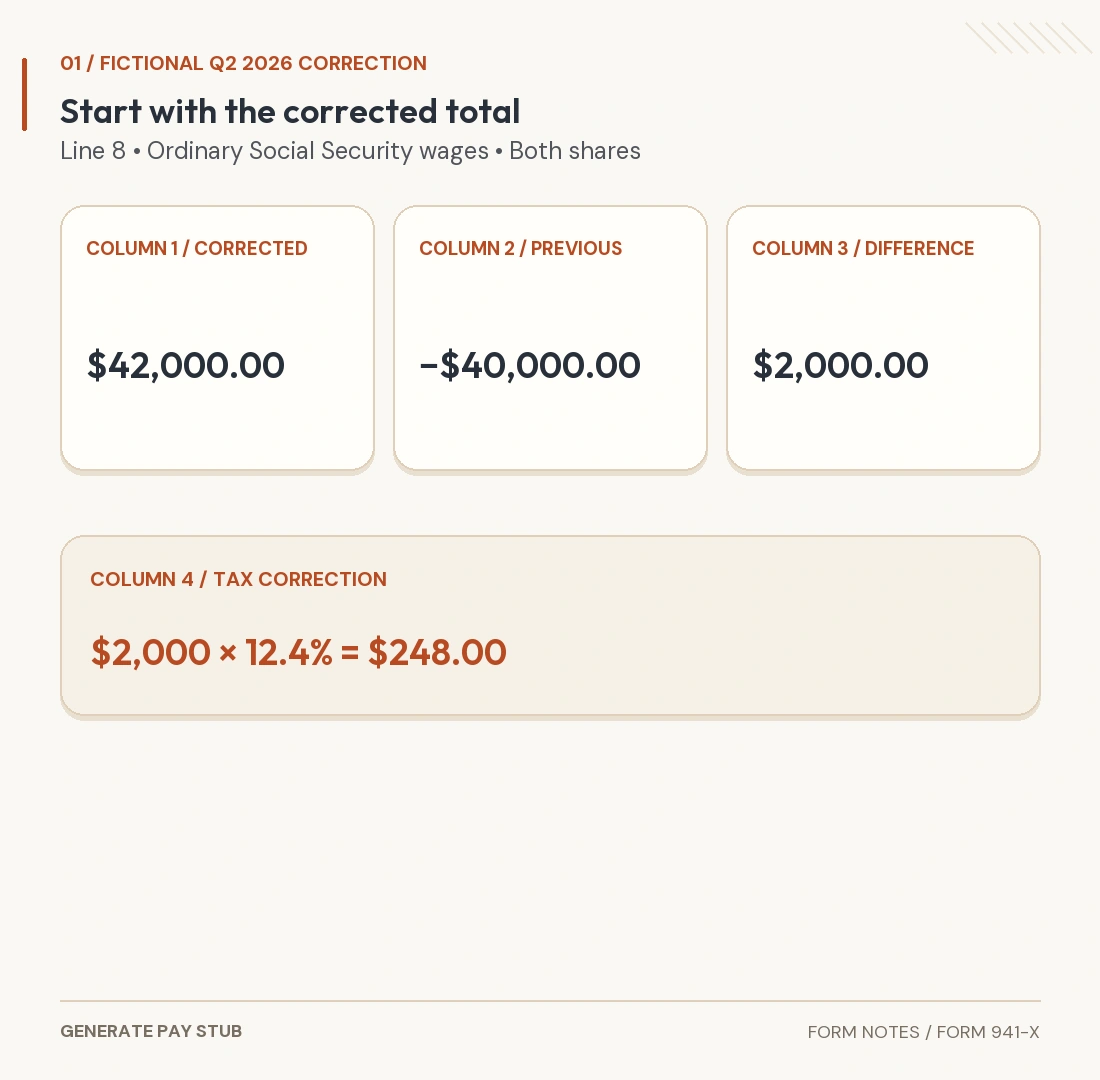
If a previously filed quarter is wrong, review Form 941-X. Do not hide an earlier-period correction in a current-quarter adjustment simply to avoid preparing the correct form.
How do you review a Form 941 from the document tool?
Select the exact year and quarter, then compare every entered total with the payroll work. The Form 941 document guide links to the 941 builder, currently offering 2025 and 2026.
It accepts employer details, taxable bases, adjustments, deposits and applicable liability entries, and prepares the original return pages and voucher. Required separate schedules and supporting forms remain separate.
Check employer identity, reference-period count, wage bases, annual thresholds, tax components, liability totals, deposit credits and signatures. Use Form 941-V only for an eligible check or money-order balance payment; it does not replace required electronic deposits.
The completed PDF does not file the return or make payments. Keep the filing acceptance, deposit confirmations and reviewed return together. Before annual wage reporting, reconcile the quarterly returns with the employee-level W-2 records.
General U.S. federal employment-tax information. The fictional case assumes ordinary wages, monthly status and fully timely deposits. Special employers, corrections, credits and relief require their complete applicable instructions.