Form 1040-ES helps individuals calculate and make estimated federal tax payments during the year. First estimate the tax using current rules, then account for withholding, credits, applicable safe harbors and payment timing. Preparing a voucher is separate from actually paying the IRS.
A useful estimate answers two different questions: how much must be paid during the year to address estimated-tax requirements, and how much is likely to remain when the return is filed. Those amounts can differ.
For tax year 2026; checked November 5, 2026. This guide addresses the standard calendar-year U.S. individual process. Its fictional example assumes the regular four-installment method applies from the first payment period, with no farming, fishing, annualization, special taxes or disaster relief changing that method.
Who may need Form 1040-ES payments?
Estimated tax is relevant when tax is not adequately covered by withholding. Self-employment, rent, investment income and other receipts can create that situation. Having a W-2 job does not automatically remove the need to review other household income.
The IRS estimated-tax overview describes individual estimates and the option of requesting more withholding from wages. Individuals generally use Form 1040-ES; nonresident aliens use the appropriate 1040-ES(NR) process instead.
Do not confuse an individual estimated payment with an employer's payroll-tax deposit or a business entity's separate obligation. A sole proprietor's business profit informs the individual estimate, while employee withholding and employer tax reporting follow other procedures.
Keep the estimate tied to the full return. A percentage reserved from gross customer receipts is a budgeting choice, not a complete calculation of federal tax.
How do the basic tests and safe harbors work for 2026?
Review both the expected balance and the applicable payment target. Under the general rule in the 2026 Form 1040-ES package, estimates generally are required when you expect to owe at least $1,000 after withholding and refundable credits and those amounts are below the smaller of the specified current-year or prior-year tax targets.
The ordinary targets use 90% of 2026 tax or 100% of applicable 2025 tax, with a full 12-month prior return required for the prior-year comparison. For higher-income taxpayers, use 110% instead of 100% when 2025 AGI exceeded $150,000, or $75,000 if the 2026 filing status is married filing separately. Qualifying farming or fishing cases have different rules.
“Prior-year tax” means the amount determined under the worksheet's instructions. It is not last year's refund, balance due or total withholding. Keep the prior return and the relevant tax calculation available.
The IRS overview also explains a no-prior-liability exception with three conditions: no prior-year tax liability, U.S. citizen or resident status throughout that year and a 12-month prior tax year. A prior refund alone does not establish the exception.
What are the standard 2026 estimated-tax payment dates?
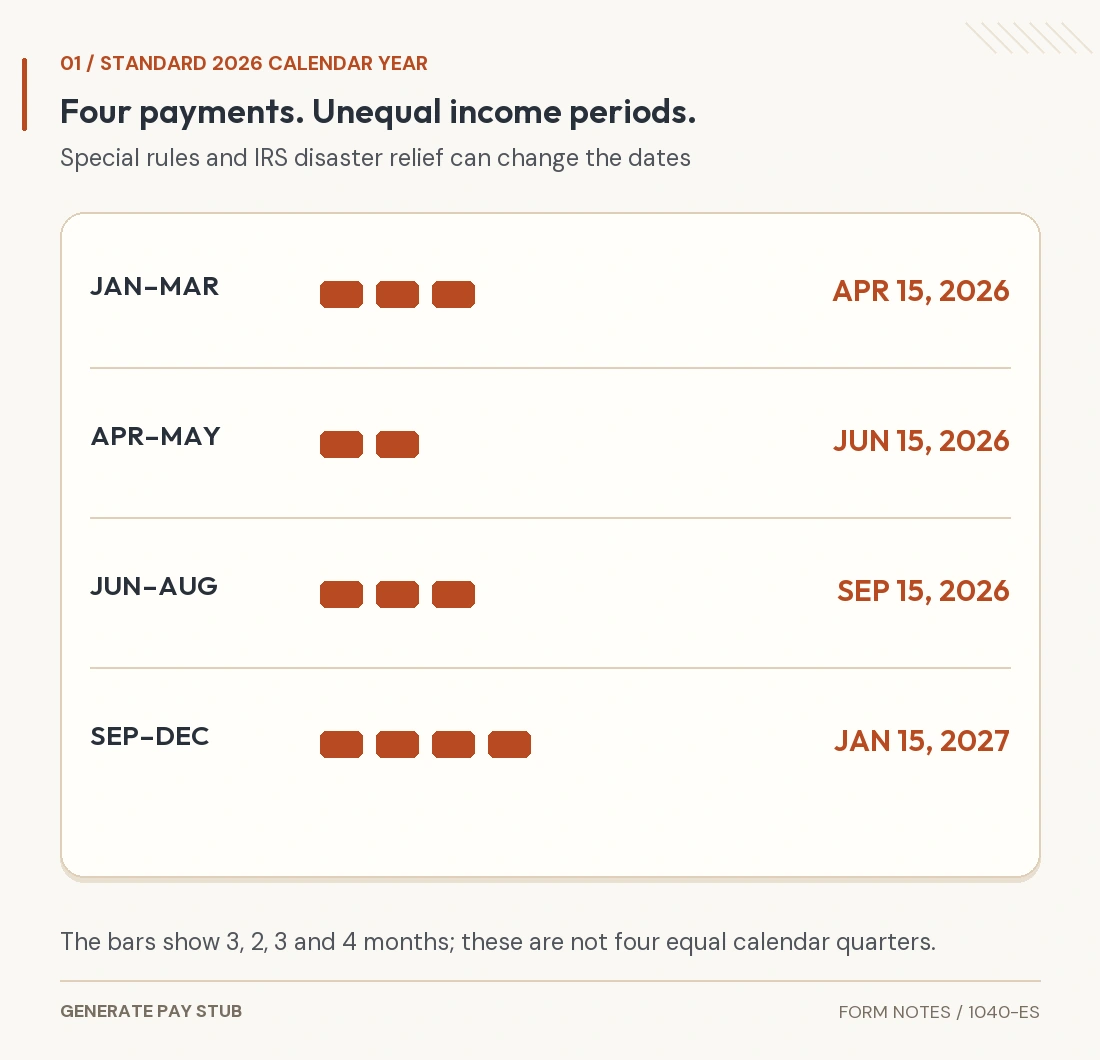
For a standard calendar-year filer, the first 2026 installment is due April 15. The next dates are June 15 and September 15, followed by January 15, 2027. The associated income periods are unequal. Do not assume each deadline follows a three-month calendar quarter.
| Income period | Payment deadline | Position at November 5 review |
|---|---|---|
| January 1–March 31, 2026 | April 15, 2026 | Past |
| April 1–May 31, 2026 | June 15, 2026 | Past |
| June 1–August 31, 2026 | September 15, 2026 | Past |
| September 1–December 31, 2026 | January 15, 2027 | Upcoming |

The 2026 package permits skipping the January 15, 2027 payment if you file the 2026 return by February 1, 2027 and pay the entire balance with it. That does not erase underpayments for earlier required periods.
Fiscal years, qualifying farmers or fishers, annualized income and IRS relief can require a different analysis. Check the applicable notices before using the table as your personal calendar.
What information belongs in an estimated-tax calculation?
Use a reasonable full-year projection and the current tax rules. Assemble expected wages and other income, business or rental results, eligible adjustments, permitted deductions, credits, self-employment and other applicable taxes, and expected withholding.
- Use taxable income categories rather than treating every bank deposit as income.
- Reconcile business receipts to profit instead of estimating solely from a 1099 total.
- Check allowed deductions and credits, including income limits.
- Use the applicable capital-gain, dividend or other special tax worksheet where required.
- Keep refundable credits and withholding in their proper categories.
- Check the relevant prior-year tax and AGI for the safe-harbor comparison.
- Record payments and prior-year overpayments actually applied.
The Schedule 1 guide explains the distinction between income and AGI adjustments. Its example is for 2025; use 2026 rules and values when building a 2026 projection.
Check corrections too. The IRS issued a 2026 Form 1040-ES SALT correction and states that the original package will not be revised. For 2026, the stated limit is $40,400, or $20,200 for married filing separately, subject to the specified income-based reduction and floor. That is a limit, not an automatic deduction for that amount.
How can a safe harbor leave tax due? A checked example
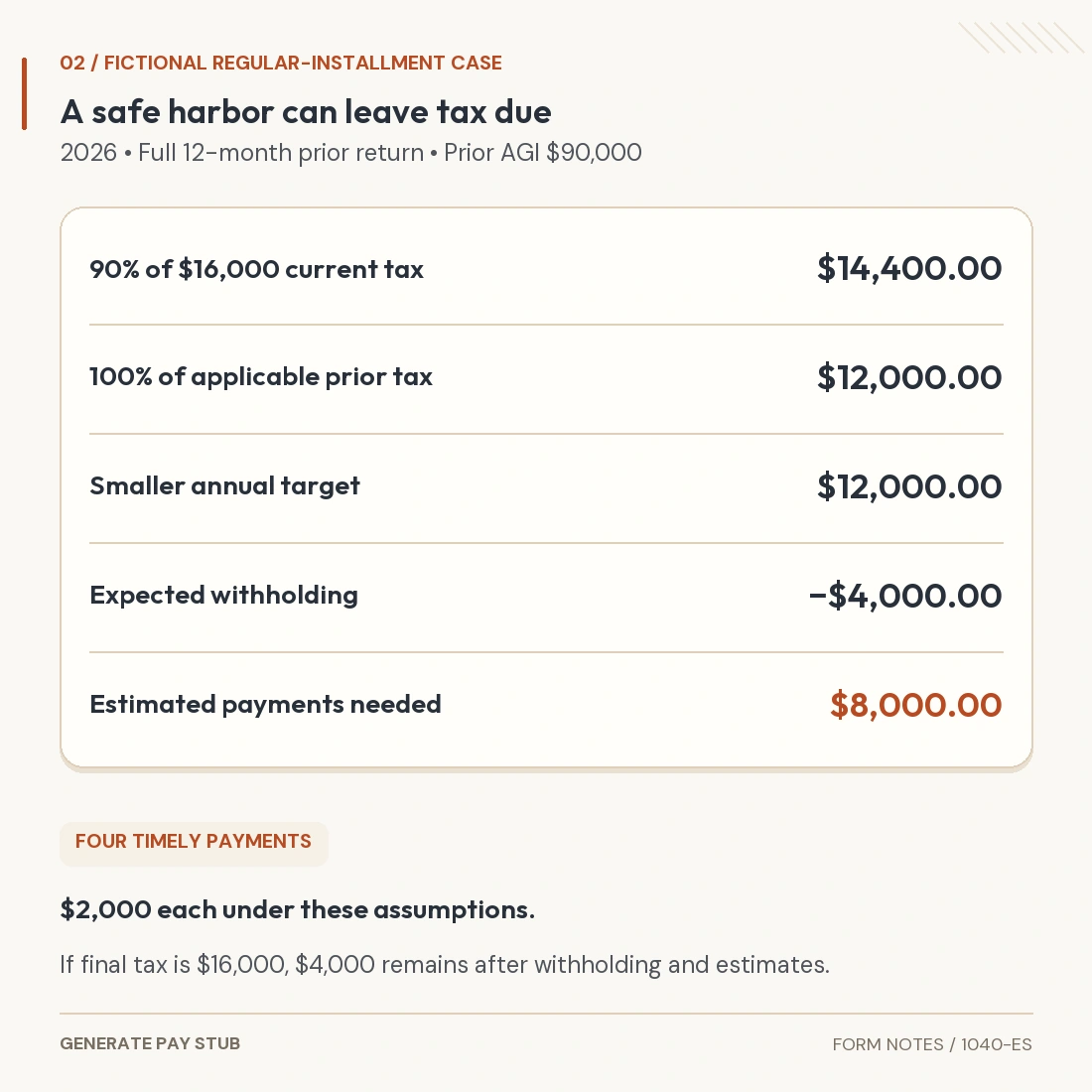
A safe harbor addresses the payment requirement; it does not reduce the final tax. Assume a fictional Single taxpayer has $90,000 of 2025 AGI, a full 12-month prior return and $12,000 of applicable prior-year tax determined under the worksheet.
Assume the properly calculated 2026 tax estimate is $16,000, expected withholding is $4,000, there are no refundable credits and the standard regular-installment rules apply for the entire year. No prior overpayment credit is being applied.
| Step | Calculation | Amount |
|---|---|---|
| Current-year target | $16,000 × 90% | $14,400.00 |
| Prior-year target | $12,000 × 100% | $12,000.00 |
| Smaller annual target | Smaller of $14,400 and $12,000 | $12,000.00 |
| Less expected withholding | Given full-year withholding | $4,000.00 |
| Estimated payments needed | $12,000 − $4,000 | $8,000.00 |
| Each of four timely installments | $8,000 ÷ 4 | $2,000.00 |

If final 2026 tax equals the $16,000 estimate, total withholding and estimates are $4,000 + $8,000 = $12,000. That leaves $4,000 payable with the return, before any other adjustments. There is no contradiction: the prior-year target and final current-year tax answer different questions.
If the same applicable prior tax instead required the 110% percentage, that target would be $13,200. It would be compared with $14,400 before subtracting withholding. Do not apply the lower 100% figure to a higher-income case automatically.
What if income arrives late or the estimate changes?
Recalculate with the appropriate timing method. Publication 505 for 2026 explains amended estimates, later first required payments and the annualized-income installment method.
A seasonal business or late capital gain may justify unequal installments under the applicable calculations. Annualization uses cumulative income, deductions and other items for specified periods; it is not simply dividing one recent deposit by four. Form 2210 with Schedule AI is required when using that method under the instructions.
As of this review, the first three standard 2026 dates have passed. Paying a larger amount now does not necessarily remove an earlier-period underpayment. Keep the actual dates and use the correct calculation rather than labeling a late payment as timely on a new voucher.
IRS Topic 306 explains estimated-tax penalties, varying installments and possible waivers. Even a refund on the completed return does not automatically prove that each required period was adequately paid.
If wage withholding is available, review whether a new W-4 is appropriate. Our 2026 W-4 guide explains annual entries versus extra withholding per paycheck. Use the applicable payment-timing rules when evaluating any change.
How do vouchers, payment records and actual payments differ?
A voucher identifies a payment; it does not move money. For an electronic payment, a mailed voucher generally is unnecessary. For a check or money order, use the matching installment voucher and current IRS mailing instructions.
The IRS offers Direct Pay from a bank account for individual estimated tax among other payment types. Select the correct payment purpose and tax year, and retain the confirmation. Other official payment methods are available.
Keep planned amounts separate from completed transactions. A useful payment record contains the tax year, amount, actual date, confirmation and any prior-year overpayment credit applied. Reconcile it with the IRS account and return before claiming payments.
Do not enter a processing or convenience fee as tax paid. For joint or changed-marital-status situations, verify taxpayer identifiers and credit allocation rather than assuming a payment automatically appears under both people.
How do you use the Form 1040-ES document builder?
Choose the year and enter verified amounts, then review the original package. The 1040-ES overview links to the 1040-ES builder, which currently offers 2025 and 2026.
It provides voucher selection, an optional regular individual estimated-tax worksheet and an optional actual-payment record. The worksheet uses your entered underlying tax and eligible deduction figures; special calculations and eligibility still require their own review.
Check the preparation notes and linked IRS updates. Form 1040-SS users need their dedicated worksheet, and the 2025 package predates later 2025 law changes. A printed original alone is not a guarantee that every later correction has been incorporated.
Review names, identifiers, year, selected voucher, payment amount and applicable deadline. Keep worksheets and records securely. The tool prepares documents; it does not make an estimated payment, submit a tax return or establish that a safe harbor has been met.
General U.S. federal tax information. The fictional example assumes the regular calendar-year method and excludes special situations. Review current IRS instructions, relief notices and professional guidance where appropriate.