Use Form 941-X to correct an already filed Form 941 for a specific quarter. Identify the error and discovery date, choose the permitted adjustment or claim process, enter corrected and previously reported totals, complete the applicable certifications and explain the changes. Payment, filing and any refund decision remain separate steps.
Start with what actually happened in payroll. An amount paid, an amount withheld, an amount reported and an amount deposited can differ—and each difference can call for a different correction.
Current form reviewed November 5, 2026. This guide uses the April 2026 revision. Its fictional example corrects Q2 2026, discovered November 5, 2026, with underreported amounts only, ordinary wages below annual thresholds, actual withholding omitted from the return and no credits or special-rate adjustments.
When should you use Form 941-X?
Use the correction form matching the previously filed employment-tax return. The IRS employment-tax correction overview identifies Form 941-X for a filed Form 941 and different correction forms for other returns.
Prepare a separate correction for each affected quarter. A current-quarter Form 941 adjustment is not a general place to absorb an older quarter's error. If no original was filed, resolve the original-return obligation instead of treating the correction form as a substitute.
The April 2026 Form 941-X original contains five return pages and a sixth page explaining process choices. Review the complete current original rather than an old screenshot; reserved and historical-credit lines need their specific treatment.
Our Form 941 preparation guide explains the underlying return. This article follows the error-discovery and correction workflow.
Which records should be reconciled before making the correction?
Build a dated explanation of the difference between actual payroll and the filed return. Include the original return, earlier corrections or adjustments, affected payroll registers, tax-base calculations, actual withholding and deposit records.
The IRS recordkeeping guidance includes wage dates, withholding certificates, deposits and filed-return confirmations among the supporting records. Keep the original evidence alongside the correction work.
- Identify the employer and exact year and quarter.
- Record when the error was discovered.
- Separate wage-base errors from actual withholding errors.
- Determine whether each tax item was underreported or overreported.
- Identify any earlier correction that changes the baseline.
- Review employee repayment, statement or consent requirements where applicable.
- Identify related wage statements and liability schedules needing attention.
- Keep the calculations and explanation supporting each changed line.
Do not create a second payroll payment merely to fix a reporting error. If wages were already paid correctly but omitted from the return, the correction should reflect those actual records.
Should you select the adjustment process or the claim process?
The choice depends on the types of errors and the limitation period, not just the final net amount. The current Form 941-X instructions and page 6 of the original explain the decision.
| Situation | Process consideration | Additional check |
|---|---|---|
| Underreported tax only | Use the adjustment process | Pay the resulting amount by filing under the applicable rules. |
| Overreported tax only | Adjustment or claim may be available | Check timing, desired credit versus refund, and employee certifications. |
| Both kinds of errors | Review the mixed-error instructions | One adjustment or separate adjustment and claim forms may be needed. |
| Overreported amounts within the final 90 days of the credit/refund limitation period | Use the claim process for those amounts | If underreported amounts also exist, use a separate adjustment form for them. |
For an adjustment producing a negative Line 27 amount, the original specifies a credit toward Form 941 for the period in which the correction is filed. A claim seeks refund or abatement under its rules. Selecting “claim” does not make an underreported tax item eligible for that process.
How do Form 941-X's four columns work?
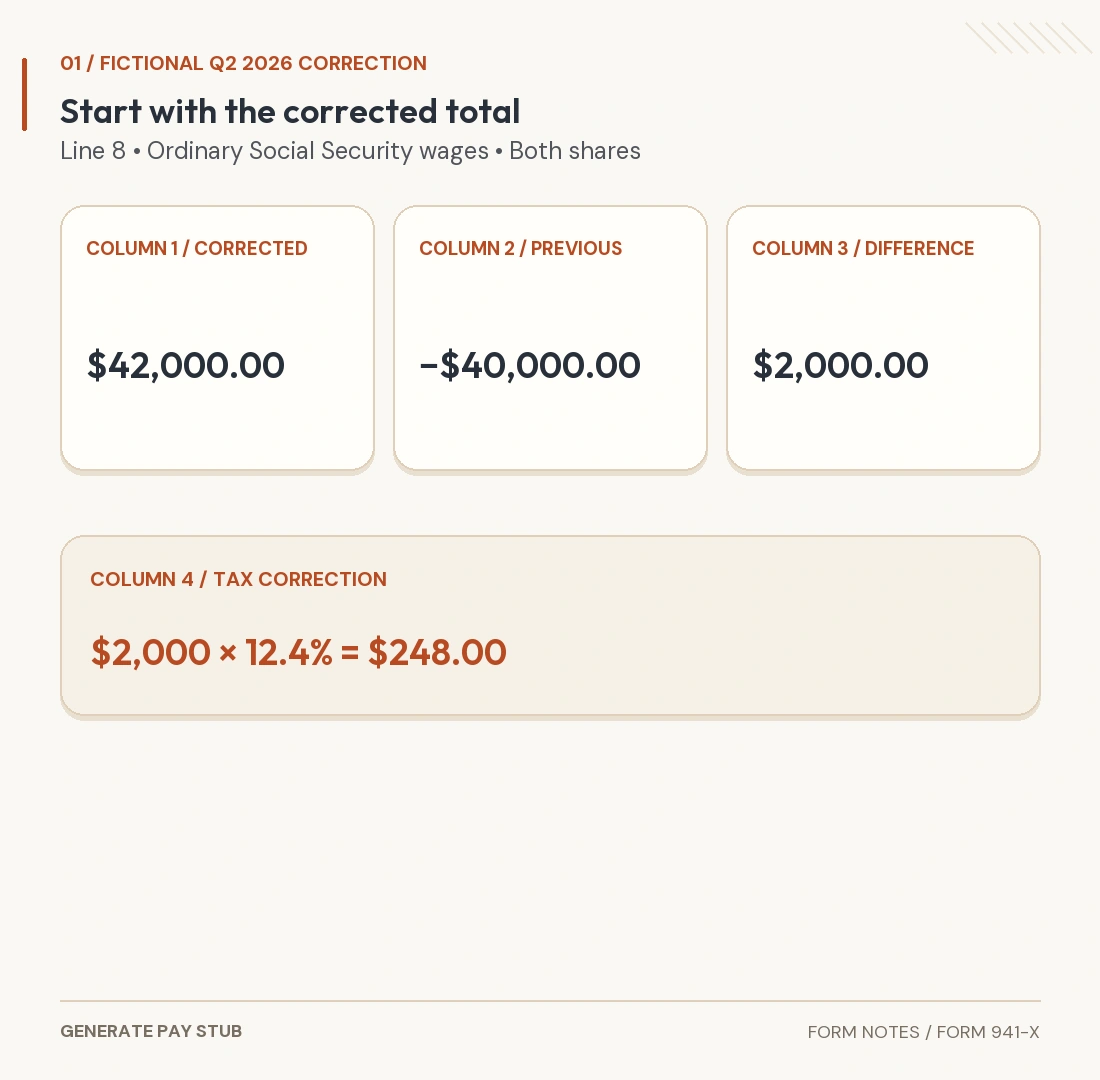
Column 1 is the full corrected amount, Column 2 is the prior reported or previously corrected amount, and Column 3 is their difference. Column 4 then shows the applicable tax correction.
For an ordinary taxable Social Security wage correction of $42,000 corrected less $40,000 previously reported, the difference is $2,000. With both shares applicable, the tax correction is $2,000 × 12.4% = $248.
Do not multiply every difference by the same rate. A wage-only line, withholding line, ordinary combined-share line, employer-share-only correction or special worker-reclassification line has its own treatment.

What does an omitted-payroll correction look like?
Correct the tax bases and actual withholding, then total only the tax corrections. Assume an employer already filed Q2 2026 Form 941 reporting $40,000 compensation, $40,000 Social Security wages, $40,000 Medicare wages and $4,000 federal income tax withheld.
On November 5, it finds a paid payroll record omitted from that return: $2,000 ordinary taxable wages and $200 federal income tax actually withheld. The employee FICA amounts were also actually withheld in payroll. Both employer and employee shares apply, all employees remain below the annual thresholds and no Additional Medicare withholding applies.
The correct totals therefore are $42,000 compensation, $42,000 Social Security wages, $42,000 Medicare wages and $4,200 FIT withholding. There are no other corrections, credits, adjustments or payments covering the additional tax.
| Changed item | C1: corrected | C2: previous | C3: difference | C4: tax correction |
|---|---|---|---|---|
| Compensation, Line 6 | $42,000.00 | $40,000.00 | +$2,000.00 | — |
| FIT withheld, Line 7 | $4,200.00 | $4,000.00 | +$200.00 | +$200.00 |
| Social Security wages, Line 8 | $42,000.00 | $40,000.00 | +$2,000.00 | +$248.00 |
| Medicare wages, Line 12 | $42,000.00 | $40,000.00 | +$2,000.00 | +$58.00 |
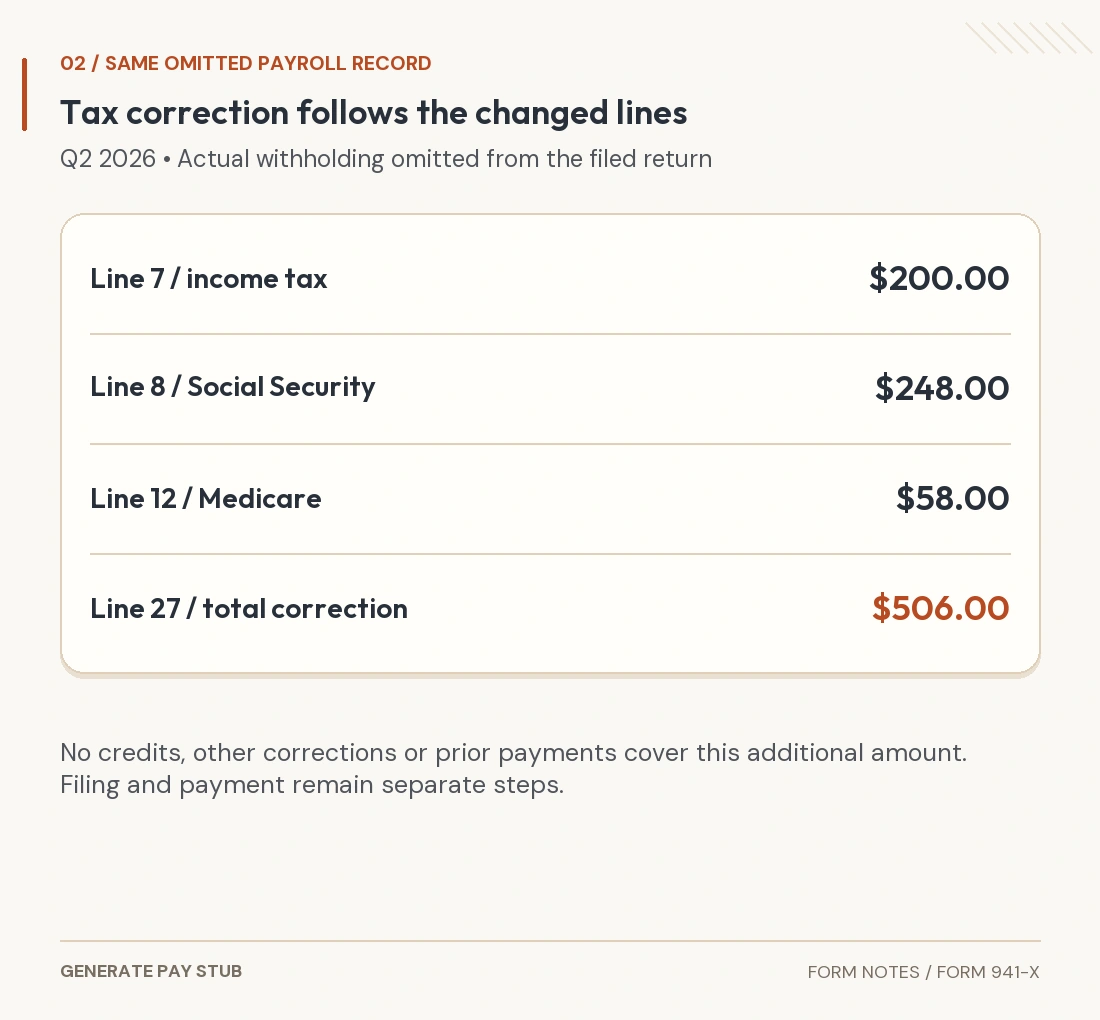
Line 6 corrects compensation information; it does not add another $2,000 of tax. Line 7 adds $200 actual withholding. Line 8 adds $248 Social Security, and Line 12 adds $2,000 × 2.9% = $58 Medicare.
The tax corrections total $200 + $248 + $58 = $506. With nothing else affecting the correction, that is the Line 23 subtotal and Line 27 amount owed.

A separate check gives the same result. Original ordinary tax was $4,000 FIT + $4,960 Social Security + $1,160 Medicare = $10,120. Corrected tax is $4,200 + $5,208 + $1,218 = $10,626. The increase is $506.
This example describes a reporting omission involving real withholding. It does not authorize inventing additional prior-year withholding when the employer actually withheld less than required.
What must the employee-related certifications establish?
Check only statements that are true for the corrections being made. Part 2 includes the required wage-statement certification and conditional statements for overreported taxes.
Depending on the process and tax, the employer may need to repay or reimburse affected employees, obtain written statements, secure employee consent or limit the correction to the employer share. These choices are not interchangeable ways to obtain the largest refund.
Read the complete printed wording before selecting a certification. Retain the underlying employee records. For prior-year federal income-tax withholding, the instructions generally permit administrative reporting corrections and specified special cases, rather than changing actual withheld tax simply because the wrong withholding calculation was used.
Additional Medicare withholding has its own restrictions. Do not assume a rule allowing a Social Security correction automatically permits an equivalent Additional Medicare tax correction.
Which deadlines and limitation rules matter?
Record the discovery date and check both the correction deadline and the limitation period. For underreported tax, the instructions generally require filing by the return due date for the period in which the error was discovered and paying by the time the correction is filed to qualify for the applicable interest-free treatment.
That treatment has conditions and exceptions. Do not promise that any filed correction automatically removes interest or penalties. Correcting promptly and retaining the discovery evidence are important parts of the process.
For overreported tax, the general credit/refund limitation is the later of three years after filing or two years after payment. Deemed filing dates, the final-90-day process rules and special situations need their own review. A return-year label alone does not establish the last permitted filing date.
Use Publication 15 for 2026 alongside the correction instructions for withholding and employment-tax adjustments. Complicated repayments, employee tax collection or reclassification cases may require professional help.
What else may need to be corrected?
Follow the error into the related records without duplicating it in a later quarter. Review W-2 or W-2c requirements, the relevant liability schedule and employee-level tax bases.
The Schedule B guide explains daily liability timing. When Schedule B is required with a correction, follow the specific amended-schedule rules and reconciliation; do not place the old quarter's correction into the current quarter's liability grid.
Prepare a specific Line 43 explanation identifying the omitted record, original and correct totals, tax calculations, quarter and discovery date. Keep supporting statements where needed. Worker reclassification, aggregate filers and historical credit lines can require additional forms or calculations.
Historical sick-leave or other credit fields refer to their printed qualifying periods. Their presence in a current revision does not create a general credit for ordinary current-year leave.
How do you prepare and review the complete Form 941-X packet?
Select the original quarter and use instruction-supported corrected figures. The 941-X overview links to the 941-X builder, currently using the April 2026 revision for its 2025 and 2026 selections.
Enter employer details, discovery date and changed lines. Review full corrected totals, previous amounts, differences, tax rates, process choice and certifications. Inspect all five return pages and the included sixth page of process guidance.
Required separate schedules, consents, statements and other supporting forms are not created simply by selecting a checkbox. Complete the authorized employer and applicable preparer signature requirements before filing.
The IRS supports electronic filing through the applicable employment-tax filing process, or paper under current instructions. A prepared PDF does not transmit the correction, pay a balance or approve a refund. Generally file the correction separately from Form 941, subject to the stated worker-reclassification exception.
General U.S. federal employment-tax information. The fictional correction assumes ordinary both-share wages and an actual-withholding reporting omission. Special rates, employee repayments, credits and time limits require their complete instructions.