Massachusetts employers must provide a pay statement with the employee’s pay showing the employer and employee names, payment date, worked hours, hourly rate, and deductions or increases for the pay period. The statement must be free. Electronic delivery is allowed when the employer provides a way to print it without charge. To check a statement, compare those fields with the underlying work and payment records rather than relying on its appearance.
Reviewed November 22, 2026. This guide focuses on Massachusetts wage statements and ordinary hourly payroll review. It is separate from our state income-tax calculator guide. Special industries, exempt work, prevailing wages, domestic work and particular benefit or deduction arrangements can need additional rules. The examples are fictional and do not certify a template or employer’s compliance.
What must a Massachusetts pay stub show?
The pay-slip requirement appears in M.G.L. chapter 149, section 148. The Attorney General’s pay and recordkeeping guide lists the practical statement details. Review each field for meaning, not merely for the presence of a heading.
| Field to check | What a reader should be able to identify |
|---|---|
| Employer and employee names | Which employer issued the record and whose wages it concerns. |
| Payment date | The actual stated payment date with month, day and year. |
| Hours worked for the period | Worked hours, with paid leave or other units distinguished. |
| Hourly rate | The rate used for the relevant earnings; explain multiple rates. |
| Deductions and increases | The amounts and understandable classifications for the period. |
Also retain the pay-period dates, earnings calculation, gross amount and cash reconciliation needed to understand the statement. These are useful review details; this table does not claim that the short statutory list is every possible requirement for every worker. A complicated payroll cannot become clear merely by filling five boxes.
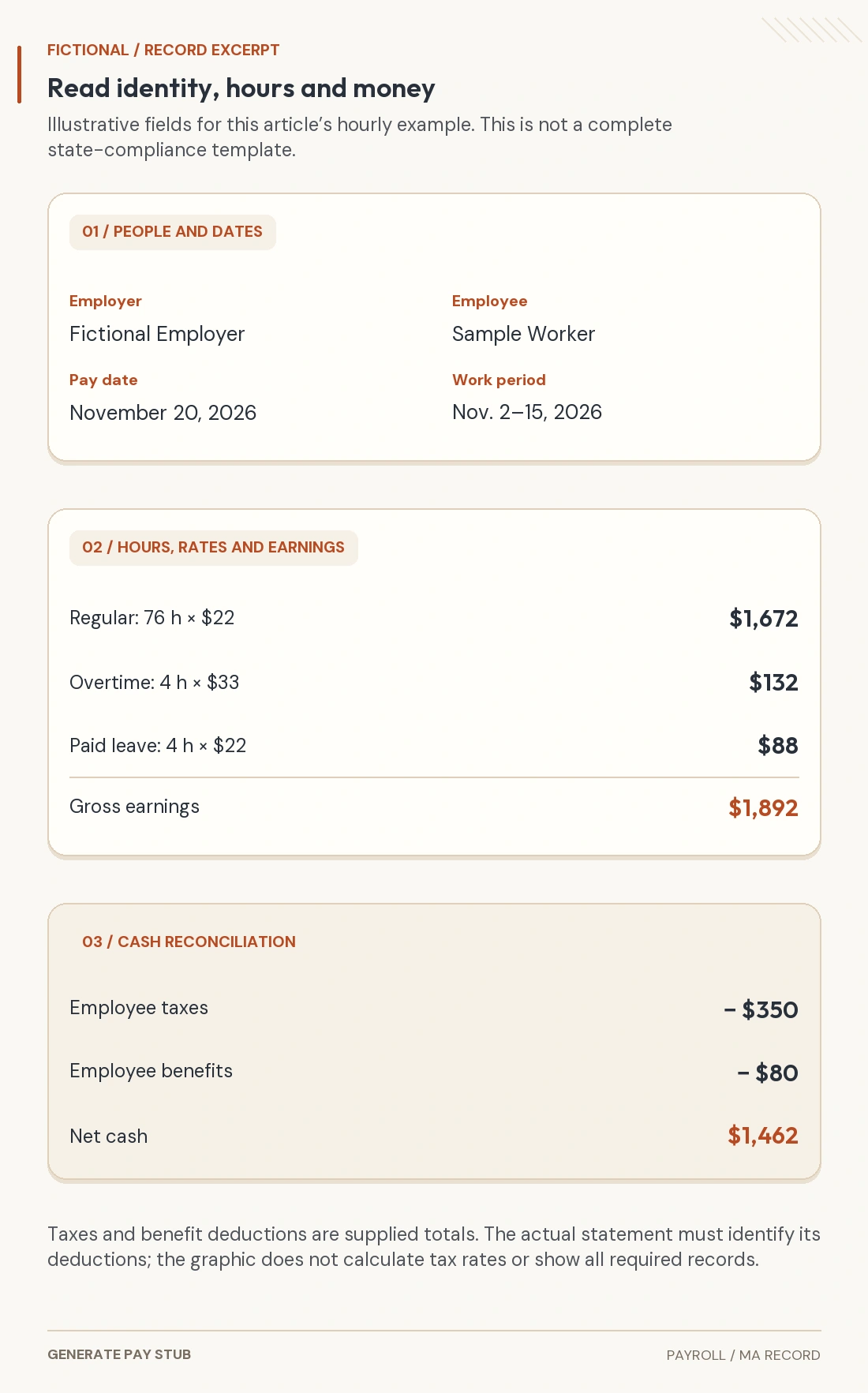
A payment date and a work-period end date answer different questions. In the example below, the work period ends November 15 and the pay date is November 20. Calling both dates “period ending” would obscure which date concerns payment. See pay-period and pay-date distinctions for related record checks.
Do not assume the employer’s entire private payroll file belongs on the employee-facing statement. The recordkeeping regulation discussed below requires additional information in employer records. That does not turn every such item, including sensitive identity information, into an instruction to print it on every shared pay stub.
Can an employer provide only an electronic pay statement?
Massachusetts’ official pay and recordkeeping guidance permits electronic statements when a worker can print the information for free. A pay-stub charge or a portal that leaves the worker without the required free printing method deserves a specific request to payroll. Direct deposit does not substitute a bank’s transaction entry for the wage statement.
Test whether you can open the complete period, read all columns and keep a usable copy. A small phone screen can hide amounts inside a horizontally scrolling table; that is different from the amounts being absent. Check print or download output for clipped columns, missing pages and blank deductions.
Keep copies before a job or portal transition when possible. If access has ended, request the statement or the relevant payroll records through the former employer’s established channel. Our electronic pay-stub guide helps organize the access request. A new self-prepared PDF cannot restore an employer’s original record history.
A fictional Massachusetts pay statement, from hours to cash
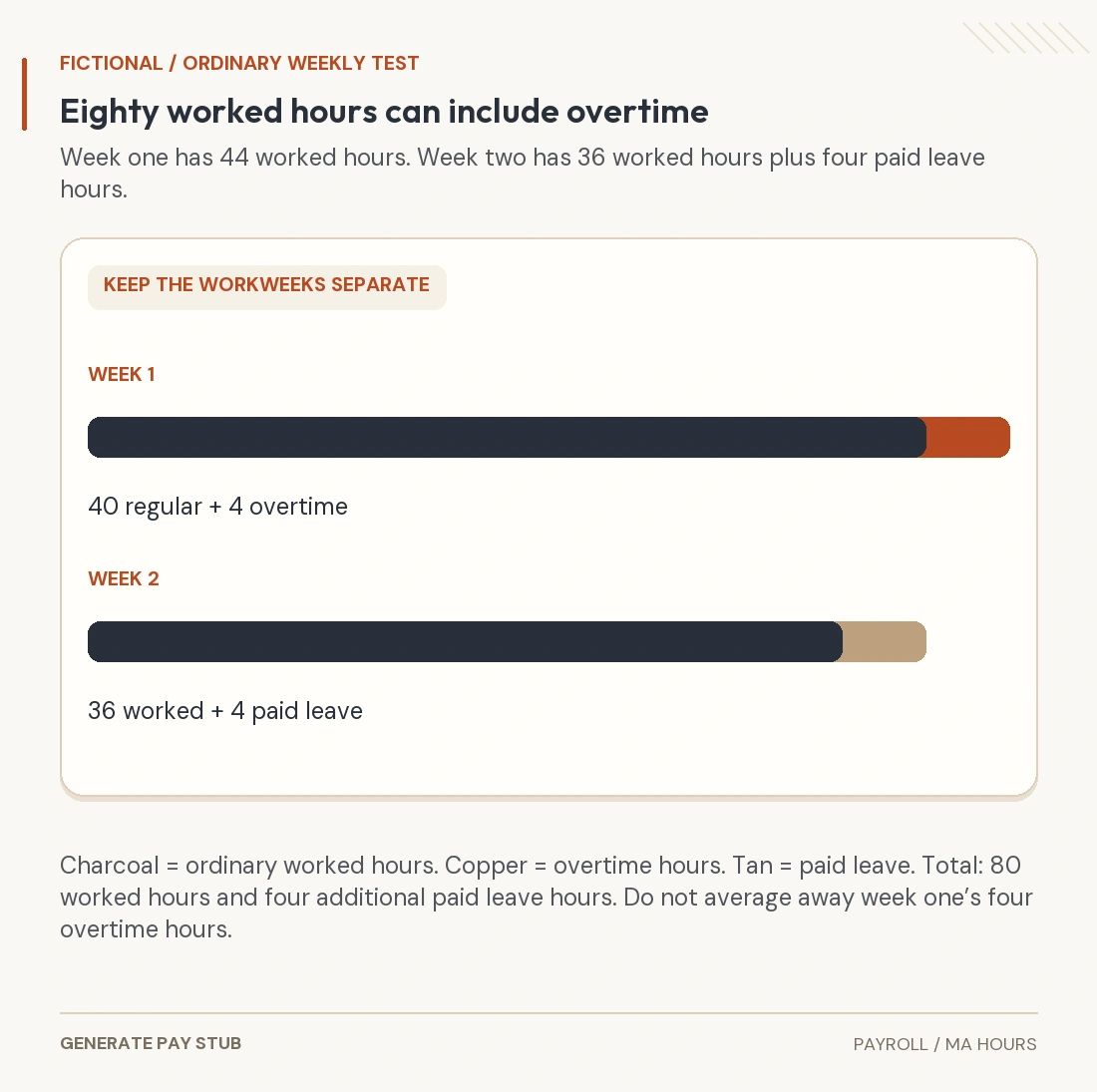
Assume a covered, nonexempt employee earns one unchanged $22 hourly rate. The pay period is November 2–15, 2026, with a November 20 payment date. In the first workweek the employee works 44 hours. In the second, the employee works 36 hours and receives four hours of paid vacation at $22. There are no bonuses, differentials, multiple rates or special overtime method.
The ordinary overtime rate under these assumptions is $33: $22 × 1.5. Regular worked hours are 40 + 36 = 76; overtime hours are four. Paid vacation is four additional paid hours, not four additional hours actually worked.
| Earnings line | Hours | Rate | Pay |
|---|---|---|---|
| Regular work | 76.00 | $22.00 | $1,672.00 |
| Overtime work | 4.00 | $33.00 | $132.00 |
| Paid vacation | 4.00 | $22.00 | $88.00 |
| Total paid units / gross earnings | 84.00 | — | $1,892.00 |
The gross calculation is $1,672 + $132 + $88 = $1,892. Now assume payroll’s actual employee tax lines total $350 and an authorized employee benefit deduction totals $80. These supplied figures are not estimates of Massachusetts or federal taxes. Net cash would be $1,892 − $350 − $80 = $1,462.

A separate employer-funded benefit would not automatically reduce that $1,462. Confirm the employee/employer designation for each line. If the actual deposit differs, review all payment allocations and any separate reimbursement or off-cycle payment. The net-pay guide explains those additional categories.
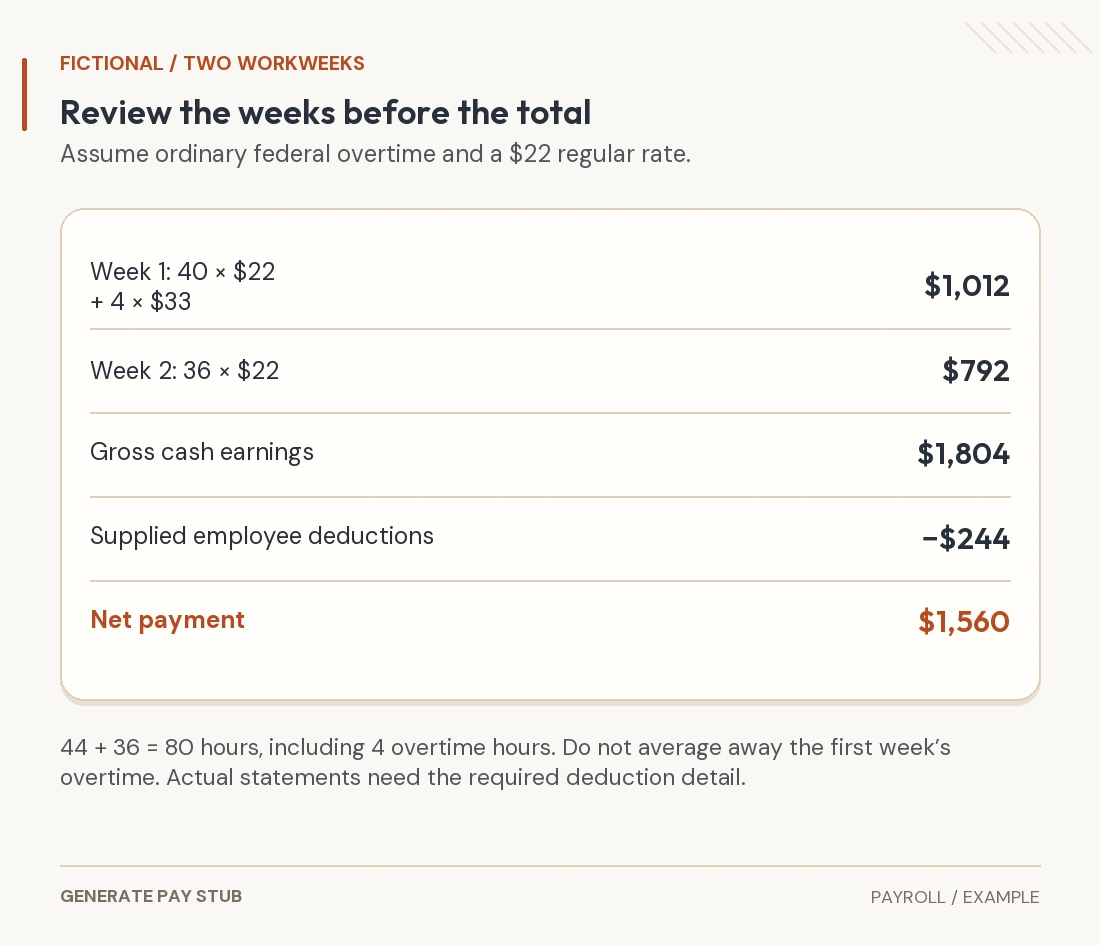
Why do eighty worked hours still produce overtime?
Because the ordinary overtime test is weekly. The state’s minimum-wage and overtime information explains the time-and-a-half requirement for most covered employees beyond forty worked hours in a workweek. State and federal exemptions are not identical, so actual coverage needs checking.
The first week has four hours beyond forty. The second week’s shorter schedule does not cancel them. An eighty-hour biweekly total is therefore not sufficient evidence that no overtime is owed. Our timesheet reconciliation guide explains why the weekly work record matters.

In this illustration, excluding the first week’s premium would lose 4 × ($33 − $22) = $44. Paying all eighty worked hours and four leave hours at $22 would yield $1,848, rather than $1,892. That identifies the premium difference; it does not say that the employee is owed the whole $132 overtime line on top of pay that already includes the four straight-time hours.
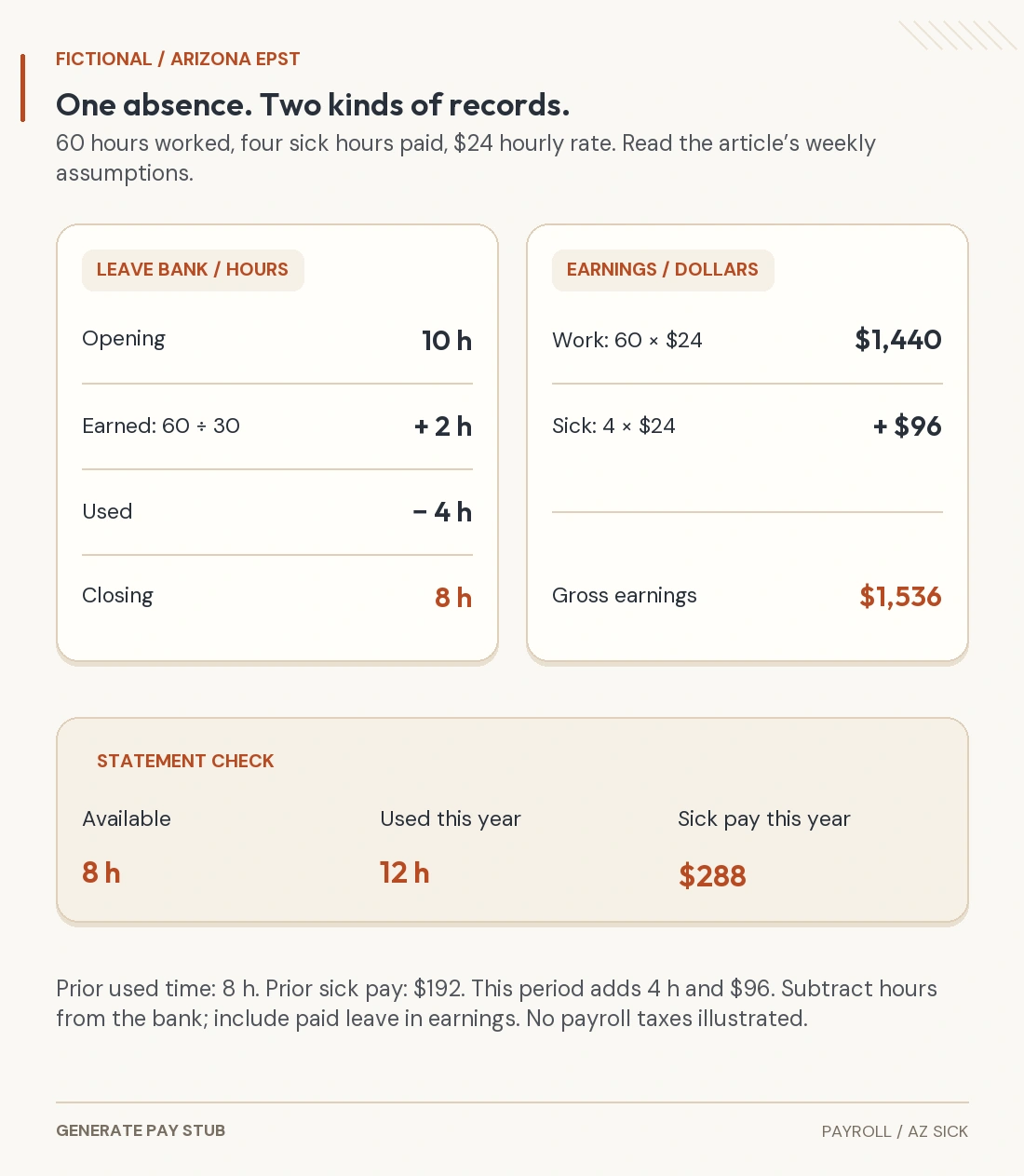
Keep a paid leave bank separate from its paid earnings. A four-hour vacation-bank reduction and $88 in leave earnings concern different records. The PTO balance guide explains how those hours and dollars reconcile.
Which deductions and new codes need explanation?
The Commonwealth’s wage-and-hour poster explains that wage deductions need a lawful basis, such as required taxes or a requested deduction for the employee’s benefit. It also distinguishes ordinary employer business costs. An employee signature is not a universal waiver allowing an employer to shift every business loss to wages.
If a deduction describes supplies, equipment damage, a cash shortage, an administrative charge or a loan recovery, request its specific authority and calculation. Do not decide legality solely by whether the remaining hourly average exceeds minimum wage. The state’s wage-deductions notice concerning Camara discusses the valid-setoff issue and rescinded historical opinion letters. Complex claimed debts require their actual facts; an employer’s label alone does not establish an uncontested debt.
For the deduction and contribution categories covered by section 150A, the statute addresses reporting amounts and written notice of the nature of deductions or contributions when first introduced. Ask for that explanation when a new line appears, rather than accepting an unexplained code as proof of employee authorization.
Income-tax withholding is a separate calculation from whether a statement identifies a deduction correctly. Use the Massachusetts calculator walkthrough for the 2026 M-4 and contribution-deduction example. A calculator estimate does not determine whether a benefit charge, employer debt or wage deduction is legally collectible.
Can you request the underlying Massachusetts payroll records?
Yes, the applicable recordkeeping rule provides an employee access route. 454 CMR 27.07(2) requires true and accurate specified payroll records, kept for at least three years after the record’s entry date. It provides a copy of records concerning the requesting employee within ten business days, and inspection of originals at a reasonable time and place if requested.
That is different from merely reprinting one summary page. For an overtime discrepancy, identify the workweek dates, daily hours, rates and related earnings. For a deduction discrepancy, identify the charge, period, transaction detail and any supporting authorization. Ask only for your relevant records, not coworkers’ private files.
A useful written request could say: “Please provide my payroll records for [dates], including daily and weekly hours, rates, earnings, deductions and any corrections, and the statement for the [pay date] payment. Please also identify how I can obtain a free printable copy.” Retain the request and delivery confirmation.
The three-year rule is an employer retention minimum for these records. It is not a universal instruction that an employee should delete all payroll evidence on a third anniversary, or a substitute for checking a claim’s filing deadline.
What if the statement is incomplete or wages are wrong?
- Identify the exact issue. Is a field missing, are hours or rates wrong, is a deduction unexplained, or is the payment itself missing?
- Preserve the evidence. Keep the complete statement, time records, pay agreement, relevant election and payment record.
- Give payroll the comparison. Use dated figures and a short calculation, such as the first week’s four overtime hours.
- Ask for both necessary remedies. A revised statement repairs the record; any unpaid money still needs payment.
- Use the appropriate next channel. Escalate an unresolved wage or access issue without assuming an internal review extends a legal deadline.
The Attorney General’s workplace complaint page identifies the state process. It says supporting documents should be kept available and are not required merely to file the complaint. The agency’s response depends on the facts; filing does not guarantee an investigation, payment or a particular result.
For an employer-authorized statement prepared with the Pay Stub Generator, check the chosen fields against the actual wage records and relevant requirements before issuance. A suitable design must express the hours, rates and classifications accurately. Creating a pay stub does not correct timekeeping, pay wages, decide an exemption or establish compliance by itself.
Common Massachusetts pay-stub questions
Does direct deposit remove the statement requirement?
No. A bank credit records money received; it does not show all the wage-statement information. Request the employer’s pay statement separately if it is missing.
Does a statement showing eighty hours rule out overtime?
No. The fictional 44-hour and 36-hour workweeks total eighty but include four overtime hours in the first week. Reconstruct each week rather than average the total across the period.
Must every listed employer record appear on the employee’s stub?
Do not confuse the employer’s recordkeeping duties with the statement’s information requirements. Preserve the appropriate private payroll records while presenting the required employee-facing information clearly.
Can I fix an employer-issued statement myself for a rental application?
Ask the issuer to correct the original. Keep any personal reconciliation clearly separate. Altering an issued statement to replace the employer’s hours, deductions or dates would break the record’s source history and would not resolve the underlying payment issue.