Ohio requires covered employers to provide employees a written or electronic earnings-and-deductions statement, or access to one, on regular paydays for each pay period. The statement must include specified identity, wage, deduction and payment information, plus additional work information for hourly employees.
This guide reviews Ohio’s requirements as of November 2026 and gives an original two-workweek example. It does not treat a pay-stub template as a legal certification. Apply the rule to the actual employment and payroll records.
What changed under Ohio’s Pay Stub Protection Act?
The Ohio Legislature’s HB106 record identifies April 9, 2025 as the effective date. A pre-change article that lists Ohio as having no state statement requirement should not be used as a current payroll checklist.
The operative provision is Ohio Revised Code 4113.14. It adopts employee and employer definitions from section 4113.51, whose employer definition includes persons with one or more employees and specified public entities. A small headcount or public-employer label should not be assumed to remove the obligation.
What information belongs on an Ohio pay stub?
| Group | Required information summarized | Practical review |
|---|---|---|
| Identity | Employee name/address and employer name. | Match the worker and actual employing organization. |
| Earnings and deductions | Gross and net wages; each addition/deduction’s amount and purpose. | Reconcile the figures and identify unexplained adjustments. |
| Dates | Payment date and period covered. | Keep payday separate from work dates. |
| Hourly work | Total hours, hourly rate and hours over 40 in a workweek. | Preserve workweek detail even when the pay period is longer. |
The hourly information is tied to being paid on an hourly basis. A salaried employee’s statement should not simply be copied from an hourly sample with invented hours. The statement rule and the separate legal classification of overtime eligibility require their own review.
Worked example: 80 hours across two weeks can include overtime
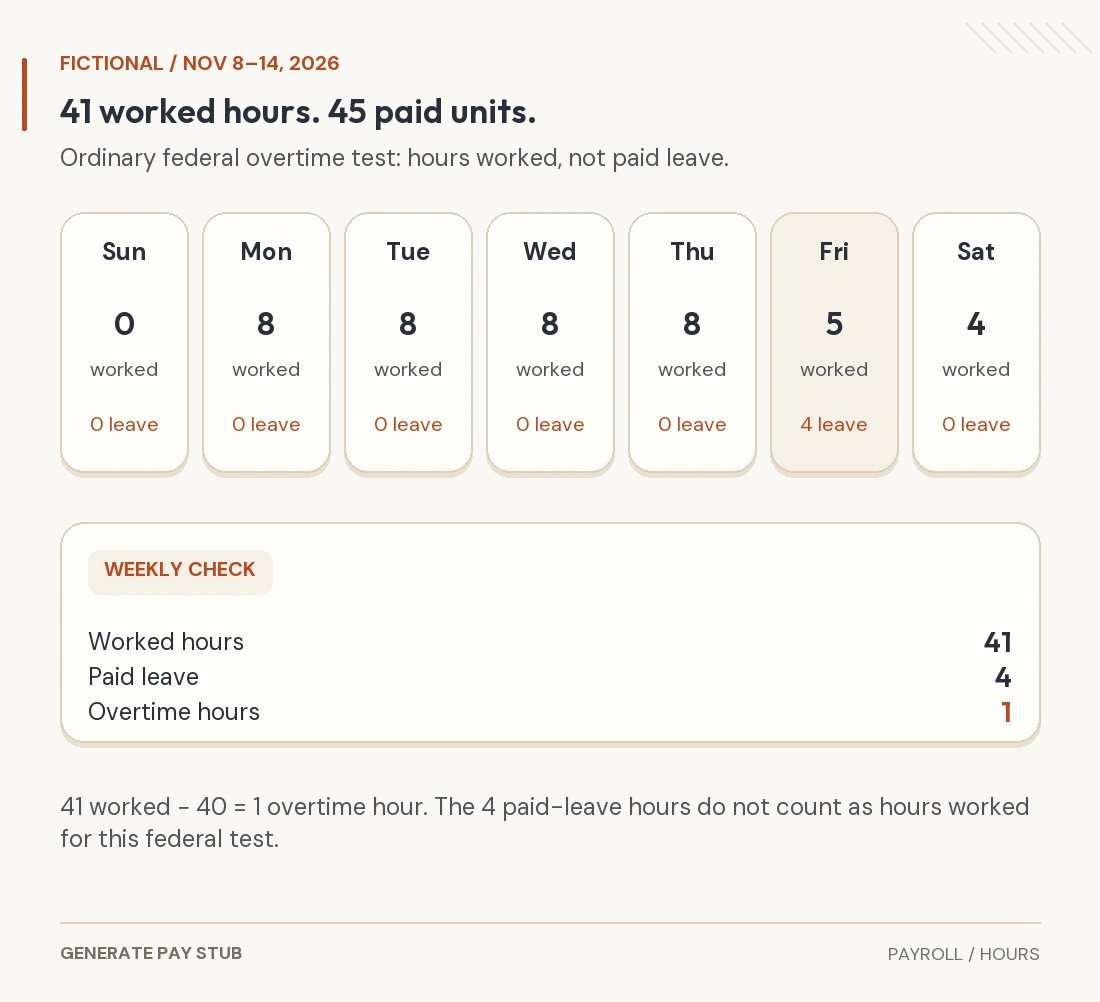
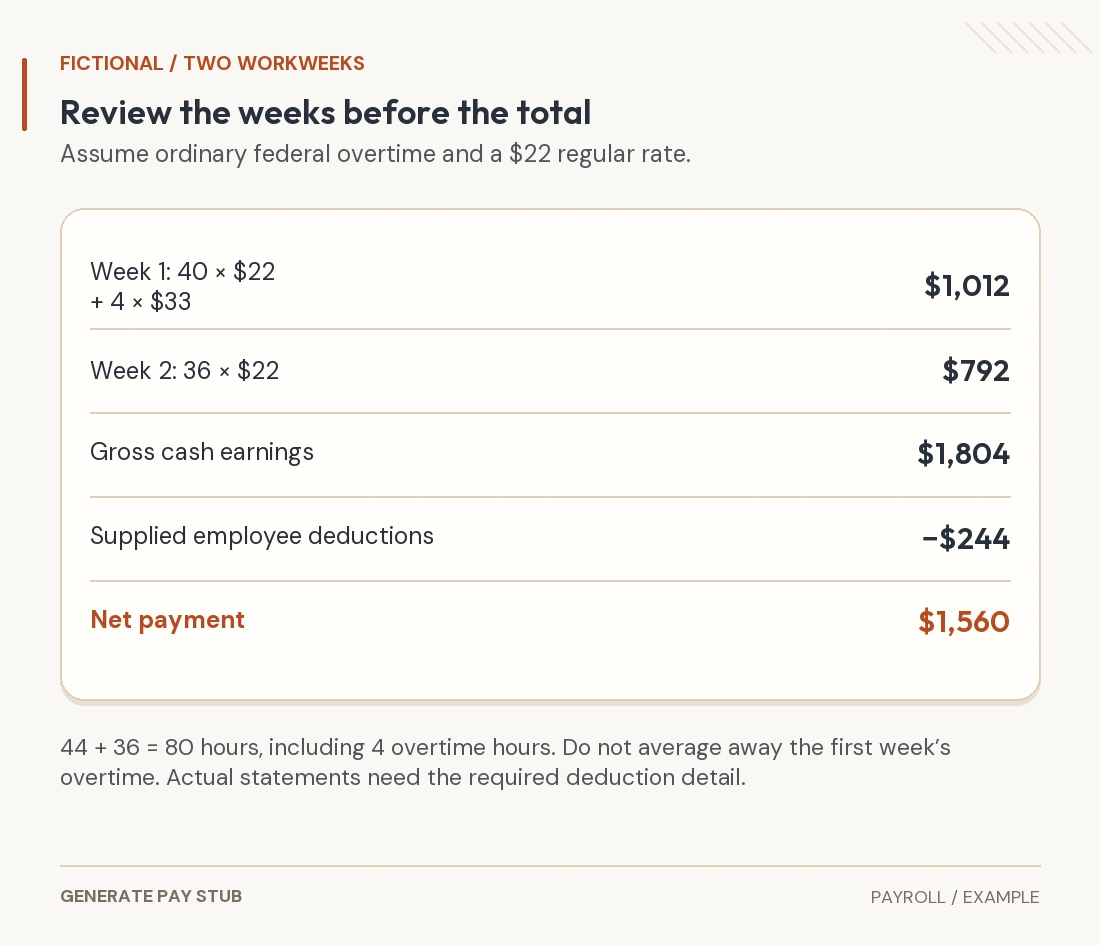
Assume an Ohio employee is covered and nonexempt under the ordinary federal overtime rule, with a $22 regular rate and no bonuses, differentials or other regular-rate components. The two workweeks have 44 and 36 actual worked hours. No daily premium rule or more generous contract provision is assumed.
The DOL overtime fact sheet says the standard federal calculation uses the workweek and does not permit averaging hours across weeks. The fictional first week therefore includes 40 regular hours and four overtime hours; the second has 36 regular hours.

| Workweek | Regular hours | Overtime hours | Gross pay |
|---|---|---|---|
| First | 40 | 4 | $1,012.00 |
| Second | 36 | 0 | $792.00 |
| Period total | 76 | 4 | $1,804.00 |
The first-week calculation is 40 × $22 + 4 × $33 = $1,012. The second is 36 × $22 = $792. Total gross is $1,804. With a separately supplied $244 of employee deductions and no other cash adjustments, net pay is $1,560. An actual statement must itemize the required addition/deduction detail; one aggregate input is used here only to illustrate the cash bridge.
Paying all 80 hours at $22 would produce $1,760, a $44 difference from the worked example. A statement can look tidy while hiding that averaging mistake. Verify the records behind the entries, not just the visual totals.
Does electronic access remove the need for complete wage information?
No. Electronic access is a delivery route. Test that the correct employee can obtain the applicable statement and distinguish the detailed record from a deposit notification. A portal screen showing only the amount transferred does not supply all the fields in the checklist.
For a practical review, use a test record with wrapped text, an adjustment and a longer work period. Confirm the employee can read the dates and line items and retain a usable copy. This is an operational quality check, not an additional format mandated here by Ohio law.
What should an Ohio employee do if no statement is provided?
Section 4113.14 directs the employee to make a written request. The employer must provide the statement no later than ten days after receiving it; if it is not received within that period, the employee may report the violation to the director of commerce. The statute says “ten days.” Ask the agency about any disputed deadline calculation rather than assuming a different phrase.
The official Ohio complaint form requires a dated copy of the original request. Preserve what you sent, evidence of receipt if available, the affected pay dates and any response. Use the current form’s submission instructions when filing.
A useful request identifies the missing periods and asks for the employer-issued statement showing the applicable fields. If money is also missing, describe that separately. This statement-request process should not be assumed to settle an unpaid-wage, overtime or deduction dispute.
For a broader distinction between records access and wage-payment issues, see paid but no pay stub. Do not create a document that falsely appears to be the employer’s response.
A practical employer review before the next payday
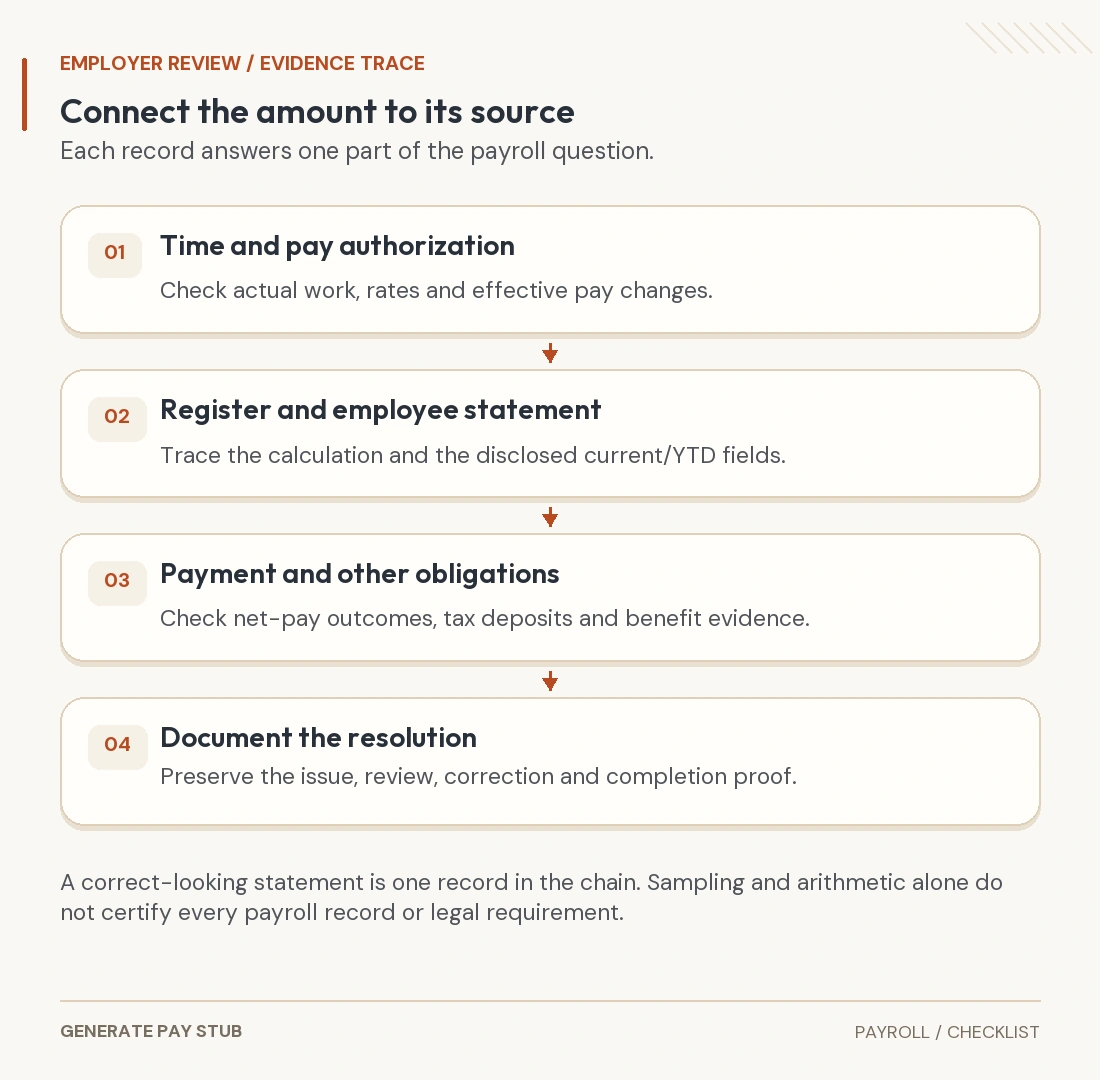
- Confirm the employee/employer coverage and the actual pay arrangement.
- Map each required field to a source record and the correct statement location.
- Reconcile workweek hours to earnings before combining the pay-period totals.
- Explain additions and deductions instead of using an unexplained adjustment amount.
- Test the employee’s delivery/access route and keep a request-response workflow.
- Correct the source payroll when needed and issue the corresponding official record.
Calculate the wages before preparing the statement. A pay stub generator or software setting does not independently establish hours worked, deduction authority or overtime treatment. For planning the take-home estimate, the Ohio paycheck-calculator guide addresses a separate tax-estimation task.
Common Ohio pay-stub questions
Did this requirement begin in 2026?
No. The cited act took effect April 9, 2025; this guide reviews it for current use in 2026.
Does an 80-hour two-week total prove no overtime?
No. The fictional 44-hour first week still produces four overtime hours under the stated federal assumptions.
Does this example calculate Ohio withholding?
No. The $244 deduction total was supplied and does not represent a tax-rate calculation.
Does a missing statement guarantee a particular cash penalty?
No remedy amount is promised here. Follow the applicable agency process and obtain advice about the specific facts when needed.