The Massachusetts paycheck calculator tracks a state withholding deduction for eligible employee contributions, limited to $2,000 over the year. Once that allowance is exhausted, state income-tax withholding can increase while gross pay, federal withholding and FICA stay the same. It is a withholding calculation change, rather than a new tax rate on the whole paycheck.
This 2026 walkthrough follows a fictional $72,000 Massachusetts salary through that transition. It also separates M-4 exemptions from federal W-4 settings and explains why the employee’s Paid Family and Medical Leave deduction is smaller than the program’s total premium.
Set up a controlled $6,000 monthly payment
Open the Massachusetts paycheck calculator. Choose 2026, annual gross wages of $72,000 and Monthly. Use federal Single, leave multiple jobs unchecked and enter zero for the W-4 adjustments and extra federal withholding.
In the Massachusetts controls, use one M-4 withholding exemption, no head-of-household reduction, zero blindness exemptions and no extra state withholding. Keep the standard PFML employee contribution treatment. Known annual local withholding and other cash deductions are zero in this test.
The example assumes one employer throughout the year, ordinary covered wages, Massachusetts as both residence and work state, and no pre-tax benefit adjustment. All modeled wage bases equal gross pay. Those assumptions deliberately leave a clear view of the state contribution deduction; they do not establish the correct elections for a reader.
The state tool calculates the modeled Social Security and Medicare amounts over its annual payment sequence. It does not ask you to supply a new $2,000 deduction for every month. Enter the supported certificate values, then inspect the complete projection.
Follow the limited contribution deduction through the year
The 2026 Circular M percentage method starts by subtracting eligible employee Social Security, Medicare or specified retirement contributions, but limits the cumulative deduction to $2,000. Its instructions stop that subtraction once the annual maximum is used.
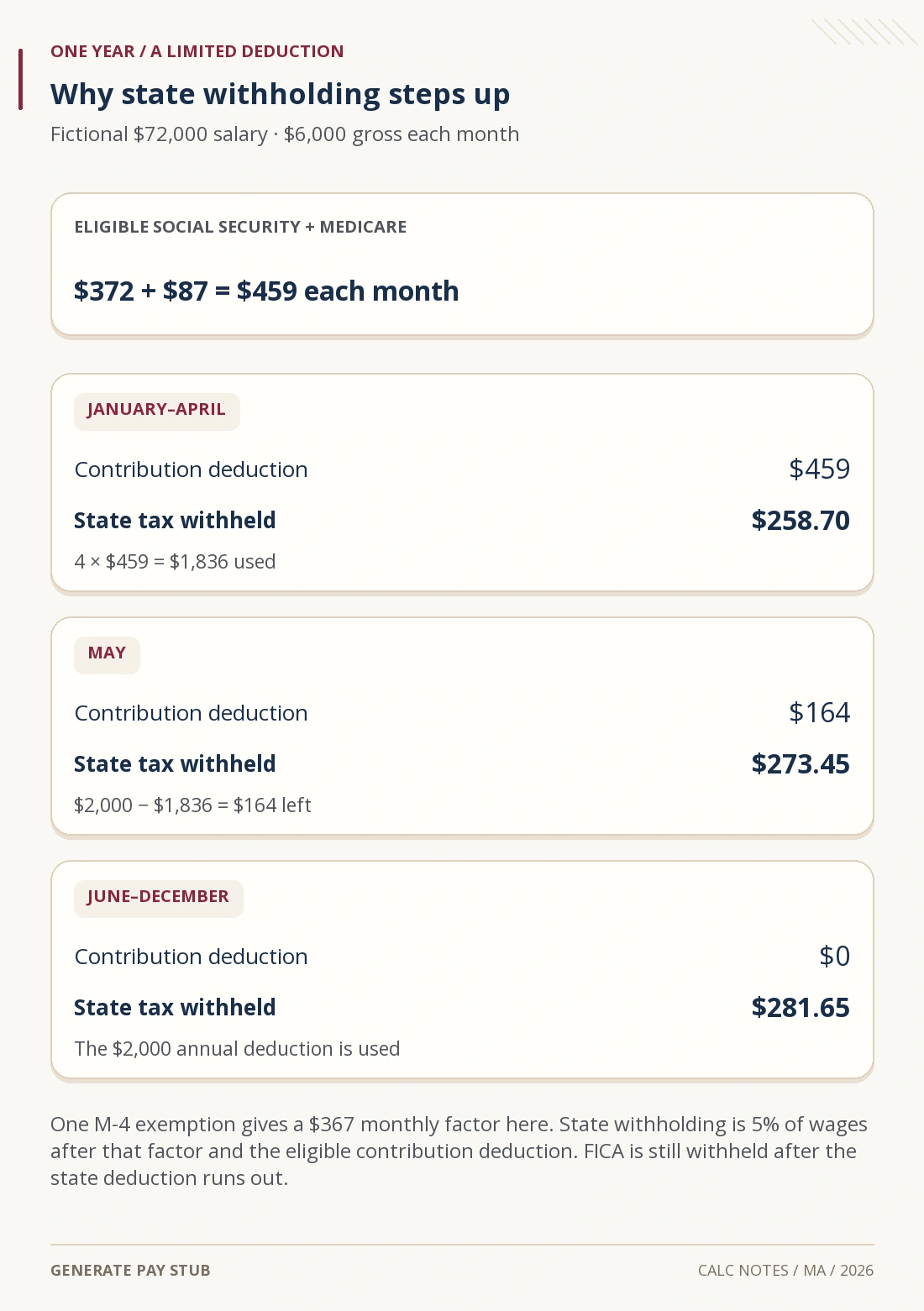
In this fictional job, each monthly payment has $372 Social Security and $87 Medicare: $459 combined. Four payments use $1,836 of the Massachusetts deduction. The fifth payment can use only the $164 remaining below $2,000. The sixth and later payments have no remaining contribution deduction under this step.
One claimed M-4 exemption gives a $367 monthly exemption factor in Circular M. Below the surtax threshold, the sample’s state calculation is 5% of the wage amount after the allowed contribution deduction and exemption factor. There is no head-of-household, blindness or extra-tax adjustment in this run.

| Stage | Allowed contribution deduction | State withholding |
|---|---|---|
| January–April: ($6,000 − $459 − $367) × 5% | $459.00 | $258.70 |
| May: ($6,000 − $164 − $367) × 5% | $164.00 | $273.45 |
| June–December: ($6,000 − $367) × 5% | $0.00 | $281.65 |
Withholding rises $14.75 in May because the deduction falls by $295: $295 × 5% = $14.75. The next step is $8.20, which corresponds to the final $164 deduction disappearing. Overall, the late-year state deduction is $22.95 higher than the early-year amount.
Neither the $2,000 limit nor the $367 exemption factor is a cash deduction taken out of the payment. They reduce the wage amount used to calculate state withholding. Actual FICA continues at $459 monthly throughout this $72,000 scenario.
Compare the three net-pay stages with the annual total
The checked live run keeps federal withholding at $584.17, Social Security at $372 and Medicare at $87 each month. Standard employee PFML is $10.80 family plus $16.80 medical, or $27.60 per payment.
Subtracting those constant amounts and the changing state withholding gives $4,670.53 net in January through April, $4,655.78 in May and $4,647.58 from June onward. Benefits or cash deductions omitted from the sample would change those net figures.
| Component | Annual amount |
|---|---|
| Gross wages | $72,000.00 |
| Federal income tax withholding | $7,010.04 |
| Massachusetts income tax withholding | $3,279.80 |
| Social Security | $4,464.00 |
| Medicare | $1,044.00 |
| PFML family employee share | $129.60 |
| PFML medical employee share | $201.60 |
| Estimated take-home pay | $55,870.96 |
The state total is (4 × $258.70) + $273.45 + (7 × $281.65) = $3,279.80. The net check is (4 × $4,670.53) + $4,655.78 + (7 × $4,647.58) = $55,870.96. These reconciliations use the rounded payment amounts returned by the calculator.
The annual-average net is approximately $4,655.91 per month. It falls between the actual modeled stages and should not be mistaken for twelve identical deposits. Our net-pay explanation shows how to compare a real deposit with a particular statement.
Separate employee PFML from the program’s total cost
The official PFML contribution guidance distinguishes the total contribution from the maximum employee amounts. For the 2026 standard arrangement, the employee share can be up to 0.18% for family leave and 0.28% for medical leave, totaling 0.46% of eligible wages.
For this $6,000 payment, $6,000 × 0.18% = $10.80 and $6,000 × 0.28% = $16.80. Applying the entire 0.88% combined employer-and-employee premium as an employee deduction would double-count part of the employer’s responsibility.
The state’s PFML contribution and payment instructions explain that employers below 25 covered individuals are generally not responsible for the employer share. Employers can pay some or all of an employee’s contribution. Neither fact means every small-employer worker automatically has a zero employee deduction.
Use standard treatment only where it fits actual coverage. An approved private-plan arrangement or employer-paid portion needs its own records. A website coverage selection does not establish exemption eligibility or settle any tax treatment of employer-paid amounts.
Use the M-4 controls without importing federal assumptions
The current Massachusetts M-4 certificate has its own exemption instructions. A permitted spouse claim generally enters four on the relevant line, rather than one. Age, dependents and other certificate conditions also matter.
Enter the supported total from the actual state certificate; do not translate federal W-4 credits into an arbitrary exemption count. The head-of-household and blindness controls are separate adjustments, and the tool’s extra withholding field adds dollars per payment.
The DOR withholding guide addresses principal-employer exemption claims when an employee has multiple jobs. The calculator cannot decide which household claims are valid from a wage number alone. Trying an election here does not update the certificate held by an employer.
Check the applicable year and the estimate’s limits
The DOR rate table sets the 2026 surtax threshold at $1,107,750. The sample is far below it. A high-income household should distinguish a single-employer wage withholding projection from final taxable income and the additional 4% surtax calculation on the return.
Massachusetts has announced a PFML contribution-structure change effective January 1, 2027. Use the 2026 sections of the official guidance for this example; do not import a later year’s premium split into a 2026 pay review.
The calculator models a full year with one set of certificate choices and regular payments. It does not reconstruct changing benefit bases, a midyear start, historical election changes, bonuses, pension methods or special military exemptions. Known annual cash deductions do not supply a pre-tax wage-base calculation.
No extra excluded program appears in the reviewed result. That does not mean actual payroll has no other deductions or that all private plans match the standard percentage method. Check coverage, taxable wages and year-to-date records before deciding a mismatch is an error.
Massachusetts paycheck calculator questions
Does using up the $2,000 deduction stop FICA?
No. This is a Massachusetts withholding-method limit. Social Security and Medicare have their own federal rules, which continue to apply.
Can I spread $2,000 equally over twelve months?
That would not reproduce this method. The example uses eligible current contributions until the cumulative limit is reached, including the partial $164 deduction in May.
Does one M-4 exemption always mean a $4,400 subtraction from one paycheck?
No. Apply the published factor for the actual payroll period. This monthly example uses $367.
Where can I compare another state?
The calculator directory links every state and DC. Read each jurisdiction’s certificate and contribution rules before comparing estimates.
Massachusetts 2026 sources and the live calculator checked November 6, 2026. Worked amounts are fictional and depend on the stated assumptions.