A meal deduction on a pay stub is correct only when the underlying time qualifies as unpaid time under the applicable rules. A payroll setting labeled “30-minute lunch” does not establish that a worker actually received an unpaid meal period. Short paid rest breaks generally stay in hours worked; they should not be subtracted again from the shift.
This U.S. guide was reviewed October 26, 2026. It explains the ordinary federal rules for employees covered by the Fair Labor Standards Act (FLSA), with a clearly identified California comparison. The calculations assume a covered, nonexempt hourly employee and the ordinary 40-hour federal workweek. Other state laws, industry rules, contracts and overtime arrangements can change the result.
Are lunch breaks and rest breaks paid under federal law?
The general FLSA rule distinguishes short rest breaks from bona fide meals. Federal law ordinarily does not require an employer to offer coffee breaks or lunch periods. When short rest breaks are provided, usually five to twenty minutes, they generally count as working time. A genuine meal period, commonly thirty minutes or longer, can be excluded when the employee is relieved of duties. The Department of Labor’s breaks overview explains the basic distinction.
Length is a starting point, rather than an automatic switch from paid to unpaid. A worker required to answer calls or perform other duties while eating may be working. A shorter meal can qualify in special circumstances. Review the actual duties, available time and governing law rather than assuming every period called lunch is deductible.
| Situation | Treatment to check | Payroll implication |
|---|---|---|
| Provided short rest break | Generally compensable working time | Keep it in worked hours; do not deduct it a second time |
| Bona fide duty-free meal | Can be excluded under the federal meal rules | Subtract only the qualifying meal time |
| Required work during a scheduled meal | Work must be recorded and paid; meal classification needs review | Correct time and any resulting overtime |
| Extended unauthorized break | Special federal conditions govern exclusion of the unauthorized extension | Do not assume the entire authorized break becomes unpaid |
The DOL hours-worked fact sheet addresses unauthorized extensions: the employer must clearly communicate the permitted duration, that extensions violate its rules, and that an extension will be punished. That exception does not create a general right to deduct ordinary paid rest time. Actual work cannot be made unpaid simply by calling it unauthorized.
Is an automatic thirty-minute meal deduction allowed?
An automatic deduction is a recording method, not proof of a meal. The employer must still capture all compensable time. A system needs a usable way to report a missed or worked meal, appropriate review of those reports, and corrections when the records are wrong. A default deduction that persists while supervisors regularly require lunch-time duties can understate wages.
The DOL healthcare hours-worked guidance specifically discusses automatic meal deductions and interrupted meals. Its examples come from healthcare, but the underlying lesson is to reconcile the system with the work actually performed. Do not treat a scheduled break, a clock-out instruction, or the absence of a written exception as conclusive evidence that no work occurred.
A pay stub might show eight and one-half paid hours without showing the nine-hour span or the half-hour lunch. The deduction may exist only in the timekeeping detail. Conversely, a separate negative “meal” earnings line requires checking whether it represents time, money, a correction or a different benefit. Ask for the code definition before deciding that a displayed negative amount is a lawful wage deduction.
How do you calculate paid hours when rest breaks stay paid?
Consider a fictional employee working 8 a.m. to 5 p.m., with a genuine thirty-minute unpaid meal and two provided ten-minute paid rest breaks. The shift spans nine hours. Deduct the half-hour meal once: nine hours minus one-half hour equals eight hours thirty minutes worked, or 8.5 decimal hours.
The two paid rest breaks are already inside those 8.5 hours. Subtracting another twenty minutes would count paid time as unpaid. Adding twenty minutes on top of 8.5 would double-count the same rest time. The correct task is to classify the time inside the shift, not create extra minutes beyond it.

Be careful with the time format. Eight hours thirty minutes is 8.5 hours, not 8.30 hours. At an assumed $24 hourly rate, one ordinary 8.5-hour day has $204 of straight-time earnings before considering overtime obligations. Our pay-stub rounding guide discusses numerical checks; rounding cannot systematically erase time worked.
How can a small daily break error change overtime pay?
Reconstruct the workweek before calculating gross wages. Assume the same shift occurs on five days in one FLSA workweek, the employee earns $24 per hour, and there are no bonuses, differentials, other compensation, state daily overtime or special overtime method. Here the regular rate is $24 and the time-and-a-half rate is $36.
Five days at 8.5 worked hours produce 42.5 hours: forty regular hours and two and one-half overtime hours. If payroll incorrectly removes both paid ten-minute breaks each day, it removes one hundred minutes over the week. The incorrect record becomes forty hours fifty minutes. That is fifty overtime minutes, not 0.50 overtime hours.
| Item | Correct record | Incorrect record |
|---|---|---|
| Worked time | 42 hr 30 min | 40 hr 50 min |
| Regular-hours wages | $960.00 | $960.00 |
| Overtime wages | $90.00 | $30.00 |
| Total gross wages | $1,050.00 | $990.00 |
| Gross wage shortfall | $0.00 | $60.00 |
The correct total is 40 × $24 plus 2.5 × $36, or $1,050. The incorrect total is $960 plus 50/60 × $36, or $990. The $60 difference concerns gross wages; the net deposit can differ because payroll taxes and other items must also be reconciled. No tax withholding is calculated in this example.

The DOL overtime fact sheet explains the ordinary weekly rule. Two weeks cannot simply be averaged to cancel overtime. A two-week statement may need separate workweek calculations; see pay period versus pay date. An includible bonus or a second hourly rate can change the regular rate, so the simple $24 example should not be reused mechanically.
Does answering a phone or walking to the lunch area make lunch paid?
Record required duties and interruptions, then evaluate the actual meal period. Eating a sandwich while continuously covering a reception desk is different from taking a duty-free lunch. Report the start and end times, the duties required, and any opportunity to resume an uninterrupted meal. Do not assume only the minutes spent speaking on a call are relevant if the employee remained responsible for coverage throughout the period.
Restrictions also require context. In its September 7, 2026 opinion letter FLSA2026-11, DOL considered a sixty-minute meal including six to fourteen minutes of required walking. It concluded the described period was bona fide because workers were relieved of duties and retained sufficient meal time. The letter contrasts a shorter period substantially consumed by required travel. It does not make all walking unpaid or settle a collective agreement’s separate requirements.
Working remotely does not remove these timekeeping obligations. Keep required calls, messages and tasks during a nominal lunch in the factual record. Our on-call guide discusses restrictions and actual work, while the travel-time guide covers a different set of travel classifications.
Can state law require breaks even though the general federal rule does not?
Yes. Check the work location and the applicable employee and industry rules. California illustrates the difference. Its meal-period FAQ generally describes a thirty-minute meal for work exceeding five hours, with a mutual waiver when the total day is no more than six hours. A second meal generally applies after ten hours, with a limited waiver for days no longer than twelve hours when the first meal was not waived. Industry and other statutory exceptions matter.
California’s rest-period FAQ generally describes paid net ten-minute rests for each four hours or major fraction, with no required rest when the total day is under three and one-half hours. These rules are not a national schedule. California also imposes a more protective premises rule for meals; satisfying a federal duty-free test alone may not settle California compliance.
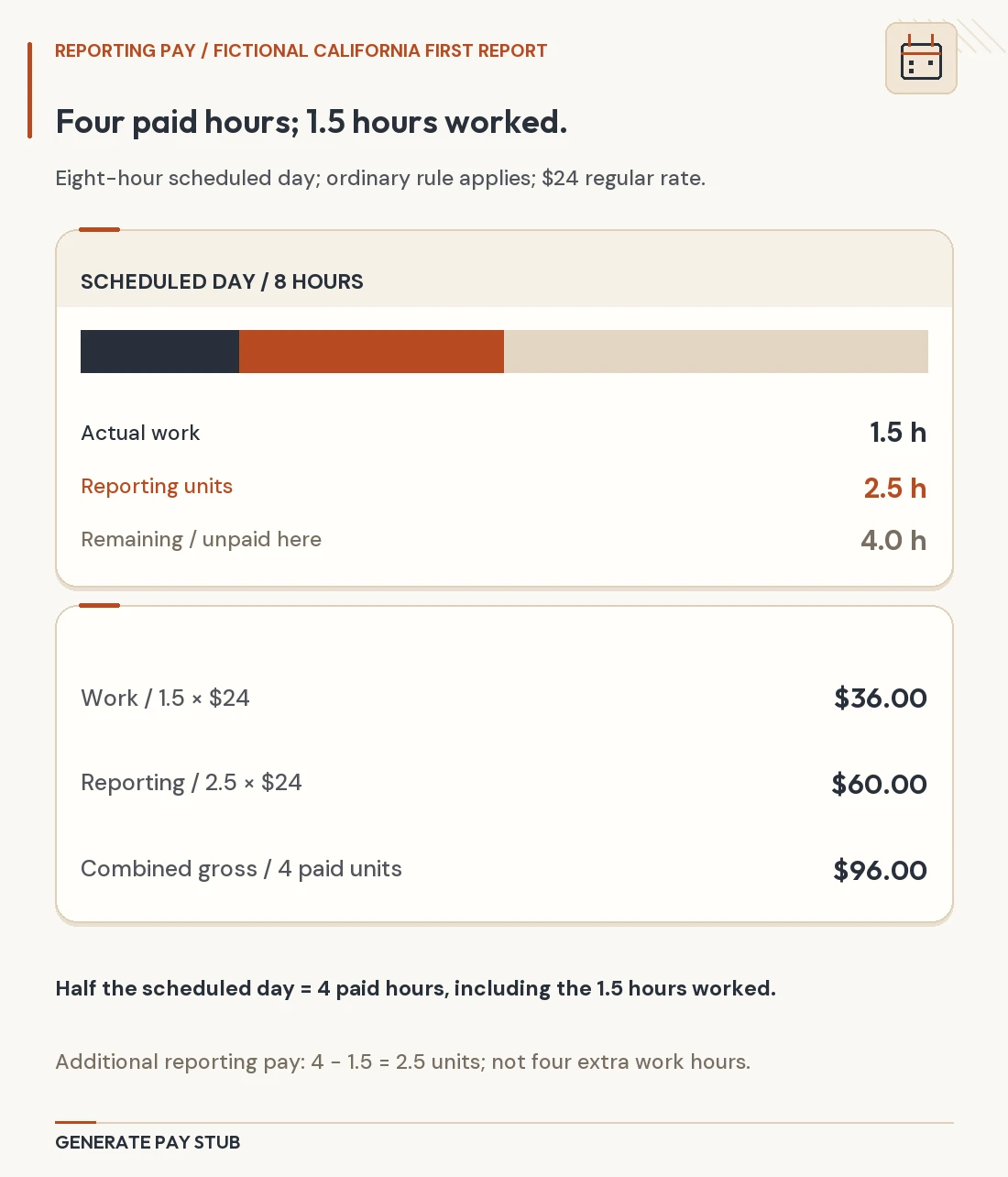
Where a California meal or rest premium is owed, distinguish that additional pay from hours actually worked. A premium does not itself create another hour worked. The California meal FAQ describes additional regular-rate pay for a noncompliant meal. Paying a premium also does not erase unpaid working time. Our California pay-stub guide addresses separate payroll tax lines; it is not a substitute for the applicable wage order.
Other protected breaks need their own review. Under the DOL pumping-at-work guidance, covered employees must be relieved from duty or paid while pumping; existing paid breaks used for pumping receive the same compensation as other paid breaks. More protective state rules can apply. Do not deduct every protected break by copying the lunch setting.
Which documents should reconcile with the hours on your statement?
Compare the timecard, edits, break exceptions, schedule, employer break policy and the pay stub. Identify each actual workweek, clock-in and clock-out time, meal recorded, and time restored after an exception. A schedule establishes the intended shift; the time records establish what happened. A meal attestation should be checked against reported duties rather than treated as a replacement for them.
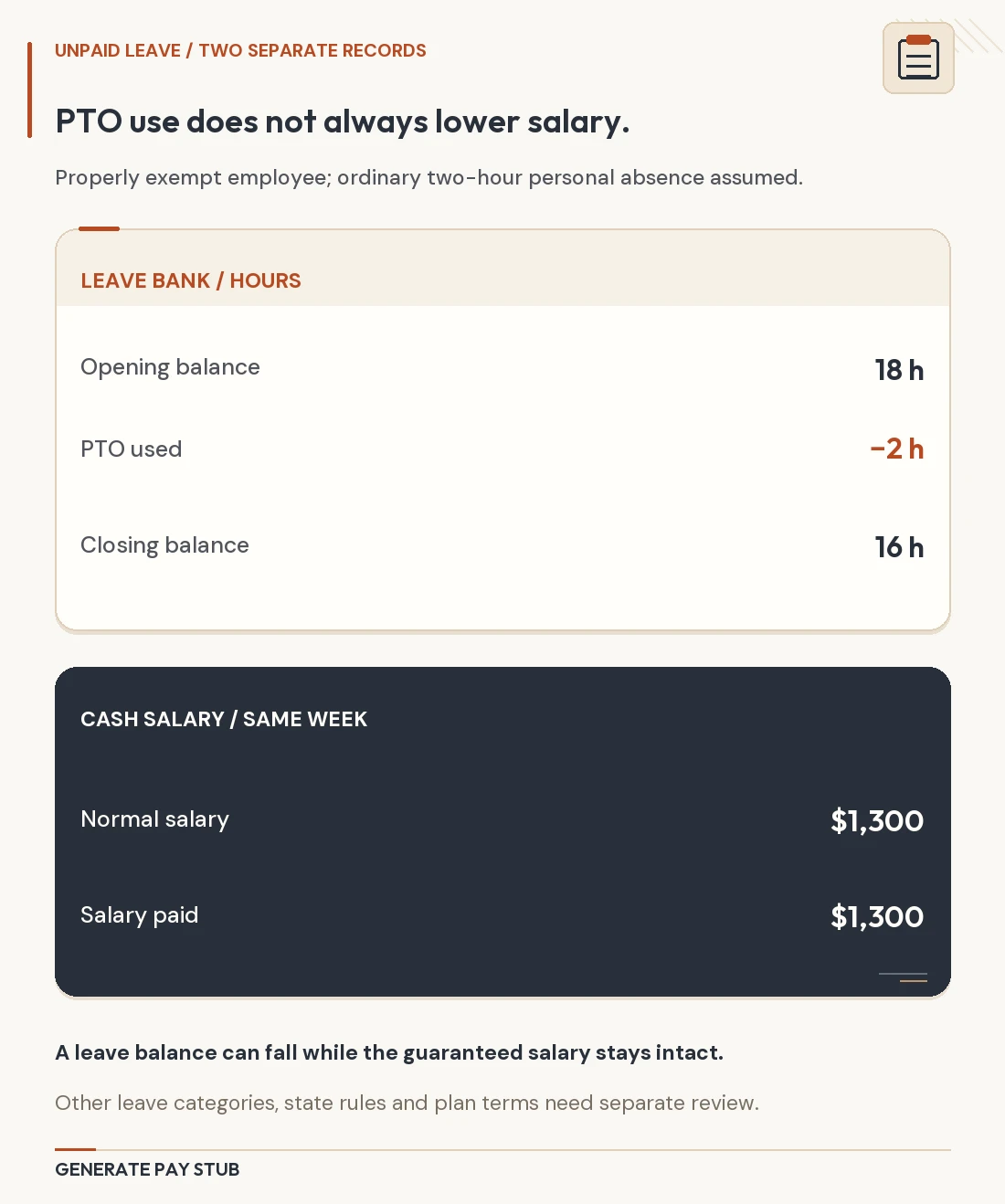
Next reconcile ordinary hours, overtime hours, rates and gross earnings. Paid leave can be payable without being worked time under the ordinary federal weekly overtime rule; our PTO guide explains that separate distinction. Keep any meal premium, reimbursement or benefit code distinct from the work-hours calculation.
What should you do if payroll deducted a meal you worked?
- List the affected dates and minutes. Explain the duties performed and whether a duty-free meal occurred later.
- Submit the employer’s correction or missed-meal report. Keep a dated copy and ask which payroll will reflect the correction.
- Ask for a workweek recalculation. Restored time can alter overtime, not just straight-time wages.
- Check the corrected statement and payment. Match gross, taxes, net and YTD records; avoid adding the same restored time twice.
- Seek the appropriate labor-agency guidance if unresolved. Federal and state claims, time limits and remedies differ; retaliation for protected wage complaints is not permitted.
Our pay-stub correction guide helps organize the records. Generate Pay Stub can present verified payroll information, but generating a new statement cannot establish that a break occurred, authorize an unpaid deduction, or replace payment of wages owed.