Travel pay on a pay stub is compensation for travel time that counts as work under the applicable rules. It is separate from mileage, airfare, lodging or other expense reimbursement. An ordinary commute is generally unpaid under federal law, while travel between work locations, a special one-day assignment and overnight business travel require different tests.
This U.S. employee guide was reviewed October 23, 2026. It covers ordinary federal rules for covered nonexempt employees, including relevant DOL opinion letters issued July 22, 2026. State requirements, authorized special arrangements, transportation-industry exemptions and agreements need separate review. Every numerical example is fictional.
Which travel category should you identify first?
Classify the journey before multiplying time by a rate. The DOL hours-worked fact sheet separates ordinary commuting, special one-day travel, travel within the day’s work and trips keeping an employee away overnight. A company label such as TRVL does not establish which category applies.
| Travel situation | Ordinary starting point | Facts to retain |
|---|---|---|
| Home to regular work and back | Ordinary commute generally is not worked time | Locations, required duties, restrictions and actual schedule |
| Between job sites during the workday | Travel as part of the principal work is compensable | Departure/arrival and required stops or tasks |
| Special one-day assignment in another city | Travel generally counts, subject to the normal-commute adjustment | Regular worksite, assignment, normal commute and qualifying meals |
| Away from home overnight | Normal-working-hours overlap matters, including nonworking days | Regular hours, journey segments, passenger/driver role |
| Required job tasks while traveling | Actual work needs its own assessment and time record | Calls, required reading, driving duties and task duration |
A personal detour, ordinary commute and employer-required job-site transfer can occur in one itinerary. Do not classify the entire day from only its first or last location. Likewise, paying a fixed travel allowance does not establish that every travel hour was correctly recorded.
Does answering email at home make the entire commute paid?
Not automatically. Actual work and the character of the travel must both be assessed. In FLSA2026-9, issued July 22, 2026, DOL considered voluntary arrangements allowing office employees to work partly at home for their own convenience. Ordinary home-to-office travel could remain noncompensable even when it occurred between work sessions, where the stated facts showed it primarily benefited the employee and no work was performed during the commute.
That conclusion is limited to those ordinary-commute facts. The letter preserves the compensability of worksite-to-worksite travel and actual work performed while traveling. It does not establish that every employer-directed transfer from a home worksite is unpaid or that a brief email decides the status of an entire journey.
A companion letter, FLSA2026-10, considered a field service engineer’s required client scheduling and travel. Substantial required calls immediately before or during travel, together with employer control over its timing and manner, supported compensable travel under the specific scenarios. The opinion distinguishes those facts from a worker choosing an ordinary commute for personal convenience.
Record what the employer required, when substantial duties occurred, who selected the travel arrangement and whether personal use was realistically available. Do not use either letter as a universal shortcut. The actual work must still be recorded even where the remaining commute is ordinary. These are federal interpretations; a more protective state test may change the result.
How is travel for a special one-day assignment counted?
A special same-day assignment in another city is generally different from an ordinary commute. Under the federal rule, the employer may disregard the time ordinarily spent commuting to the regular worksite. Qualifying meal periods are assessed separately. The DOL special-one-day assignment advisor illustrates why assignment travel cannot simply be classified as ordinary home-to-work travel.
Consider an employee with a fixed regular worksite and a normal 30-minute commute each way, sent to another city for one day. Assume the following schedule, no job tasks during the normal-commute adjustment, and a genuine one-hour meal completely free of work: leave home at 6 a.m.; travel until 9; work 9–12; meal 12–1; work 1–5; travel home 5–7.
The elapsed day is 13 hours. Actual assignment work is seven hours and round-trip travel is five hours. Subtract the one-hour meal and the assumed one-hour normal round-trip commute: 13 − 1 − 1 = 11 compensable hours, comprising seven assignment hours and four compensable travel hours. This is an ordinary federal example; state daily-overtime and different travel rules are not calculated here.

Keep the itinerary and normal-commute evidence. A 30-minute normal commute each way is not a legal assumption that applies to every employee. Travel to a terminal and time within the assignment require the appropriate facts; do not deduct the same ordinary commute twice under two different labels.
Does overnight travel on Saturday or Sunday have to be paid?
Overnight travel during the employee’s normal working hours generally counts even on a day the employee does not ordinarily work. DOL Fact Sheet 22 explains that corresponding hours on nonworking days are included. For travel away overnight, its enforcement policy generally excludes passenger travel outside regular working hours when no work is performed. This is not the rule for every kind of same-day travel.
Use a separate fictional employee whose normal schedule is 9 a.m.–5 p.m., Monday–Friday. On Saturday, during a qualifying overnight business trip, the employee travels as a passenger from 2–8 p.m., performs no work, has no meal deduction within that interval and is subject to no more protective state or agreement rule. Three hours, 2–5 p.m., overlap normal hours; the remaining three, 5–8 p.m., fall outside them.

Airport waiting, required connections, changes of time zone and an irregular normal schedule need an actual time log and the applicable rule. Record elapsed time consistently rather than subtracting local clock readings from different time zones. Do not automatically deduct an hour for a meal that was actually spent working or that never qualified as a meal period.
Staying in a hotel does not, by itself, mean every overnight hour is worked time. Required duties, restricted waiting and qualifying off-duty periods must be distinguished. The Oregon BOLI travel-time guide provides a state agency’s explanation of travel categories; the applicable state’s current requirements still need to be checked for the actual job.
What if the employee drives, takes calls or works during the trip?
The passenger exclusion does not excuse actual required work. The DOL work-performed-while-traveling advisor describes required driving, clerical tasks and other work. An employee required to drive or act as an assistant/helper is generally working, subject to qualifying exclusions. Commercial drivers can also require a separate overtime-coverage analysis.
A different rule may apply when public transportation is offered but the employee asks to drive a personal vehicle instead. The advisor explains that the employer may count the actual driving time or the time that would have counted using the offered public transportation. Do not treat employee-choice driving and employer-required driving as identical facts.
If an otherwise excluded passenger period includes a required 30-minute work task, record and assess that work; do not declare it unpaid merely because the plane departed after normal hours. Also avoid automatically counting overlapping task time twice if that interval is already compensable travel. Record the work facts and the travel classification together.
Can a different travel rate still produce overtime?
Yes. A valid different rate changes the pay calculation, not whether compensable travel belongs in the worked-hour total. The Texas Workforce Commission travel-time guide discusses a properly established lower travel rate, accurate separate records and weighted-average overtime. An agreement cannot retroactively erase earned wages or override a higher applicable minimum or special rule.
For a separate fictional workweek, assume a covered nonexempt employee works 36 job hours at $30 and eight correctly classified travel hours at an agreed $19 rate. All 44 hours receive straight time. Assume the $19 rate satisfies applicable wage requirements, no bonus or other includible pay exists, and no state daily overtime, special method or additional agreement changes the calculation.
| Calculation step | Calculation | Amount |
|---|---|---|
| Job straight time | 36 × $30 | $1,080.00 |
| Travel straight time | 8 × $19 | $152.00 |
| All straight-time remuneration | $1,080 + $152 | $1,232.00 |
| Weighted regular rate | $1,232 ÷ 44 hours | $28.00 |
| Extra overtime premium | 4 × 0.5 × $28 | $56.00 |
| Gross wages before employee deductions | $1,232 + $56 | $1,288.00 |
The regular rate is $28, which differs from both the $30 job rate and $19 travel rate. Since straight time already covers all 44 hours, the remaining premium is $56. Excluding the eight travel hours would miss the federal overtime in this example. Applying 1.5 times the last printed rate without checking the method can also produce the wrong amount.
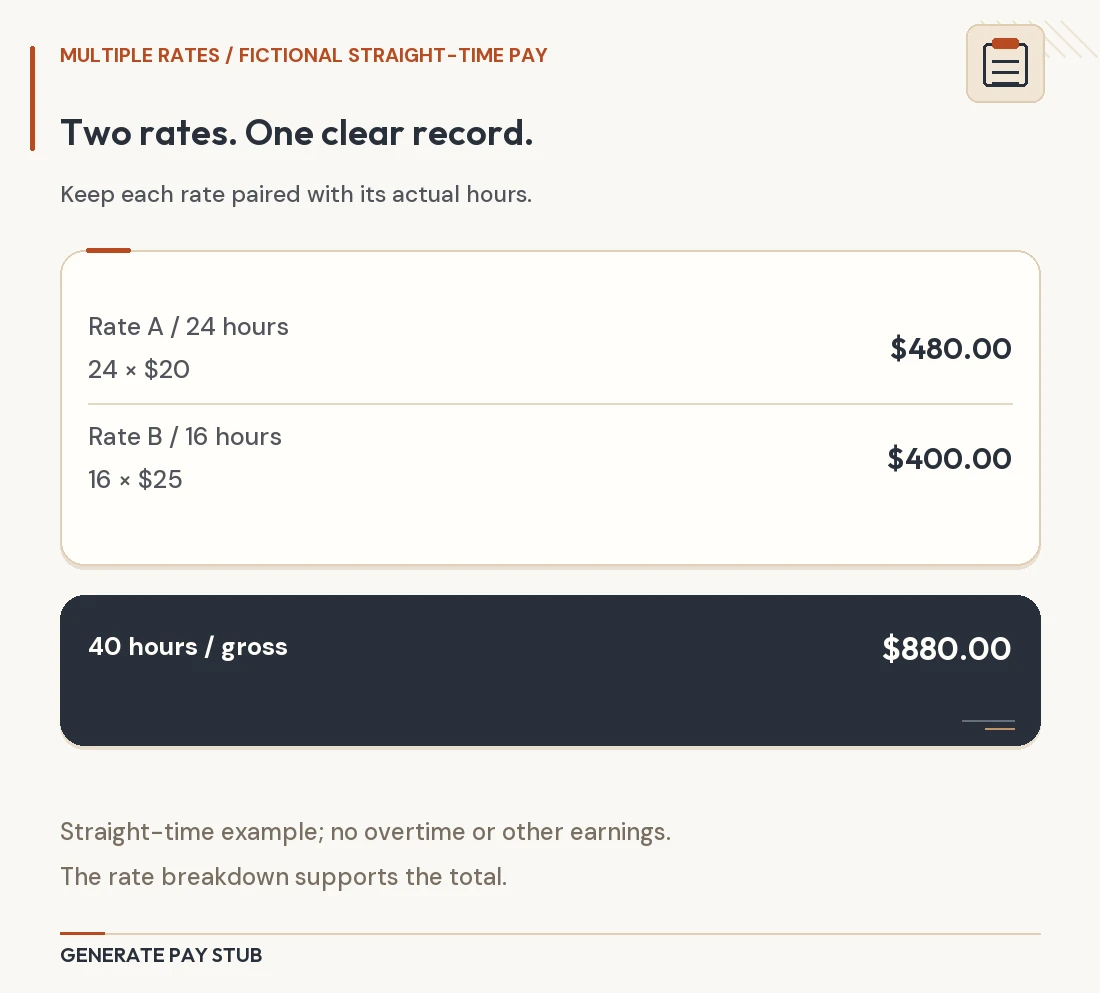
The DOL overtime guide describes the workweek and multiple-rate framework. See our two-rate pay-stub explanation for additional statement details. A biweekly payment still requires the appropriate underlying workweek calculations.
Is travel-time pay the same as mileage or per diem?
No. Wages pay for work; a qualifying reimbursement repays an expense. Paying for a hotel does not settle whether the trip’s travel hours were compensated. Conversely, paying the correct travel wage does not automatically satisfy a separate expense-reimbursement obligation.
The tax and labor-law reimbursement tests also differ. IRS Publication 463, currently available for 2025, explains an accountable arrangement’s business connection, timely substantiation and return-of-excess conditions. Qualifying payments are distinguished from nonaccountable amounts reported as wages. Use the current payment-year rules for any actual rate or limit; none is assumed here.
For overtime, the DOL regular-rate guide separately addresses actual or reasonably approximate business-expense reimbursements. Satisfying one tax label does not automatically decide every wage-and-hour question. A flat allowance that actually substitutes for wages cannot be assumed excluded merely because it is named MILEAGE.
Extend only the two-rate weekly example: assume a separate $500 reimbursement fully qualifies for the stated tax and regular-rate exclusions. Gross wages remain $1,288; the reimbursement is $500; the combined amount before employee wage taxes and deductions is $1,788. It is not $1,788 of taxable wage gross and is not a guaranteed $1,788 net deposit.

The 2026 IRS employer guide supplies the wage-tax framework. No employee withholding amount is calculated without the employee’s actual facts. Our reimbursement guide and gross-to-net explanation cover the remaining reconciliation.
How should you investigate missing travel hours or pay?
- Record the journey segment by segment. Keep work locations, departure/arrival, time zone, normal hours and ordinary commute evidence.
- Identify actual duties. Separate required driving, tasks, site transfers, passenger periods and genuine off-duty or meal intervals.
- Confirm coverage and rate. Review classification, applicable jurisdiction, advance rate agreement and any special requirements.
- Rebuild each workweek. Include all compensable travel once, allocate includible dollars and check the overtime method.
- Reconcile expenses separately. Match receipts or substantiation to reimbursement lines without turning them into hours or duplicate wages.
- Trace the correction. Compare wages already paid with the revised amount, deductions, deposit and YTD entries.
Use the pay-stub correction workflow and YTD guide to document the discrepancy. Generate Pay Stub should present supported payroll figures; generating a TRVL line cannot determine whether a disputed commute is compensable or replace the trip log. Keep those source records with the preparation checklist.