The Ohio paycheck calculator needs the correct 2026 payroll table period as well as your IT 4 exemption count. The table changed on August 1. Municipal and school-district withholding are separate from the state income-tax result.
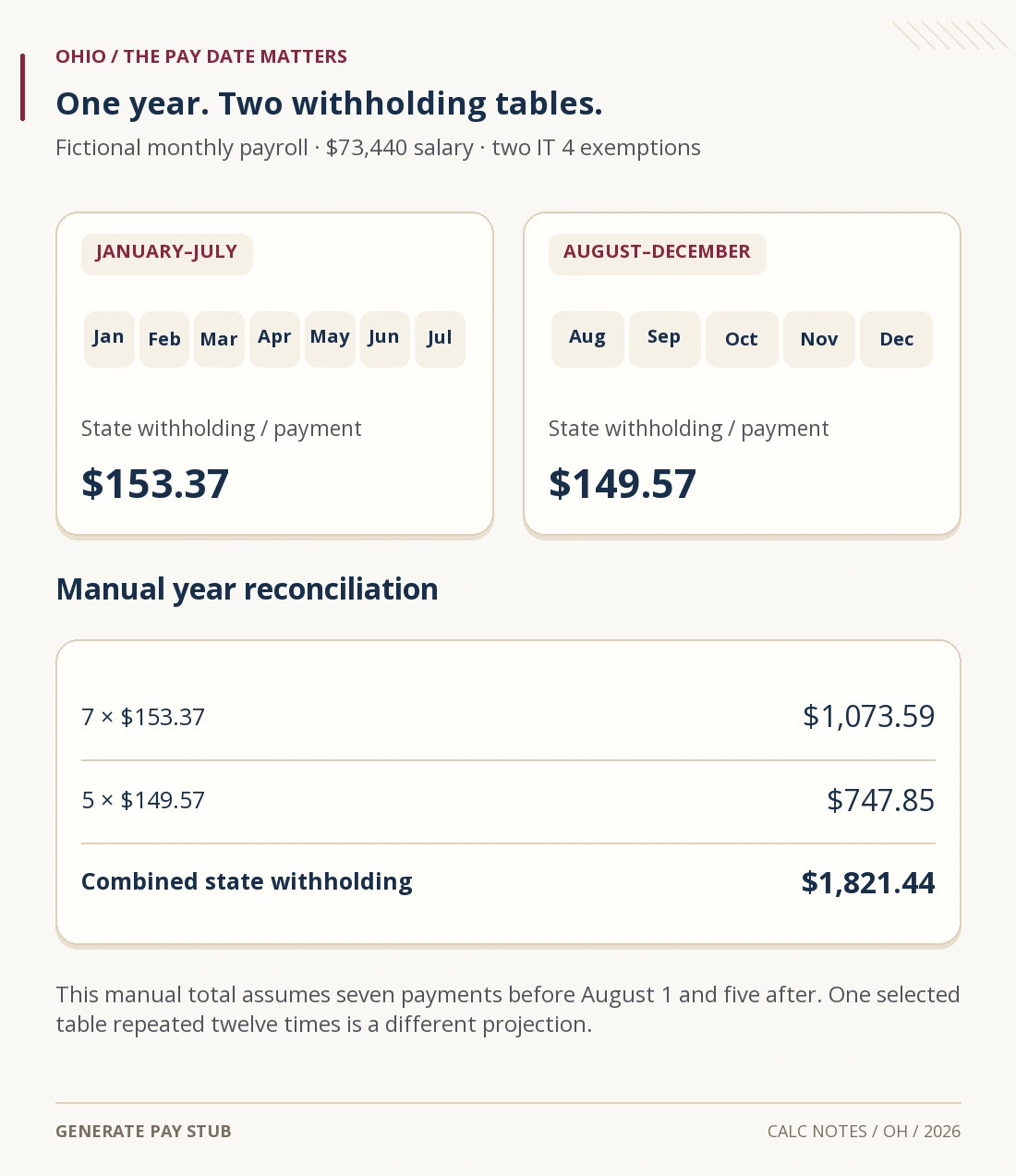
For a fictional $73,440 annual salary paid monthly with two state exemptions, we verified $153.37 state withholding using the January–July setting and $149.57 using August–December. Those are comparable payment estimates. Neither twelve-month projection automatically reconstructs a calendar year that used both tables.
Choose the table for the payment date
The Ohio Department of Taxation’s employer page identifies the preceding table as effective through July 31, 2026 and the revised table as effective August 1, 2026. The calculator exposes those periods in its state settings.
The revised optional computer formula applies a $650 annual reduction for each exemption. Its middle band retains a 2.990% marginal payroll percentage but changes the fixed component to $416.80. The matching preceding formula uses $462.39 in that band.
A 2025 revision date on that preceding document does not make it irrelevant to early 2026 payroll. Effective dates determine which table belongs to a payment.
The annual calculator repeats whichever table you select across the modeled payments. It does not switch tables automatically halfway through that projection. For a year-end reconciliation, combine actual deductions or calculate the relevant periods separately.
Read the IT 4 input before changing its count
Ohio’s new-employer guidance describes the IT 4 as the employee’s state withholding certificate, including exemption and school-district information. Its exemption rules concern the employee, spouse and qualifying dependents. They are not the federal W-4’s annual credit dollars.
Use the supported count on the actual certificate. Our two-exemption test assumes a valid election; it does not establish which exemptions a reader may claim.
A federal status change can alter federal withholding without creating a corresponding Ohio status field. The state model instead asks for its table period, IT 4 count and extra state dollars per paycheck.
Review certificate details when family circumstances or residence changes. Entering a number on a calculator does not update the employer’s payroll file.
Reproduce the $6,120 monthly comparison
Open the Ohio paycheck calculator, select 2026 and enter $73,440 annual gross with Monthly selected. The modeled payment is $6,120 before deductions.
Choose federal Single, with multiple jobs disabled and all federal adjustments at zero. Enter two Ohio exemptions, no additional state amount, and zero for known annual local and other deductions.
Run the January–July table first, record its result, then change only the table period to August–December. Holding the other inputs steady isolates the effect of the revised payroll schedule.
The fictional employee has one full-year job, lives and works in Ohio, and has ordinary wages with no pre-tax benefits. All wage bases equal gross here. This controlled case excludes both municipal and school-district deductions.
Follow the two optional computer formulas
Two exemptions reduce annualized wages by $650 × 2 = $1,300. Formula taxable wage is therefore $73,440 − $1,300 = $72,140.
The amount above the middle-band threshold is $72,140 − $26,050 = $46,090. At 2.990%, that component is $1,378.091.
For January–July, add $462.39 and divide by 12: $1,840.481 ÷ 12 = $153.373416…; the rounded payment deduction is $153.37.
For August–December, add $416.80 instead: $1,794.891 ÷ 12 = $149.57425, giving $149.57. The change is $3.80 per modeled payment. Preserve the published percentage precision while calculating.
| Result of selected setting | January–July table | August–December table |
|---|---|---|
| State amount each month | $153.37 | $149.57 |
| Estimated cash each month | $4,887.88 | $4,891.68 |
| State sum if repeated 12 times | $1,840.44 | $1,794.84 |
| Cash sum if repeated 12 times | $58,654.56 | $58,700.16 |
The twelve-payment state amounts total rounded checks rather than copying the unrounded annual formula. Do not read the right-hand annual cash figure as the actual 2026 net pay of someone who used the preceding table for seven months.
Combine seven preceding-table payments and five revised-table payments
Assume one payment in each month, with January through July paid before August 1 and the remaining five paid under the revised table. Keep wages and all elections constant.
The manual state total is 7 × $153.37 + 5 × $149.57 = $1,073.59 + $747.85 = $1,821.44. This is a separate reconciliation using the verified payment amounts, not a third automatic calculator output.

| Year reconciliation entry | Calculated total |
|---|---|
| Unchanged annual gross | $73,440.00 |
| Federal withholding over 12 checks | $7,326.84 |
| Ohio state withholding: seven plus five | $1,821.44 |
| Employee Social Security | $4,553.28 |
| Employee Medicare | $1,064.88 |
| Cash before city, school and benefit items | $58,673.56 |
The August payment is $6,120 − $610.57 federal − $149.57 state − $379.44 Social Security − $88.74 Medicare = $4,891.68. The earlier payment is $3.80 smaller.
Seven earlier cash payments plus five later ones total $58,673.56. A biweekly calendar, off-cycle pay, a late payroll update or changed wages needs its actual payment history instead of this monthly pattern.
Keep municipal and school-district deductions separate
The state’s school-district FAQ explains that district withholding differs from city withholding. The IT 4 notifies an employer of residence in a taxing school district.
The main employer guidance also distinguishes traditional-base districts from earned-income-base districts: exemption treatment differs. A district rate cannot safely be applied to gross wages without checking its tax base.
The calculator does not identify a municipality or school district from an address. A zero in the known local cash field means no local amount was entered, not that no tax applies.
If payroll has already supplied a verified annual municipal or school deduction, a known annual cash entry can reflect that amount in the projection. Keep a separate breakdown of each item. The field does not calculate resident credits, work-city rules or district eligibility.
Understand what the comparison leaves out
Withholding tables are payroll collection methods, not a complete annual return. Other income, household credits and payments can produce a different final liability or balance.
An additional Ohio amount is per payment. A request for $8 on every monthly check means $96 over twelve checks; it is distinct from an annual $8 cash entry and from $8 of extra federal withholding.
For benefits, check whether the item changes federal, Ohio or FICA wages before using an ordinary-wage result. Our pre-tax and post-tax explanation helps separate the wage basis from the final cash subtraction.
This tool cannot establish exemption entitlement, file an IT 4, reconstruct missing employer records or prove income earned.
Ohio paycheck calculator questions
Which 2026 table should I choose?
Match the table’s effective period to the payment being reviewed.
Is school-district tax included in the state line?
No. Determine district and municipal withholding separately.
Why is the later table’s annual total different from the manual year total?
The tool repeats one selected table. The manual example combines seven earlier and five later deductions.
Does a lower withholding result prove my annual tax fell by the same amount?
No. Withholding and final liability require different calculations.
Ohio sources, formula precision and both live table selections reviewed November 6, 2026.