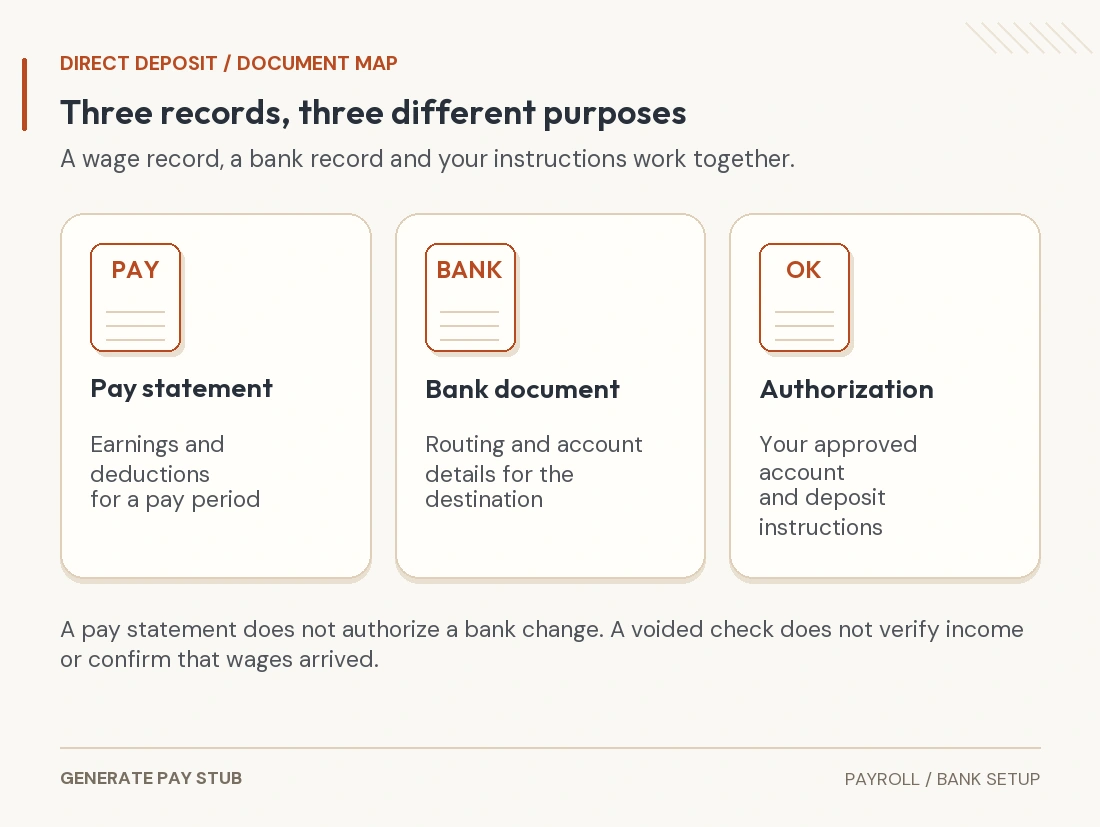
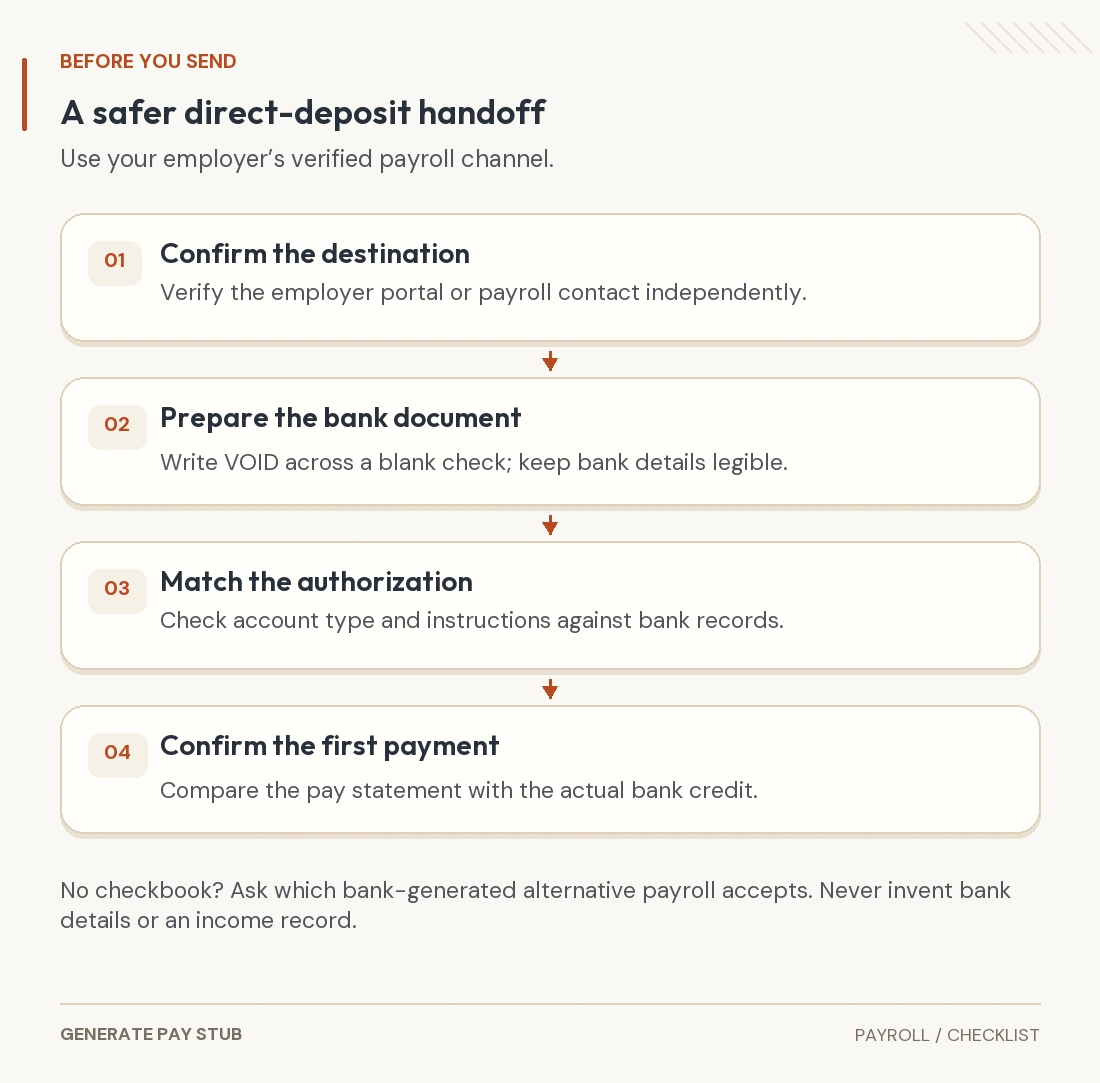
A pay stub and a voided check serve different purposes. The pay stub explains earnings and deductions. A voided personal check supplies bank-account details that payroll may use for direct deposit. Providing both does not merge them into a new financial document, prove that wages reached the bank or automatically authorize withdrawals.
This guide explains U.S. payroll setup as reviewed in November 2026. The employer’s process, bank instructions and applicable state wage-payment rules determine which documents are accepted. Use genuine records and a verified submission channel.
Why would someone ask for a pay stub with a voided check?
The requester may be checking two separate facts: the earnings record and the destination account. Ask what task each document supports before sending it. New-hire payroll may only need bank setup information and an authorization; an existing pay stub is not universally necessary just to establish direct deposit.
A lender or another financial institution may use an income statement and account evidence in its own verification process. Its acceptance requirements are specific to that transaction. A voided check does not prove the account balance, establish ongoing employment or guarantee that a loan or application will be approved.

| Document | Useful information | What it does not establish by itself |
|---|---|---|
| Pay stub or earnings statement | Pay-period earnings, deductions and reported net pay | Bank ownership, account setup consent or completed payment |
| Voided personal check | Printed bank routing and account information | Current earnings, available balance or safe unrestricted sharing |
| Bank-generated account letter or deposit form | The account details the bank confirms | Acceptance by every employer or other recipient |
| Direct-deposit authorization | The employee’s approved deposit instructions | That payroll has processed the change or funds have arrived |
Nacha’s direct-deposit enrollment guide identifies routing and account information as the core bank details. The employer’s own enrollment instructions explain how to supply them. A separate pay-stub number or payroll transaction reference should not be substituted for either one.
How to prepare a voided check for direct deposit
First confirm that payroll accepts a voided check and whether it wants a scan, photograph or original. Use a blank personal check for the intended account, rather than a check already written to someone else.
- Use permanent, readable ink. Write “VOID” prominently across the front so the check is clearly unsuitable for payment.
- Keep the bank information legible. Do not obscure the routing number and account number needed for setup. Make sure any copy shows the full required area without blur or glare.
- Leave payment fields unused. Do not add a payee, payment amount or signature merely to create a direct-deposit attachment. Follow any specific bank instruction for the document requested.
- Record the check’s disposition. Mark that check number as void in your own register so it is not mistaken for a payment or a missing check later.
- Submit through the verified process. Attach it only where the confirmed payroll instructions require, together with the separate authorization.
Chase’s voided-check guidance describes writing VOID without covering the bottom bank-number line and emphasizes that sensitive account details remain visible. The mark is not a privacy shield. If a check was already issued, lost or used in a disputed transaction, ask the bank what action is needed; writing VOID on a retained copy is not a substitute for dealing with that payment.
What if you do not have paper checks?
Ask payroll for its approved alternative before ordering a checkbook. Possible options include a bank-generated direct-deposit form, an account-verification letter, a bank-issued starter check or the employer’s secure self-service enrollment process. The recipient decides which it accepts; a screenshot from a bank app is not universally sufficient.
A savings account can also receive direct deposit when the account and payroll system support it. Because a savings account may not have personal checks, the bank’s own account documentation is often the relevant starting point. For one actual employer example, SUNY Oswego’s payroll FAQ describes bank completion of its form when using savings or not attaching a blank voided check. Its form procedure is an example, not a rule binding other employers.
Ask the bank for a document intended for ACH direct deposit. Do not assume that every deposit slip, wire-transfer instruction or account screenshot contains the correct routing information for payroll. If the employer needs an account-holder name, confirm how it appears on the bank record and how any joint account is handled.
Never create an imitation bank letter, edit a check image to show different numbers or invent an earnings record to complete the packet. If the existing documents do not satisfy the recipient, resolve the missing evidence with the bank or payroll team.
Which numbers should match?
Compare the bank’s approved ACH instructions with the enrollment form, not with an unrelated number on a pay stub. Confirm the following through your bank or authenticated bank account:
- Routing number: the bank-routing information appropriate for the intended deposit type.
- Account number: the destination account’s actual number, including any required leading zeros.
- Account type: checking or savings, as applicable.
- Account-holder information: the ownership details required by the bank and employer.
Do not use the debit-card number as the account number. A check’s serial number identifies that particular check; it is not the bank account. A payroll system may also display an internal “check number” even when wages are deposited electronically.
A pay stub may show only the last few account digits for privacy. Those masked digits can help you spot an unexpected destination, but they cannot supply a complete new direct-deposit instruction. If the numbers disagree, pause setup and get an explanation rather than selecting whichever looks familiar.
How to send a pay stub and bank details more carefully

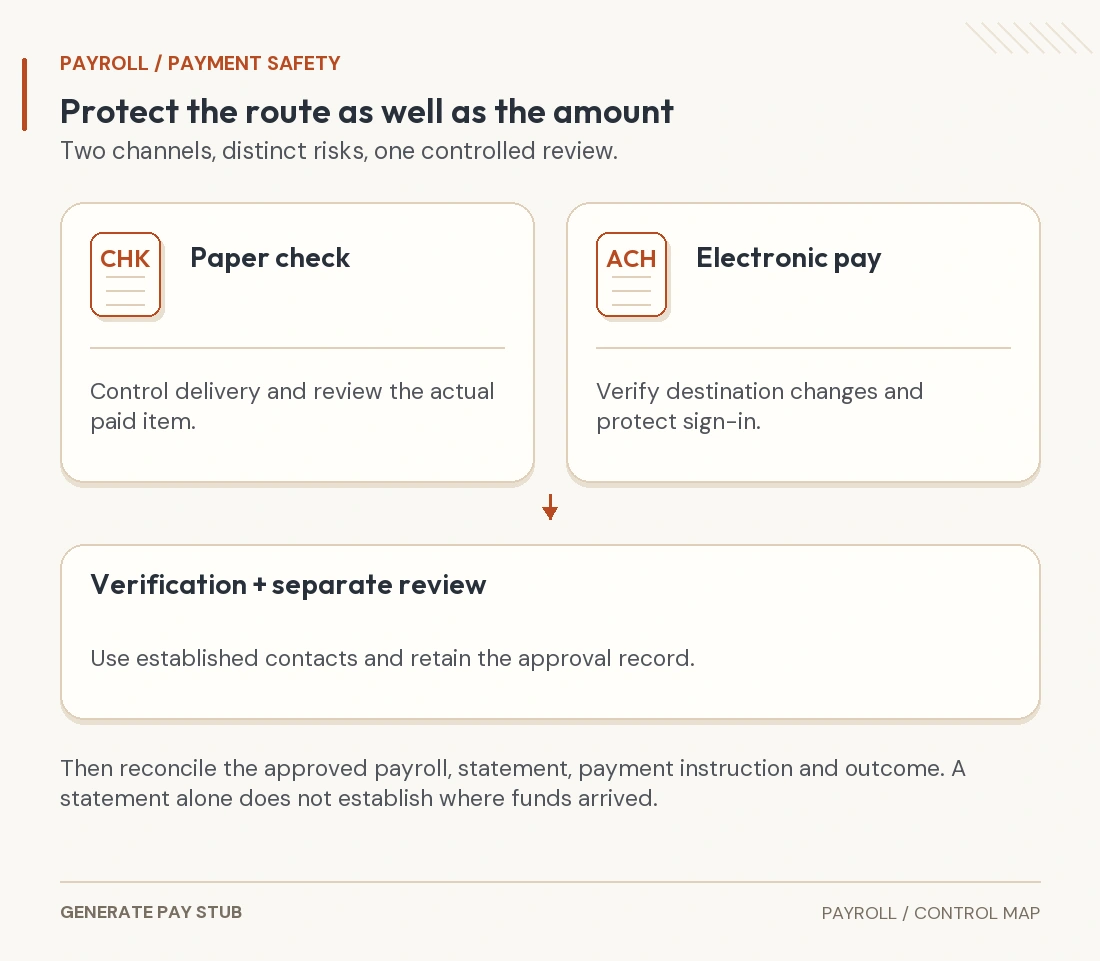
Use the employer portal or contact method you already know is legitimate. Reach payroll through a verified directory, established phone number or bookmarked portal if a message unexpectedly asks you to change bank information. An urgent email and a realistic company logo do not verify the request.
The FBI’s employee self-service phishing alert explains how fake login sites can capture credentials and enable payroll redirection. It recommends navigating to the genuine site directly or through a trusted bookmark. Keep passwords and one-time login codes out of document attachments and ordinary payroll correspondence.
For an income-only request, ask whether a redacted copy is acceptable before sharing unrelated account data. For bank setup, concealing the required account digits can defeat the purpose, so use the secure designated process instead. Keep an unmodified original in your own records and identify any redacted copy clearly.
Do not post a check or pay stub in a public forum to ask for help. When a copy is no longer required, follow the applicable retention process and dispose of it securely. The fact that the check says VOID does not prevent someone from learning its bank details.
Can an employer choose the bank or require direct deposit?
These are separate questions. Under Regulation E, 12 CFR 1005.10(e)(2), an employer cannot condition employment on receiving salary at one particular financial institution. The official interpretation allows required direct deposit under the federal rule when employees can choose the receiving institution, or a choice between a designated bank and another payment method.
That federal framework does not settle every state wage-payment or consent requirement. Check the law where the employment is covered, the type of worker and the employer’s process. A request for a voided check does not itself establish that the employee must open a new account or waive another available payment method.
What to check after submitting the documents
Ask payroll when the new instructions are expected to take effect and what payment method will be used during any validation period. Keep access to the old account until you have confirmed the change and resolved outstanding transactions with the relevant parties.
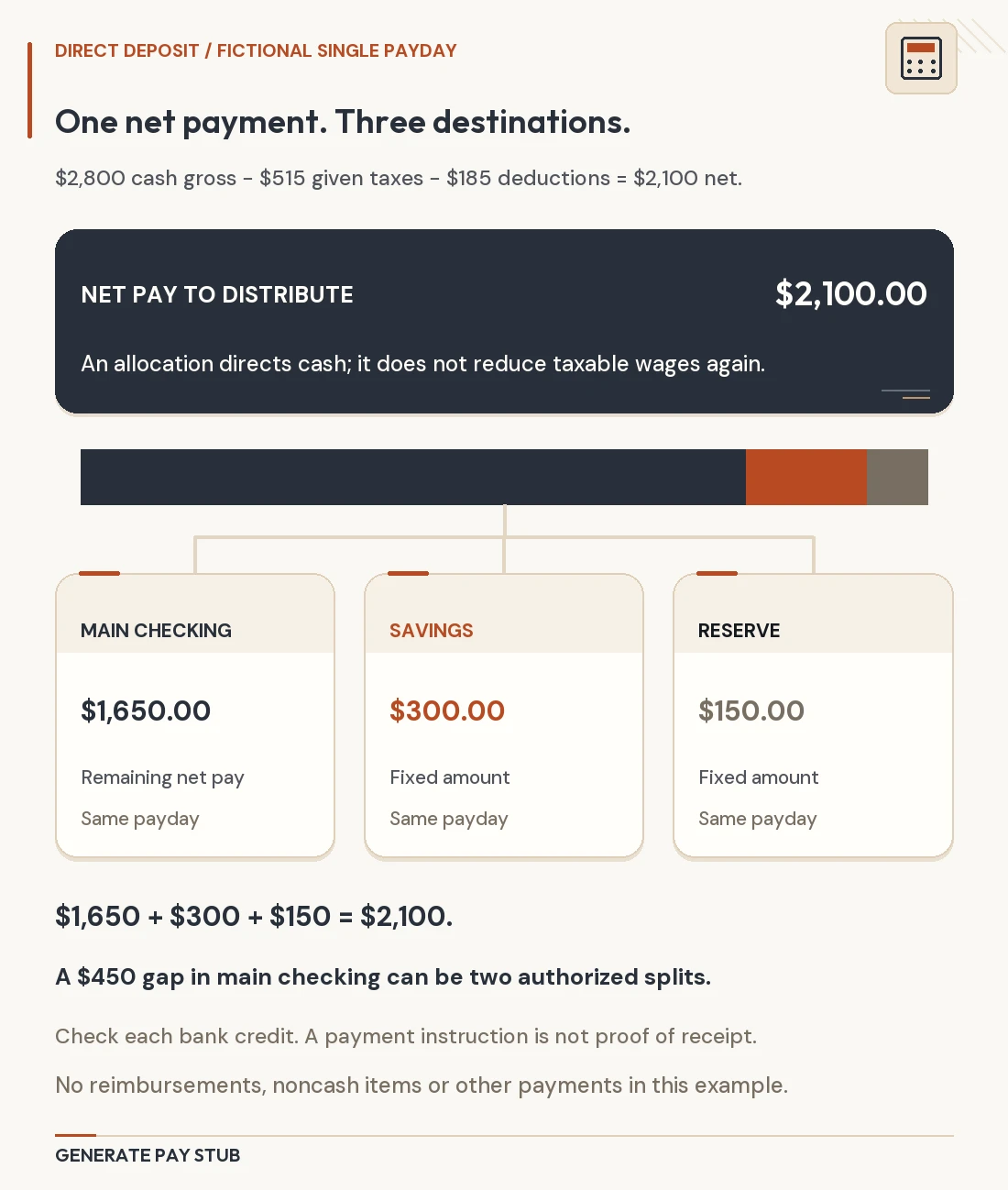
On the first affected payday, compare the pay stub’s net amount and destination details with the actual bank credit. A setup confirmation does not prove the transfer has settled. If the deposit is missing, report it promptly using a verified contact and retain the statement and setup confirmation. Our direct-deposit pay-stub guide covers split payments, pending deposits and missing-pay investigations.
A payroll advice can be a nonnegotiable record rather than a cashable check. Oracle’s payroll documentation, for example, describes automatic-deposit advice as a nonnegotiable form showing earnings and deductions. Do not try to cash a document marked VOID or nonnegotiable, or assume that marking means the electronic wages were canceled. Ask payroll to explain the status.
Common questions about the document packet
Does a voided check let someone withdraw money?
It is not a signed authorization for arbitrary withdrawals, but it exposes bank information that can be misused. Share it only for a verified purpose through the approved channel. Contact the bank promptly if you suspect misuse.
Is a canceled check the same as a voided check?
No. A canceled check commonly refers to a check processed as a payment, while a blank check marked VOID is prepared so it will not be used as a payment. Ask which record is actually required; a cleared payroll check and a bank-setup attachment are not interchangeable.
Can a pay-stub generator replace the bank document?
No. An accurate earnings statement can organize genuine payroll details, but it cannot issue a bank verification letter or establish control of an account. Obtain the account evidence from the bank and the deposit instructions from the actual payroll process.
Must the pay stub and check appear on the same page?
There is no universal requirement to combine them into one image. Follow the recipient’s upload instructions, keep both records legible and avoid sending extra sensitive pages just to make a single-file packet.