Direct deposit on a pay stub describes how payroll intends to send your pay; the bank’s transaction record shows whether the money reached your account. Compare the statement’s net pay with all deposit allocations for that payment, not just the amount appearing in your main checking account. A pending entry, a payroll PDF, and spendable funds are different stages.
This U.S. guide was reviewed October 20, 2026. It explains ordinary employee payroll paid through the ACH network, with fictional examples. Bank policies, employer processing deadlines, and state wage-payment laws can affect the result. Nacha’s explanation of ACH payments describes the employer-to-bank payment route; it does not make a generated statement proof of settlement.
What does direct deposit on a pay stub actually mean?
It is a payment-method or allocation label, separate from the earnings calculation. DD, ACH, EFT, deposit, checking, or savings codes may appear near net pay or in a distribution section. Their exact meanings depend on the employer’s payroll system. An account ending in 4821 should be a masked reference to a destination, not the employee’s full account number.
Distinguish these records: the wage statement explains earnings, deductions, and net pay; a payroll payment instruction identifies the destination and amount; the bank ledger identifies the actual credit and its status. A statement can be available before the scheduled payment date. Conversely, a bank can provide early access before the employer’s official payday.
The pay period is when work was performed; the pay date is when the employer schedules payment. A download timestamp is neither. If a two-week work period ended Sunday and the statement says payment Friday, seeing the PDF on Wednesday does not make Wednesday the promised payday. Keep those dates visible when comparing records. Our payroll schedule guide explains these different calendars.
Direct deposit also does not calculate wages or discharge payroll obligations by itself. A statement-generation tool prepares a document from inputs; the employer or payment provider must separately initiate the actual payment. Do not assume a button that creates a PDF also originates ACH transactions. See pay-stub generators versus payroll services for that distinction.
Why is the deposit smaller than net pay on the pay stub?
A valid split-deposit election can distribute one net payment among several accounts. Nacha’s enrollment guide describes fixed-dollar and percentage allocations. Availability and processing order depend on the employer’s system; do not assume every employer supports multiple destinations.
In this original example, a fictional employee’s statement has $2,800 gross cash earnings, $515 employee taxes, and $185 other employee deductions. These are given payroll results, not tax calculations. There are no reimbursements, noncash offsets, or other payments. Net pay is $2,800 − $515 − $185 = $2,100.
| Destination | Instruction | Amount |
|---|---|---|
| Savings ending 2046 | Fixed amount first | $300.00 |
| Reserve checking ending 7192 | Fixed amount second | $150.00 |
| Main checking ending 4821 | Remaining net pay | $1,650.00 |
| All destinations | Must reconcile to this net payment | $2,100.00 |

If only $1,650 appears in main checking, the $450 difference may be the two authorized allocations. Confirm the other accounts actually received their credits; an instruction on paper is not enough. If the $150 destination was rejected, $1,950 may have arrived across the other two accounts while $150 still needs tracing or replacement.
A percentage instruction also needs a denominator. Twenty percent of this $2,100 net payment is $420; twenty percent of $2,800 gross is $560. They are not interchangeable. If the instruction is “$300 to savings, then 20% of what remains,” that second allocation is $360 because the remaining balance is $1,800. Ask payroll how priority and percentages work rather than guessing from a portal label.
Check what happens when net pay falls below the sum of fixed requests. The system may reduce an allocation, apply priority, or reject an instruction under its own configuration. A $400 net payment cannot fund two $300 allocations without some other source. Confirm the employer’s actual fallback before relying on either account for an automatic bill.
Payroll retirement contributions, benefit deductions, and garnishments belong in the wage-to-net calculation. A transfer of net pay to an ordinary personal savings account belongs in payment distribution. If an employer reports the same $300 as both a wage deduction and a distribution of already reduced net pay, request the source calculation. Our net-pay guide helps separate those stages.
Why can a direct deposit show as pending, early, or unavailable?
A pending notification can mean the receiving institution has information about an incoming payment before settlement. Nacha’s consumer FAQ directs customers to their bank for the specific status. The notification itself does not establish that money is available to spend.
The employer supplies payment information to its originating bank; the ACH network routes the entry to the receiving bank. Payroll submission, settlement, posting, and availability are related but different events. One bank’s early-pay feature can advance its own funds before settlement, while another waits. A coworker’s Tuesday notification does not prove your Friday payroll is late.
The CFPB’s availability guidance says electronically deposited payroll funds must be available by the next business day after the banking day of receipt. Many institutions offer earlier availability. This banking rule does not let an employer disregard an earlier wage-payment deadline, and a payroll upload is not necessarily the receiving bank’s receipt of funds.
Ask the bank what its displayed status means and whether it has actually received the payment. Ask payroll for the intended effective date and confirmed release status. Weekends, banking holidays, and processing cutoffs matter, but there is no universal promise that every deposit appears at midnight or exactly two days early. Confirm a holiday payroll schedule before the relevant payday rather than assuming the next Monday is always acceptable.
What should you do if the pay stub shows a deposit but no money arrived?
Start with the employer’s payroll team and your receiving bank, using the same payment identifiers. Nacha’s consumer FAQ explains that the organization sending a misplaced deposit is positioned to locate it. Nacha governs the network but does not maintain individual consumer payment records or trace your paycheck for you.
| Observed result | Check with payroll | Check with the bank |
|---|---|---|
| Statement exists; no bank entry | Was the payment actually released, and for which effective date? | Is any matching incoming credit or pending notice present? |
| One split arrived; another did not | Amount and masked destination for each separate allocation | Status of the specific missing credit, not just the main deposit |
| New account was recently added | Which election was effective for this payroll run? | Was the destination open and able to receive that ACH credit? |
| Payment was returned or rejected | Return status, reason, and confirmed replacement plan | Reason the original credit could not be accepted |
| Wrong destination or unauthorized change | Securely verify the change and start tracing urgently | Report the suspected error or fraud through a verified contact |

- Confirm the correct payment. Compare pay date, employer, current net amount, and every split. Separate an expense reimbursement or off-cycle bonus from the ordinary wage payment.
- Verify the masked destination. Use the employer’s secure channel to confirm full details when necessary. Do not paste account numbers into a public ticket or social-media post.
- Ask whether it was sent. Request a release confirmation, effective date, amount, and available ACH trace or payment reference. A portal screenshot marked processed may describe payroll calculation rather than successful transmission.
- Ask the receiving bank to investigate. Supply the verified employer name, amount, date, and reference. Record its explanation of pending, received, returned, or unavailable funds.
- Document the remedy. If a replacement is needed, confirm the original payment’s status and the replacement method, amount, and expected date. Avoid accidentally treating an original and a replacement as two earned wages.
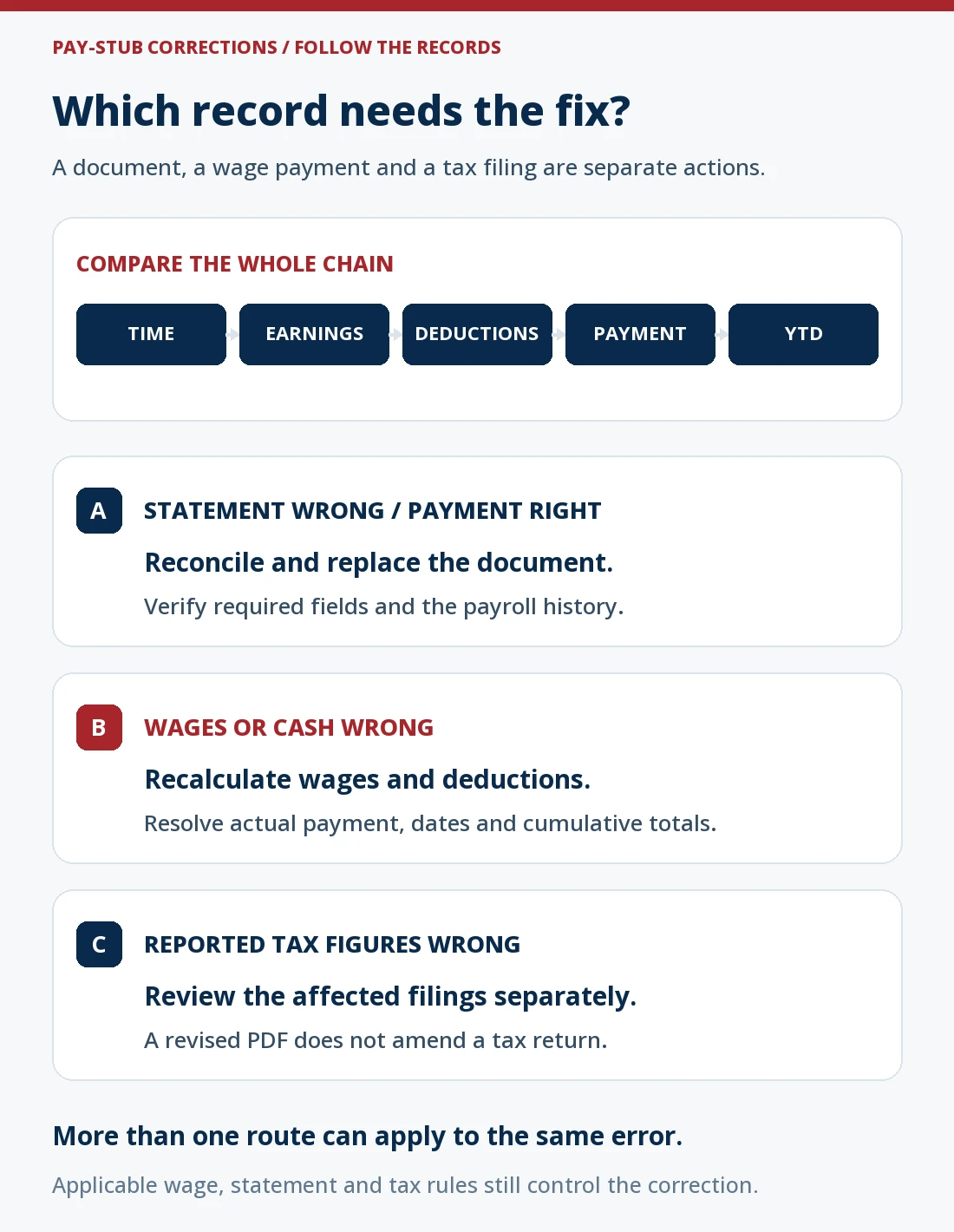
A failed transfer does not mean earnings, taxes, or deductions should be silently erased. The corrected payment record and any revised wage statement should reflect what actually happened. If a replacement and the original both arrive, notify payroll promptly and obtain documented instructions; do not assume both deposits are additional earned compensation.
For wages covered by the FLSA, the DOL’s FLSA reference guide explains that required wages are due on the regular payday. State law can provide broader wage rights and different deadlines, including final pay. The DOL final-pay guidance directs unpaid former employees to wage authorities after payday and notes state differences. A bank trace and a wage complaint address different issues; do not assume waiting for a return automatically extends the employer’s legal deadline.
How do you change direct deposit without losing track of a paycheck?
Confirm the election’s effective payroll before closing the old destination. A change submitted after a processing cutoff may apply to a later check. An accepted portal form is not proof the current payment file already uses the new account.
Obtain account and routing information from the bank’s authenticated app, official website, or established support channel. A debit-card number is not a substitute for the ACH account number. Confirm account type, permitted ACH deposits, ownership requirements, and any employer verification procedure. Some systems use a preliminary verification process; do not assume it involves a particular waiting period or that the first paycheck will automatically be a paper check.
Save the election confirmation and ask payroll to identify the first affected pay date. Check the first credit and every split at the new destination. Update any transfers or bill payments that depended on the old account. Keep the old account available until outstanding transactions are resolved when practical; ask both institutions about fees and closure requirements rather than leaving an unwanted account open indefinitely.
Can your employer require a particular bank or payroll card?
Federal Regulation E prohibits requiring an account at a particular institution as a condition of employment. The CFPB’s section 1005.10(e)(2) and official interpretation distinguishes requiring electronic pay with institution choice from forcing a specific bank. State law can add restrictions or consent requirements; the federal interpretation is not permission to ignore them.
A payroll card is also not the only option an employer may force on an employee. The CFPB payroll-card explanation says an alternative must be offered and describes fee disclosures. Ask which lawful alternatives are available in your work jurisdiction and compare access costs. A card account, a personal bank account, and the employer’s payroll portal serve different functions.
What if someone changed your direct-deposit account without permission?
Report it immediately through established payroll and bank contacts. The FBI’s payroll-diversion alert explains how stolen portal credentials can redirect wages and suppress alerts. An unexpected change is different from an ordinary processing delay.
Use a known phone number or an independently opened company portal to report the change. Ask payroll to secure the account and contact its payment provider about the affected transfer. Secure compromised credentials through the legitimate service, enable available multifactor authentication, and preserve relevant notices, dates, and screenshots. Follow the bank’s fraud-reporting instructions. The FBI also identifies IC3 reporting for suspected crime; a report does not guarantee funds can be recovered.
Never send a password, one-time code, or full payroll record to someone who contacts you claiming a missing paycheck requires “verification.” When sharing evidence, disclose only what the verified recipient needs. Mask unrelated balances and account details. The pay-stub privacy guide and PDF review checklist cover safer document handling.
Which documents should you keep after a deposit problem?
Keep an earnings record, an authorization record, and a payment-outcome record together. Save the original statement, relevant election confirmation, masked destination, bank entry/status, trace reference, and payroll’s written resolution. If a new statement is issued, retain the original with the correction explanation so the history remains intelligible.
For income verification, a statement explains how pay was calculated and a bank credit supports receipt; neither should be altered to conceal a split or timing difference. A concise note can explain why one $2,100 net payment produced $1,650, $300, and $150 credits. Our pay stub versus bank statement guide explains the different evidence each document supplies.
When preparing a statement with Generate Pay Stub, enter verified earnings, actual deductions, the real pay date, and accurate payment details. A generated document cannot settle an ACH entry, recover a missing deposit, or replace an employer’s payment confirmation. Use the payroll correction workflow if the earnings themselves are wrong, and retain source records with the preparation checklist.