An IRS wage levy on a pay stub means the employer is withholding part of a payment under an IRS collection notice. It is separate from ordinary federal income-tax withholding for the current year. The protected amount comes from the applicable levy instructions and exemption information—not automatically from the ordinary 25% consumer-debt garnishment ceiling.
Reviewed November 21, 2026. This U.S. guide explains employee payroll records for an IRS wage levy, with a fictional levy served in 2026 and the 2026 Publication 1494 table. It does not calculate a state tax levy, child-support order, bankruptcy withholding or a particular taxpayer’s collection liability.
Is this an IRS levy, income-tax withholding or another garnishment?
The IRS levy overview describes seizure of property to collect a tax debt. A paycheck deduction may be labelled “IRS levy,” “tax levy” or a payroll code. Obtain the actual agency notice and payroll’s code explanation; a short label does not identify the governing rules.
| Entry | Purpose | Relevant check |
|---|---|---|
| Federal income tax withheld | Current payroll tax withholding | Wage base, W-4 information, pay frequency and withholding procedure. |
| IRS wage levy | Collection under the IRS notice | Levy instructions, exempt amount and any IRS release or modification. |
| Other garnishment or support | Collection under a different order or procedure | Issuing authority, debt category and the applicable limits and priority rules. |
DOL Fact Sheet 30 expressly excludes debts for federal or state taxes from the ordinary CCPA amount limitations. The ordinary garnishment guide therefore cannot be used as a substitute levy calculator. State tax levies also require their own instructions; this article’s IRS example does not calculate them.
A wage levy generally continues across future wage payments until the IRS releases it or the collection situation is otherwise resolved. Receiving another pay stub does not mean a new notice must be issued for each payment. Do not confuse that continuing wage process with the separate rules for a levy on a bank account.
Which records determine the amount exempt from levy?
The IRS’s employee wage-levy guidance explains the exempt portion and the Statement of Dependents and Filing Status supplied through the employer. Return that statement within three days. Without it, payroll uses the married-filing-separately, zero-dependent basis described by the IRS. Do not assume your W-4 automatically supplies the correct levy statement.
Check the table year, actual pay frequency, filing status, allowed dependents and any additional exemption for age or blindness. Also identify IRS directions allocating an exemption to another income source, or a relevant support adjustment. The example below assumes none of those special adjustments; it does not establish a minimum that every employee must receive from every employer.
What does “take-home pay for the levy” mean?
It is not a synonym for gross wages. IRM 5.11.5.4.5 explains the IRS policy generally attaching usual take-home pay and its treatment of payroll deductions. Existing deductions and newly elected voluntary deductions can be treated differently, and some voluntary deductions can be disallowed. Ask payroll for the bridge from gross earnings to the amount used under the levy instructions instead of subtracting whichever deductions you prefer.
The illustration supplies that pre-levy amount so it can focus on the exemption arithmetic. It does not calculate the underlying income taxes, benefits or allowable deductions for a real employee.
2026 example: a weekly payment with two dependents
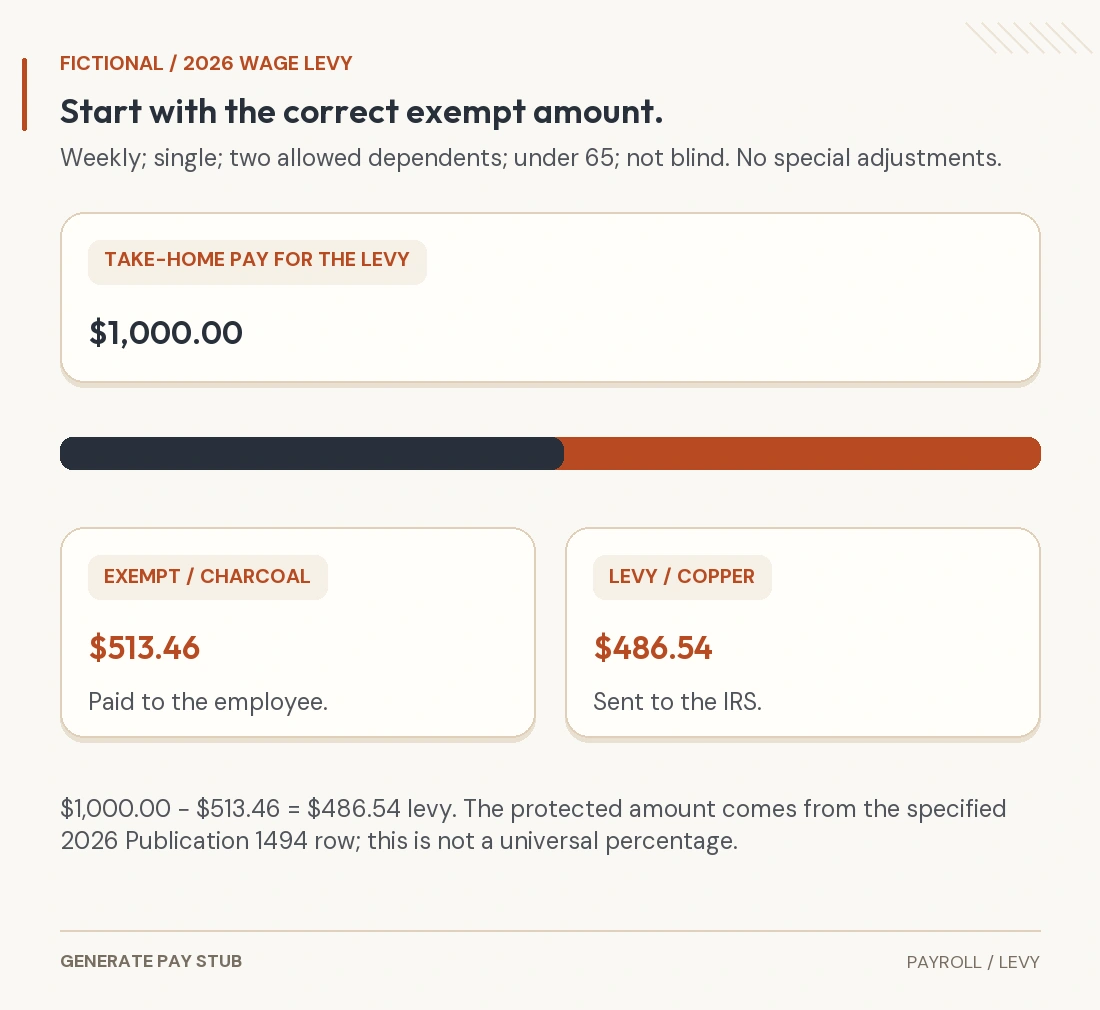
Assume a valid IRS levy served in 2026, a weekly-paid taxpayer filing single, two allowed dependents, age below 65 and no blindness adjustment. Assume there is no exemption allocated to another income source, support adjustment, partial release or other special direction. Payroll has established $1,000.00 of take-home pay for this levy calculation.
The 2026 Publication 1494 table, revised December 2025, gives $513.46 exempt for that weekly row and two-dependent column. Subtracting it leaves $486.54 for the IRS: $1,000.00 − $513.46 = $486.54. The employee receives $513.46 under these stated assumptions.

| Pay frequency | Exempt amount |
|---|---|
| Weekly | $513.46 |
| Biweekly | $1,026.93 |
| Semimonthly | $1,112.49 |
| Monthly | $2,225.01 |
Use the actual table row. Biweekly and semimonthly are different schedules, and simply doubling the rounded weekly figure gives $1,026.92 rather than the table’s $1,026.93 biweekly amount. This is another reason to retain the exact source and calculation, as explained in the payroll rounding guide.
Does a separately issued bonus get another exemption?
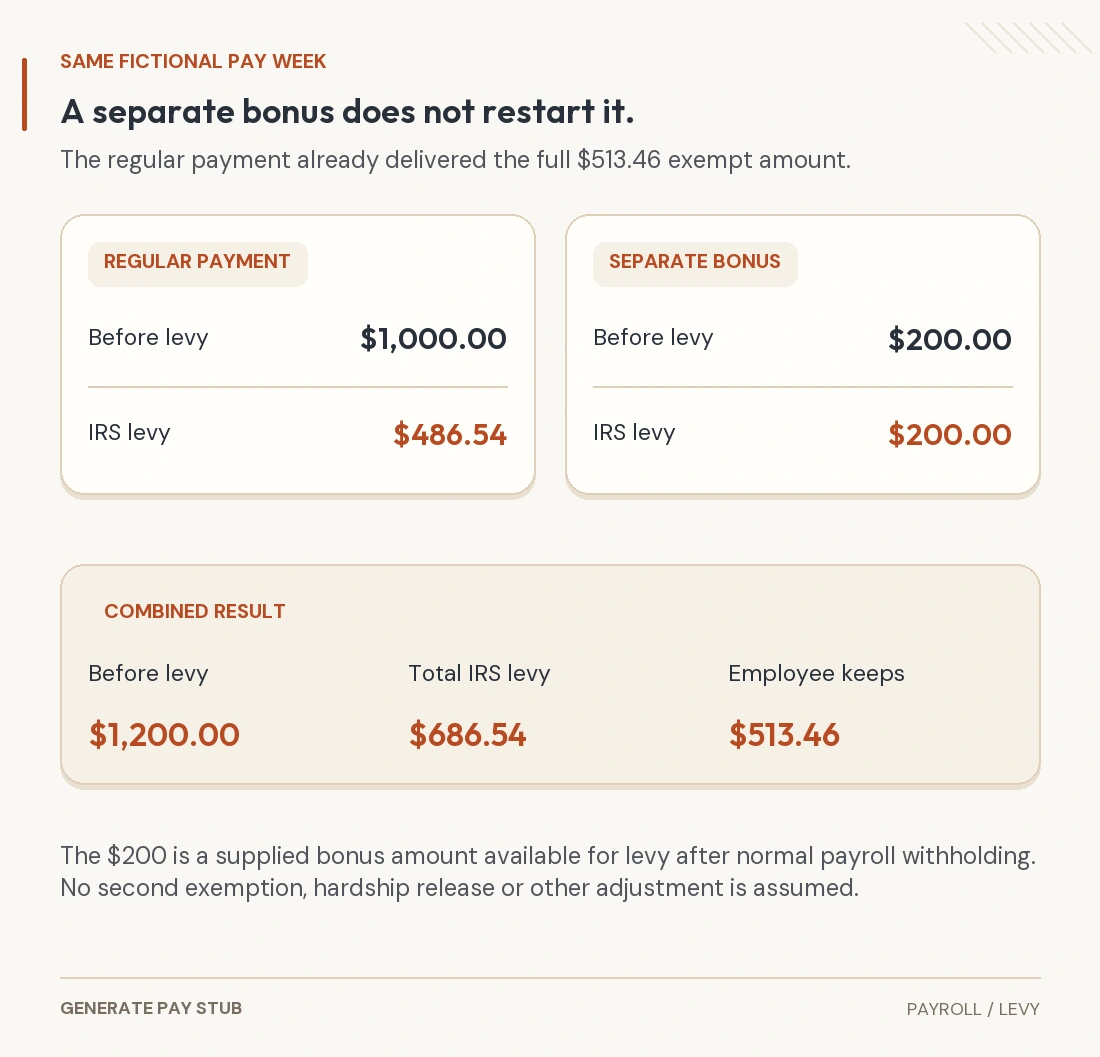
Not merely because it appears on another statement. The IRS wage-levy guidance explains that the exempt amount is tied to the pay period. A separate bonus in the same period can be fully available for levy after the regular payment has already delivered that period’s full exempt amount.
Extend the fictional weekly example with a separate $200.00 bonus amount available for levy after normal payroll withholding. This is a supplied net amount for the illustration, not $200 of gross bonus wages. Because the regular payment has already paid the $513.46 exemption, the additional levy is $200.00. Across both payments, the pre-levy amount is $1,200.00, the total sent to the IRS is $486.54 + $200.00 = $686.54, and the employee retains $513.46.

Check the actual period and directions before applying that result to a different payment. A separate check, a correction and a replacement can represent different payroll events. The off-cycle payroll guide helps identify the event; the levy instructions determine its collection treatment.
Five records to request from payroll
- The notice: the issuing agency, form, receipt date and applicable instructions. The IRS commonly uses Form 668-W for wages and related income.
- Your statement: a copy of the submitted dependents/filing-status information and when payroll received it.
- The lookup: table year, pay-frequency row, dependent column and any additional or specially allocated exemption.
- The calculation: gross-to-pre-levy reconciliation, exempt amount, levy deduction and remaining payment for each affected period.
- The remittance and change history: amounts sent, relevant pay dates, modifications and any release received.
The IRS guidance for employers receiving a levy explains continuous wage attachment, the notice forms and a new statement when a levy continues into another calendar year. It also notes that interest and applicable penalties can continue after the notice’s dated balance. A YTD pay-stub deduction total is therefore not a reliable current payoff quote.
Use a specific request: “Please show the table year, pay-frequency row and dependent count used for my [payment date] levy deduction, and reconcile the pre-levy amount, exemption and remittance.” For a payroll arithmetic or transcription problem, the pay-stub correction guide explains how to preserve both versions. A dispute about the IRS debt or release needs the IRS’s involvement.
What if the levy prevents payment of basic living expenses?
The IRS hardship guidance says to contact the number on the levy or correspondence immediately and explain the financial situation. The IRS generally needs financial information to determine whether a wage levy prevents basic, reasonable living expenses. If that wage-levy hardship is established, the levy must be released. Have payroll’s contact and delivery details ready so a release can reach the right place.
The separate IRS levy-release guidance covers release grounds and appeal rights. Release does not erase the remaining tax debt, and recovery of money already sent is a separate request. An installment arrangement’s terms matter; do not assume a telephone discussion alone authorizes payroll to stop collection.
Ask when payroll received the actual release or modification and which payment it affects. Keep the notice, case correspondence and pay statements securely. This guide does not authorize ignoring a levy, decide an appeal or promise a particular IRS resolution.
Common IRS levy questions about a pay stub
Is the levy another income tax for this paycheck?
It is collection under the notice, separate from regular current-year withholding. Keep those amounts separately identified when reviewing the statement or explaining the deposit.
Can every employer pay the full exemption?
Not necessarily. The IRS can allocate exemptions to another income source. Obtain the actual directions; do not reuse the full table amount independently across multiple sources.
What if I pay court-ordered child support directly?
The employee wage-levy guidance describes contacting the IRS about qualifying support ordered before the levy reached the employer. It also cautions against using the same child for a duplicate exemption. Payroll should not resolve the interaction by guessing from a bank transfer.
Does the bank-levy 21-day hold also apply to wages?
The employer guidance identifies that waiting rule for bank accounts. Wage levies have their own timing and continuing effect. Follow the actual wage notice and act promptly; do not wait twenty-one days based on a bank-account article.
Can a generated statement remove the levy?
No. Changing a document does not release the IRS notice, change the tax debt or authorize stopping a remittance. The relevant next step is the employer’s calculation record and, when needed, the IRS correction or release process.