A payroll card receives wages; a pay stub explains how those wages were calculated. To check a payment, compare the pay stub's assigned net amount with the actual payroll credit on the card account. Then reconcile purchases, withdrawals, fees and other activity separately. The card's current balance is not the amount of the latest paycheck.
Reviewed October 29, 2026, this guide covers U.S. payroll cards, federal consumer protections and a selected New Jersey wage-payment example. It includes fictional arithmetic, not the terms or fees of any specific card. State requirements, the issuer's agreement and the actual payment allocation all need to be checked.
Is a payroll card statement the same as a pay stub?
No. They document different stages of the transaction. The employer's statement can show earnings, taxable bases, employee taxes, benefits and net pay. The card account shows credits and debits after funds are sent. A card statement may prove receipt of a deposit, but it generally cannot supply the missing hours, rates or tax calculation by itself.
| Record | Question it answers | What it cannot establish alone |
|---|---|---|
| Pay stub or earnings statement | How did earnings become net wages for this payment? | Whether the issuer actually credited the account |
| Payroll funding or payment record | How much was sent, to which destination and with what status? | The employee's later purchases, withdrawals or account balance |
| Card transaction history | What actually posted to the account after and around payday? | Whether gross wages, hours or withholding were correctly calculated |
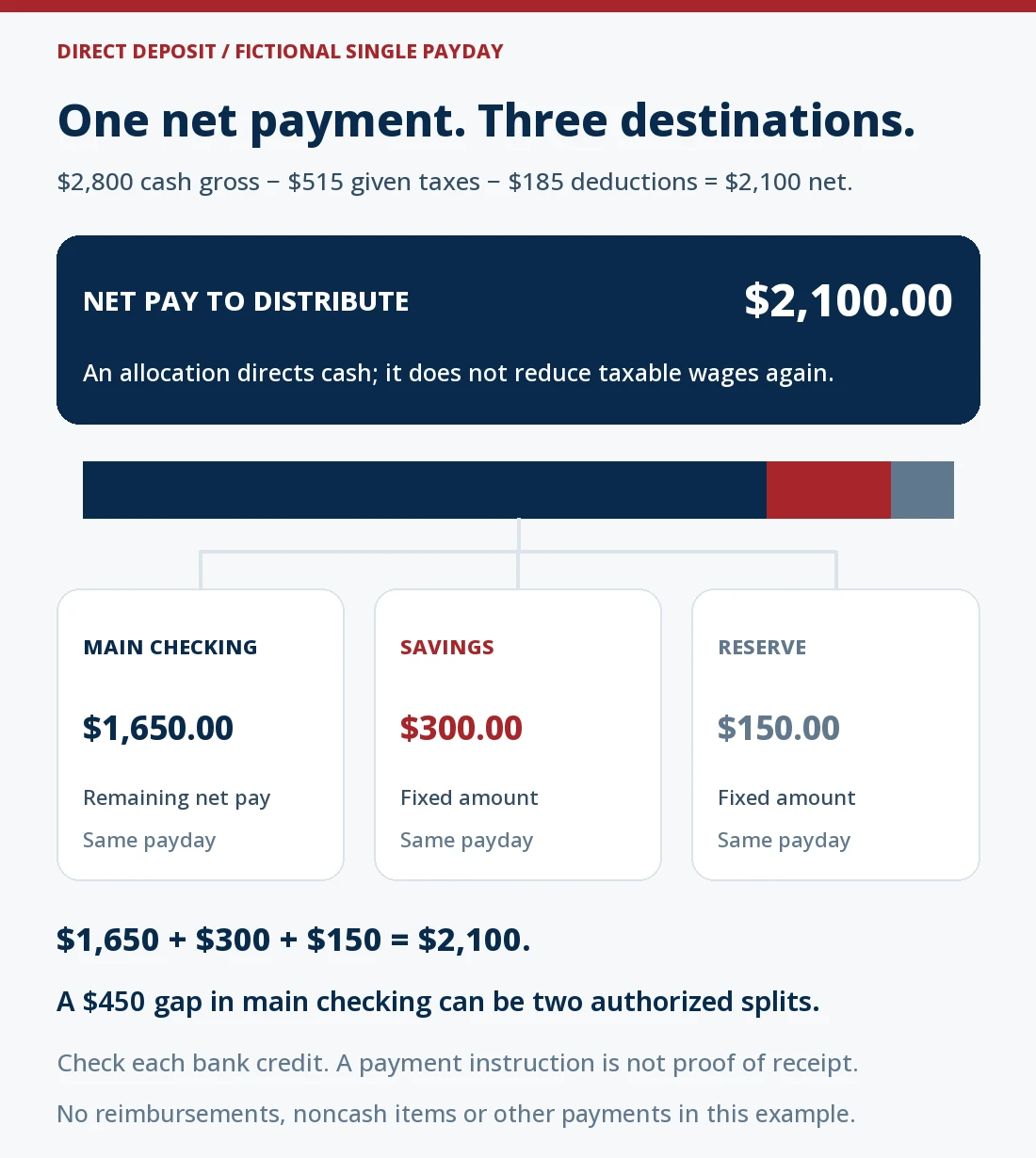
First check whether the employee split pay between the card and another account. A $1,400 net paycheck with $1,000 assigned to the card and $400 elsewhere should not produce a $1,400 card credit. Confirm the allocation before declaring a $400 shortage. Our split-payment and missing-deposit guide explains that broader tracing process.
A payroll card is also different from a credit card or an earned-wage-access advance. If an app offers early access or a separate credit feature, do not assume its advance, repayment and fees are the same as the employer's wage calculation. Identify the product and agreement rather than grouping every wage-related transaction under “payroll deduction.”

Can an employer make you accept its payroll card?
An employer cannot make its chosen payroll card your only payment option under the federal rule. The Regulation E compulsory-use provision, section 1005.10(e)(2), protects the employee from having employment conditioned on an account at a specified institution. Its payroll interpretation permits required electronic deposit if the employee can choose the receiving institution, or an employer-selected institution when another payment method is available.
The CFPB payroll-card rights guide explains that at least one other way of receiving wages must be offered. Federal law does not guarantee that every worker may demand every possible payment method. State wage-payment laws can add consent and access requirements, so ask about the alternatives actually available in your state.
For example, the New Jersey labor department's payroll-card FAQ describes written consent, disclosed features and fees, a statement of deductions, and at least one opportunity per pay period to withdraw wages in full without a fee or difficulty. It also states that accepting the card cannot be a condition of hire or continued employment. These are New Jersey conditions; do not assume every state uses identical wording.
How can a correct $1,400 payroll credit leave a $1,260 balance?
The account balance includes money that was there before payday and activity after it. In this fictional example, gross wages are $1,800, tax withholding is a given $300 and employee benefits are $100. Net wages are $1,400, all assigned to the payroll card. The $300 is an assumed payroll figure, not a tax-table calculation.
Assume the card started with $40. A $1,400 payroll credit brings the balance to $1,440. A $75 purchase, a $100 cash withdrawal, a $3 card-program withdrawal fee and a separate $2 ATM-operator fee then leave $1,260. Assume all these transactions are posted and there are no holds, reversals, interest, other credits or debits. The example illustrates reconciliation; it does not establish that these fees are allowed for a particular worker or state.
| Posted event | Account change | Balance after event |
|---|---|---|
| Opening balance | — | $40.00 |
| Payroll credit matching assigned net pay | +$1,400.00 | $1,440.00 |
| Purchase | −$75.00 | $1,365.00 |
| ATM cash delivered | −$100.00 | $1,265.00 |
| Card-program withdrawal fee | −$3.00 | $1,262.00 |
| Separate ATM-operator fee | −$2.00 | $1,260.00 |
The reconciliation is $40 + $1,400 − $75 − $100 − $3 − $2 = $1,260. The payroll credit itself is not $1,260 or $1,395. In the assumed ATM sequence, the worker received $100 cash while the account fell by $105 once both fees posted. Do not label that entire $105 as cash received, and do not subtract those fees again from the pay stub if they were charged only inside the card account.

Which payroll-card fees should you check before using the card?
The CFPB fee explanation recommends reading the fee disclosures before choosing this method of payment. Compare the activities you actually need: in-network and out-of-network withdrawals, balance inquiries, replacement cards, inactivity, transfers and cash access. An ATM operator may impose a fee separate from the card program's charge.
Ask how to receive the full wage payment without a fee where your state's law requires that access. An advertised free withdrawal method is only useful if the procedure, location, limits and timing work for the wages being paid. A no-fee purchase does not necessarily mean no-fee cash access. Keep the disclosure version that applied when you enrolled and any later change notices.
Card-account charges and deductions taken by the employer before sending wages need separate explanations. A fee on an issuer ledger does not establish that an employer was allowed to reduce gross wages by the same amount. Our payroll-deduction guide covers another distinction: a collection is not automatically pretax just because it relates to payday.
What should you do when the payroll credit is missing or smaller than net pay?
Compare the actual assigned credit, not just the displayed balance. Confirm the pay date, allocation, amount and destination using the employer's payment record. Verify whether the issuer lists the credit as posted, pending, reversed or absent. Ask each party for a case number and the status of its part of the transaction.
If $1,400 was assigned to the card but only a $1,375 payroll credit posted, the unresolved difference is $25. That is different from a full $1,400 credit followed by a separately listed $25 charge. Both deserve an explanation, but the first concerns the incoming payment and the second concerns account activity. Do not assume the issuer's fee schedule proves that an unexplained short credit was a valid charge.
Pending merchant authorizations can also make available funds differ from a posted transaction balance. Ask the issuer to identify each hold and release status; do not count the pending and final versions of the same purchase twice. Our pay-stub and account-statement comparison explains why those records cannot replace one another.
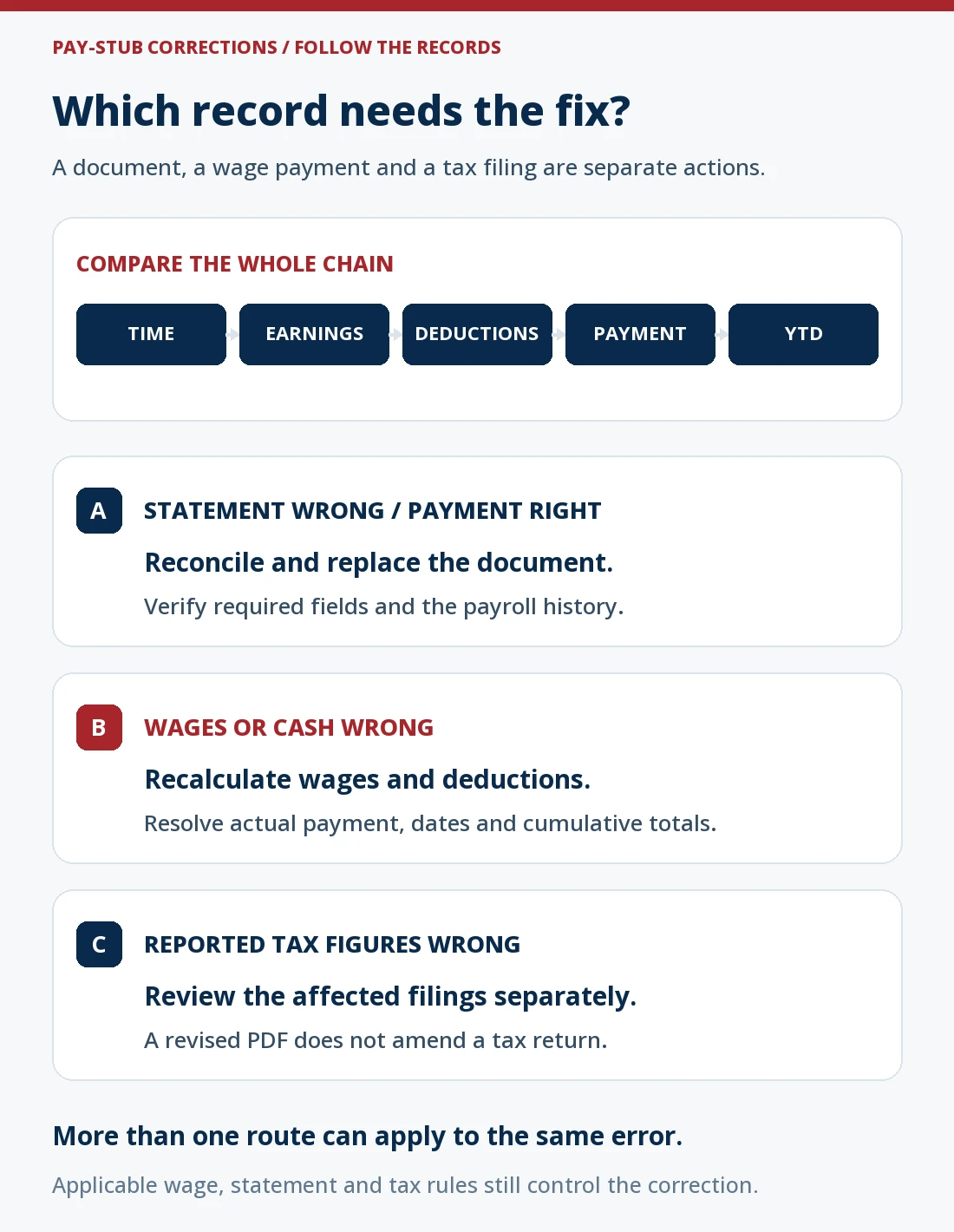
If the gross wages or tax withholding are wrong, payroll needs to address the earnings statement as well. If a payment went to the wrong destination, the employer and payment provider need to trace it. Creating a new PDF does not move funds or prove wages were delivered.
How should you report a lost card or unauthorized transaction?
Contact the issuer immediately through its verified channel. The CFPB lost-card guidance specifically includes payroll cards in federal error-resolution protections. Keep the date and time of your notice, transaction details and confirmation. Do not send a PIN, password or full card number in an ordinary payroll email.
Do not start a blanket dispute clock from the pay stub's issue date. For institutions using the transaction-history alternative, Regulation E section 1005.18(e) generally ties the modified error-notice period to electronic access or a requested written history reflecting the error; an alternative 120-day-from-posting procedure is available to institutions. Other loss and unauthorized-transfer rules also matter. Report promptly and obtain the applicable written instructions rather than waiting for an assumed deadline.
Payroll cards should not be confused with every unregistered retail prepaid product. The regulation's unverified-account exception expressly excludes payroll-card accounts. Complete the issuer's legitimate activation and identification steps, but do not assume a payroll-card error has no federal protection merely because another prepaid product's registration rule was quoted to you.
What records and protections should you confirm with the issuer?
Obtain a complete transaction history, the cardholder agreement, fee disclosures and the provider's dispute instructions. A balance-only screenshot cannot reconstruct the deposit and later activity. Keep your earnings statements separately; our electronic pay-stub access guide covers obtaining the employer's records.
Deposit insurance and unauthorized-transaction protection address different risks. The FDIC prepaid-card guidance explains that coverage depends on the banking arrangement and conditions. Deposit insurance addresses an insured bank's failure; it is not insurance against a stolen card or a card provider's bankruptcy. Verify the named bank and account arrangement rather than relying only on a card logo.
Which documents make a payroll-card problem easier to resolve?
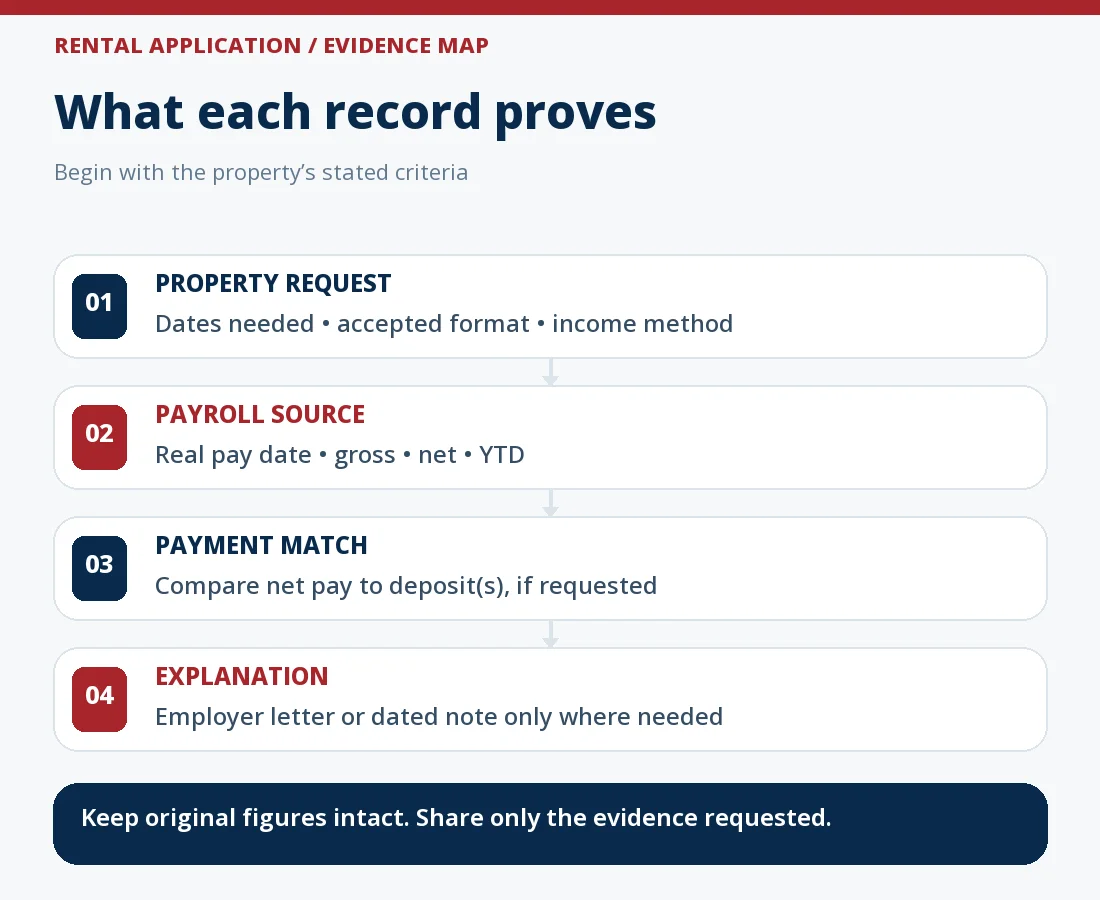
- Pay calculation: keep the original stub, hours, gross, taxes, deductions and assigned net.
- Payment trace: record the destination's masked identifier, amount, pay date and payroll status.
- Account activity: download the full posted history and separately identify holds and reversals.
- Terms: retain the applicable fee schedule, payment choice and state access instructions.
- Follow-up: keep issuer and employer case numbers, notice dates and any confirmed correction.
Use our pay-stub correction process when the payroll calculation itself is wrong and our net-pay guide to check the arithmetic. Generate Pay Stub can display documented payroll amounts; it cannot issue a payroll card, trace a deposit or decide a financial institution's dispute.