
A pay stub explains how a payroll payment was calculated. A bank statement records activity in a bank account, including a payroll deposit when one is received. The main difference in a pay stub vs. bank statement comparison is the question each document answers: what made up your pay, or what happened in your account?
Both can be useful when organizing income records, but one does not contain all the information in the other. Start with the information you need to establish, then choose the corresponding record.
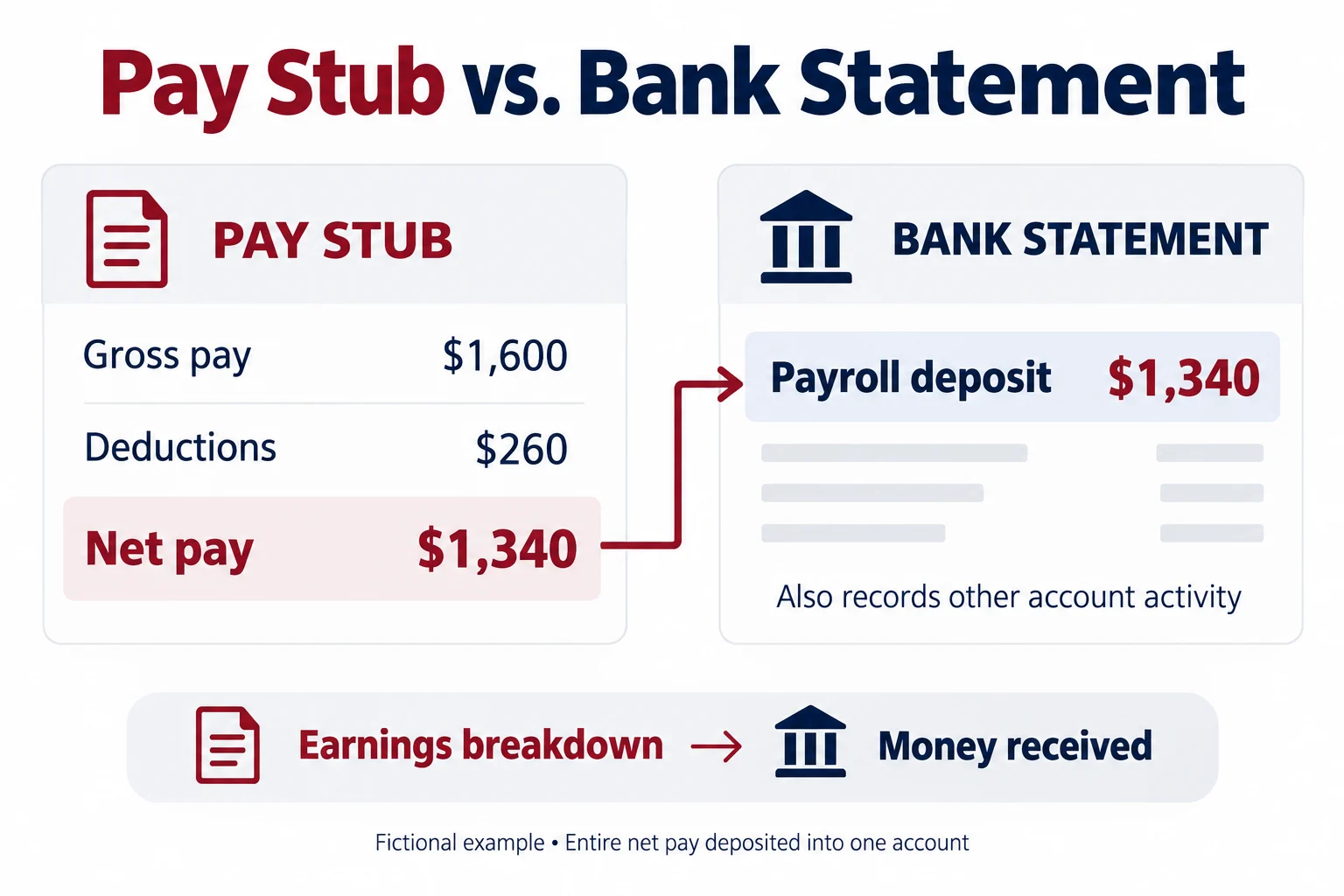
Pay stub vs. bank statement at a glance
| Question | Pay stub | Bank statement |
|---|---|---|
| Where does it come from? | The employer or payroll system. | The bank or credit union. |
| What does it describe? | Earnings and deductions for a payroll payment. | Account activity during a statement cycle. |
| What explains take-home pay? | The earnings and deduction breakdown. | The deposit entry shows the amount credited, without the underlying payroll calculation. |
| Does it show spending? | No account spending history. | Account transactions and balances. |
| Which dates matter? | The covered pay period and payment date. | The statement cycle and individual transaction dates. |
What a pay stub tells you
An earnings statement provides the payroll context behind a payment. The federal consumer education site Consumer.gov describes a pay stub as a record of earnings and amounts taken out for taxes and benefits.
Depending on the payroll layout, you may also see hours, rates, current-period totals, and year-to-date figures. Those details help answer questions such as whether the correct earnings lines were included. A deposit amount alone cannot show which hours or benefit elections produced it.
Keep different payroll figures distinct. If a statement lists gross earnings and multiple taxable wage amounts, they serve different purposes; our gross pay and taxable wages guide explains that distinction.
What a bank statement tells you
A bank statement places a payment within the account's broader activity. For covered electronic transfers, CFPB Regulation E, section 1005.9(b) describes statement information including transfer amounts, credit or debit dates, transaction types, third-party identification, and opening and closing balances.
This record is useful for identifying an account credit. It does not itemize the employer's payroll deductions. A closing balance also reflects other activity, so it is not a substitute for either the paycheck amount or the employee's earnings total.
One payment viewed through two documents
Consider the fictional illustration above. A pay stub records $1,600 in gross pay and $260 in total deductions, leaving $1,340 in net pay. In this example, that full net amount is deposited into one account.
The bank statement records a $1,340 payroll credit. It does not provide the missing $260 deduction breakdown. Even when the amounts connect perfectly, the records describe different parts of the process.
For a document packet, label the pair with the payroll payment date and retain each original file. This makes it easier to identify which earnings statement accompanies which account entry without editing either document.
Can a bank statement replace a pay stub for proof of income?
Ask the organization requesting your documents. Its requirements determine whether it wants payroll detail, evidence of deposits, or both. There is no universal substitution rule that makes a bank statement interchangeable with a pay stub for every rental, lending, or other application.
Before sending a packet, confirm:
- Which document types and date ranges are requested.
- Whether complete statements or particular pages are needed.
- Whether any redaction is permitted and which details must remain visible.
- How to submit the records securely.
Multiple credits in an account are not automatically multiple wage payments. For example, moving your own savings into checking creates an incoming transaction without creating new employment earnings. Keep the origin of each relevant payment clear instead of labeling all deposits as salary.
Where to get the right record
For a missing pay stub, check the employer's payroll portal or ask the payroll team for a copy covering the required payment. For a missing bank statement, use the bank's statement download service or request it directly from the institution.
If you are responsible for preparing payroll documents, use the underlying payroll records to establish earnings and deductions. A bank credit is insufficient to reconstruct unknown gross pay, tax withholding, hours, or year-to-date totals. The pay stub preparation checklist maps those fields to their supporting records.
When using GeneratePayStub.com to format a pay statement, enter substantiated payroll information. A generated document does not independently verify employment or guarantee acceptance by a third party.
Common questions
Is a direct deposit notification a pay stub?
A notification about money arriving in an account is not the same as an earnings statement. Look for the separate payroll document if you need the earnings and deduction calculation.
Can I calculate gross pay from a bank deposit?
The deposit alone is not enough. Different earnings and deduction combinations can produce the same take-home amount. Obtain the payroll breakdown rather than guessing the missing figures.
Should the statement dates cover the same period?
Identify the requested date range first. Payroll periods and bank statement cycles may have different boundaries. If assembling both documents, check that the bank record includes the relevant payment entry; do not assume matching month names establish a match.
Before sharing, check that every file is legible and complete using our pay stub PDF review guide.