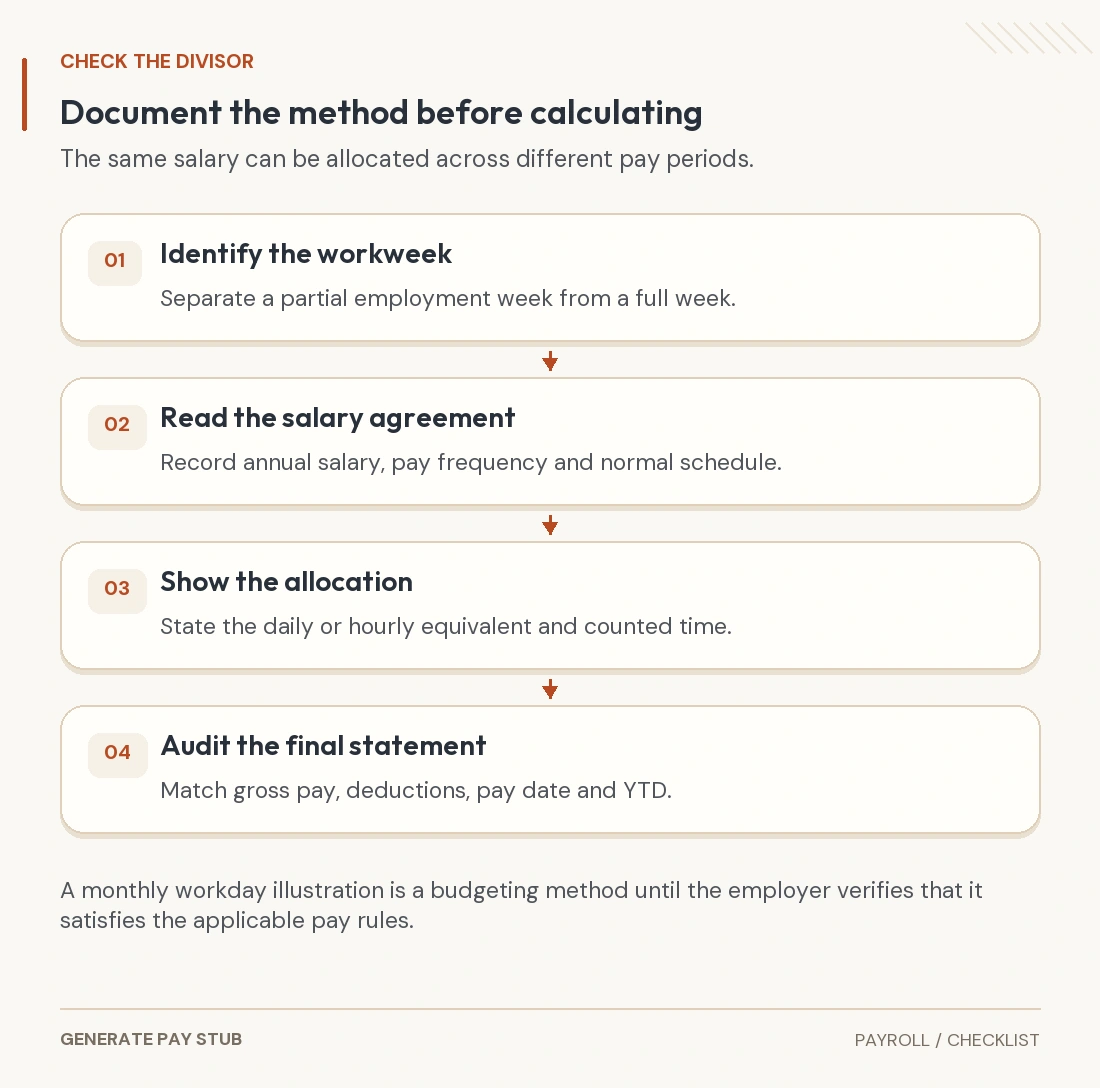
Prorated salary is a proportional part of the normal salary for a defined portion of employment. For a first or final partial week, begin with the agreed salary, identify the normal workweek and document the time included. Then verify that the method is permitted for that employee. A mathematically correct fraction can still produce an improper salary deduction.
This U.S. guide was reviewed in November 2026. It focuses on starting or leaving a job, rather than ordinary unpaid leave. Federal exemption rules, state wage laws, the employment agreement and benefit terms all matter. Every dollar example below is fictional.
What does prorated salary mean?
A full salary covers the period specified by the pay arrangement. Proration allocates part of that salary to a shorter covered period, commonly when employment starts after a workweek has begun or ends before it finishes. A pay stub may label the earnings as salary, partial salary, new-hire pay or a salary adjustment.
Three different quantities often get mixed together:
- Annual salary: the agreed annual compensation rate, such as $65,000.
- Payroll-period allocation: the normal amount assigned to a weekly, biweekly, semimonthly or monthly payment.
- Partial-period earnings: the salary actually owed for the portion being paid.
A payroll program may show a normal salary line and an offsetting adjustment instead of one reduced earnings line. Check their combined gross effect. A field showing an hourly equivalent does not automatically make the worker hourly or establish the correct overtime calculation.
When can an exempt employee’s salary be prorated?
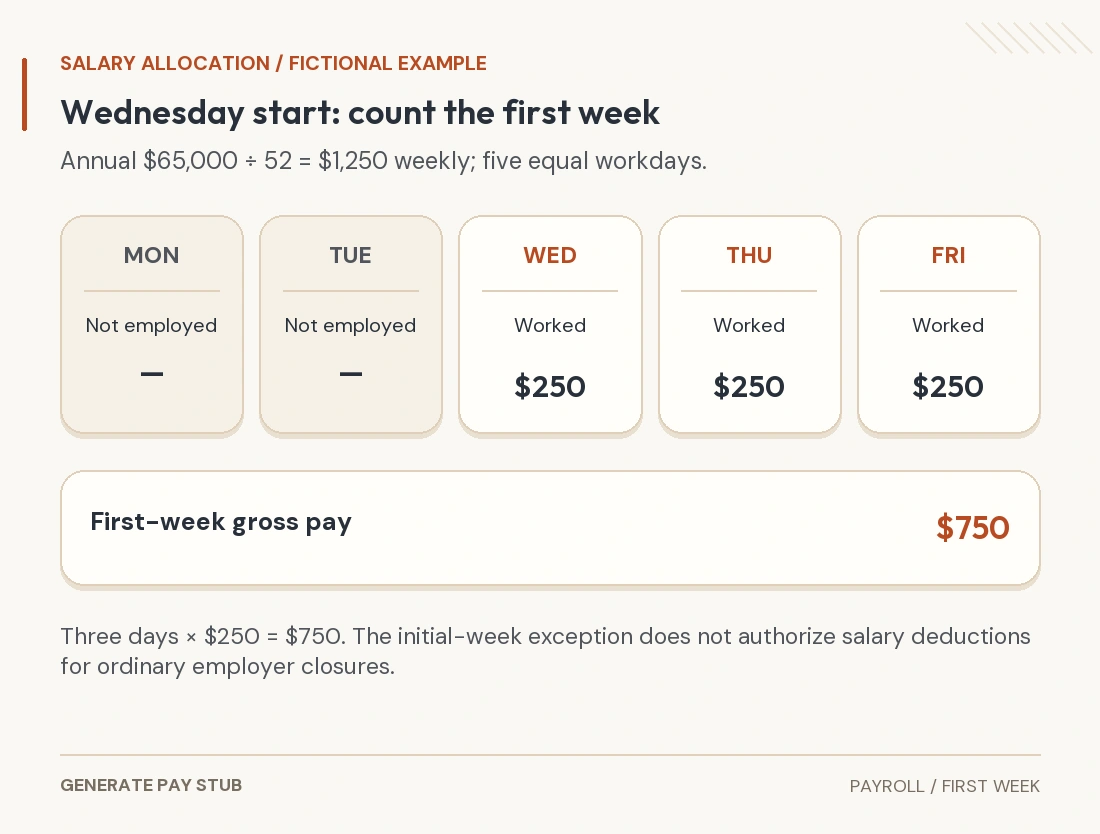
Under 29 CFR 541.602(b)(6), an employer can pay a proportional salary for actual work in an employee’s initial or terminal employment week. Daily or hourly equivalents of the full weekly salary can be used. The same regulation distinguishes that exception from the normal salary-basis rule.
Do not start by assuming that every salaried worker is exempt. The job duties and compensation requirements must be satisfied, and state law can impose additional protections. The example here assumes a valid exemption; it does not test an employee’s classification.
Outside a permitted exception, working fewer than five days does not necessarily reduce an exempt employee’s salary. A weather closure, quiet business day or employer decision to send someone home is different from the employee not yet being employed. The Department of Labor’s salary-deduction advisor explains that an available employee’s salary generally cannot be reduced simply because the employer has no work.
A partial-day absence during an ordinary week is another different issue. Leave balances may be handled separately from salary. See our unpaid-leave and salary-deduction guide for that situation. Do not use an initial-week formula as a general attendance penalty.
How to calculate a prorated first-week salary
Assume a new employee has a $65,000 annual base salary, allocated over 52 weeks. The established workweek and normal schedule are Monday through Friday, eight hours per day. Employment starts Wednesday, and the employee works Wednesday, Thursday and Friday. There are no commissions, bonuses, leave payments or other earnings.
Under a documented daily-equivalent method for this initial week:
- Convert the annual salary to its weekly equivalent: $65,000 ÷ 52 = $1,250.
- Divide by five equally paid normal workdays: $1,250 ÷ 5 = $250 per day.
- Count the three worked days during employment: 3 × $250 = $750 gross salary.

| Method | Calculation | First-week gross |
|---|---|---|
| Daily equivalent | $1,250 ÷ 5 days × 3 days | $750.00 |
| Hourly equivalent, normal 40-hour schedule | $1,250 ÷ 40 hours × 24 hours | $750.00 |
| First partial week plus one full week | $750 + $1,250 | $2,000.00 |
The hourly result agrees because the assumed days all have eight hours. It is a salary-allocation illustration, not a new hourly compensation agreement. Different schedules need their own documented denominator. Do not automatically divide an exempt employee’s salary by actual hours worked in a busy week and use that changing rate to dock another week.
If the first biweekly payroll period contains this three-day initial week and one full week, base gross earnings would be $2,000 under these assumptions. If it contains only the initial week because of a payroll cutoff, the first check may show $750 and the later week will appear on a subsequent statement. Pay-period dates explain which of those situations applies.
Which divisor should payroll use?
There is no single “salary divided by 30” shortcut that answers every U.S. payroll situation. Weekly equivalents, scheduled workdays and calendar-day allocations are different methods. The employee’s compensation arrangement, the reason for proration and applicable law determine which method is suitable.
| Proposed method | What the denominator means | What to verify |
|---|---|---|
| Weekly salary ÷ scheduled days | Equally weighted normal workdays | Actual first/final employment week and normal schedule |
| Weekly salary ÷ normal hours | Hourly equivalent of full weekly salary | Consistent normal hours; whether proportional time is permitted |
| Monthly salary ÷ scheduled monthly workdays | Allocation within a particular month | Written method and compatibility with weekly salary protections |
| Calendar-day allocation | Calendar dates, including non-workdays | Contract and legal basis; do not mix with a workday numerator |
For a purely numerical monthly illustration, a $6,000 monthly amount divided by 20 scheduled workdays gives $300; seven covered workdays would produce $2,100. That illustrates a workday fraction only. It does not establish that $2,100 satisfies the employee’s weekly salary entitlement. A monthly payroll still has to respect the applicable workweek rules.
Calendar-day and workday formulas can produce different results because their units differ. Dividing by 30 calendar days and multiplying by seven workdays combines incompatible units. Likewise, two semimonthly checks are not two biweekly checks: the normal annual counts are 24 and 26 respectively. A payroll calendar with an unusual number of paydays needs a documented treatment rather than an improvised divisor.
Round at the documented stage. Keeping intermediate precision and rounding the payable amount to cents can differ from rounding a repeating daily rate first. Ask payroll to show both the underlying rate and the final rounding rule if a small discrepancy remains.

What should a prorated-salary pay stub show?
Check the pay period, payment date and earnings description first. Then reconcile gross earnings with the agreed salary and partial-period calculation. Hours may be informational for an exempt role; they should not conceal a different salary method. For nonexempt work, reliable hours records remain essential. Our salary-versus-hourly guide explains those pay-stub distinctions.
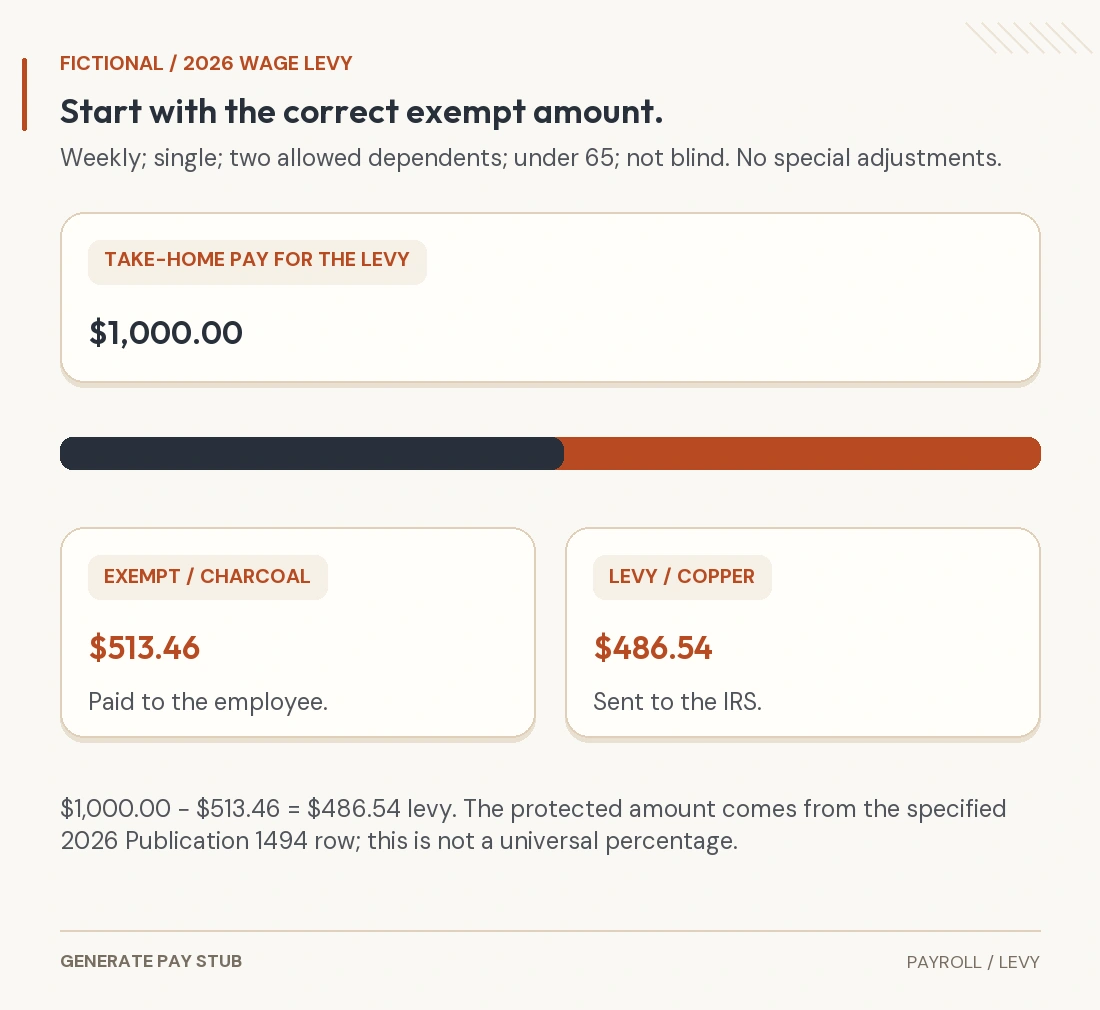
Taxes and benefit deductions are a second calculation. A paycheck equal to 60% of normal gross salary will not necessarily produce 60% of normal net pay. Withholding depends on taxable wages, the payroll period and the employee’s elections; insurance or other deductions may follow plan-specific collection rules. Avoid reducing every deduction by the same fraction unless the governing rule actually calls for that.
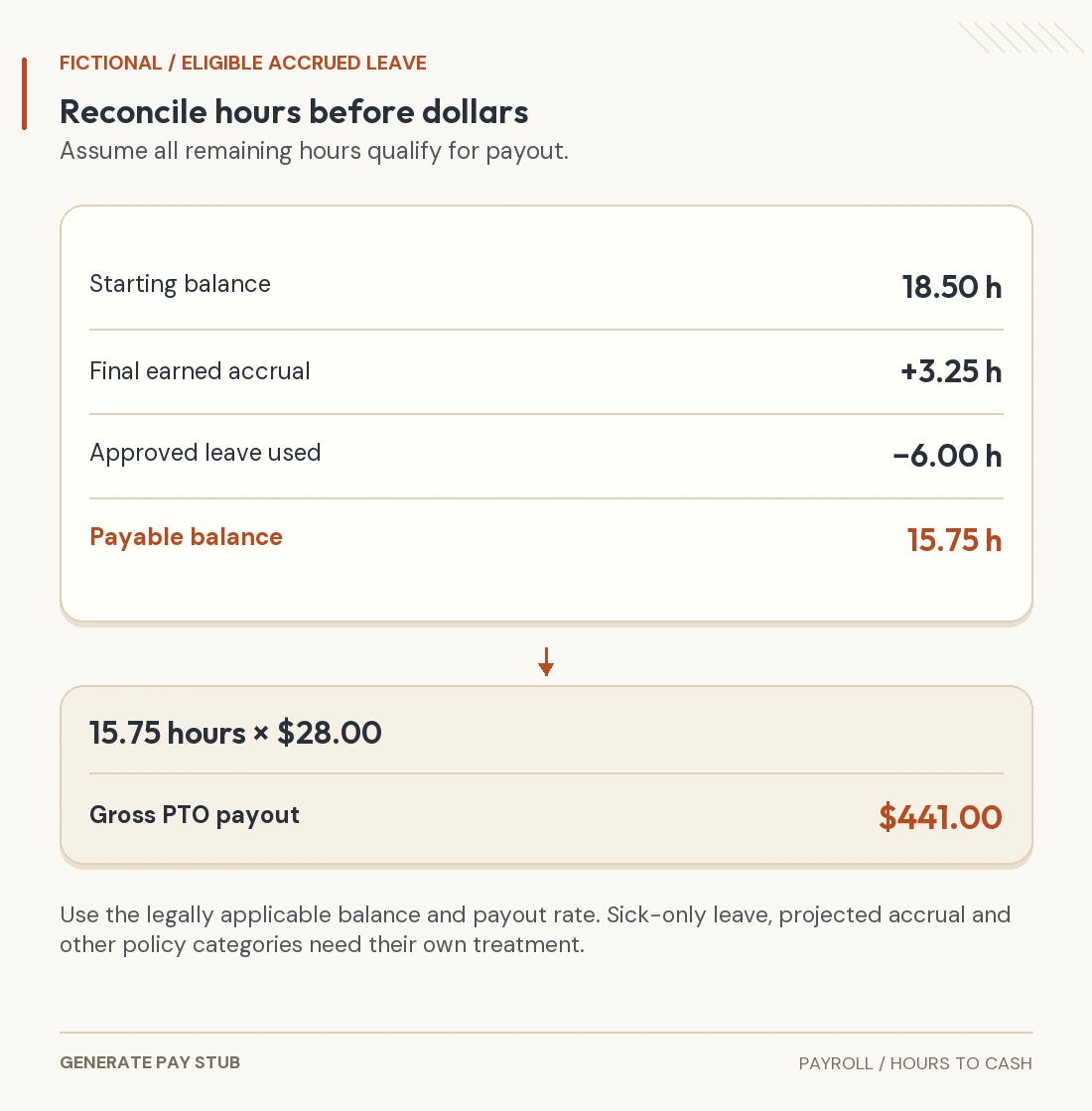
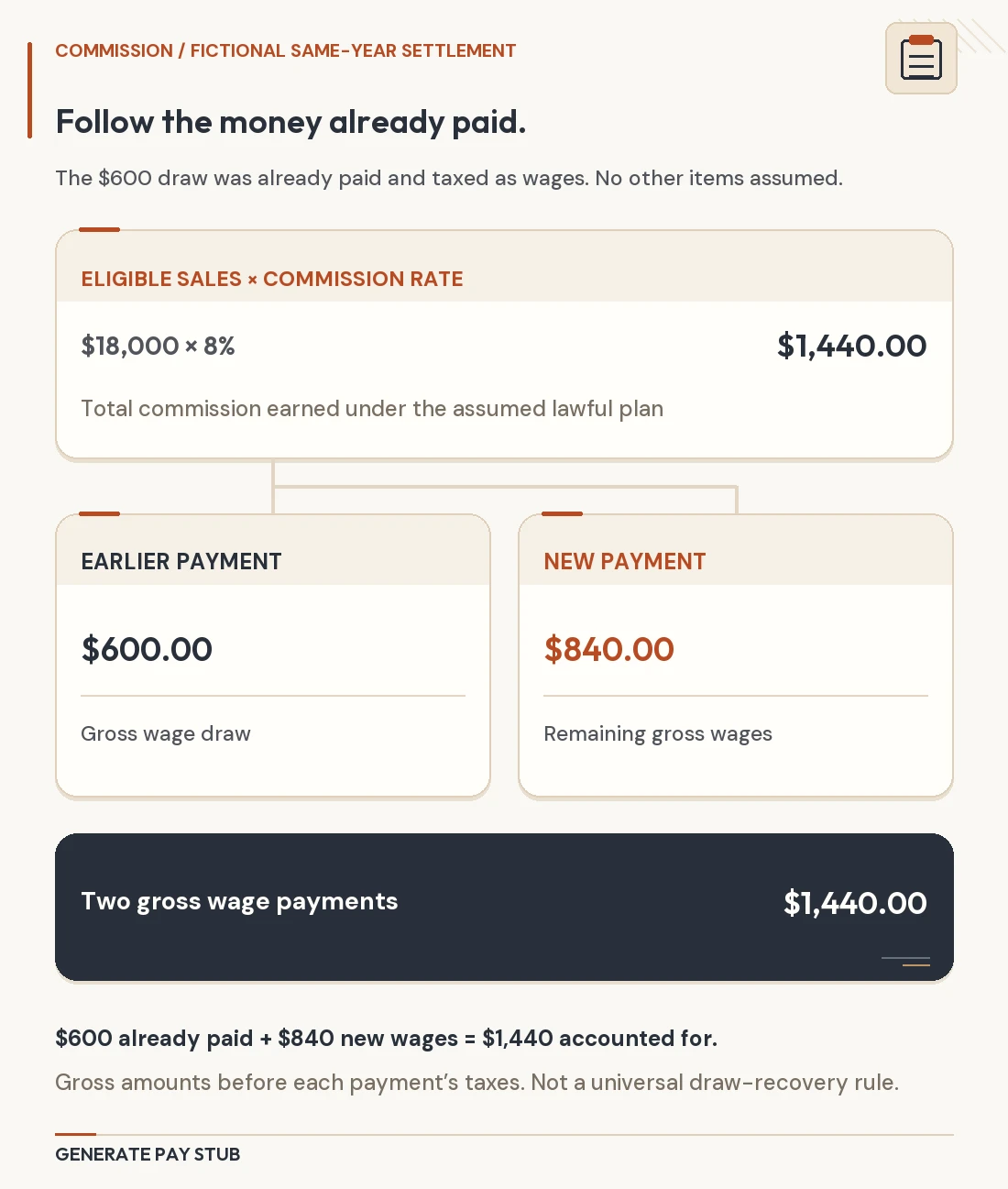
Separate base salary from other amounts on a final statement. Accrued vacation, expense reimbursements, earned commissions and severance each need their own eligibility and calculation review. A final-week salary calculation cannot establish whether a PTO payout is owed. Keep any recovery of an advance or equipment charge separate and verify authorization and applicable deduction limits.
For year-end reconciliation, use the payment date and actual payroll records. A partial work period crossing December and January can raise timing questions that the annual salary rate alone cannot answer. Check the pay date, the YTD change and the employer’s W-2 reporting rather than assigning wages to a tax year only from the work dates.
How to challenge an unexplained prorated amount
Ask for a written reconciliation containing five items: the annual or periodic salary used, normal workweek, first or last employment date, divisor with units, and the time included. Attach the offer letter or current salary agreement and the relevant statement. Describe the disputed arithmetic without assuming that the normal full-period amount was necessarily owed.
If the arithmetic is right but the deduction seems impermissible, identify the reason for the reduction and request a salary-basis review. The DOL salary-basis fact sheet covers improper deductions and complaint-policy considerations. Preserve records of any correction and recheck both the next payment and the YTD earnings.
Final-pay deadlines are a separate issue from the salary fraction. The DOL’s final-paycheck guidance says federal law does not require an immediate final paycheck; states can require earlier payment. As one specific example, Texas final-pay guidance distinguishes involuntary separation from resignation. Do not borrow a state’s deadline without confirming it applies to your employment.
Questions about prorated salary
Does starting on Wednesday always mean three-fifths of a week?
Only if the covered schedule and valid method support that fraction. The example assumes five equal Monday–Friday workdays and work on all three remaining days. A four-day schedule, different workweek or unequal hours changes what must be checked.
Can payroll prorate a midperiod salary increase?
An increase can require allocating earnings at old and new agreed rates. Confirm the effective date and lawful prospective compensation arrangement. That task is different from reducing an established exempt salary for an ordinary absence. Keep each rate and covered period visible on the reconciliation.
Are benefits automatically prorated with salary?
No universal rule makes benefit premiums, retirement elections or leave accrual equal the salary fraction. Check plan terms, eligibility dates and payroll collection instructions. A smaller earnings line is not proof that a full premium deduction is wrong.
Can a pay-stub generator decide the legal amount?
Our pay stub generator can help present verified earnings and deductions. The underlying compensation calculation must first come from the actual agreement, time records and applicable rules. Creating a statement does not resolve an exemption dispute or establish that wages were paid.