South Dakota does not impose personal state income tax, but an ordinary employee’s paycheck can still include federal income-tax withholding, Social Security, Medicare and benefit deductions. A useful South Dakota paycheck estimate compares those deductions and cash, rather than treating the entire salary as take-home pay.
This 2026 guide tests two fictional offers: $60,840 and $66,040, both paid every two weeks. The $5,200 annual salary difference becomes $4,178.20 more modeled cash before benefits. Follow the inputs and arithmetic to see which parts of that comparison apply to your own offer.
Understand what a zero South Dakota income-tax line means
The South Dakota Department of Revenue confirms that the state does not impose income tax. That supports a zero state wage-income-tax deduction for this ordinary resident example.
A zero state line does not make federal withholding zero. The IRS FICA rate guidance separately identifies employee Social Security at 6.2% and Medicare at 1.45%. Both example salaries remain below the 2026 Social Security wage base.
The calculator has no South Dakota state allowance worksheet or state income-tax rate to select. Federal certificate choices and actual payroll deductions still require attention.
Sales, property and other household taxes are outside this wage calculation. They may matter when evaluating a location, but they should not be inserted as automatic employee payroll-tax rates.
Enter two offers that can be compared fairly
Open the South Dakota paycheck calculator and select 2026. For the first run enter $60,840 annual wages and Every Two Weeks, producing 26 payments of $2,340.
Choose federal Single. Leave the multiple-job option off, with no federal annual credits, other income, deduction adjustments or extra amount per payment. Set known annual local and other deductions to zero.
Run the estimate and record its itemized figures. Change only annual wages to $66,040; this gives $2,540 gross on the same 26-payment schedule.
Both fictional jobs are ordinary full-year employment, with South Dakota residence and work, identical federal elections, no pre-tax benefits and no special wage exclusions. Federal taxable wages and FICA wages equal gross.
Holding those assumptions constant makes the difference meaningful. It does not prove that two actual employers offer identical health costs, retirement plans, working hours or paid leave.
Compare the verified biweekly payment results
| Biweekly result | $60,840 offer | $66,040 offer |
|---|---|---|
| Gross wage payment | $2,340.00 | $2,540.00 |
| Federal withholding | $196.95 | $220.95 |
| Social Security deduction | $145.08 | $157.48 |
| Medicare deduction | $33.93 | $36.83 |
| South Dakota income tax | $0.00 | $0.00 |
| Cash before benefits and other items | $1,964.04 | $2,124.74 |
The first payment reconciles to $2,340 − $196.95 − $145.08 − $33.93 = $1,964.04. The second is $2,540 − $220.95 − $157.48 − $36.83 = $2,124.74.
The recurring cash difference is $160.70. Do not compare $2,340 gross at one employer with $2,124.74 net at another; use the same stage of the calculation.
Trace where the additional $200 of gross goes
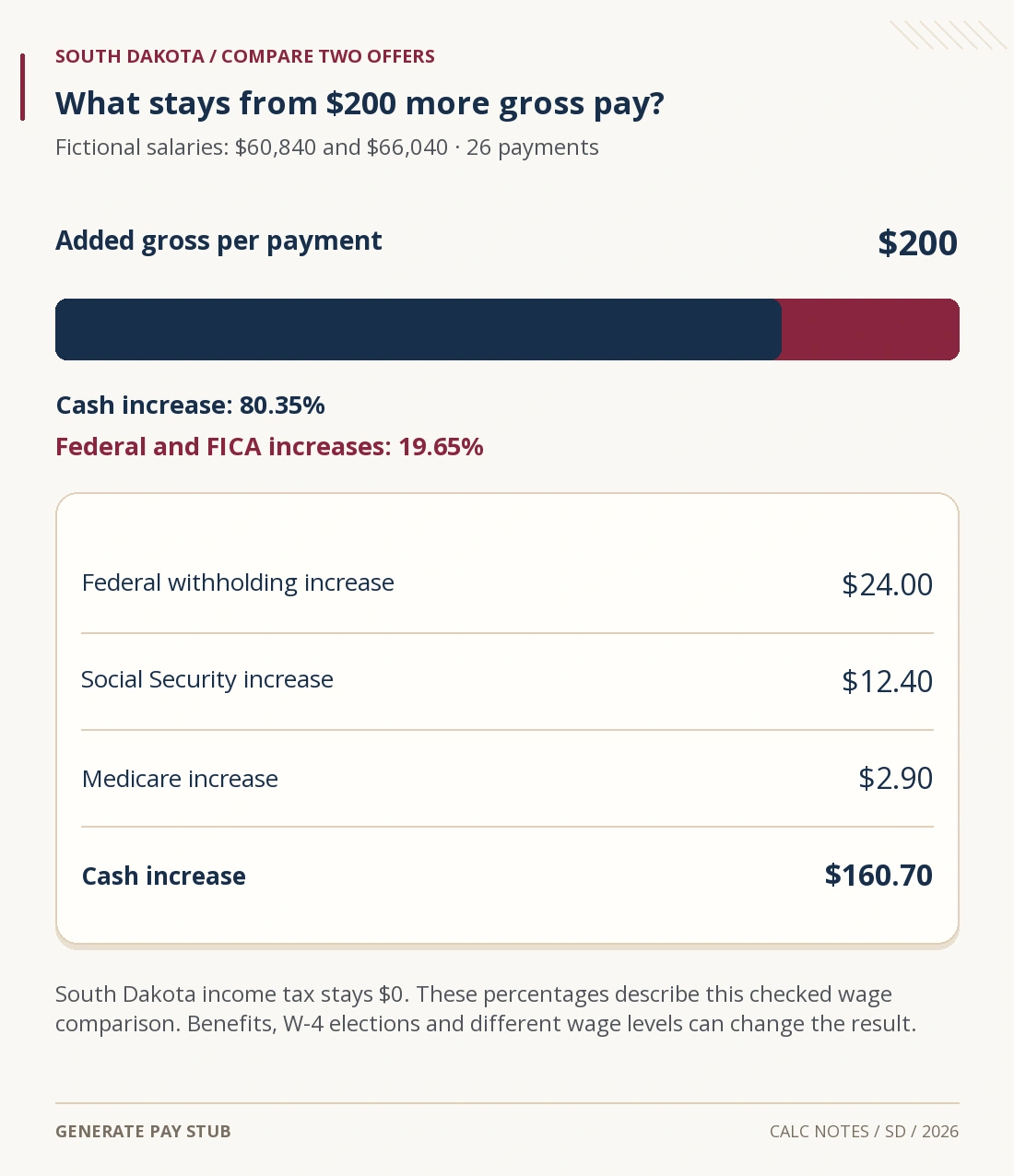
Each higher-offer payment has $200 more gross. In these two live runs, federal withholding rises by $24, Social Security by $12.40 and Medicare by $2.90.
The remaining increase is $200 − $24 − $12.40 − $2.90 = $160.70. That is 80.35% of this specific additional wage amount. The remaining 19.65% reflects increased federal withholding and employee FICA.

Across 26 payments, additional gross is $5,200 and additional modeled cash is $160.70 × 26 = $4,178.20. The difference in deductions is $1,021.80.
The 80.35% figure cannot be reused as a universal South Dakota take-home rate. A different salary band, federal election, wage cap or benefit cost can change it.
Reconcile the higher offer’s annual estimate
| Annual earning or employee deduction | Amount |
|---|---|
| Wages before modeled deductions | $66,040.00 |
| Federal withholding across 26 payments | $5,744.70 |
| South Dakota income-tax withholding | $0.00 |
| Employee Social Security across the year | $4,094.48 |
| Employee Medicare across the year | $957.58 |
| Cash estimate before omitted items | $55,243.24 |
The lower offer’s annual cash is $51,065.04. Subtracting it from $55,243.24 confirms the $4,178.20 difference.
Annual federal withholding here is the sum of rounded payment deductions, not an independently rounded tax-return calculation. Neither annual cash figure is verified income or a guarantee about the employer’s actual payroll.
Review federal W-4 choices and benefit costs
The IRS Form W-4 guidance explains that the certificate tells an employer how much federal income tax to withhold. Changes in personal or financial circumstances can warrant a new certificate.
Match the calculator’s annual fields to their units. Credits, other income and deduction adjustments are annual; additional federal withholding is per paycheck. The form’s multiple-job treatment should reflect the actual household situation.
Compare employer benefit information before deciding that the modeled wage difference is the entire improvement. A higher insurance premium could reduce the gain, while an employer contribution could add value outside cash pay.
Known annual cash deductions can help reflect confirmed amounts. For example, a $1,300 after-tax deduction spread evenly over 26 payments is $50 each. Entering it as cash does not decide whether a different benefit qualifies for pre-tax treatment. Read the benefit tax-base explanation before altering wage inputs.
Check a move, another job or an employer expense separately
South Dakota’s Reemployment Assistance guidance states that benefits are funded by employer taxes and employees do not pay those costs. An employer’s RA charge should not be added as another employee wage deduction.
A move or cross-state work arrangement needs its actual residence and work rules. Selecting South Dakota on one screen cannot establish that another state has no withholding claim.
For a second job or a working spouse, this one-employer comparison does not combine the household’s income, deductions and payments. Check the federal certificate process and year-to-date records instead of assuming the first-job result is complete.
A salary negotiation can also involve different hours, overtime treatment, bonuses or commissions. Keep uncertain amounts separate from guaranteed salary and inspect the pay basis described in the offer.
South Dakota paycheck calculator questions
Why is my net pay below gross without state income tax?
Federal withholding, FICA and other payroll deductions can still apply.
Will a $5,200 raise always add $4,178.20 of cash?
No. That result belongs to the tested salaries and unchanged elections in this guide.
Is employer Reemployment Assistance a deduction I should enter?
No. It is employer-funded.
Does the calculator certify an offer’s earnings?
No. It projects entered figures; supporting wage documents serve a separate purpose.
South Dakota primary sources and both 2026 offer estimates reviewed November 6, 2026.