Use the Florida paycheck calculator to compare salary offers with the same federal elections, pay schedule and deduction assumptions. Florida has no personal state income tax, but federal withholding and employee FICA deductions still affect the cash difference between offers. A $500 increase in gross biweekly pay does not necessarily add $500 to the deposit.
In this checked 2026 comparison, fictional annual offers of $52,000 and $65,000 produce estimated biweekly take-home pay of $1,690.85 and $2,092.60. The difference is $401.75 per payment before benefits and other deductions. The steps below explain how to reproduce the comparison and when the simplified estimate needs more information.
Keep the comparison controlled before changing the salary
Open the free Florida paycheck calculator and select 2026. Use Biweekly pay, which models 26 payments. Select Single for federal withholding, leave the multiple-jobs setting off and enter zero for annual credits, other income, deduction adjustments and extra withholding.
Start with $52,000 in the annual gross wage field. Leave known annual local withholding and other cash deductions at zero. Record the result, then change only annual wages to $65,000. Do not change the payment schedule or W-4 settings during this first comparison.
The scenario assumes the employee lives and works in Florida for the full year, receives ordinary wages from one employer and has no excluded compensation or pre-tax benefits. Federal, Social Security and Medicare wage bases are all assumed to equal gross wages. These assumptions make the salary effect visible; they are not a claim that every employer’s benefits and wage bases are identical.
The state page requests no separate Florida withholding certificate fields for this ordinary wage estimate. Both 2025 and 2026 are available, so choose the year of the pay you are comparing instead of treating the default as timeless.
Two salary offers, compared on the same biweekly basis
The first annual amount produces $2,000 gross per payment; the second produces $2,500. The live calculator returned the following employee deductions and net amounts.
| Per-payment component | $52,000 annual offer | $65,000 annual offer |
|---|---|---|
| Gross wages | $2,000.00 | $2,500.00 |
| Federal income tax withholding | $156.15 | $216.15 |
| Employee Social Security | $124.00 | $155.00 |
| Employee Medicare | $29.00 | $36.25 |
| Florida personal income tax | $0.00 | $0.00 |
| Estimated take-home | $1,690.85 | $2,092.60 |
The first payment reconciles as $2,000 − $156.15 − $124 − $29 = $1,690.85. The second is $2,500 − $216.15 − $155 − $36.25 = $2,092.60. Multiplying the rounded payment estimates by 26 gives annual take-home projections of $43,962.10 and $54,407.60.
These annual figures describe the modeled wage stream. They are not promises of a refund, an employer deposit schedule or a final tax return result. If the actual offer is hourly, part-year or dependent on a bonus, establish the expected regular wage amount before making this comparison.
Trace the extra $500 rather than guessing a tax percentage
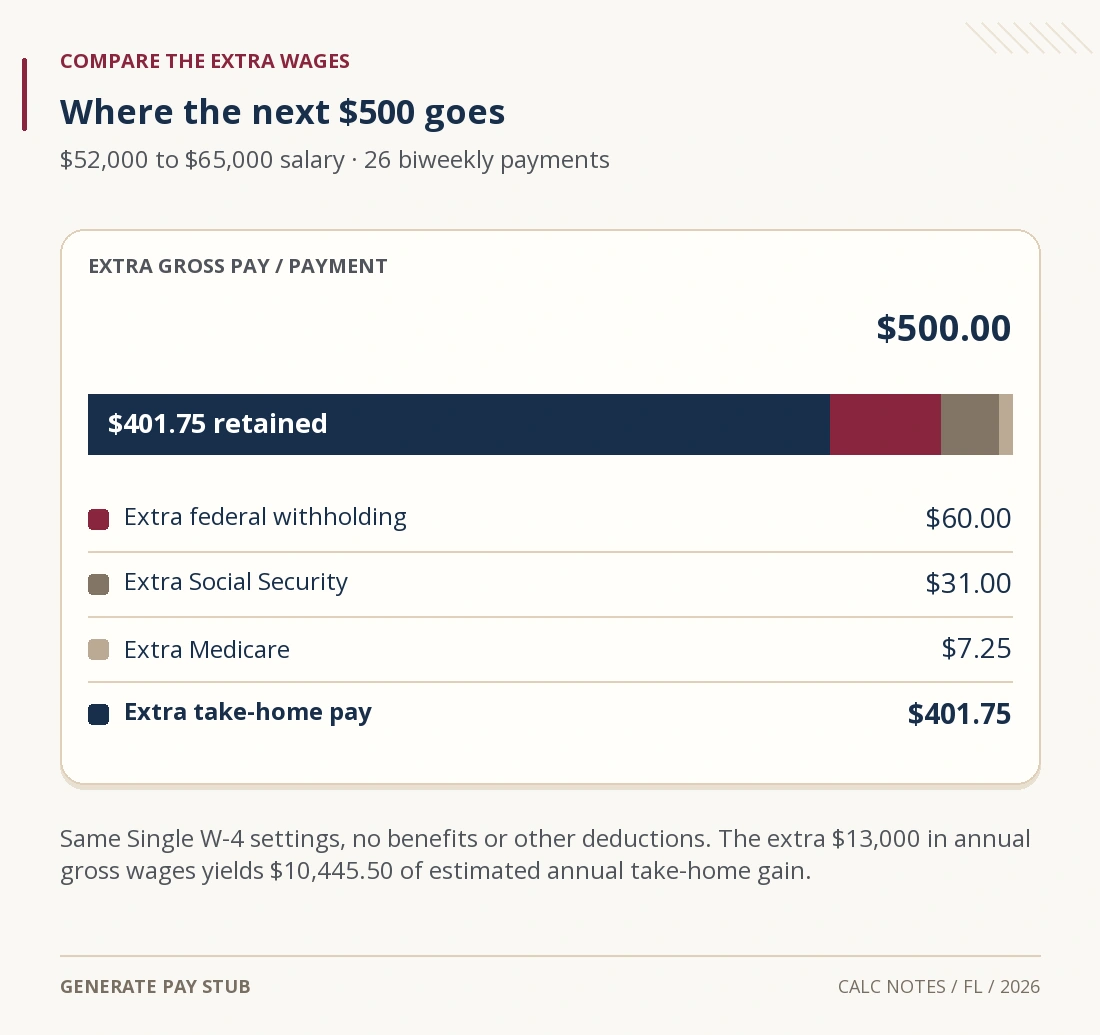
The $13,000 annual salary difference equals $500 across each of the 26 modeled payments. Of that $500, the estimate allocates $60 to additional federal income tax withholding, $31 to additional employee Social Security and $7.25 to additional employee Medicare. The remaining $401.75 increases estimated take-home pay.

The annual check is $401.75 × 26 = $10,445.50. Equivalently, $13,000 − $1,560 additional federal withholding − $806 Social Security − $188.50 Medicare = $10,445.50. This is a useful estimated cash gain for the stated profile, not a universal “keep this percentage of every raise” rule.
At other wage levels, a different withholding row, the Social Security ceiling or Additional Medicare withholding can change the marginal result. Credits and multiple-job settings can change it too. Repeat the controlled comparison at your figures rather than multiplying a raise by a percentage borrowed from this example.
Why does federal withholding rise by $60 per payment here?
The ordinary employee Social Security and Medicare rates are 6.2% and 1.45%, respectively. Under these assumptions, the incremental amounts are $500 × 6.2% = $31 and $500 × 1.45% = $7.25. Both salaries remain below the 2026 Social Security ceiling. IRS Topic 751 explains the rates, wage-base limit and separate Additional Medicare trigger.
For federal income tax withholding, 2026 IRS Publication 15-T supplies the modern W-4 percentage method. With these Single elections, the worksheet’s adjusted annual wages are $43,400 for the lower offer and $56,400 for the higher offer, after the method’s $8,600 adjustment. Both remain in the same applicable withholding row.
The annualized calculations are $1,240 + 12% × ($43,400 − $19,900) = $4,060 and $1,240 + 12% × ($56,400 − $19,900) = $5,620. Converting to 26 payments gives $156.15 and $216.15 after rounding. The tool sums those rounded amounts, producing annual withholding of $4,059.90 and $5,619.90; their difference is exactly $1,560.
The worksheet adjustment is already built into the method. It is not a benefit deduction to enter again, and the calculation is not a determination of your return’s effective income tax rate. Our federal withholding calculator guide isolates the W-4 controls if you want to examine those next.
A zero Florida personal income tax line does not mean zero deductions
The Florida Department of Revenue’s personal income tax FAQ confirms that Florida does not impose a personal income tax. The ordinary Florida-only salary examples therefore have no state personal income tax withholding.
Florida’s reemployment tax is a different employer obligation. The Department’s reemployment-tax guidance says workers do not pay it and employers must not deduct it from wages. Do not add an employer reemployment rate to an employee take-home calculation.
The tool also lists no additional supported statewide employee contribution in its reviewed Florida program section. That is a limited model statement. It does not erase federal taxes, voluntary benefits, retirement contributions, court-ordered deductions or an obligation connected to work in another jurisdiction.
Bring benefits and job details back into the offer decision
Once the salary-only comparison is clear, gather each offer’s actual employee benefit costs, retirement elections, pay frequency and expected paid weeks. Employer insurance contributions and retirement matching also affect total compensation, even though they are not cash deposits from the calculator.
This state calculator does not model separate pre-tax wage bases. Its known annual deduction fields subtract cash amounts without recomputing tax bases. Do not enter a pre-tax benefit there and assume the result includes its tax effect. Compare the relevant wage bases with payroll or a fuller benefits calculation; our gross-versus-taxable-wage article explains the distinction.
For a cash deduction whose tax treatment is already accounted for elsewhere, match its units to the annual field. For an amount quoted per payment, check how many payments actually include it. A benefit charged on 24 payments is not automatically charged on all 26 biweekly paydays.
A move, remote work across state lines, a second job, seasonal employment or irregular earnings can invalidate the simple full-year Florida-only setup. The result does not decide residency or allocate income between states. Use the general calculator walkthrough for input and model checks before relying on a headline net figure.
Florida paycheck calculator questions
Can I compare offers with different pay schedules?
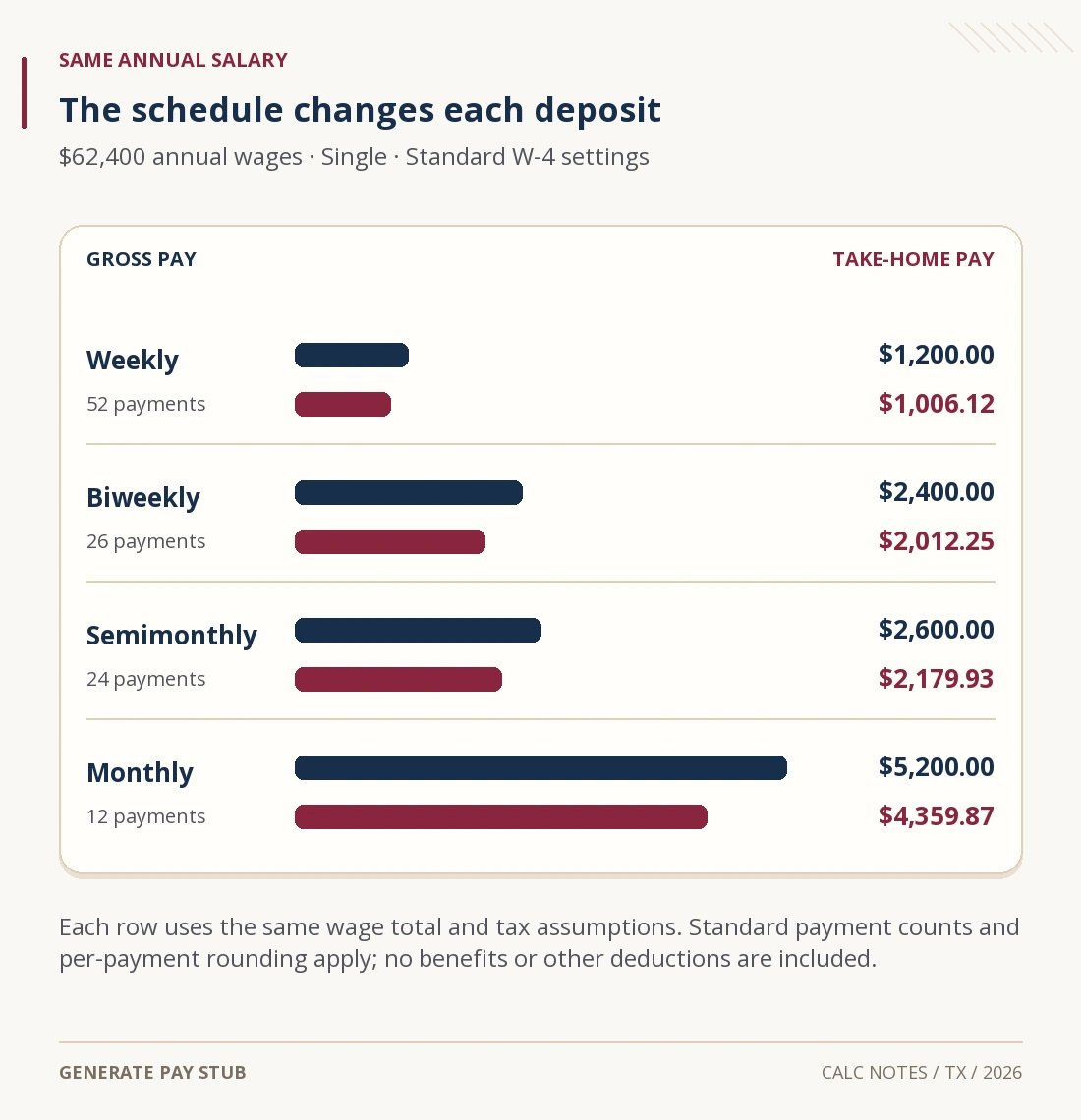
First put the gross offers on a consistent annual basis. Then model each employer’s actual schedule. A larger individual payment can simply reflect fewer payments a year, as our controlled schedule example illustrates.
Will the $13,000 raise always add $10,445.50 to take-home pay?
No. That is the checked difference for this particular 2026 wage pair and elections, with no benefits or other adjustments. Different wages or W-4 choices can change it.
Does the calculator apply to contractors?
The examples use employee payroll deductions. Independent contractor earnings require a separate income and self-employment tax review rather than treating this employee result as a contractor estimate.
Can I choose another state without providing personal details?
The free state calculator directory links the available tools. The reviewed wage calculators request the financial inputs needed for the estimate without a name or email entry.
Florida agency references, 2026 federal rules and both live offer calculations checked November 6, 2026. These fictional comparisons estimate employee cash pay under the assumptions shown.