SUTA is commonly used to describe state unemployment insurance tax, which an employer generally calculates using the applicable state’s wage rules and the employer’s assigned rate. The annual taxable wage base limits the wages subject to a particular contribution; it is not a limit on earnings, and it does not automatically determine employee withholding.
This November 2026 employer guide focuses on three practical questions: which wages are taxable, which rate belongs in payroll, and which state’s unemployment system covers the work. State examples are identified separately. The worked calculation uses fictional inputs rather than presenting one state’s numbers as a national standard.
What determines the employer’s SUTA calculation?
Identify the unemployment account, calendar year, covered employee wages, taxable wage base and assigned rate. Read the rate notice for any separate assessments or adjustments. The employer’s industry, experience and account history can affect the assigned rate; a generic online percentage is not a substitute for the notice.
For example, Minnesota’s 2026 guidance identifies a $44,000 wage base and distinguishes new-employer rates, experience rates and assessments. Those are Minnesota rules. They do not establish the wage base or full charge in another state.
Check the rate’s effective period and the state unemployment wage definition. Federal income-tax wages, Social Security wages and state unemployment wages can differ. A label such as “taxable pay” without identifying the tax is not enough to choose the correct base.
A fictional SUTA example when wages cross the annual base
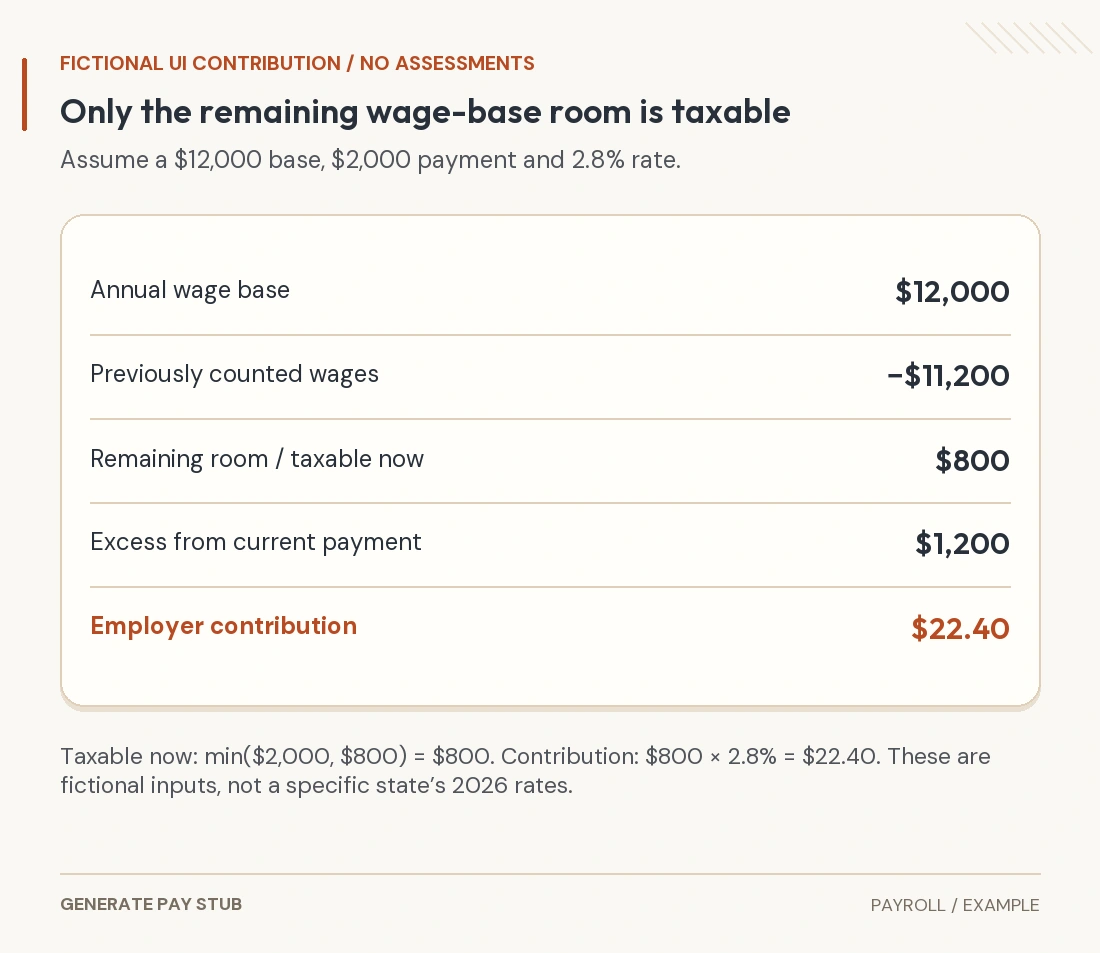
Assume a covered employee, a fictional annual wage base of $12,000.00, an applicable employer contribution rate of 2.8%, and no separate assessments. Assume the employer has already paid $11,200.00 of wages counted toward that base and now pays another $2,000.00 of otherwise covered wages. These inputs do not describe Minnesota’s actual 2026 base.
Only $800.00 remains below the assumed limit: $12,000.00 − $11,200.00. Therefore $800.00 of the new payment is taxable for this contribution and $1,200.00 is excess over the base. The contribution on that payment is $800.00 × 2.8% = $22.40.

| Calculation item | Amount |
|---|---|
| Assumed annual taxable wage base | $12,000.00 |
| Previously counted wages | −$11,200.00 |
| Remaining wage-base room | $800.00 |
| Current otherwise covered wages | $2,000.00 |
| Current taxable wages | $800.00 |
| Current excess wages | $1,200.00 |
| Employer contribution at assumed 2.8% | $22.40 |
For this simplified setup, current taxable wages equal the smaller of the current covered wages and the positive remaining wage-base room. Once the room is exhausted, a later otherwise covered payment has no taxable wages for this particular employer contribution under these assumptions. Other taxes can continue.
Why total wages and taxable wages both matter
A wage-base limit does not mean wages above it disappear from the employer’s records. Utah’s unemployment guidance distinguishes wages above its base as excess wages that remain reportable. Check your own state’s reporting instructions rather than stopping all wage reporting once a contribution cap is reached.
In the fictional example, the current payment remains $2,000.00 even though only $800.00 is taxable for the assumed UI contribution. Record the employee’s actual earnings and the appropriate UI classifications separately. An employer tax cap does not reduce the employee’s gross earnings to $800.00.
Keep year-to-date amounts tied to the correct employer, tax and year. An unrelated prior employer’s payroll totals are not enough, by themselves, to establish the wage-base room in your account. Review the state’s actual credit, transfer and successor rules before carrying amounts between records.
Which state should receive unemployment wages for multistate work?
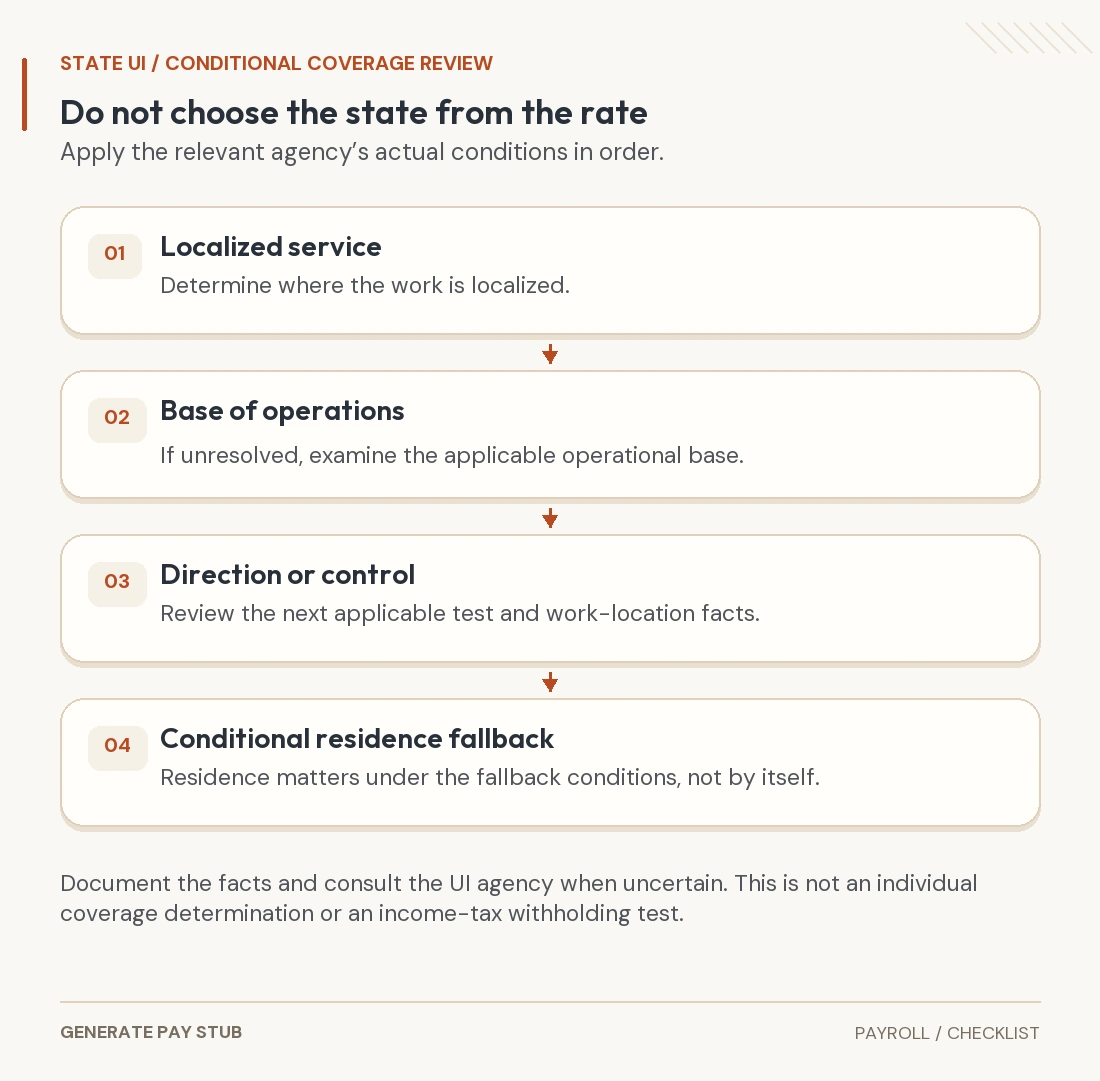
The DOL’s localization-of-work guidance describes a framework intended to place an individual’s service for one employer under one state’s UI law. It is a different question from income-tax withholding, and a home mailing address alone does not settle every case.
The ordered review considers whether service is localized, then the applicable base of operations and direction/control tests, with residence as a conditional fallback. Each stage has legal conditions, including where service is performed. A payroll administrator should not pick a preferred tax rate or split unemployment wages casually among states.

Iowa’s employer handbook provides state reporting guidance for one-state work, multistate work and permanent transfers. It also specifically notes that out-of-state wage credits are not allowed beginning in the first quarter of 2026. That dated note is a useful reminder to check current rules rather than carry forward an older instruction.
For a remote or traveling worker, document actual work locations, whether out-of-state service is temporary, the operational base and where work is directed. Ask the relevant UI agency to resolve an uncertain coverage situation. Do not assume the income-tax withholding state or benefit-claim mailing address automatically provides the answer.
Transfers and acquisitions need a separate wage-base review
A permanent interstate transfer and a change in business ownership are different events. The state may have specific rules about prior wages, account continuity or successor treatment. Keep any agency determination with the payroll setup records.
For example, the Missouri successor FAQ says prior-owner wages can be used only when the state has determined successor status for the UI account. This illustrates why an acquisition alone should not trigger an assumed wage-base carryover.
When changing payroll services, reconcile the year-to-date UI wage history as well as the current rate. A software migration is not necessarily a new legal employer or a new tax year. An accidental reset can overstate taxable wages; an unsupported carryover can understate them.
Does the employer’s SUTA amount come out of employee net pay?
Do not automatically turn the employer’s liability into an employee deduction. Minnesota expressly says employers cannot withhold its employer UI tax from wages. Some states separately require employee unemployment contributions, with their own rules.
For example, Pennsylvania’s contribution guidance distinguishes employer contributions based on taxable wages from employee contributions based on gross wages. The two calculations should not be conflated. Our unemployment deduction guide focuses on the employee-facing question.
What should an employer reconcile each quarter?
- Match the state account, employer entity and reporting period.
- Reconcile total covered wages, taxable wages and excess wages by employee.
- Check the rate notice, effective dates and separate assessments against payroll settings.
- Review new hires, interstate changes, acquisitions and imported year-to-date balances.
- Match the filed wage report, contribution calculation, payment and any agency adjustment.
Keep federal FUTA separate. A state UI calculation does not, by itself, establish the federal taxable base, credit-reduction treatment or federal deposit requirement. See FUTA records and Form 940 for that distinct review.
Common SUTA questions
Is SUTA one national rate?
No. The state rules and employer’s assigned account rate matter, along with any assessments.
Do all payroll taxes stop at the state UI wage base?
No. Each tax has its own base and rules. Reaching one contribution limit does not settle the others.
Can I use a previous owner’s wage totals automatically?
No automatic rule is established here. Review state successor treatment and any official determination first.
Does this example calculate my actual tax bill?
No. It demonstrates wage-base arithmetic using supplied assumptions. Apply the actual state rules, year, rate notice and reporting instructions to your payroll.