
Who pays for unemployment insurance? In the United States, employers generally fund it through federal and state payroll taxes, while states administer benefit claims. Federal unemployment tax (FUTA) is an employer expense, not a deduction from an employee's pay. Some states also require worker contributions to their state unemployment programs. That distinction explains why one employee's pay stub may show an unemployment-insurance line and another employee's may not.
This guide uses rules and published rates for 2026. A worker checking an earlier or later pay period should use the rate and wage limit for that year. The examples below assume covered employment and do not determine an individual's eligibility for benefits.

Who pays, and who sends benefits?
There are three different roles. Keeping them separate makes the answer much clearer:
- The employer generally pays federal FUTA tax and a state unemployment tax on covered wages. These are business payroll costs, not the employee's federal withholding.
- The state unemployment agency runs its program, evaluates claims under state law, and pays eligible claimants. The U.S. Department of Labor's program overview describes the federal-state arrangement.
- The employee may also contribute under a particular state's rules. Alaska, New Jersey, and Pennsylvania publish worker-contribution rules for 2026; details and examples appear below.
The DOL Office of Inspector General explains that, in ordinary circumstances, state employer taxes generally fund benefits while federal funding generally supports administration. This is a general description of the system, not a promise that a particular employer's tax payment determines a former worker's benefit check.
Eligibility for benefits follows the relevant state program's requirements. A worker should not decide whether to apply for unemployment solely by looking for a deduction on a pay stub.
Why federal FUTA tax should not reduce an employee's net pay
The IRS 2026 Employer's Tax Guide says only the employer pays FUTA. It is not withheld from an employee's wages. The standard federal rate is 6% on the first $7,000 of FUTA-taxable wages per employee for the year. Eligible employers can receive a state-tax credit of up to 5.4 percentage points, producing a 0.6% effective rate when the full credit applies.
Those numbers describe employer liability, not an employee pay-stub deduction. For an illustrative employer with $7,000 of FUTA-taxable wages for one covered worker and the full credit, 0.6% × $7,000 is $42 of federal tax. That $42 comes from employer funds. It must not be subtracted from the worker's net pay just because it was calculated using the worker's wages.
The 0.6% result is not universal. Late or ineligible state-tax payments and a FUTA credit-reduction state can change the employer's federal tax. Coverage and exceptions also matter. Employers should use the applicable instructions and their actual records, not a generic 0.6% shortcut.
State employer unemployment taxes are separate from FUTA. A state's employer rate and annual taxable wage base can differ from the federal figures. Some employers have special coverage or reimbursement arrangements. A state rate quoted in an online article is not a substitute for the employer's current state agency notice.
When does unemployment insurance come out of a paycheck?
For many employees, no unemployment-insurance contribution is taken from wages; their employer pays the applicable employer taxes. But a worker contribution is possible under state law. These 2026 examples come directly from each state's labor agency:
| State | Published worker UI rate | Illustration on $2,000 taxable wages |
|---|---|---|
| Alaska | 0.50% | $10.00 |
| New Jersey | 0.3825% for the listed regular worker UI rate | $7.65 |
| Pennsylvania | 0.07% | $1.40 |
Example assumptions: the entire $2,000 payment is covered wages within the applicable 2026 state wage base; there are no special worker classifications or adjustments. The table compares the worker contribution only. It does not compare employer rates, calculate other payroll taxes, or establish the amount to withhold for a real employee.
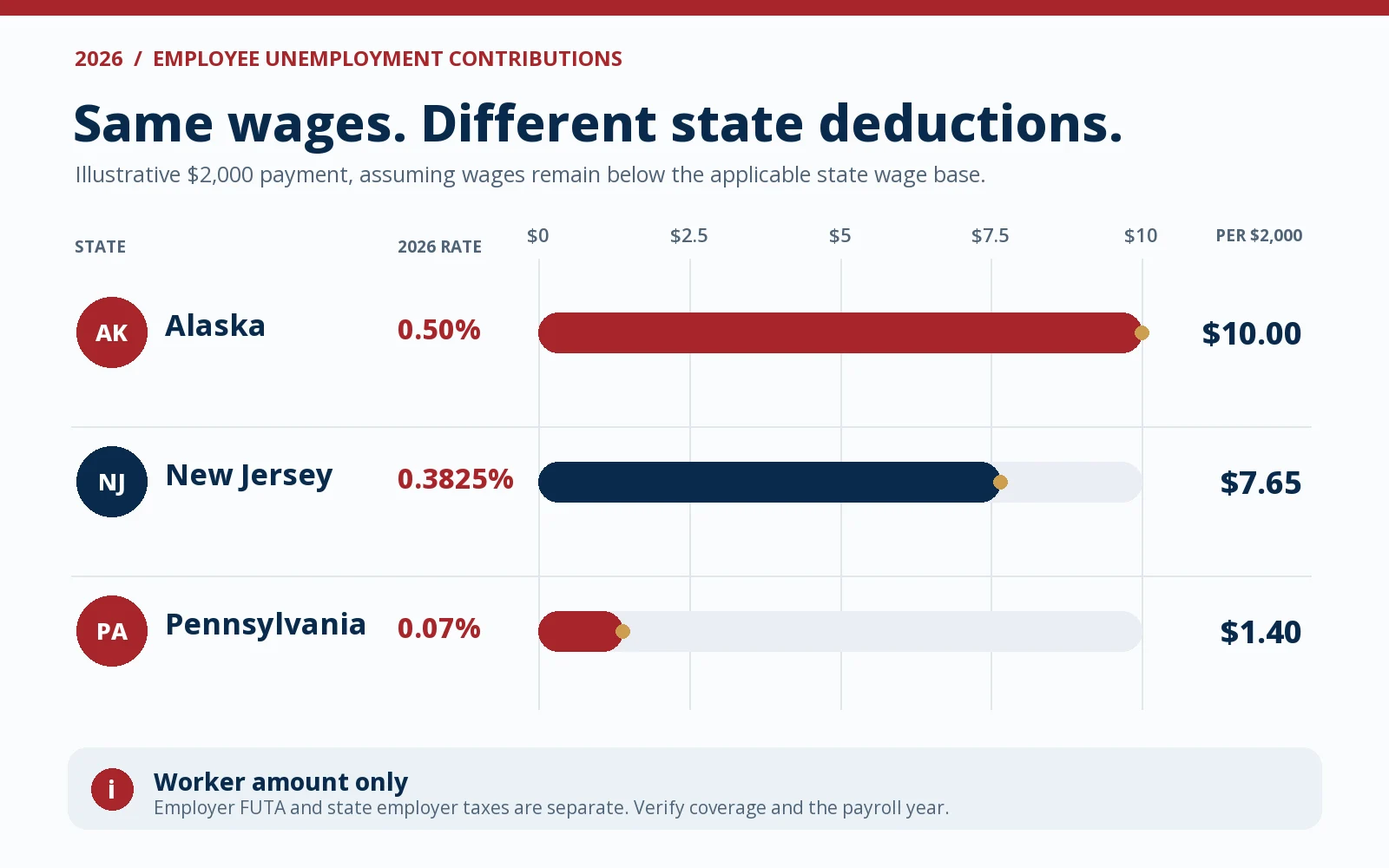
Rate details matter. Alaska lists a $54,200 taxable wage base for 2026. New Jersey lists a $44,800 base for UI worker and employer contributions; its published table also has a different UI worker rate for a governmental reimbursable employer. Pennsylvania's page says its employee contribution is calculated on gross wages, while its employer taxable wage base is a separate $10,000 figure. These distinctions are why the correct payroll year, covered wages, and state category must be checked before comparing a stub with a published rate.
New Jersey also lists disability, workforce, and family-leave contributions separately from UI. A combined-looking payroll label should be checked against the provider's code legend before treating every dollar as an unemployment contribution.
What should a pay stub show about unemployment tax?
If you see a line such as “UI,” “SUI,” or a state-specific abbreviation among employee deductions, first identify the state and ask payroll what the code represents. Under an applicable state worker-contribution rule, the line reduces net pay. Its amount should reflect the covered wage base and applicable rate for that period.
If the statement lists an employer tax section separately, an unemployment amount there may describe an employer expense for information or internal reporting. It should not be added to the employee's deduction total merely because it appears on the same page. Distinguish the employer and employee columns before deciding that take-home pay is wrong.
FUTA is different: the IRS explicitly assigns it to the employer. If a line labeled “FUTA” actually reduces your net pay, ask payroll to identify the calculation and legal basis. Keep the original statement while the issue is reviewed. Our gross pay versus taxable wages guide helps distinguish the base used for a tax from the amount deducted.
A state contribution on a current paycheck is also different from income-tax withholding from unemployment benefits paid later to a claimant. Those are separate transactions. Consult the state agency about a claim, and check its benefit statement for any withholding from the benefit payment.
How to check an unemployment deduction in five steps
- Read the section heading. Is the amount under employee deductions, employer taxes, or an informational column? Only the first directly reduces the employee's net pay.
- Identify the abbreviation. Ask payroll for the complete name. “UI” and “DI” are different in New Jersey; another provider may use a different code.
- Match the work and pay location. Establish the state unemployment program used for the payment. A home address by itself may not identify the state whose UI rules apply.
- Check the year, rate, and wage base. Use the applicable state's official instructions for that pay date. Compare the calculation with the correct covered wages, not automatically with net pay.
- Request an explanation or correction. Give payroll the pay date, exact label, displayed amount, and source you checked. Ask whether the line is an employee contribution, employer information, or a coding error. Keep the reply and any corrected statement.

Do not edit an employer-issued statement to “remove” a line you think is wrong. A corrected payroll amount may require a payment correction and updated cumulative totals, not just a different PDF. Our Pay Stub Help 101 guide walks through earnings, deductions, and year-to-date reconciliation; the source-record checklist is useful for the payroll team.
What should an employer verify before preparing the statement?
First establish whether the wages and employer are covered by FUTA and the relevant state program. Keep the employee's work location, the state agency account and rate notice, the applicable wage bases, prior taxable wages for the year, and the payroll calculation together. That record is more reliable than copying last year's rate into a new template.
Next separate four amounts in the payroll system: federal employer FUTA, state employer UI tax, any state employee UI contribution, and other employee deductions. A state disability or family-leave charge should have its own explanation when it applies. The state wage-statement checklist can help check which information must appear on the document; it does not decide the underlying tax liability.
If you use GeneratePayStub.com to format a statement, enter amounts supported by the actual payroll records and preview how employer and employee items appear. Producing a document does not pay the unemployment tax, file Form 940, register an employer with a state, or establish benefit eligibility.
Frequently asked questions
Does the state or my former employer pay me after I file a claim?
The state unemployment agency administers the claim and benefit payment under its program. Regular benefits are generally funded through the state UI system rather than a direct check from your former employer. Ask the state agency about your own claim and eligibility.
If no UI was deducted from my wages, can I still apply for unemployment?
Yes, the absence of an employee UI deduction does not by itself prevent an application. In most states, employer taxes finance the program. The state determines coverage and eligibility based on its rules and your work history.
Is state UI the same as state income tax or federal FUTA?
No. They serve different purposes and have separate rates, wage bases, and reporting rules. A pay stub should not collapse them into an unexplained deduction. Request the payroll code definitions if the labels are ambiguous.
Could an employer's FUTA rate change without changing my pay?
Yes. The employer's credit and state circumstances can change its federal tax cost while your contractual gross pay and employee deductions follow their own rules. A change in employer tax liability is not, by itself, a reason to subtract more FUTA from the worker's paycheck.
The key check: determine whether the item is an employer expense or an authorized state worker contribution. Then compare only that worker contribution with the correct state rule and covered wages for the payment year.