A move from biweekly to semimonthly payroll should map every work date to a payment, preserve the established overtime workweek and explain the transition before the first changed payday. Changing how often a check arrives is a scheduling decision; it does not erase earned wages or automatically change the employee’s agreed annual compensation.
This U.S. planning guide uses a fictional March–April 2027 transition and federal workweek principles, with Texas guidance as one state example. It is not a payment calendar approved for every state, industry or employment agreement. Verify the actual jurisdiction and payment rules before implementing a change.
Can an employer switch to semimonthly pay?
It depends on the applicable payday rules and any employment or collective bargaining agreement. Pay frequency, the lag between work and payment, required notice and permitted employee categories are separate questions. A schedule that works for one employer may be unsuitable for another.
The U.S. Department of Labor’s state payday directory illustrates those differences, but its table is dated January 2023. Use it as a starting directory, then verify the current state requirements directly. Do not treat an older summary table as final approval for a 2027 implementation.
For example, Texas Workforce Commission’s frequency-of-pay guidance describes at least twice-monthly pay for nonexempt employees and recommends advance written communication identifying the last old payday and the first two new ones. That recommendation helps prevent confusion; it is not a nationwide notice period. The agency also emphasizes that changing paydays does not change the FLSA workweek.
Before changing software, establish who is covered, what notice is required and when each earned wage payment must be made. Review weekends, holidays and processing cutoffs separately. A vendor’s available calendar does not determine whether the employer’s chosen dates meet the law.
How do you prevent missing or duplicated days during the switch?
Build a coverage map using work-period start and end dates, then add the actual payment dates in a separate column. The day after one period ends should be the first day of the next covered period unless there is a genuine documented break in employment. Period labels alone cannot prove continuity.
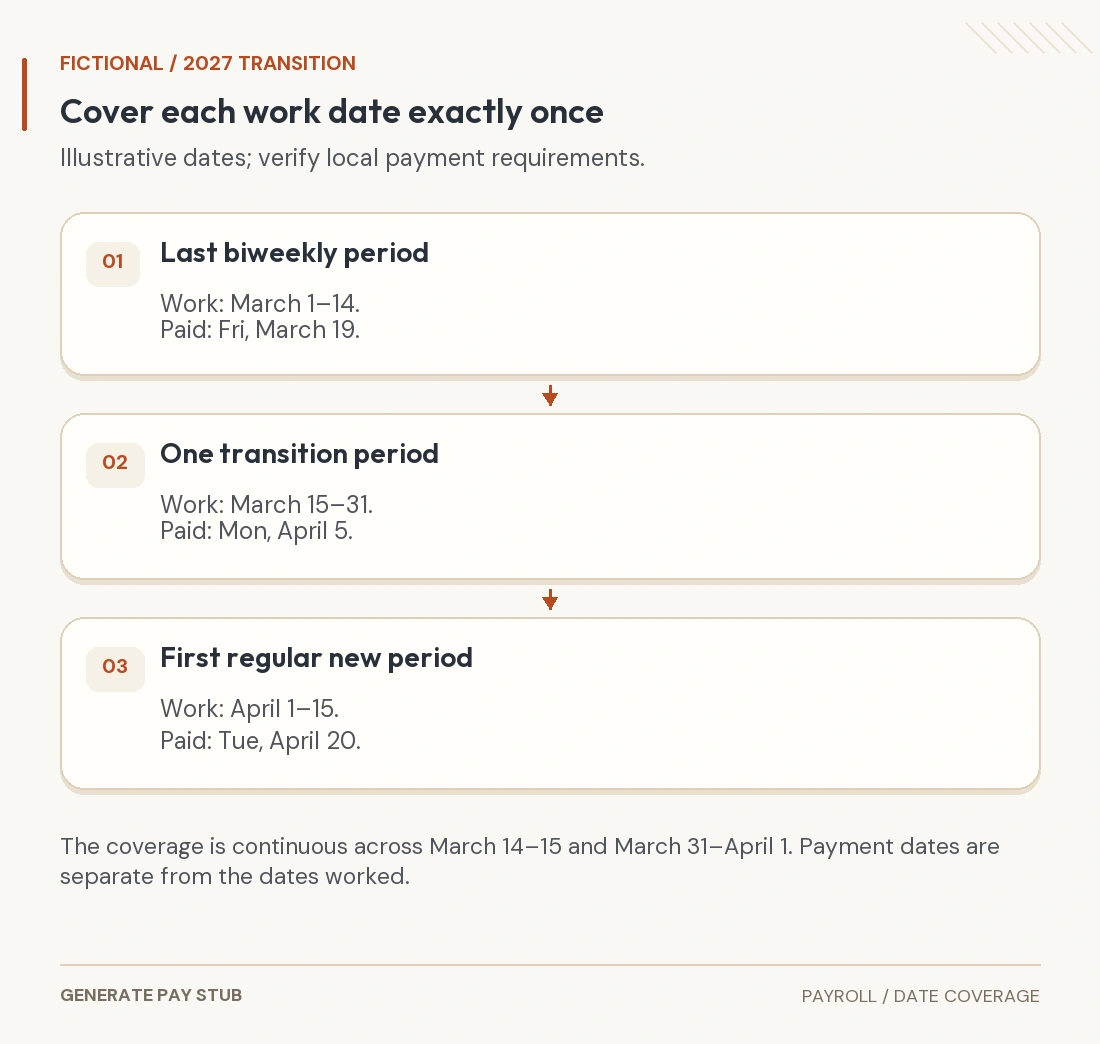
The fictional example below finishes a two-week period, uses one 17-day transition period and then starts regular half-month periods. The 17-day bridge is a special transition interval, not a claim that normal semimonthly periods always last 17 days. These are illustrative payroll-record dates, not a recommendation to delay wages.
| Stage | Work covered | Payment date |
|---|---|---|
| Last biweekly period | March 1–14, 2027 | Friday, March 19, 2027 |
| Transition period | March 15–31, 2027 | Monday, April 5, 2027 |
| First regular semimonthly period | April 1–15, 2027 | Tuesday, April 20, 2027 |

In this example, the first handoff is March 14 to March 15, and the second is March 31 to April 1. The three periods contain 14 + 17 + 15 = 46 calendar dates. Count work hours from the actual time records; calendar-day coverage is not a substitute for hours worked.
Also review the earlier and later paydays outside this small extract. Three correct rows do not establish the entire month’s required payment frequency. If a transition creates a cash-flow gap for employees, address it through a lawful payment arrangement and clear documentation rather than silently shifting already promised wages.
What happens when a workweek crosses the new pay-period cutoff?
DOL Fact Sheet 23 explains that federal overtime for covered, nonexempt employees generally follows hours over 40 in a fixed, recurring 168-hour workweek. A semimonthly cutoff does not create a fresh overtime clock. Averaging a long week against a short week does not satisfy the general rule.
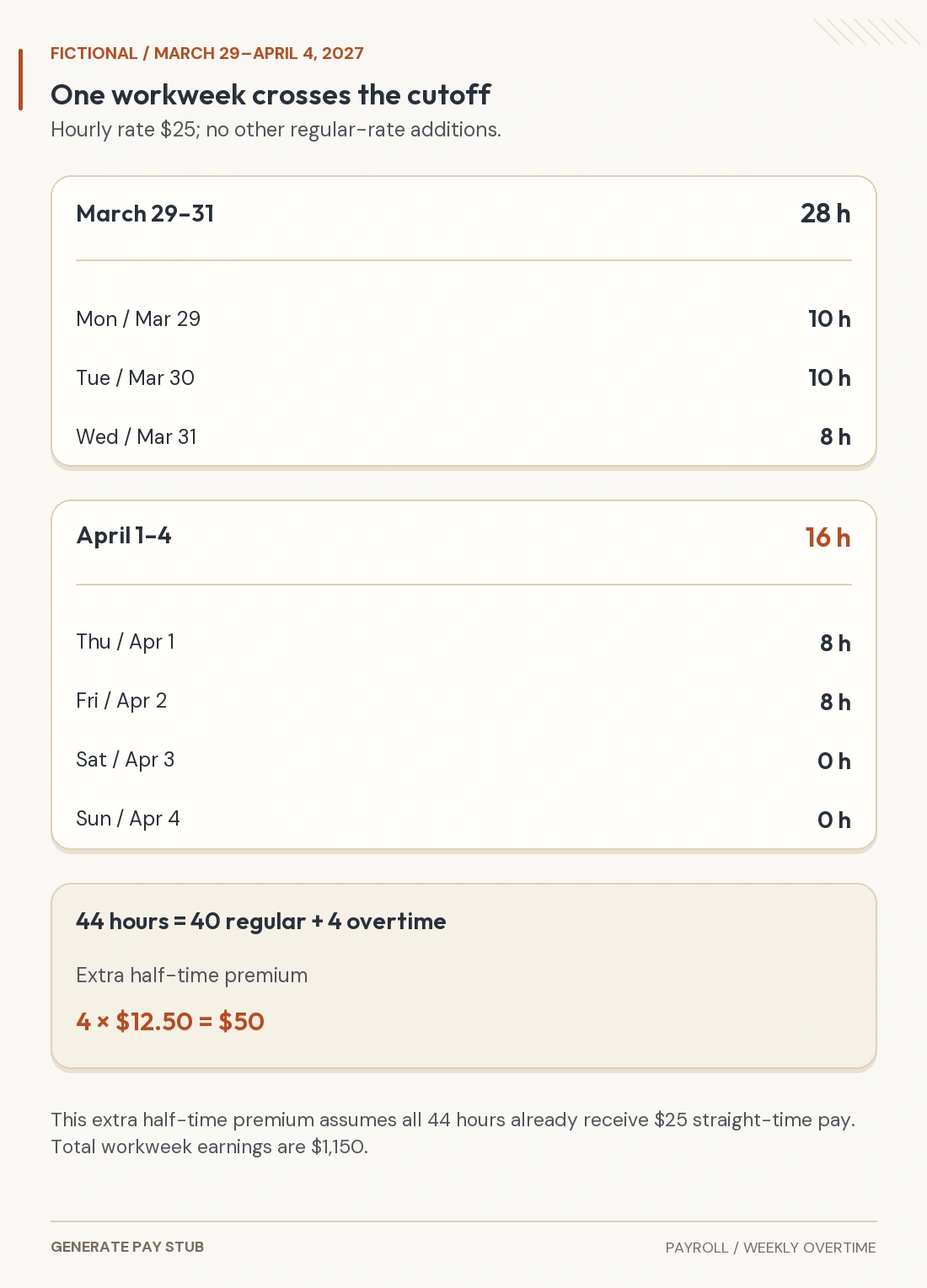
Assume a Monday–Sunday workweek, a $25 hourly rate, no bonuses or other regular-rate additions, and no additional state daily-overtime requirement. The employee works 10 hours Monday, 10 Tuesday and 8 Wednesday, March 29–31, 2027. They then work 8 hours Thursday and 8 Friday, April 1–2, with no weekend hours.
March contains 28 of those hours and April contains 16, but all 44 belong to one workweek ending April 4. The payroll-period split must preserve that relationship.
| Calculation | Result |
|---|---|
| March 29–31 worked hours | 28 h |
| April 1–4 worked hours | 16 h |
| Whole workweek | 44 h |
| Hours above 40 | 4 h |
| Straight-time pay for all 44 hours | $1,100.00 |
| Additional half-time premium: 4 × $12.50 | $50.00 |
| Total workweek earnings | $1,150.00 |

The check is 44 × $25 = $1,100, plus 4 × $12.50 = $50, totaling $1,150. Equivalently, 40 × $25 + 4 × $37.50 = $1,150. Do not add four full $37.50 payments on top of straight-time pay already covering those same four hours.
Keep the cross-period reconciliation visible in payroll records and apply the actual overtime payment deadline. Do not postpone a known amount indefinitely while waiting for a convenient later run. More complex pay, including nondiscretionary incentives, can change the regular rate and require additional analysis.
Does the larger semimonthly salary check mean a raise?
Not necessarily. In a separate full-year illustration with exactly 26 biweekly payments, a $62,400 annual salary divides into $2,400 per check. With 24 semimonthly payments, the corresponding amount is $2,600. The annual reference is the same; the number of installments differs.
That comparison does not price the 17-day transition period or establish an employee’s lawful salary proration. A midyear change needs the actual agreement, compensation already paid and applicable salary rules. Do not simply pay a full old installment and a full new installment for overlapping dates, or reduce earned compensation to make the software totals match.
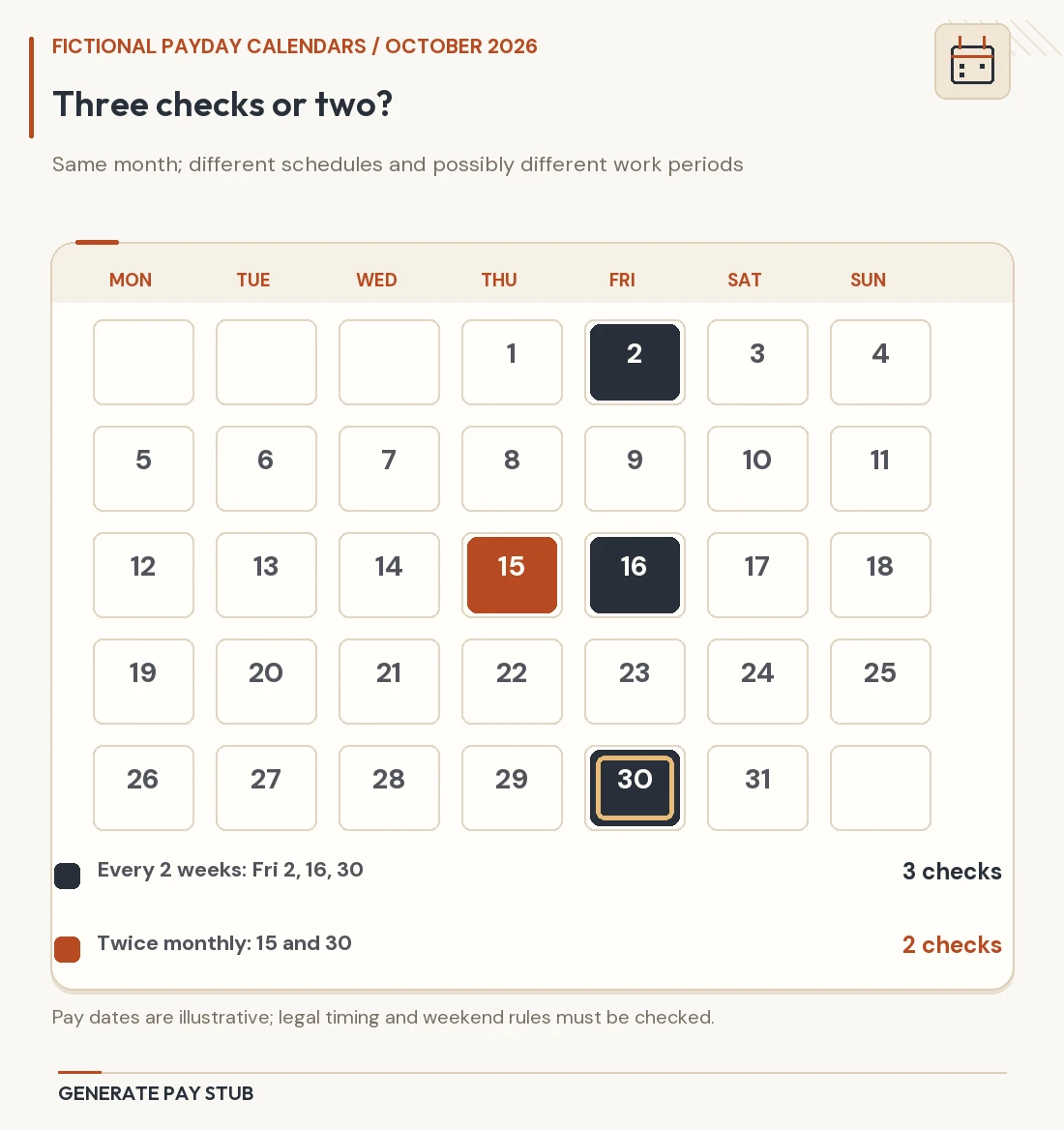
Some biweekly calendars have 27 paydays. Review the actual date sequence, as explained in our 2027 biweekly calendar guide. The 26-check salary illustration here is explicitly not a claim that every 2027 cycle has 26 payments.
Which deductions and tax settings need a separate review?
Confirm each benefit premium, retirement election, garnishment and other deduction against the governing plan, order or authorization. A fixed amount per paycheck and a fixed annual target are different instructions. The frequency change does not itself authorize changing the annual target or collecting an extra premium.
For example, a hypothetical additional withholding election of $20 per regular payment produces $520 over 26 payments, compared with $480 over 24. That $40 difference is a full-year illustration, not a calculation for the partial-year transition. Review any intended annual goal before making a new election.
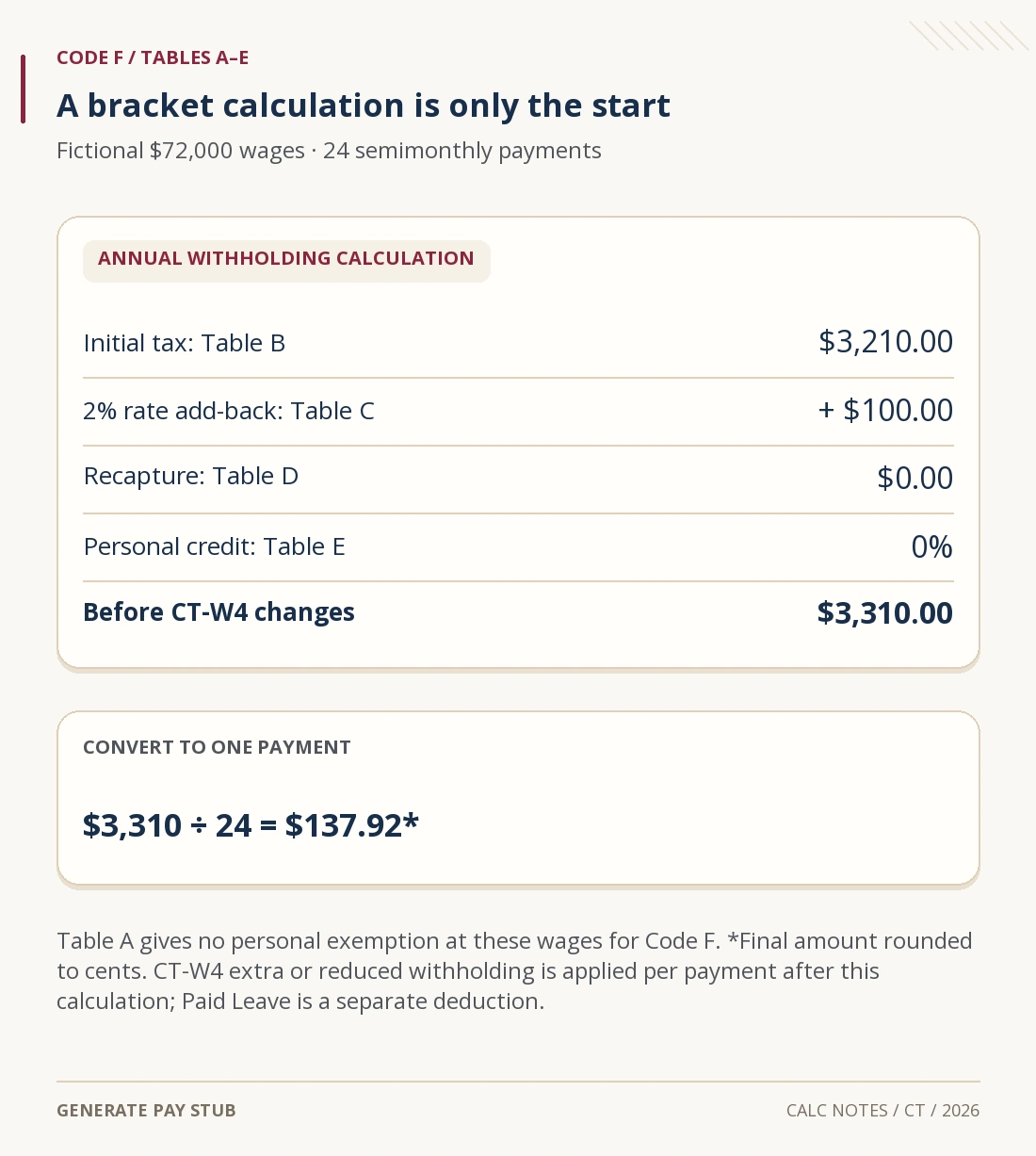
IRS Publication 15-T uses payroll-period-specific methods and includes additional withholding from Form W-4. The employer must select the method appropriate to the actual payment period and payment year, including any irregular transition payment. This article does not calculate 2027 withholding or apply 2026 tax tables to future wages.
For the same employee, employer and year, preserve legitimate YTD wage and deduction history through the schedule change. Do not reset cumulative balances merely because a new frequency code is assigned. Reconcile benefits and tax balances separately rather than expecting net deposits to stay identical.
What should employees check on the first three affected statements?
DOL’s recordkeeping guidance identifies daily and weekly hours, the workweek start, earnings, deductions and payment-period details among the relevant records. Use those underlying records to check the last old, transition and first regular new statement.
- Coverage: match the end and start dates; find any overlap or uncovered day.
- Hours: reconcile actual time, including the week that crosses the cutoff.
- Compensation: confirm the agreed rate or salary method and any required overtime adjustment.
- Deductions: compare each charge with its authorization and YTD balance.
- Payment: match the issued net amount to the actual payment and investigate discrepancies.
The IRS employment-tax recordkeeping guidance separately supports retaining payment and withholding records. Keep the transition notice, issued statements and reconciliation together. Ask payroll for an explanation and corrected issued record if something is wrong.
For regular-cycle math after the transition, see semimonthly dates and earnings checks. A complete coverage map answers a narrower question than the general choice between pay frequencies.
Common payroll-transition questions
Can payroll restart the overtime week on the 1st and 16th?
A pay-period boundary alone does not reset the established workweek. Preserve the full week in the overtime analysis.
Should the transition check equal a normal paycheck?
Not automatically. It depends on the dates, hours, compensation agreement and applicable rules. Get the calculation rather than judging by check size alone.
Does changing the schedule create a new tax year?
No. Preserve same-year history and apply the correct payment-year rules. A frequency setting is not a new calendar year.