The Connecticut paycheck calculator needs the actual CT-W4 withholding code, then applies the state’s calculation tables before adding or subtracting any certificate adjustment. Multiplying gross pay by one headline rate will not reproduce the full calculation. CT Paid Leave is a separate employee contribution.
This guide checks a fictional $72,000 salary paid semimonthly under Code F. It follows the $137.92 state deduction, identifies the $100 annual tax-rate add-back and compares separate extra-withholding and reduced-withholding assumptions.
Use the actual CT-W4 code instead of inferring it from W-4
The current 2026 CT-W4 certificate asks the employee to select a statement based on expected state filing status and gross income. Different household and income conditions can lead to different letters, even within the same broad filing status.
For this fictional Single employee with $72,000 wages and no other income, the ordinary certificate selection is F. The example assumes a valid Code F certificate on file. It is not the missing-certificate default and is not an exempt claim.
Married couples with two earners need particular care. The certificate discusses combined income and possible additional or reduced withholding. A one-job salary input does not supply the whole household calculation. Copy the supported code and adjustments from the actual certificate rather than choosing a letter because it gives the smallest deduction.
The Connecticut paycheck calculator offers A, B, C, D and F in its reviewed controls. It does not determine the certificate conditions for a reader.
Set a $3,000 semimonthly scenario
Choose 2026 and enter $72,000 annual gross wages. Select Semimonthly, which models 24 payments of $3,000. For federal withholding, select Single and keep the multiple-jobs checkbox off and W-4 dollar adjustments at zero.
Set CT-W4 Code F, no extra state withholding and no reduced withholding for the initial run. Use standard CT Paid Leave coverage. No known annual local withholding or other cash adjustment is supplied in this controlled scenario.
Assume continuous work for one employer throughout the year, Connecticut residence and employment, ordinary wages and no benefit-related changes to the tax bases. Federal, Social Security, Medicare, Connecticut and covered Paid Leave wages all equal gross pay in this sample.
Follow the state calculation beyond the initial bracket
The official TPG-211 rules effective January 1, 2026 use annualized wages and Tables A through E. Although the file sits in a directory named 2025, the document explicitly identifies the 2026 rules and says they are unchanged from 2025.
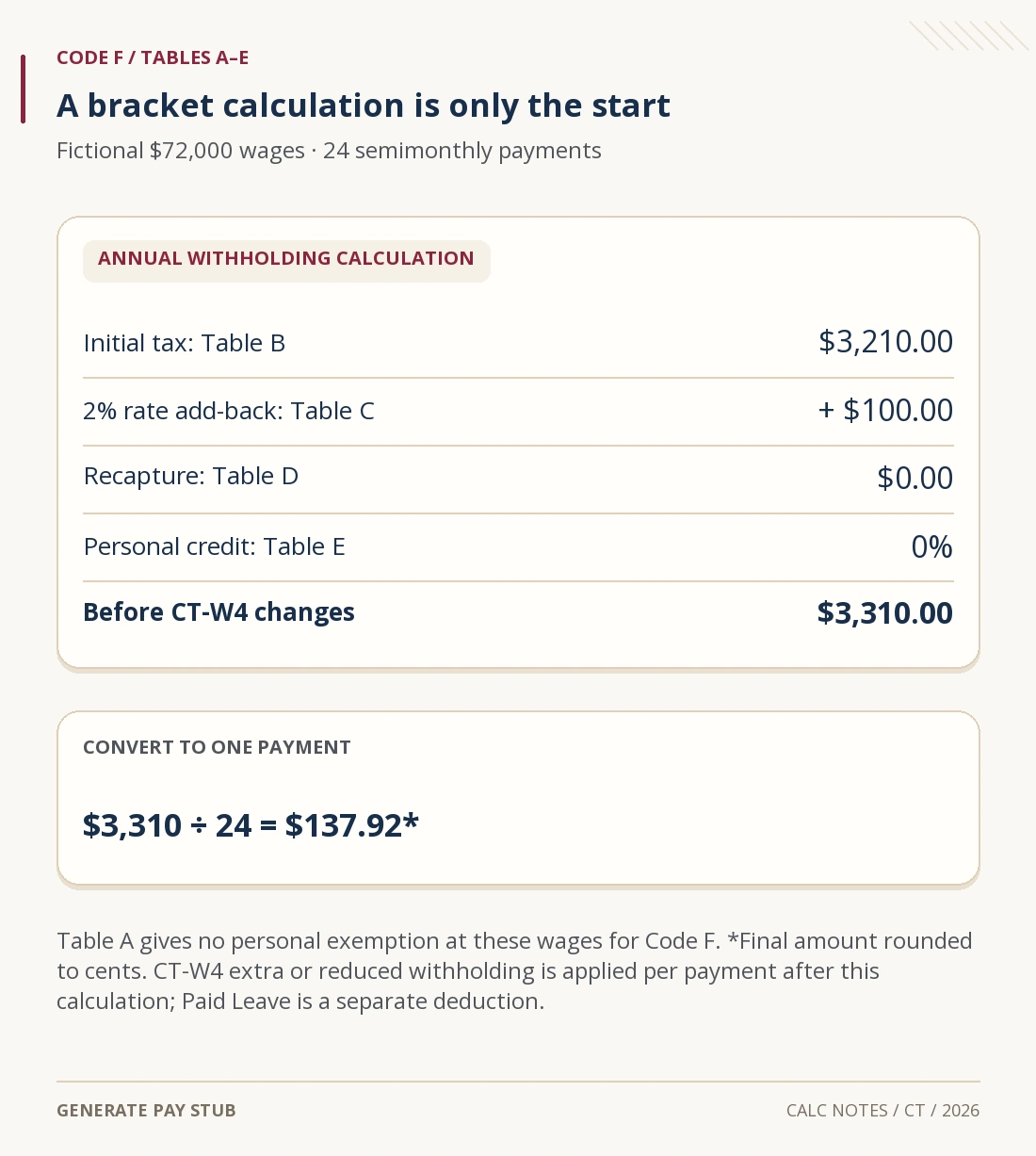
At $72,000 annualized salary under Code F, Table A supplies no personal exemption, so annualized taxable income remains $72,000. Table B gives $2,000 plus 5.5% of the amount above $50,000: $2,000 + ($22,000 × 5.5%) = $3,210 initial tax.
Table C adds $100 because Code F salary is above $71,500 and within the band ending at $76,500. This is the 2% tax-rate phase-out add-back; it is not another 2% applied to the whole salary.
Table D recapture is zero at these wages, and Table E gives no personal tax-credit percentage. The annual calculation therefore remains $3,210 + $100 = $3,310. Divide by 24 payments and round $137.916666… to $137.92.

The tables’ income tests use annualized salary before the personal exemption subtraction where specified. Substituting a different income base can change the exemption, add-back or credit result.
The annual payroll projection adds 24 rounded payment deductions: $137.92 × 24 = $3,310.08. That eight-cent rounding difference from $3,310 is expected in this run. It does not mean the add-back was $100.08.
Compare extra and reduced withholding as separate payment-level choices
CT-W4 line 2 adds withholding per pay period; line 3 requests a reduction under the applicable instructions. For arithmetic comparisons, we checked each adjustment separately while leaving Code F and every other input unchanged. The reduction test assumes a properly supported certificate amount; the tool does not establish that entitlement.
| State adjustment | State withholding/pay | Estimated net/pay | Annual net |
|---|---|---|---|
| No extra or reduction | $137.92 | $2,325.50 | $55,812.00 |
| $25 extra; no reduction | $162.92 | $2,300.50 | $55,212.00 |
| No extra; $10 supported reduction | $127.92 | $2,335.50 | $56,052.00 |
The $25 extra lowers net by $25 per payment and $600 across the modeled year. The independent $10 reduction increases net by $240 over 24 payments. These fields use payment-level dollars, not annual dollars or percentages.
The state’s 2026 withholding review publication addresses adjustments using the worker’s broader facts. It also explains how a new request must account for an existing line 2 or line 3 amount. A desired cash target alone is not a complete basis for reducing withholding.
A smaller deduction affects current cash and estimated tax payments. It does not establish lower final Connecticut liability or a guaranteed refund.
Include CT Paid Leave outside the income-tax calculation
The CT Paid Leave Authority’s contribution guidance maintains the 2026 rate at 0.5% of covered wages up to the Social Security contribution wage base. The contribution wage definition and coverage must be checked separately from the CT-W4 letter.
The sample’s $3,000 covered payment has $3,000 × 0.5% = $15 employee Paid Leave contribution, or $360 over 24 payments. None of the three certificate-adjustment tests changes that $15 amount.
The Authority’s contribution explanation also addresses multiple employers: each employer continues its required contributions until the worker reaches the limit with that employer. The reviewed annual model represents one employer, not a combined multi-job contribution reconciliation.
Keep standard treatment only when it matches actual coverage. An approved private plan or employer-paid employee portion needs its own records; a calculator selection does not itself establish approval.
Reconcile the original annual take-home projection
| Pay line | 2026 projection |
|---|---|
| Annual gross pay | $72,000.00 |
| Federal income tax withholding | $7,009.92 |
| Connecticut income tax withholding | $3,310.08 |
| Employee Social Security | $4,464.00 |
| Employee Medicare | $1,044.00 |
| CT Paid Leave employee contribution | $360.00 |
| Estimated take-home pay | $55,812.00 |
The per-payment check is $3,000 − $292.08 federal − $137.92 Connecticut − $186 Social Security − $43.50 Medicare − $15 Paid Leave = $2,325.50. Twenty-four payments total $55,812.
Those amounts include no insurance, retirement or other unentered cash deduction. Compare actual statement wages and deductions before treating this fictional net as a budget. The net-pay reconciliation guide provides a line-by-line checking approach.
Recognize unsupported certificates, special wages and payroll histories
The reviewed tool does not implement Code E exemption claims or missing/invalid-certificate default withholding. Its ordinary Code F result must not be used as a substitute for those distinct treatments.
Nonresident apportionment, special military circumstances, supplemental compensation and other special methods need separate review. The single-state annual model also cannot reconstruct a changed residence, varying benefits or earlier certificate elections.
Known annual cash fields do not establish pre-tax exclusions. A benefit adjustment can affect different wage bases differently, whereas a simple cash subtraction changes only the estimated amount left.
Federal W-4 elections remain separate. The federal calculator walkthrough explains those inputs; changing a federal control does not automatically create the same CT-W4 adjustment.
Connecticut paycheck calculator questions
Can I multiply all wages by 5.5%?
No. The bracket formula uses a base amount and excess wages, followed by the applicable exemption, add-back, recapture and credit rules.
Is the $100 add-back taken from each paycheck?
No. It is part of this example’s annual state computation before conversion to 24 payments.
Is CT Paid Leave included in the $137.92 state line?
No. The sample has a separate $15 employee Paid Leave contribution per payment.
Does testing a reduction update my certificate?
No. Follow the state instructions and the employer’s process for any actual CT-W4 change.
Connecticut 2026 rules, certificate guidance and three live calculator runs reviewed November 6, 2026. All figures use the stated fictional assumptions.