
A semi-monthly pay stub records one of two regular payments in a month. To check it, read the pay period (the dates the wages cover), the separate pay date (when payment is made), and the current and year-to-date amounts. Two payments each month normally mean 24 pay periods a year. That is different from biweekly pay, which follows a 14-day cycle and generally uses 26 periods for annual payroll calculations. The distinction changes the size and timing of individual checks; it does not, by itself, change an agreed annual salary.
The practical trap is assuming that a half-month is two workweeks. Calendar halves have different lengths, and a workweek can cross the 15th. Use the employer’s actual schedule and time records, not a copied date or a flat hours estimate, when preparing or reviewing the statement.
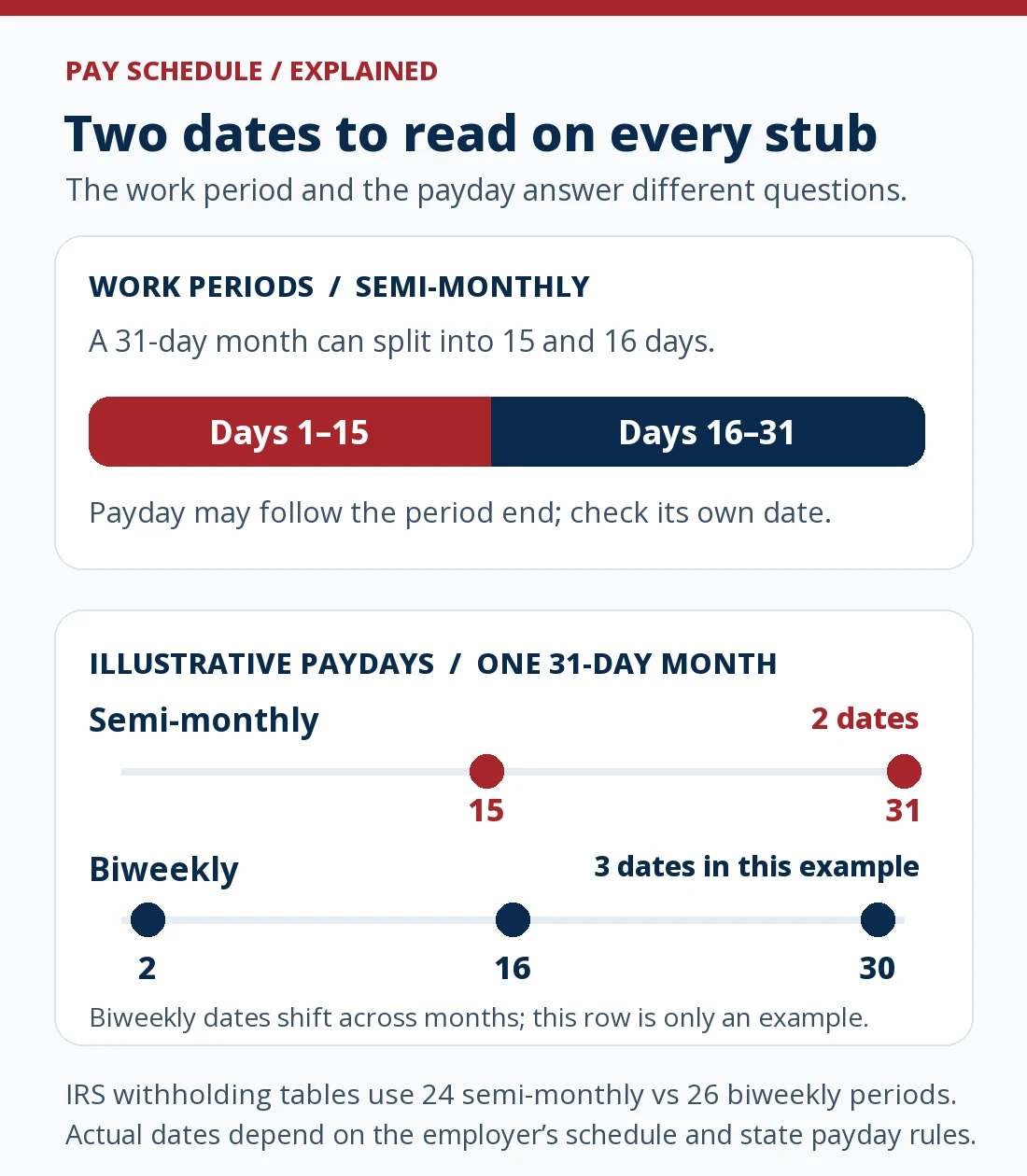
First separate the period worked from the date paid
Suppose a company’s semi-monthly periods are May 1–15 and May 16–31. Its payment dates might be May 20 and June 5. In that example, May 1–15 identifies which work the first statement covers; May 20 identifies when those wages are paid. A statement showing the correct payday but the wrong work dates can still be misleading. These dates are only an illustration: actual payday timing must match the employer’s schedule and the applicable state rules.
The U.S. Department of Labor’s federal recordkeeping fact sheet distinguishes the date of payment from the pay period covered and requires covered employers to keep accurate wage and hour records for nonexempt workers. It does not make every item on that federal recordkeeping list a universally required field on every employee-facing pay stub. State wage-statement and payday rules vary; the DOL state payday overview is a starting point, and the relevant state labor agency supplies the operative rule.
If the payment date falls in the next month, do not quietly move the work-period end date to match it. The two fields answer different questions. Our pay stub preparation checklist explains how to tie each field to a source record.
Why a semi-monthly check is not a biweekly check
| Question | Semi-monthly | Biweekly |
|---|---|---|
| What sets the rhythm? | Two designated pay dates in each month | Every 14 days, usually on the same weekday |
| Standard annual period count | 24 | 26 |
| Can one month show three regular paydays? | No, under a twice-monthly schedule | Yes, depending on where the 14-day cycle falls |
| Are the calendar halves equal in days? | Not necessarily | Each regular interval is 14 days |
The 2026 IRS Publication 15-T lists 24 annual payroll periods for semi-monthly withholding and 26 for biweekly withholding. These are the standard frequencies used in its calculations. They are not a reason to label a 14-day payroll run “semi-monthly,” and a calendar month containing three biweekly paydays does not make those payments semi-monthly.
For a hypothetical employee earning a fixed $62,400 annual salary, a full regular semi-monthly period is $62,400 ÷ 24 = $2,600 gross. At a standard biweekly frequency, the same annual salary is $62,400 ÷ 26 = $2,400 gross for a full regular period. Both schedules add to $62,400 over their respective 24 or 26 regular periods. This example assumes the salary is paid evenly and ignores a partial start or end period, unpaid leave, bonuses, and other adjustments. A $200 difference between the two gross check amounts alone does not show a pay cut.
How to check salary and hourly earnings
For a full-period salaried payment, start with the employment terms and payroll record. Confirm the annual salary, the actual payment frequency, and whether this is a normal full period. Divide by 24 only when the arrangement really is a 24-period salary schedule. A first check after a mid-period hire, a final check, or a period affected by unpaid time may need a different calculation. Ask payroll how that partial amount was determined rather than forcing the normal full-period formula onto it.
For hourly pay, use the approved hours and rates assigned to the work period. Imagine an employee earns $23 per hour and works 68 straight-time hours in one half-month and 76 in the next. Before other earnings, those amounts are 68 × $23 = $1,564 and 76 × $23 = $1,748. The example assumes no overtime premium is owed for those hours and no other earnings apply. It shows why copying the same hours onto both statements is unreliable; it does not determine overtime from half-month totals. When a worker has two rates, separate the hours at each rate before adding the earnings.
A salary can also be subject to overtime rules if the worker is nonexempt. “Salary” describes a pay method; it is not, by itself, an overtime exemption. The workweek check below matters whenever the employee is entitled to overtime.
Check overtime by workweek, even across the 15th
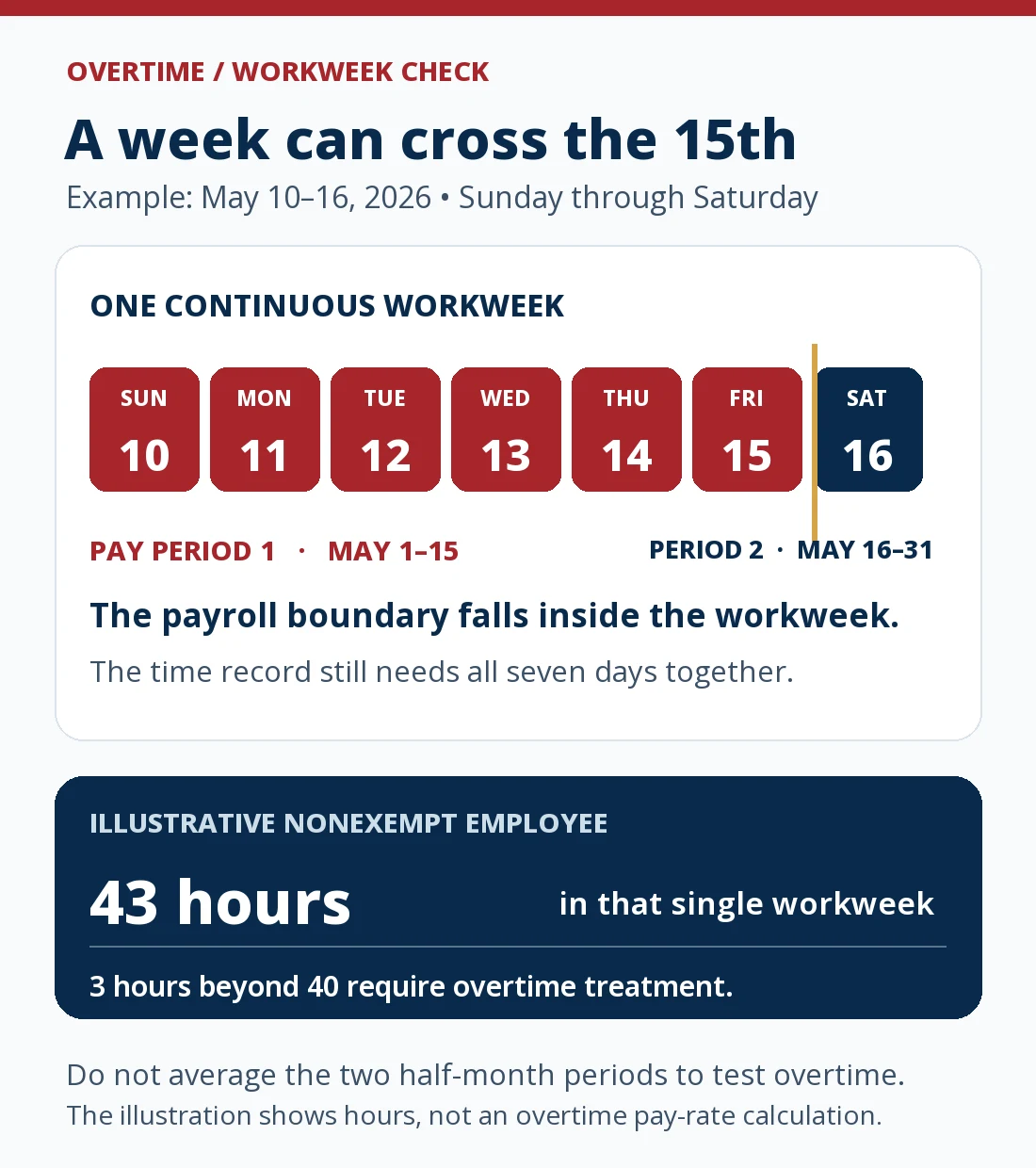
For federal overtime, a workweek is a fixed, recurring seven-day period. The Department of Labor’s overtime guidance says covered nonexempt employees generally receive overtime pay for hours worked over 40 in a workweek, at no less than one and one-half times the regular rate. Hours from different workweeks cannot be averaged to cancel overtime. State law or a particular job may add requirements, so the employer should apply the relevant rules.
Consider a hypothetical nonexempt employee whose workweek runs Sunday through Saturday. The week of May 10–16, 2026 crosses a semi-monthly boundary after May 15. If the employee works 43 hours in that single week, the federal 40-hour threshold is exceeded by 3 hours, regardless of how many hours land on each side of the boundary. The illustration does not calculate the regular rate or decide which payment carries the premium; payroll must use the full time record and follow the applicable pay-timing rules.
What should happen to taxes, deductions, and YTD totals?
Changing from biweekly to semi-monthly changes the payroll frequency used in federal income-tax withholding methods. It does not mean every tax line is simply the old check’s amount multiplied by 26 and divided by 24. The actual withholding calculation depends on taxable wages for that payment, the employee’s Form W-4 information, the applicable year’s method, and other relevant adjustments. IRS Publication 15-T supplies separate semi-monthly and biweekly procedures. It is also possible for gross pay and taxable wages to differ.
Benefit premiums and other non-tax deductions depend on the plan and employer’s deduction schedule. Some are taken from every regular check; others may be collected in selected pay periods. Do not infer an error solely because a line differs from an old biweekly stub. Compare the benefits election or payroll instructions with the current statement, then ask payroll about an unexplained difference.
Year-to-date (YTD) amounts are a running record of payments already made in the calendar year, subject to the way each field is defined. Check the pay date and prior statements before assuming the current YTD gross must equal “annual salary divided by 24, times the number of calendar halves elapsed.” A delayed payday, partial period, adjustment, bonus, or midyear start can break that shortcut. Reconcile prior paid amounts to the current YTD line; Pay Stub Help 101 explains how to read current and YTD columns.
A five-step semi-monthly pay stub review
- Identify the schedule. Confirm that the employer actually pays twice per month and record its designated period and payday rules.
- Check both dates. Compare the stub’s work-period start and end with the payroll calendar, then verify the separate pay date. Watch for a period crossing into the next month.
- Rebuild gross earnings. Use the agreed salary for a full period, or actual hours at each rate for hourly work. Investigate partial periods and extra earnings separately.
- Review workweeks and deductions. For a nonexempt employee, check every full workweek that touches the half-month period. Match withholding and benefit lines to payroll and plan records.
- Reconcile net and YTD. Gross less actual employee deductions should equal net pay. Compare each YTD figure with prior paid statements, accounting for corrections and off-cycle payments.
Keep the underlying payroll record with the statement. A document-formatting tool cannot establish that wages were earned, taxes were remitted, or the statement was issued by an employer. Correct the source payroll data when an amount is wrong, then issue a corrected statement through the proper payroll process.
Common questions
Does semi-monthly mean every 15 days?
No. It means two paydays in each month. The gaps between dates can vary with month length and the employer’s calendar. A repeating 14-day cycle is biweekly.
Why was my hourly semi-monthly gross lower than last time?
The number of workdays and hours in each half-month may differ. Compare actual hours, rates, unpaid time, and any separate overtime or other earnings. The lower amount is not explained by the schedule alone.
Can a semi-monthly stub have a pay date in the next month?
Yes, depending on the payroll schedule and applicable state payday rules. Keep the work-period dates accurate and show the actual payment date; do not label the next month’s payday as the period in which the work occurred.
Is a third check in a month automatically an error?
Not necessarily. It may reveal a biweekly schedule or an off-cycle correction, bonus, or other separate payment. Ask which period and earnings the third payment covers before changing the statement.