Wisconsin’s 2026 paycheck calculator uses the approved WT-4 alternate withholding method: a sliding annual deduction, $400 per withholding exemption and a payroll rate schedule. Its payroll brackets are different from the brackets used to calculate tax on an individual return.
In our checked Single example, increasing annual salary from $65,040 to $66,240 raises gross pay by $100 a month. Projected monthly cash rises by $74.41 before unentered deductions. One reason the state withholding changes is that the payroll formula’s sliding deduction becomes smaller as wages rise.
Identify the payroll method before comparing rate tables
The Department of Revenue’s official withholding calculator explicitly uses the alternate method effective for periods beginning January 1, 2022 onward. Its current instructions still point to that method.
The agency’s October 2025 employer update said there were no plans at that publication date to change withholding rates. The January 2026 withholding guide retains the approved method.
Consequently, seeing an older effective date on the payroll method does not, by itself, establish that a 2026 estimate is outdated. Check the current publication and its stated application.
The 2026 WT-4A worksheet separately uses current return-oriented schedules to estimate liability for an agreement. Swapping those return brackets into the ordinary WT-4 payroll method would change the calculation being performed.
Enter the fictional WT-4 salary example
Start the Wisconsin paycheck calculator with year 2026, annual wages of $65,040 and Monthly. This produces twelve equal $5,420 gross payments.
Choose federal Single, no multiple-jobs checkbox and zero for each federal adjustment. Separately choose Wisconsin Single or higher Single rate, one valid WT-4 exemption and no additional state withholding. Annual local and other cash amounts start at zero.
Assume a full year with one ordinary private employer, living and working in Wisconsin. No benefits alter the wage bases, so gross wages equal the amounts used for income tax and FICA.
Form WT-4 provides Single, Married and Married-but-higher-Single choices. Use the actual withholding election. Federal credit dollars do not supply the state exemption count, and the tool’s initial zero does not choose your lawful certificate allowances.
For the second run, change only annual wages to $66,240. Everything else stays the same. This is a full-year salary comparison, not a prediction of a midyear raise’s exact calendar-year result.
Calculate the sliding annual deduction
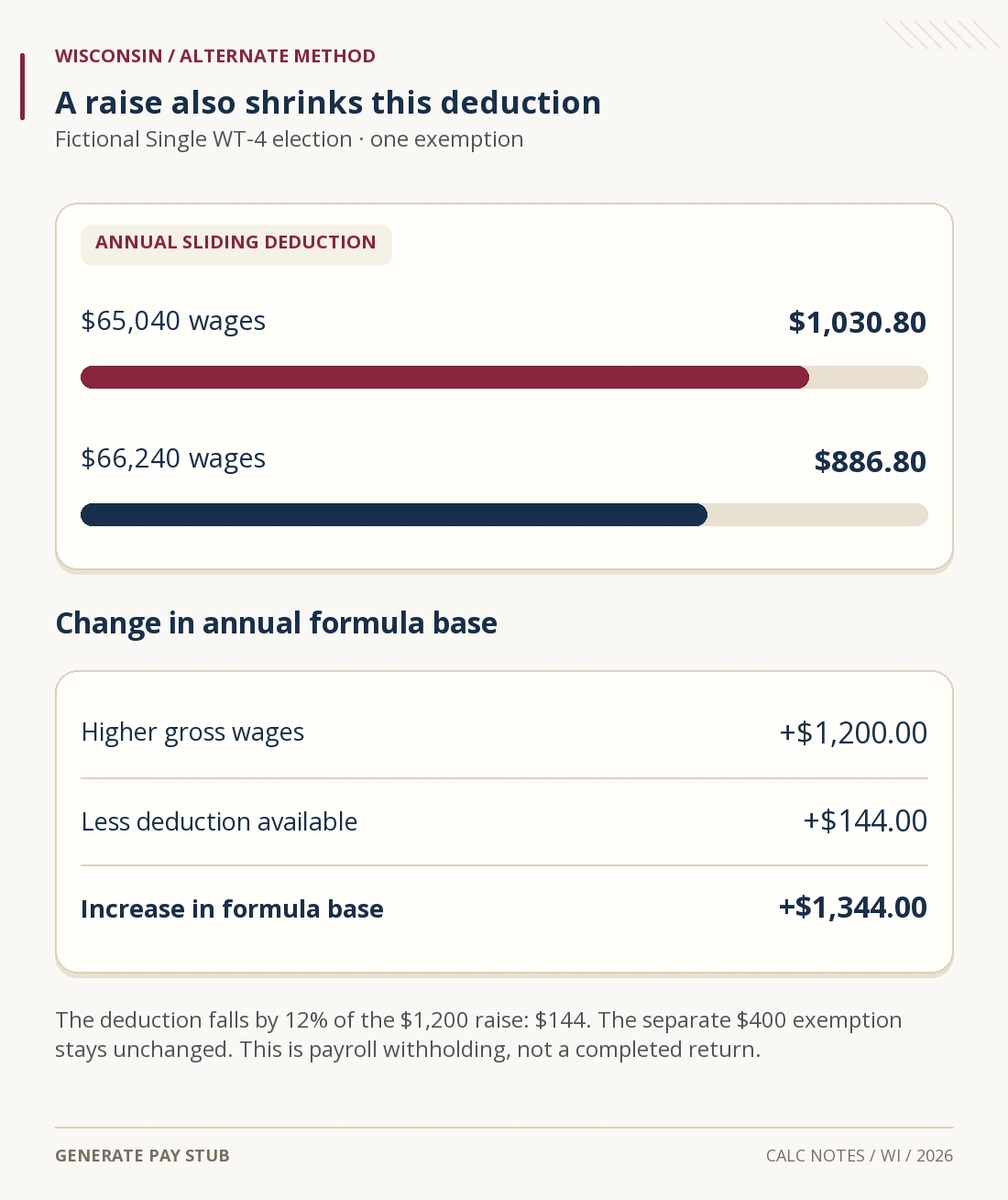
The alternate method in Publication W-166 uses a $6,702 deduction for Single annual earnings below $17,780. Within the phaseout range, subtract 12% of earnings above $17,780; at $73,630 or more, this deduction is zero.
For $65,040 wages: $6,702 − 0.12 × ($65,040 − $17,780) = $1,030.80. One exemption then removes another $400, leaving $63,609.20 as the annual net wage used by the withholding schedule.
At $66,240, the sliding deduction becomes $886.80. After the same $400 exemption, the annual formula base is $64,953.20.
Both salaries remain within the same Single phaseout range. Married withholding uses a different deduction calculation; the Single figures above should not be carried into that election.

Trace Wisconsin withholding before comparing cash
Both calculated bases fall in the payroll band using $1,045.04 plus 5.30% of the amount above $25,520.
At the first salary, $1,045.04 + ($63,609.20 − $25,520) × 0.053 = $3,063.7676. Divide by twelve and round to cents: $255.31 per month, totaling $3,063.72 across twelve rounded payments.
At the higher salary, the annual formula yields $3,134.9996, giving $261.25 monthly and $3,135 across the assumed year.
The increase in annual formula base is $64,953.20 − $63,609.20 = $1,344. Applying 5.30% gives $71.232 before period rounding. The twelve-payment increase is $71.28, because each monthly deduction is rounded.
The sliding deduction and exemption are calculation reductions, not cash benefits or separate taxes. The $400 exemption is also not a $400 tax credit.
Explain where the $100 monthly raise goes
| Monthly change | Amount |
|---|---|
| Additional gross wages | $100.00 |
| Additional federal withholding | $12.00 |
| Additional Wisconsin withholding | $5.94 |
| Additional employee Social Security | $6.20 |
| Additional employee Medicare | $1.45 |
| Additional cash available | $74.41 |
The difference is $100 − $12 − $5.94 − $6.20 − $1.45 = $74.41. Twelve such monthly differences equal $892.92.
This result reflects these two salaries, these certificate settings and the calculator’s rounded payments. A raise that crosses a different withholding band, changes benefit contributions or occurs after the year begins requires a new scenario. It is not a universal percentage of raises that workers keep.
Compare both annual cash ledgers
| Annual earning or employee deduction | $65,040 salary | $66,240 salary |
|---|---|---|
| Gross wages | $65,040.00 | $66,240.00 |
| Federal income-tax withholding | $5,624.76 | $5,768.76 |
| Wisconsin income-tax withholding | $3,063.72 | $3,135.00 |
| Employee Social Security | $4,032.48 | $4,106.88 |
| Employee Medicare | $943.08 | $960.48 |
| Cash before other deductions | $51,375.96 | $52,268.88 |
The lower salary’s monthly reconciliation is $5,420 − $468.73 federal − $255.31 Wisconsin − $336.04 Social Security − $78.59 Medicare = $4,281.33. The higher salary produces $4,355.74.
An unknown premium or retirement election has not been silently estimated. Use the actual treatment when comparing a real deposit; a pre-tax payroll deduction can affect the wage base, while another deduction may only affect cash.
Understand WT-4A, reciprocal work and other limits
WT-4A is an employee-employer withholding agreement based on estimated liability. Its instructions first direct employees to consider whether the correct maximum WT-4 exemptions would sufficiently reduce overwithholding.
The ordinary tool does not implement a WT-4A agreement or determine eligibility for complete withholding exemption. Entering a larger arbitrary exemption count is not a substitute for either process.
Multiple jobs and a working spouse can make a one-employer projection incomplete. WT-4’s instructions discuss coordinating exemptions across employers and requesting extra withholding where appropriate. Updating the calculator alone does not update payroll.
The agency’s cross-state FAQ lists reciprocity with Illinois, Indiana, Kentucky and Michigan for qualifying employee income. It does not make all income or every neighboring-state situation exempt. Check residency and the applicable declaration outside this all-Wisconsin example.
Wage-bracket payroll and the approved alternate formula can produce small differences. Neither replaces a completed return, resolves benefit exclusions automatically or verifies earnings for a lender.
Wisconsin paycheck calculator questions
Should I replace the payroll brackets with the 2026 return brackets?
No. Use the schedule required by the payroll method being checked.
Why does this example’s formula base rise by more than the raise?
The wage increase also reduces the sliding deduction.
Is a withholding exemption a tax credit?
No. In this method, it reduces the formula base by $400.
Does the calculator submit WT-4 to the employer?
No. A payroll election requires the separate certificate process.
Current Wisconsin payroll publications, certificate instructions and both live salary runs reviewed November 6, 2026.