The Rhode Island paycheck calculator estimates 2026 state income-tax withholding separately from employee TDI, which includes TCI. For a covered worker, the 2026 TDI rate is 1.1% on wages up to $100,000, giving a $1,100 maximum. That cap can make later checks larger even when gross salary stays constant.
Our original example uses $120,120 annual pay in 26 equal biweekly payments. It traces the RI W-4 state deduction, the partial TDI payment at the cap and the resulting difference between annual-average cash and individual checks.
Set a covered-employee example with 26 equal payments
Open the Rhode Island paycheck calculator, choose 2026, enter $120,120 annual gross and select Every Two Weeks. Each modeled gross payment is $4,620.
Use federal Single, leave the multiple-job treatment off and set federal annual adjustments and extra withholding to zero. In the state settings enter two supported RI W-4 exemptions/allowances and no additional state amount.
Keep ordinary TDI coverage selected and leave annual local and other deductions at zero. Assume a covered adult employee, one employer, Rhode Island residence and work for the whole year, no pre-tax benefits and no special wage exclusions.
The illustration starts covered wages at zero for the year. An employee joining a company partway through a year needs actual wage and contribution records; the full-year sequence below is not a reconstruction of that employee’s history.
Calculate the RI W-4 state income-tax line
The 2026 withholding booklet uses percentage tables shared by all filing statuses. Its biweekly exemption value is $38.46. Our payment is below the $11,184.62 biweekly allowance cutoff.
Two exemptions reduce the payment’s formula wages by $38.46 × 2 = $76.92. Subtract from $4,620 to obtain $4,543.08.
The applicable biweekly band is $118.35 plus 4.75% of the excess over $3,156. The calculation is $118.35 + ($4,543.08 − $3,156) × 0.0475 = $184.2363, rounded to $184.24.
Across 26 unchanged payments, state withholding totals $4,790.24. The TDI wage cap does not stop this separate income-tax calculation.
RI W-4 is a state certificate; federal W-4 information cannot substitute for it. A federal filing-status change may affect the federal line without selecting a different Rhode Island percentage table.
Apply the 2026 TDI rate and wage ceiling
The Department of Labor and Training’s 2026 rate announcement sets the employee TDI rate at 1.1% and the wage base at $100,000. Maximum contribution is $100,000 × 0.011 = $1,100.
The same announcement explains that TCI is part of TDI. Do not add another caregiver contribution to this employee deduction. It also identifies unemployment insurance as employer-funded, so an employer UI expense does not belong in this employee cash ledger.
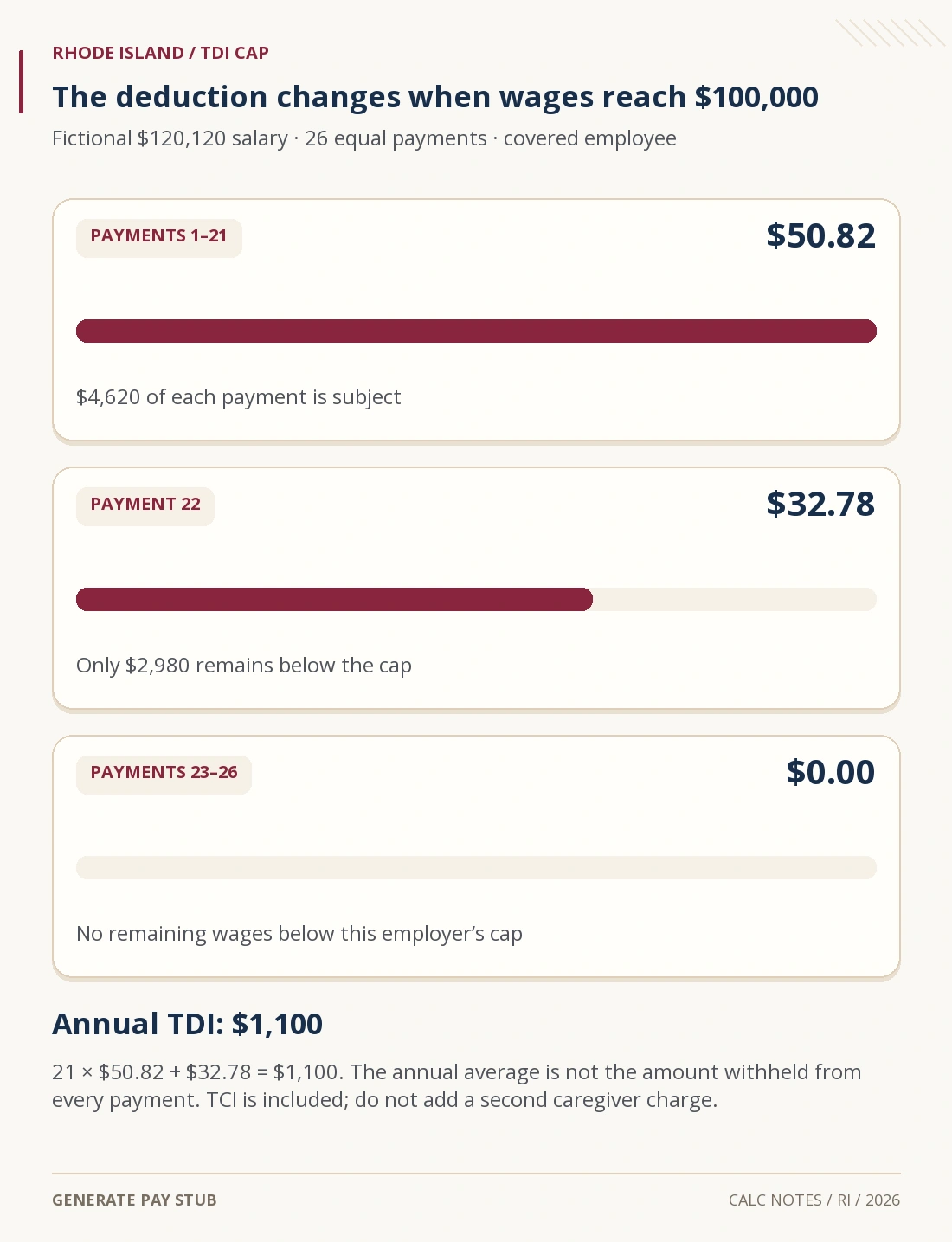
Before the ceiling is reached, $4,620 × 0.011 = $50.82 per payment. After it is reached, this employer’s additional wages are outside the annual TDI base.
Follow the smaller TDI deduction on payment 22
After 21 payments, covered wages are 21 × $4,620 = $97,020. Contributions have totaled 21 × $50.82 = $1,067.22.
Only $100,000 − $97,020 = $2,980 remains under the wage ceiling. Payment 22 therefore has $2,980 × 0.011 = $32.78 of TDI, even though gross remains $4,620.
The full cap has then been reached. Payments 23 through 26 have $0 TDI in this model. The contribution total reconciles to $1,067.22 + $32.78 = $1,100.

| Payment range | TDI deduction | Cash for a payment |
|---|---|---|
| Payments 1–21 | $50.82 | $3,354.73 |
| Payment 22 | $32.78 | $3,372.77 |
| Payments 23–26 | $0.00 | $3,405.55 |
The non-TDI deductions remain $676.78 federal, $184.24 Rhode Island income tax, $286.44 Social Security and $66.99 Medicare per payment. The first payment’s cash is $4,620 − $676.78 − $184.24 − $286.44 − $66.99 − $50.82 = $3,354.73.
Compare deductions line by line if a later check rises. A TDI cap crossing can explain the change without any raise or benefit election.
Reconcile the annual cash figure rather than repeating the first check
| Annual ledger component | Total |
|---|---|
| Salary payments before deductions | $120,120.00 |
| Federal income-tax withholding | $17,596.28 |
| Rhode Island income-tax withholding | $4,790.24 |
| Employee Social Security contribution | $7,447.44 |
| Employee Medicare contribution | $1,741.74 |
| Employee TDI, including TCI | $1,100.00 |
| Cash before omitted benefits or other items | $87,444.30 |
The annual cash total is 21 × $3,354.73 + $3,372.77 + 4 × $3,405.55 = $87,444.30. Dividing by 26 gives an average of about $3,363.24; none of the three payment amounts above equals that average.
Repeating the first $50.82 TDI deduction for all 26 payments would overstate modeled contributions by $221.32. This is why annual deductions should follow the cap sequence rather than multiplying an early check blindly.
Review coverage and multiple-employer facts
The DLT tax-information page identifies workers aged 14 and 15 as exempt from TDI deductions and coverage. Other special employment categories can also have different coverage. The ordinary adult example does not determine an exemption.
For more than one employer, do not assume a single-employer calculator can coordinate their contribution records. DLT’s employer tax FAQ describes a TX-16 refund claim for employees whose wages from multiple employers exceed the TDI wage base.
Use the claim form for the relevant year and check the actual contributions. Some general agency text still mentions a prior-year wage base; the explicit 2026 announcement controls the $100,000 limit used here.
Benefit arrangements can create different wage bases. For example, the DLT FAQ identifies specified employee retirement and benefit contributions as excluded employment-tax wages. Our equal-base example does not calculate those exclusions.
Investigate a different payroll result in a useful order
Check the year, gross payment, pay frequency, state taxable wage amount and actual RI W-4 count. At higher payment amounts, the booklet’s allowance cutoff can remove the exemption reduction, even when a count is on file.
Next check the TDI coverage and covered wages, including earlier wages and withheld contributions with the employer. A state-income-tax exemption does not by itself establish a TDI exemption.
Finally, reconcile optional deductions. Known annual local or other amounts change projected cash but do not determine tax eligibility or whether a benefit reduces taxable wages. See the deduction base comparison.
A requested state extra is per payment. Neither changing that entry nor choosing a TDI treatment submits payroll instructions. This estimate also cannot certify wages earned or determine the final income-tax refund.
Rhode Island paycheck calculator questions
Do I pay TCI on top of the TDI deduction?
No. TCI is included in TDI.
Why does TDI fall before gross pay changes?
The annual covered-wage ceiling can produce a partial deduction followed by zero.
Does the federal status select a different Rhode Island percentage table?
No. The state tables are shared across filing statuses; the state certificate still matters.
Should every check match the displayed annual average?
No. Annual caps can change individual deductions during the year.
Rhode Island 2026 sources, payment sequence and annual reconciliation reviewed November 6, 2026.